
Hoover
Active Member
Maybe you missed the irony.Genuine question: how would you react if the BBC ran a column saying "if Russia does X, we'll just nuke them"?

Maybe you missed the irony.Genuine question: how would you react if the BBC ran a column saying "if Russia does X, we'll just nuke them"?
Come on. Russia placed nukes in Kaliningrad after 2014, and in Belraus during the war. That is a provocation. Done by Russia. Okay, for you not, of course.Is "when" a factor to consider?
During a negotiation, is "don't do it" a provocation or doing "it" afterwards the provocation?
Sorry, I meant to quote and ask @rsemmes, not you. Fixed that now.Maybe you missed the irony.

First, nothing new: Greater reliance on nuclear weapons has become a staple feature of Russian defense strategy. This trend became particularly pronounced in 1999 when NATO bombing of Yugoslavia over Kosovo vividly demonstrated that Russia’s capability to resist a highly superior conventional force was limited. (Zapad-99)Come on. Russia placed nukes in Kaliningrad after 2014, and in Belraus during the war. That is a provocation. Done by Russia. Okay, for you not, of course.
 nonproliferation.org

western media have been reporting on killing the Russians for ages, they host officials that celebrate the death of Russians, they blow Russian casualties out of proportion, making it look like Ukraine is killing more Russians. EU and US officials talk openly about killing Russians, small Poland even thinks it can defeat Russia. remember when Biden said that if Russia invades, there will be no more Nord stream? i think Russian media should be more active in this type of publication, it might make the west rethink it's policy towards RussiaGenuine question: how would you react if the BBC ran a column saying "if Russia does X, we'll just nuke them"?

Ukraines counter-offensive is developing around Krasniy Liman. They're trying to push Russia across the Zherebets river. They've also pushed Russia out of Nikolaevka and have re-entered Ray-Aleksandrovka, though Russian counter-attacks are developing. September may be the first month of Ukrainian net gains since 2023, outside of Kursk region. And this is, in my opinion, the biggest success for Ukraine since the fall of '22. They've effectively removed Russian pressure on the Slavyansk-Izyum road. It's also noteworthy that Russia's failure here is following a pattern. They didn't complete work on the flanks of their assault, and instead tried to push into Liman proper before fending off Ukraine's counter-offensive. They failed to take Krasniy Liman and Ukraine succeeded on the flanks, forcing a Russian withdrawal. Some sources have condemned Russia's West MD quite strongly, claiming this is the result of false reporting to Russian leadership. This is probably at least somewhat true, given Putin's claims about Svyatogorsk. On the other hand there is evidence of a robust pattern of airstrikes to cover the Russian withdrawal in this area. So the lies have to be happening at a fairly high level, well above the tactical. Note West MD has a pattern of poor performance and of trying for visible results over substance. We saw this in their assault on Kupyansk a year ago.Last, Ukraine has cleared all of the city of Liman...
And Stepnogirsk is a huge grey area.
No irony, just a genuine question. How would you react if the BBC ran a column saying "if Russia does X, we'll just nuke them"? Just to understand your position better.Rubio just said that the explosives that never existed transported by 5 British nationals from London in 3 vans was Iran.
Where is the irony?
Not sure that follows. The airstrikes show that higher command knew about the withdrawal when it happened, not that they knew the real situation before. You can have optimistic reporting going up the chain for weeks, and then at the point where the position is collapsing the truth becomes undeniable and air assets get released to cover the pullback.On the other hand there is evidence of a robust pattern of airstrikes to cover the Russian withdrawal in this area. So the lies have to be happening at a fairly high level, well above the tactical.
Related question: is Russia's limit on men economic rather than demographic?So is Russia really short on men overall, or has Russia not provided sufficient replacements to other sectors, to husband a fresh grouping of forces in the Chernigov area? There are no obvious answers, only time will tell.
It would be interesting to know how badly the units in the Ukrainian counter-offensive are attrited.Is it possible this is what Russia's command is banking on? Have they given up on a territorial gain sufficiently large to force a political concession, and are they now fighting to a military conclusion, intended to force a full collapse of the Ukrainian armed forces through attrition? There's no obvious answer at this time, but this could be a factor.
The same reaction as to Rubio's or to Trump's being upset because those Britishers are not in Guantanamo: None. It is just another (wild in this case) statement by a politician or an influencer. I was reading something "interesting" in the editorial of lemonde, just another one...No irony, just a genuine question. How would you react if the BBC ran a column saying "if Russia does X, we'll just nuke them"? Just to understand your position better.
Well, it could have played out that way. But Russian command is still insisting they control the area, and old videos are being posted on related social media channels to try and "prove" this. The strikes also seem to have come well before the pullback. In other words it seems Russia was aware of the Ukrainian counter-offensive. Overall it's fuzzy. Putin claiming Russia has Svyatogorsk is interesting too because at one point Russian infiltrators had reached Svyatogorsk, though no Russian consolidation took place. But Putin announced it well after Russia has been pushed back from there.Not sure that follows. The airstrikes show that higher command knew about the withdrawal when it happened, not that they knew the real situation before. You can have optimistic reporting going up the chain for weeks, and then at the point where the position is collapsing the truth becomes undeniable and air assets get released to cover the pullback.
Of course the real limit is currently economic (and financial) since Russia has to pay them and pull them from the work force.Related question: is Russia's limit on men economic rather than demographic?
Unemployment is at record lows. The defence industry itself reports labour shortages. So every recruit is a worker taken from somewhere.
Or is there still a large pool of men with low economic output, in poor rural regions or low-productivity jobs, where, sending them to the front is still a clear net gain for the war effort?
I would suspect losses are substantial. They always have been in this kind of fighting previously. The real question I think is whether the losses are sustainable or unsustainable.It would be interesting to know how badly the units in the Ukrainian counter-offensive are attrited.
Most western estimates use places like Mediazona:western media have been reporting on killing the Russians for ages, they host officials that celebrate the death of Russians, they blow Russian casualties out of proportion, making it look like Ukraine is killing more Russians.
 en.zona.media
To come back to this, just to reply, as I was not able to do so earlier. No confusion on my part about their electoral process, but I surely botched my post up. I was actually going to go back and edit it, edited the one I made after (re question marks) and, apparently, moved on. So…That's actually not what the polls say, but I understand where the confusion comes from[…]
https://m.youtube.com/watch?v=P3FKHH2RzjI&pp=0gcJCYsCo7VqN5tD&ra=mIs this also an obligatory reminder as mine was? Haha.Ukraine was never in a position to threaten Russia's security, in fact the opposite was the case as Russia had taken over Crimea and other area's. While a country does have the right to react to a direct threat to their security that is were it stops . I disagree with the etc as this could be used for any excuse. The politics of a country are its choice and must remain so.
In regard to no elections in time of war, this is not unusual were there is fighting close by, the UK never held elections during WW2 until after the war in Europe finished My own country which rates very high on the democratic scale did not hold elections during WW2 and several other countries followed the same course.
For the “Ukraine is a democracy” crew, the latest v-dem report published recently:
View attachment 54588
View attachment 54589
The full report for those interested:
Thanks for coming back to this, I've read your answer in full, but I won't reopen it, since I've already pulled too often the thread away from the war hehe.To come back to this, just to reply, as I was not able to do so earlier. No confusion on my part about their electoral process, but I surely botched my post up. I was actually going to go back and edit it, edited the one I made after (re question marks) and, apparently, moved on. So…
A few things to consider in the polls you provided. The most obvious one is Tiahnybok. There is no universe in the world we know where he would defeat Yanukovych (or most of anyone else in the UA political space) in the presidential election in Ukraine. The idea is beyond preposterous. If the two somehow (it would never ever, and I mean ever - I cannot stress this enough - happen in real life) got to the second round, Yanukovych would clear the house (probably better than Churchill did in 2019), regardless of what any poll says. I mean, while I don’t like hyperbole… in this case, there are no words one can use to describe these results as unreasonable that can be treated as such.
Second, Klitchko as the front-runner is not necessarily a serious proposition. The actual election was not due for another year (and a quarter if we take Dec 17, 2013 as the starting point). Have you ever listened to the guy talk? He has hard time putting words together. It would be like electing Mike Tyson to the presidency in the US or Valuev in Russia. Granted, they elected Klitchko to be the mayor of Kyiv (and a clown as a president in Ukraine and Valuev to Duma in Russia, so everything is possible). Would he survive a political campaign in a normal world and sustain his polling numbers? Probably (or most certainly) not, in my opinion. But your point stands as opposed to the one I ended up making.
Furthermore, Poroshenko would likely not be a thing if not for the events that took place. Timoshenko was jailed since… 2011 (?) to February (?) 2014 and would not be able to run. Yatseniuk? He ranked significantly below Timoshenko in the opinion polls consistently (and always), which should translate to the polls you cited accordingly, but it does not. I do not see him as a strong contender at all at the time (see where he is today). They would need another face. Also note, Klitchko allegedly agreed to withdraw his candidacy for a united front candidate type of thing. He was the front runner though, according to most polls. He settled for the guaranteed post of mayor of the capital vs the presidency of the country. Unreasonable, right? Well, I would refer back to the point I made just above. I am talking about a democratic process, of course, which events that took place had nothing in common with, in spite of being advertised as such.
What your cited poll numbers show is that it is anyone but and the opposition would back any candidate but. Again, Tiahnybok is a huge red flag. Regardless, your post is a fare counterpoint to the one I ended up making. Nothing is as clearcut though. A lot has been going on and things were not static. What is notable, however, is that every single poll I saw gave a noticeable boost to Yanukovych’s ratings immediately after Dec 17. Furthermore, no president in the Ukrainian history had such high approval ratings when he was removed from office (and by democratic means, which is kind of important or should be). Kravchuk (the first president) was the absolute record holder (I’d bet he still might be if…) being defeated by Kuchma while still enjoying ~20% or something like that in approval ratings. Kuchma ran in single digits at the end of his second term (opted not to run for reelection although was permitted by the court and endorsed Yanukovych instead). Yushchenko is the record holder on the other end, running something like 2% or slightly higher in the approval ratings at the end of his first and only term (but Maidan and all, only electing Yanukovych again). Poroshenko was in single digits or just above when he was defeated by Zelensky. Yanukovych had well above 36% in approval from decided voters (likely higher across the entire population) after signing the debt agreement on Dec 17, 2013. The opposition then decided to “reject Russia’s preferred president” and shit hit the fan. Why none of the other leaders of the country were “rejected” by the opposition of the day, but served their term(s) since they all had substantially lower approvals (Yushchenko was basically a reject of society, for instance)?
In 2014, shit really started hitting the fan. I would recommend listening to this conversation of Michael Kimmage (of Kennan Institute) with Yaroslav Hrytsak, start at 26:19 (if not interested in the whole thing). I don't think anyone can question Hrytsak’s bias (laughing), so there is no Russian (or anti-Ukrainian?) propaganda here anyone can, as usually, accuse me of (laughing harder).
The guy clearly tells us the major protests began after Yunokovych announced that he was not going to sign the EU agreement. To note, he also says that it was Yanukovych himself who changed course and said that he would previously. This is the money fishing expedition I talked about long time ago that has nothing to do with Russia or the EU, but the funds the country desperately needed. But anyway, he said he would not sign the agreement (after negotiations with the EU), protest began, but died down a week later because there was no wide support, Hrytsak tells us. For whatever reason, protesters were beaten up (allegedly by Yanukovych’s people), so there was another wave of protests as a result. Hrytsak says that it is very clear that there was a third party that tried to destabilize the situation as much as possible every time things seemed to settle and some consensus was agreed to. Of course, his conclusion here is that it was Putin trying to set a precedent where he comes in and sets order (or whatever the idea is). So, we basically have, an allegedly Russian-puppet president, who signed a financing agreement with Russia and not the EU, the protests died down, but Putin, being as unreasonable as he is, decided to wreck havoc because… whatever the thought process is here.
So when someone says that the “opposition rejected” or “democratic forces” and the like, it is not an honest discussion. At the time, Yanukovych had more support than the actively opposing forces, I believe this is fairly clear. The portrayal of the events that took place and every escalation that followed is the key difference in the eventual outcome. We will never know what could have been, unfortunately.
Another thing to note here about Hrytsak’s statements. At one point he says “I was younger, but I remember” because he was also at Maidan. This is rubbish, of course. No respected or self-aware historian would speak this way about any extraordinary social events that they themselves were a part of. This is psychology 101, basic stuff. Here Prof Paul Bloom of Yale (now of University of Toronto too) explains this phenomenon in one of his lectures on Introductory Psychology (at 49:21 exactly, and less than two minutes on):
I would actually suggest going a little further back, to 37:22 mark and go from there because it directly relates to our discussion overall. It is critical, in my opinion, to understand or, at least, be aware of these things happening “behind the scenes”, naturally, because we are humans.
If anyone is interested in Introductory Psychology course, by the way, Bloom’s entire course from Yale is on Yale’s Youtube (link to the first lecture, then go from there):
That is just an aside for those interested (because why not?) and I don’t think many can beat Paul’s classes (my PSYCH 101 course was quite a bit more lame, when I took it, lol). Note, this stuff is somewhat dated (I don’t recall the exact year it was posted, surely over a decade ago) and new research has taken place, but all these fundamentals are true today as they were back then.Code:https://m.youtube.com/watch?v=P3FKHH2RzjI&pp=0gcJCYsCo7VqN5tD&ra=m
Lastly, The Origins of War series ran by the Kennan Institute, as mentioned above, are quite great and I highly recommend it. Many interesting people talking about Ukraine, Russia (mostly), etc. I haven’t listened to all the episodes yet (and the project is still ongoing), but most of the ones I did listen to so far were good stuff. The depth of the project and the number of people (historians, analysts, politicians, etc) interviewed deserves some attention in itself. Search for it and give it a try. I think Kennan Institute has a chronological order somewhere, though it is not as relevant (it began last winter, I feel like, maybe spring).
The first direct Russian missile strike on a moving civilian grain ship at sea occurred on 12 September 2024Didn't Ukraine start an escalation by attacking shipping? And at another time, refineries and energy infrastructure? Random civilian targetting in Moscow and elsewhere? Attacks on shipping? Terror attacks on military officers and other persons of interest? Bombed an oil pipeline?
I am under the impression that they started these escalations but I may be wrong, these are literal question for anyone that is keeping track of this war in an organized manner like @Feanor
Also, Russia would keep attacking however it could, with whatever resources it had, even without China, Iran, N.Korea. Ukraine would have just capitulated very soon, if it didn't have any assistance.
"We have developed an estimate based on excess male mortality". It sounds perfectly reasonable. Just how biased is that estimate?Most western estimates use places like Mediazona:
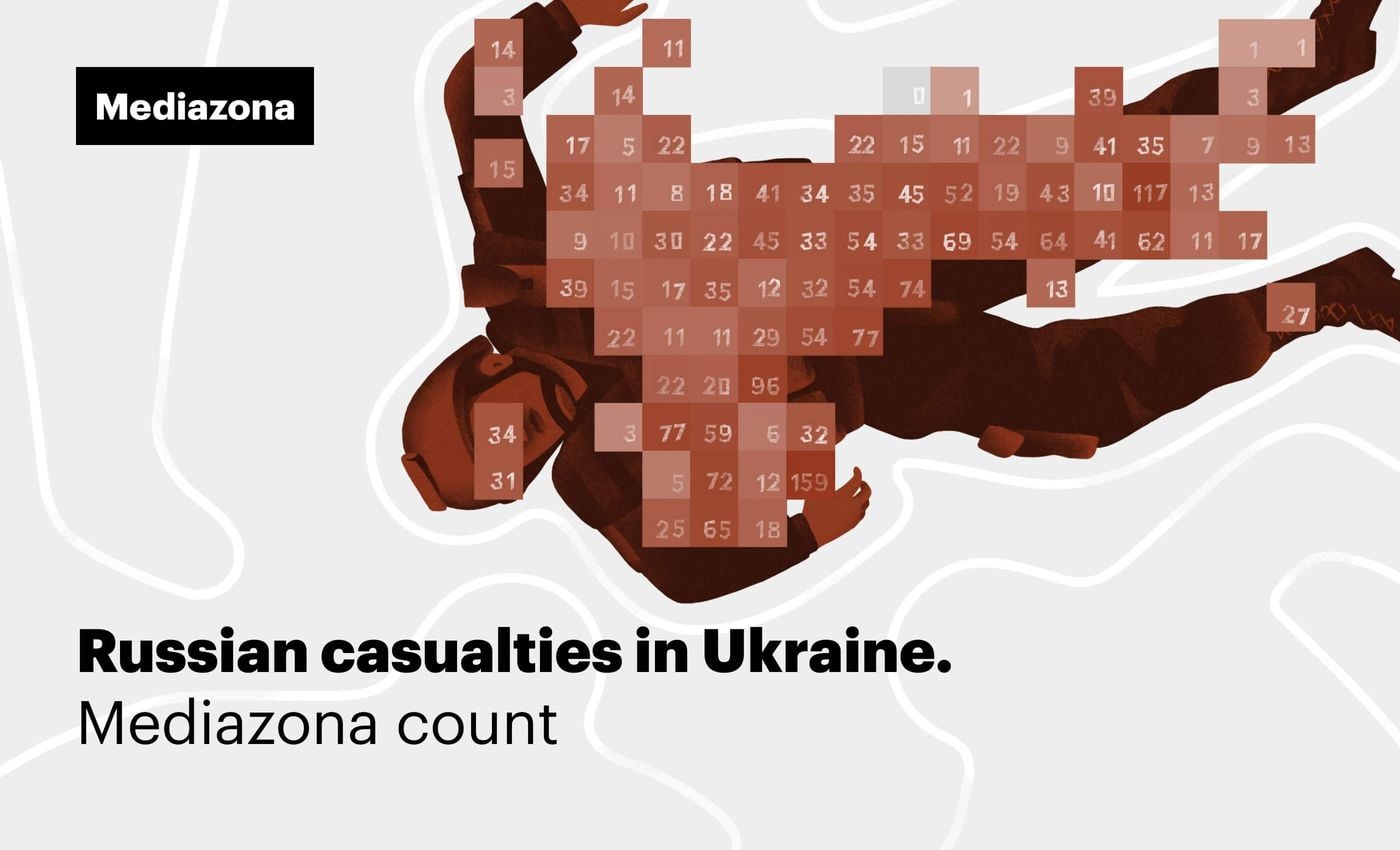
Russian losses in the war with Ukraine. Mediazona count, updated
259,000 deaths confirmed by September 21
These are based on actual Russian records. Do you object to some of the methodologies here ?

 www.theguardian.com