The Russian-Ukrainian War Thread

Feanor

Super Moderator
Staff member
I do not believe there is any observable significant shortage of diesel in farming operations, but I do not have much evidence to state so with utmost certainty. Russia has also been importing record amounts of gasoline and diesel from Belarus. They are also still selling diesel due to contractual obligations, etc.

If there was, it would have no effect on Putin. Not sure why people tend to think that it would (or any of it, in fact). In spite of, what appears to be, a general belief, Putin is pretty isolated from these events. First and foremost, the blame is falling on Ukrainians. When it comes to internal politics, there is quite a ladder that never reaches the top. It is actually rather amazing that it is Putin who appears to be (almost micro-) managing the country, giving out orders and “advice” on television to various officials, bureaucrats, CEO’s, etc. The feedback ladder, however, never gets quite that high: it is always these very people who take the fall because “не справились с поставленными задачами” (failed to accomplish the assigned goals), “не оправдали доверия” (something like “did not live up to trust”), etc; then comes the next level, such as “за хищения в особо крупных размерах” (for grand larceny or embezzlement) and so on. And the ladder is very high.

What happens instead is the pressure to increase pressure (ha!) increases. This is rather trivial stuff for anyone familiar with Russia. Anyone who tells you otherwise is flat out wrong, whether it is intentional misrepresentation or lack of expertise.
Good tsar, bad boyars. Same story as many times in the past.
 

personaldesas

Active Member
Good tsar, bad boyars. Same story as many times in the past.
Wenn das der Führer wüßte!

Metinvest lost all its assets way back when (2015-16?). The company declared that they will not operate in the occupied territories (after being forced to register in separatists republics). That’s how I remember it. Akhmetov seized to be the richest Ukrainian, if I recall correctly.

Edit: all it’s assets in the occupied territories, of course. It is s till huge UA company.
I think that the DPR/LPR seized them as a reaction to the rail blockade, and at some point gave them to Yurchenko.
 
Last edited:

Redshift

Active Member
Are you calling the British Museum a bunch of "criminal associates"?

Talking about fuel and you go for looting in a war...
Yes but what about .....


Russia systematically plundered and extracted massive quantities of cultural artifacts from neighbouring Asian states during its imperial expansion into Central Asia and the Caucasus in the 19th century.While the West colonized overseas, Russia practiced land-based imperialism. It conquered local khanates and emirates across modern-day Uzbekistan, Kazakhstan, Kyrgyzstan, Tajikistan, Turkmenistan, Georgia, Azerbaijan, and Armenia. Much like European colonial expeditions, Russian military and "scientific" missions stripped these regions of their cultural heritage, transferring the finest treasures to Moscow and St. Petersburg.
 

Redshift

Active Member
Yes but what about .....


Russia systematically plundered and extracted massive quantities of cultural artifacts from neighbouring Asian states during its imperial expansion into Central Asia and the Caucasus in the 19th century.While the West colonized overseas, Russia practiced land-based imperialism. It conquered local khanates and emirates across modern-day Uzbekistan, Kazakhstan, Kyrgyzstan, Tajikistan, Turkmenistan, Georgia, Azerbaijan, and Armenia. Much like European colonial expeditions, Russian military and "scientific" missions stripped these regions of their cultural heritage, transferring the finest treasures to Moscow and St. Petersburg.
Oh and, of course

In late 2023, Vladimir Putin signed a federal law explicitly declaring that all items held by Russian state museums are "indivisible" and permanent property of the holding museum, regardless of how they were historically acquired. This law essentially shut down any legal mechanisms for neighboring independent Asian states to claim restitution for their stolen heritage
 

KipPotapych

Well-Known Member
Bit of a sidenote, but I thought its an interesting read.

Just reading back a little, the posts I skipped.

This is, indeed, interesting. I also posted earlier (probably in the Middle East thread?) about the Colombian involvement in Sudan on behalf of the UAE (apparently some atrocities). It is not unlikely that Colombian veterans of RU-UA war have gone that route as well. There were also reports about Colombians who served in Ukraine now working for the Mexican cartels. Other interesting reports too. And this trend will surely continue (we ain’t seen nothing yet!?)

And this is very concerning. Colombia has been a farm for those looking for mercenaries for many years. Now those having served (or serving) in Ukraine (on both sides, it should be noted) gained (or are gaining) extraordinary experience. Consider this limited list:

- FPV and counter-FPV operations and tactics;
- IEDs, as in improvised drone payloads;
- repairing and modifying drones on the go (in the field);
- reconnaissance and surveillance;
- electronic warfare and disruption of communications, as well as operating in such environments;
- UAV/artillery integration/coordination and counter-battery fire;
- coordinating artillery fire with infantry and armour movement;
- small unit tactics, concealment, etc;
- urban warfare;
- operating under heavy aerial surveillance and in “grey zone” or “kill zone” environment;
- not unlikely involvement in mid- and long-range strikes using various UAVs;
- drone interception;
- engineering - trenches, dugouts, fighting positions, etc - designed for drone surveillance and attack;
- logistics in drone and heavy fighting environment;
- combat medicine, evacuations, etc;
- UGVs and other “drones”;
- experience with a great variety of Western arms and equipment;
- a whole bunch more, without a doubt, along with the general real/big war experience;
- and, finally and very importantly, combination of all of the above and its implementation, leaderships roles, training personnel and new recruits, and so on --> application of this vast experience and knowledge elsewhere, training adversaries, current and future…

This is very real and brutal stuff with significant consequences that we will have to deal with in the future. Potential for fireworks is not insignificant.

And while mercenaries who went through Ukraine are an immediate (and on) concern, the Russian and Ukrainian troops who will be available after it is all over are a much greater issue simply due to pure numbers. There is some discussion about consequence of demobilization and returning veterans and whatnot for the two countries, comparison with Afghanistan and Soviet Union. Some of what this (often great) analysis is missing is that the world is much more open and integrated today than it was in late 80s and 90s. I believe consequences of this will be felt far and beyond the two states. This thing is going to change the conflicts to come. I have very little doubt about it. And probably not for the best.
 

KipPotapych

Well-Known Member
I think that the DPR/LPR seized them as a reaction to the rail blockade, and at some point gave them to Yurchenko.
I honestly don’t remember the details. I do remember they were required to register operations under the new government, they refused (with some epic declarations), without a doubt under huge pressure from the new UA authorities and not without some serious deliberation, new realities, etc. They lost some significant assets in the process. Now (in)famous Azovstal was also theirs before the invasion.
 

personaldesas

Active Member
And while mercenaries who went through Ukraine are an immediate (and on) concern, the Russian and Ukrainian troops who will be available after it is all over are a much greater issue simply due to pure numbers. There is some discussion about consequence of demobilization and returning veterans and whatnot for the two countries, comparison with Afghanistan and Soviet Union. Some of what this (often great) analysis is missing is that the world is much more open and integrated today than it was in late 80s and 90s. I believe consequences of this will be felt far and beyond the two states. This thing is going to change the conflicts to come. I have very little doubt about it. And probably not for the best.
Yes, this has been on my mind too. Hundreds of thousands of battle hardened men, a lot of them carrying serious psychological baggage from it. We've seen in past wars how hard the return to civilian life can be, especially with limited economic opportunities waiting at home. In the West the obvious reference is Vietnam combat vets and how their outcomes went.

Would love to hear from people with more cultural context on the former Soviet republics, how did this play out after the Chechen wars? I've heard some stories, but nothing systematic.

And shady organisations with deep pockets are going to love scooping up struggling veterans, PMCs included. Managing all this is going to be quite the challenge.
 

personaldesas

Active Member
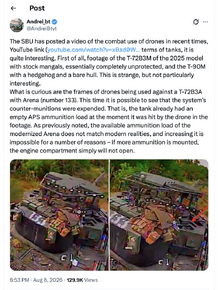
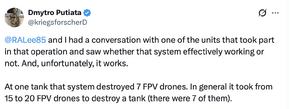
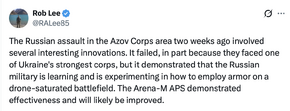
Western Analysts tend to think that Arena-M APS does indeed work.

Screenshot 2026-08-09 at 11.35.12.png
Screenshot 2026-08-09 at 11.34.14.png
Screenshot 2026-08-09 at 11.34.07.png


rsemmes

Active Member
Oh and, of course

In late 2023, Vladimir Putin signed a federal law explicitly declaring that all items held by Russian state museums are "indivisible" and permanent property of the holding museum, regardless of how they were historically acquired. This law essentially shut down any legal mechanisms for neighboring independent Asian states to claim restitution for their stolen heritage
Even if you are going off topic...
You are just saying that Russia is like the UK (and its monarchy), another western democracy.

Edit
2023 or 1963? Cultural Property (Armed Conflicts) Act 2017 passed to criminalize dealing in unlawfully exported cultural property, Buckingham Palace secured a specific exemption ensuring police powers of entry do not apply to the sovereign's private estates.
You don't read theguardian?
Pretty sure you know of the British Museum Act 1963 and the National Heritage Act 1983, right?
 
Last edited:

Feanor

Super Moderator
Staff member
Western Analysts tend to think that Arena-M APS does indeed work.

View attachment 55362
View attachment 55363
View attachment 55364

To be fair, Andrey Tarasenko isn't a western analyst by any stretch of the imagination, but yes I think the general conclusion has to be that Arena-M can intercept FPV drones and does add some measure of survivability.

Even if you are going off topic...
You are just saying that Russia is like the UK (and its monarchy), another western democracy.

Edit
2023 or 1963? Cultural Property (Armed Conflicts) Act 2017 passed to criminalize dealing in unlawfully exported cultural property, Buckingham Palace secured a specific exemption ensuring police powers of entry do not apply to the sovereign's private estates.
You don't read theguardian?
Pretty sure you know of the British Museum Act 1963 and the National Heritage Act 1983, right?
This is irrelevant to the discussion at hand. The wider argument about western hypocrisy has been made ad nauseum. This thread is for discussing the war.
 

Hoover

Active Member
Zelenski wants (as usual) to use Starlink in Russia...
while Russia is getting its own Starlink over Ukraine.
It would make targeting more easier, but currently the drones are quite succesful against Russian energy infrastructure even without using Starlink, isn´t it?

And the Russian "Starlink" will be in full working condition in 2-3 years. Currently they have usable access for a few minutes a day over the battefield. So it is far away being a Starlink substitute until they get more satellites in position.
 

rsemmes

Active Member
It would make targeting more easier, but currently the drones are quite succesful against Russian energy infrastructure even without using Starlink, isn´t it?

And the Russian "Starlink" will be in full working condition in 2-3 years. Currently they have usable access for a few minutes a day over the battefield. So it is far away being a Starlink substitute until they get more satellites in position.
Yes.

Also...
Russia is already using Rassvet and, how effective are Russian attacks? A higher number, missiles?
Yes, you can always look on the bright side of life...

Maybe Zelenski and everyone not living in Ukraine are doing just that.
 

Feanor

Super Moderator
Staff member
It would make targeting more easier, but currently the drones are quite succesful against Russian energy infrastructure even without using Starlink, isn´t it?
This is an interesting question. In general Russia intercepts the overwhelming majority of Ukrainian drones, and recent use of Flamingo cruise missiles hasn't exactly been a success either. Ukraine launches so many drones and against so many targets that even a very small percentage of penetrations can deal substantial damage, but it suggests that if Russia can get their drone defense network running better they may be able to overcome that entirely. This is where Starlink could be very useful. And "very successful" is a relative term. They have yet to actually destroy an oil refinery. It's a disruption, it's damage, but not total destruction. Overall despite many attacks, Russia's energy grid is largely intact, and even the fuel shortages are slowly disappearing. Attacks on shipping, especially in the Azov Sea are another story. So overall I think Ukraine would benefit substantially from being allowed to use Starlink over Russia, and it would create substantial problems for Russia. Russia is also aware of this, hence the continued deployment of the new Volna-Kupol-Garant EW system that is apparently able to interfere with Starlink functionality. And this interference must have some impact, since Ukraine has made it a point to hunt this new system and strike it.

And the Russian "Starlink" will be in full working condition in 2-3 years. Currently they have usable access for a few minutes a day over the battefield. So it is far away being a Starlink substitute until they get more satellites in position.
The key thing is how quickly this project is getting off the ground, and even without full working condition, it can start contributing to Russian capabilities. It's definitely something Ukraine should be concerned about.

Meanwhile in the Dobropol'ye area things are getting worse for Ukraine. Russia has taken one of the two large refuse mounds east of the town. It's possible the town will fall relatively quickly, though it's also possible it will take months. A lot depends on whether Ukraine can/will reinforce the sector. The road from Dobropol'ye to Kramatorsk is not just contested, it's now physically cut. So the value of the logistics corridor is now 0. In a way this means that the actual capture of the town is less significant. Reaching the next highway north of it, west out of Kramatorsk, would likely take quite a long time. Russia would have to not only take Dobropol'ye, but also Belozerskoe, and Novodonetskoe, and then push north even from there. Of course Dobropol'ye has value as another built up urban area where it's easier to hide supplies and equipment from drones, making it a good pushing off point for future advances. But I think the main value of advancing here has already been realized for Russia. Further advances will happen, but it would require a major Ukrainian collapse for them to have impacts on the big battles coming up in Slavyansk and Kramatorsk.
 

KipPotapych

Well-Known Member
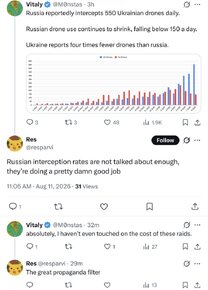
In general Russia intercepts the overwhelming majority of Ukrainian drones, and recent use of Flamingo cruise missiles hasn't exactly been a success either.
IMG_6428.jpeg

He says he hasn’t even touched on the cost. Say $50,000 per drone (probably some slightly less, but many are likely significantly more, so I will call this a conservative estimate) 550 come at a price tag of 27.5M USD or $850M per month, likely a lot more. Even this number, however, represents about 12% of the total 2025 defense budget. Again, in my opinion, this is a conservative estimate (but I stand to be corrected). Moreover, this includes only the cost of drones themselves, no other expenses associated with these strikes. And this is mostly to hit irrelevant infrastructure. And in 2025, Russia reportedly lost about $13B in oil revenue due to these strikes. And… You are catching my drift.

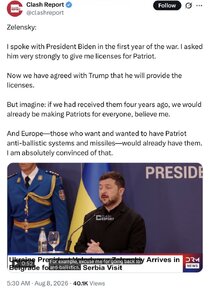
Many are completely deluded on the subject though. This is a normal perception:

IMG_6401.jpeg

Here is a bit more of reality:

We parsed the main Russian monitoring channels for reports of drone interceptions in Moscow and Moscow Oblast. In total, we recorded around 1,500 reported detections and interceptions.

To understand the scale:

According to Sobyanin, 6,225 drones flew toward the Moscow region in July alone. Of those, 780 were reportedly intercepted on the approaches to Moscow.

- Map 1 — interceptions only.
- Map 2 — air-defense positions in Moscow and Moscow Oblast.
- Map 3 — both layers combined.

Now to the results of our sample. To put it mildly, they are disappointing:

- Around 1,400 drones — approximately 93% — were intercepted on the first and second defensive lines in the region.
- Around 100 drones — approximately 6% — reached the third defensive line around the Moscow Ring Road.
- Inside Moscow itself — exactly one drone, or 0.07%.

One. A single drone.

And what actual targets were hit over the past two months? This is almost the entire list:

- The Kapotnya oil refinery, several times in June
- The Dubna Space Communications Center
- Wildberries warehouses and logistics centers
- Several industrial zones and residential buildings damaged by debris

That is all.

Against the backdrop of thousands of launches, this is not even a drop in the ocean. It is almost ridiculous.

If the strategy was to force Russian air defenses to waste all their missiles in this area, it has failed. Their systems remain operational, their missile stocks appear sufficient, and the defensive ring is working.

If the goal was to find routes for a breakthrough, the map shows that approaches were tested from every direction. There are no open corridors.

Decide for yourselves whether this is acceptable or not.


I simply copied this post (legit and respectable UA OSINT account, for those who are not familiar with it): DroneBomber (@DrnBmbr) on X

I am certain that there's little to no economic sense in these strikes (most definitely the latter for Moscow region, it is extremely ineffective and overwhelmingly costly). I would love to see a similar table for the Ukrainian strikes like one in the following article for the Russian weapons:


Note how that table fully explains reduced number of Geran UAVs (and reported likely transition to jet-powered Grans), reduction in production of cruise missiles, as well as Kinzhal, and lean on Iskander-M. Today’s reality of lack of interceptors only makes delivery of the payloads cheaper. The simple thing is that Russia likely causes more damage with one Iskader-heavy strike than Ukraine does in a few months. This is not a sustainable or advantageous strategy. “Quite successful” is not how I would describe it.


As for Flamingos… I believe out of about 4 dozens launched so far, only two made it and I am not even sure if both hit the target (I think one may have missed? Maybe not, I don’t remember). Past few launches (of multiple missiles each) were all intercepted by Ru aviation. Ukraine now says that they need to deal with the Russian aviation in order to make the Flamingos wunderwaffe effective again (as if it ever was), without mentioning that it is basically just a turd, at least for now.


Today, Rassvet (the Russian “equivalent” of Starlink) covers Ukraine for 2 to 3 hours a day, which is expected to increase to 4 to 6 by October. This is from the Ukrainian reports. So not a few minutes. This capability and the expected increase comes from the satellites that had already been launched and the next batch will only extend the coverage in the months (not years) to come. Worth a read:


Fire Point (strangest company ever, by the way) is now “developing” epic satellite interceptors to deal with the issue.


Since there is space for two more attachments, I will use the opportunity.

IMG_6412.jpeg

His face expression in the captured moment basically describes the situation.

IMG_6402.jpeg

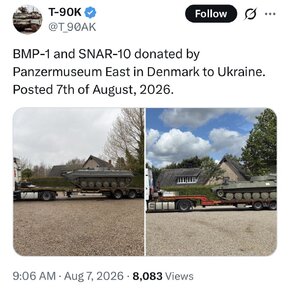
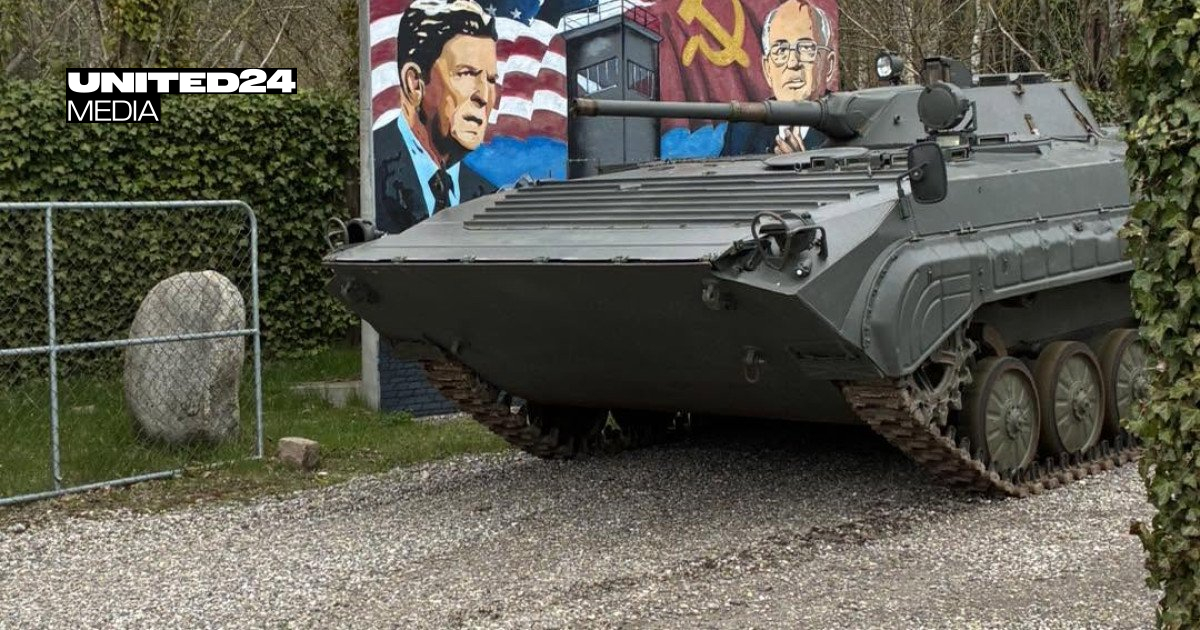
Things are looking up! I love how the UA media presents it as (bolding mine):

A Danish military museum, Panzermuseum East, transferred a batch of armored vehicles[…] The delivery included a BMP-1 infantry fighting vehicle and an MT-LB tracked armored platform equipped as a SNAR-10 ground artillery reconnaissance station.


Feanor

Super Moderator
Staff member
View attachment 55385

He says he hasn’t even touched on the cost. Say $50,000 per drone (probably some slightly less, but many are likely significantly more, so I will call this a conservative estimate) 550 come at a price tag of 27.5M USD or $850M per month, likely a lot more. Even this number, however, represents about 12% of the total 2025 defense budget. Again, in my opinion, this is a conservative estimate (but I stand to be corrected). Moreover, this includes only the cost of drones themselves, no other expenses associated with these strikes. And this is mostly to hit irrelevant infrastructure. And in 2025, Russia reportedly lost about $13B in oil revenue due to these strikes. And… You are catching my drift.

Many are completely deluded on the subject though. This is a normal perception:

View attachment 55387

Here is a bit more of reality:

We parsed the main Russian monitoring channels for reports of drone interceptions in Moscow and Moscow Oblast. In total, we recorded around 1,500 reported detections and interceptions.

To understand the scale:

According to Sobyanin, 6,225 drones flew toward the Moscow region in July alone. Of those, 780 were reportedly intercepted on the approaches to Moscow.

- Map 1 — interceptions only.
- Map 2 — air-defense positions in Moscow and Moscow Oblast.
- Map 3 — both layers combined.

Now to the results of our sample. To put it mildly, they are disappointing:

- Around 1,400 drones — approximately 93% — were intercepted on the first and second defensive lines in the region.
- Around 100 drones — approximately 6% — reached the third defensive line around the Moscow Ring Road.
- Inside Moscow itself — exactly one drone, or 0.07%.

One. A single drone.

And what actual targets were hit over the past two months? This is almost the entire list:

- The Kapotnya oil refinery, several times in June
- The Dubna Space Communications Center
- Wildberries warehouses and logistics centers
- Several industrial zones and residential buildings damaged by debris

That is all.

Against the backdrop of thousands of launches, this is not even a drop in the ocean. It is almost ridiculous.

If the strategy was to force Russian air defenses to waste all their missiles in this area, it has failed. Their systems remain operational, their missile stocks appear sufficient, and the defensive ring is working.

If the goal was to find routes for a breakthrough, the map shows that approaches were tested from every direction. There are no open corridors.

Decide for yourselves whether this is acceptable or not.


I simply copied this post (legit and respectable UA OSINT account, for those who are not familiar with it): DroneBomber (@DrnBmbr) on X

I am certain that there's little to no economic sense in these strikes (most definitely the latter for Moscow region, it is extremely ineffective and overwhelmingly costly). I would love to see a similar table for the Ukrainian strikes like one in the following article for the Russian weapons:


Note how that table fully explains reduced number of Geran UAVs (and reported likely transition to jet-powered Grans), reduction in production of cruise missiles, as well as Kinzhal, and lean on Iskander-M. Today’s reality of lack of interceptors only makes delivery of the payloads cheaper. The simple thing is that Russia likely causes more damage with one Iskader-heavy strike than Ukraine does in a few months. This is not a sustainable or advantageous strategy. “Quite successful” is not how I would describe it.


As for Flamingos… I believe out of about 4 dozens launched so far, only two made it and I am not even sure if both hit the target (I think one may have missed? Maybe not, I don’t remember). Past few launches (of multiple missiles each) were all intercepted by Ru aviation. Ukraine now says that they need to deal with the Russian aviation in order to make the Flamingos wunderwaffe effective again (as if it ever was), without mentioning that it is basically just a turd, at least for now.


Today, Rassvet (the Russian “equivalent” of Starlink) covers Ukraine for 2 to 3 hours a day, which is expected to increase to 4 to 6 by October. This is from the Ukrainian reports. So not a few minutes. This capability and the expected increase comes from the satellites that had already been launched and the next batch will only extend the coverage in the months (not years) to come. Worth a read:


Fire Point (strangest company ever, by the way) is now “developing” epic satellite interceptors to deal with the issue.


Since there is space for two more attachments, I will use the opportunity.

View attachment 55388

His face expression in the captured moment basically describes the situation.

View attachment 55389

Things are looking up! I love how the UA media presents it as (bolding mine):

A Danish military museum, Panzermuseum East, transferred a batch of armored vehicles[…] The delivery included a BMP-1 infantry fighting vehicle and an MT-LB tracked armored platform equipped as a SNAR-10 ground artillery reconnaissance station.

There's been a lot of mockery of Russian air defense when Ukrainian drones manage to penetrate airspace and hit a target, but overall the performance has been quite good, and this should come as no surprise. Russia has had experience with drone attacks in Syria, with in some cases double digit drone waves being sent against Khmeimeem for example. Russia was working on the Gvozd' missiles for the Pantsyr before the current war, based on experience from Syria. And Russia has been preparing to deal with cruise missiles for quite some time now. Russian military planners had been anticipating those kinds of attacks ever since at least the 2003 invasion of Iraq. Low and slow targets, while potentially hard to intercept, are a type of target Russia had prepared for extensively. Moscow region air defense grid specifically is one of the toughest (probably the toughest) GBAD networks on the planet, and that's before we realize that Russia is also using aircraft (both rotary and fixed-wing). Ukraine's Mi-8 fleet does solid work downing Shaheds. Why wouldn't a Ka-52 do the same but better, with it's better sensors and an auto-cannon instead of a door gunner with a machinegun and his eyeballs?

Russia can't cover everything, it's a very large country with spread out infrastructure and valuable targets all over the place. This is where the difference between Moscow and other areas also becomes quite stark. Russia's grid around Moscow can't be replicated nation-wide, Russia can't afford it. SAM towers and SHORAD on high-rises are expensive. There are also many SAM regiments around Moscow. The current waves of drone-defense BARS units being formed are there partly to provide low-cost interception options for relatively easy targets in other areas. They're of course also likely to get sent to escort logistics convoys to Crimea, and do other such work. BARS-Crimea already does drone defense all over the peninsula. But, when working together with regional air defense, they can substantially improve performance in other areas. It's why I think Ukraine really does need to get Starlink use over Russia so they can actively maneuver drones to avoid ground-fire, and target air defense positions manually the same way Russia does with some of their Shaheds especially as Russia's drone defense teams get better at their job, and more numerous.
 

harvestman

New Member
As for Flamingos… I believe out of about 4 dozens launched so far, only two made it and I am not even sure if both hit the target (I think one may have missed? Maybe not, I don’t remember). Past few launches (of multiple missiles each) were all intercepted by Ru aviation. Ukraine now says that they need to deal with the Russian aviation in order to make the Flamingos wunderwaffe effective again (as if it ever was), without mentioning that it is basically just a turd, at least for now.
I assume the "two hits" is based off this May 2026 data, which alleges two hits + one disputed from Aug 2025 - March 2026. But this source claims four Flamingo strikes, this source claims multiple strikes, there is this claim from June, this claim of three strikes, and this claim of a strike from last month. Are these claims reliable? If so, does that suggest that the Flamingos are more effective than the May 2026 data suggests? Apologies if I am misreading anything; this is not my area.
 
Top