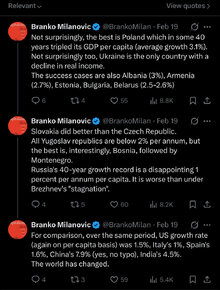
Ok, weird conclusions in the post above, but I will provide another learning opportunity here. Doubt it will take with the young Spaniard, but maybe some random reader will find this helpful.
At first, I stopped reading the article referenced above and closed the page at
[…]co-founder of the Ukraine Business News Network, said[…]
This is usually - I’d say in
at least 90% of the cases and probably closer to 100 when they talk about Russian economy and business - a dead giveaway that what you are about to read is pure propaganda that has little to do with how things really are. It matters not whether you believe me or not, but this is how it is.
But anyway, I then clicked on the link again and continued reading, getting to this part:
Oil and gas, once accounting for nearly 40% of Russia’s budget revenues, now contribute closer to 20–25%, McNamee said. The decline has accelerated following new U.S. sanctions on energy giants Rosneft and Lukoil and continued Ukrainian strikes on Russian energy infrastructure.
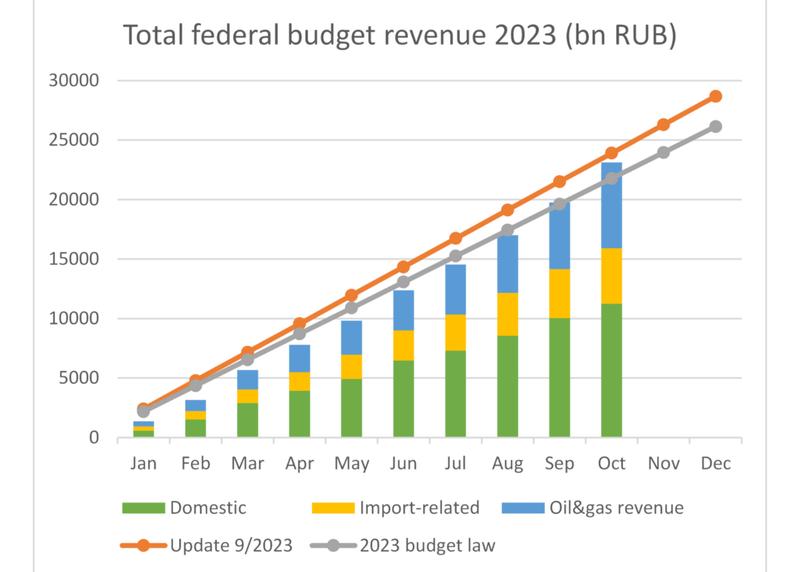
Let’s see about the budget composition first and his statement of “once accounted for”. So here is a chart for illustrative purposes (it is real stuff though form 2023):
The chart was taken from this article:
How Russia saved the 2023 budget – Riddle Russia.
As you can see from the chart, where green and yellow represent tax revenue, the oil and gas portion is somewhere between the “expert’s” declared 20 and 25%. In other words, over 75% of the budget revenue in 2023 was internally generated via income tax and consumption. When the guy says “once accounted for nearly 40%” (it actually used to hit more than 40%), he tries to give you the impression that this is a recent development. In reality, it has not been the case for over a decade. To be more exact, this ratio in the budget revenue generated from exports of hydrocarbons to that generated internally started changing rather dramatically after 2014, after the first Ukraine related sanctions were imposed - they started “bulletproofing” their economy (and actually did an excellent job, as is clearly evident from the past 4 years, as well as prior years).
There was also an increase (of 2%) in VAT effective January 1, which is going to affect this ratio as well, time will tell which way. I would bet five bucks that the same “expert” or his colleague(s) talked about this sales tax increase as “zomg, inflation spiked in Russia in January!”. Anyone who reads news from questionable outlets must have seen an article talking about it. For educational purposes, a tax increase like this is not inflationary (and no tax increases generally are), unlike, for instance, Trump’s tax in the form of tariffs and the way he implements the policy. In case of the former, there is a one time price increase of 2% with clearly defined policy and exemption clauses (if any - I never read the legislation or detailed reports because I don’t care), there is no uncertainty and it is a well implemented policy to raise revenue and bring the self-sufficiency to hydrocarbon-dependency ratio further in line with economic and (geo)political goals of the administration. This is why the overall inflation downward trend in Russia has not changed. Furthermore, this is a deflationary measure, which will help central bank in its fight with overheated economy and the resulting inflation. In case of the latter - the Trump administration policy of tariffs - on the other hand, even the most educated and experienced people in the field cannot predict the future and the downward inflation trend was reversed in April of last year and it has been heading up ever since due the uncertainty and a whole lot of it. This is one of the examples when an authoritarian government can implement better economic policy, provided the policy is the right policy to implement to begin with. Democratic governments do not have this luxury. Anyway, this is already beyond the scope of what I was going to say, so let’s get back to the “expert” in the article cited.
The “decline has accelerated” that the “expert” in the article is talking about is, again, not entirely related to the reasons he provides (sanctions and UA strikes). I mean those had an effect, surely and obviously. UA strikes much less, about a margin of error; sanctions more so, but the effect from sanctions is temporary due to the nature of the product that is being sanctioned (this should have been one of the takeaways from the podcast I recommended above). The biggest effect, however, was the overall drop in oil prices, increase in the value added tax, etc. In other words, there is a picture being intentionally painted in the article for the reader to draw certain conclusions that are not only wrong for today’s situation, but they have no representation of the future and cannot be applied to make any reasonable forecasts about what is going to happen to the Russian economy. It is simply nonsense targeted at an average reader who knows nothing about the subject matter beside what the other similar article told them last week and another the month prior. It is simple manipulation of half-valid (which is very important) data/information to make the reader draw conclusions that have no relationship to reality, like “Russia is doomed” and “the collapse is coming”. One should probably ask themselves why it is the case: why is this bullshit being spread over and over and over..? Funny enough, none of the infamous “forecasts” have materialized in the past four years, yet many still keep making the same forecasts and the “unsuspecting” reader (which is extremely weird in itself to still be unsuspecting) buys it and carries it on.
Anyway, last comment on this section of the “expert’s” opinion. Provided the oil and gas revenue in Russia drops by, say 10%
on the year (very important, not just some month(s), but the entire year), a direct impact on the budget would below 2.5% and likely below 2%. Does this look like something we are actually seeing in real life? Now transfer this train of thought to today’s headlines like “Russia is going to take a huge hit from India’s 30% reduction in the RU oil purchases” (which probably isn’t going to happen to begin with). I can do the “fundamental math” for those interested. So all this “traumatic” and “catastrophic” stuff is just words meant to entice the audience and keep the excitement and involvement going, nothing more. It’s like views and likes on any social media platform.
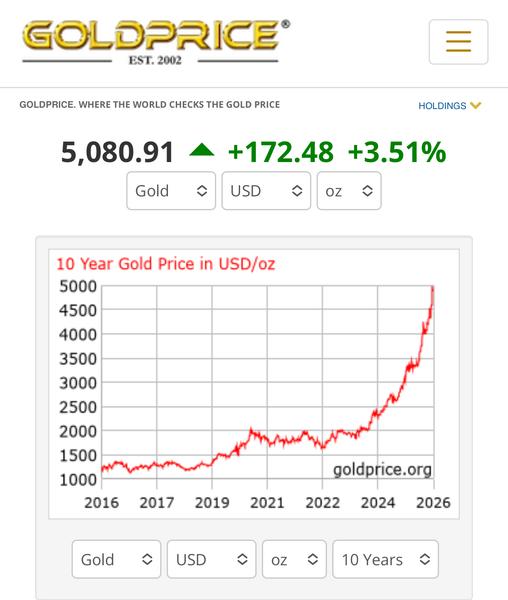
I did not read the article further, but I have a fairly good idea of what they talked about. So let’s look at a few charts here. Here is one, the price of gold in the past 10 years (the screenshot is from yesterday, the price is lower today):
Source:
Gold Price
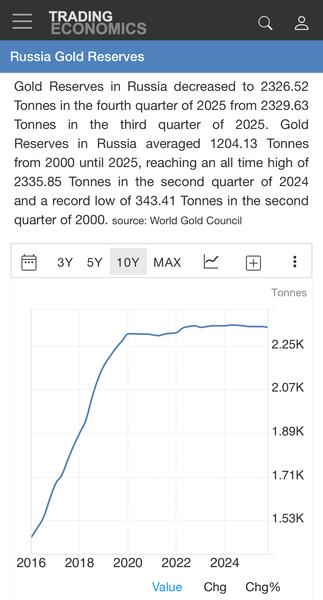
Russia’s gold reserves in metric tonnes over the past 10 years:
Source:
Russia Gold Reserves
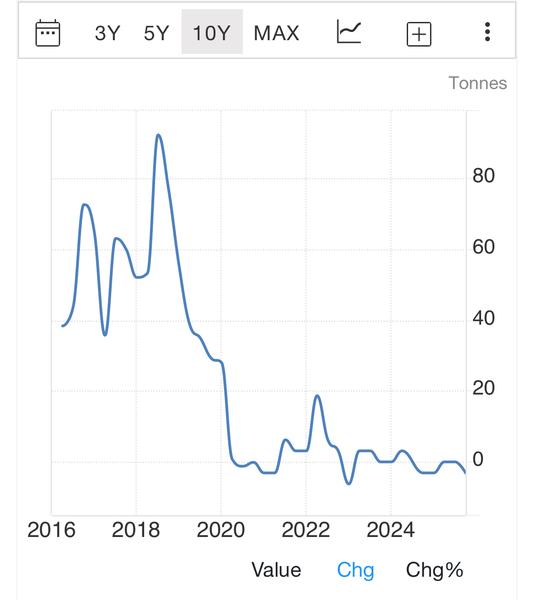
Another chart from the same source as above representing the annual change (in metric tonnes) over the past decade:
Over 99% of the Russian gold reserves (which currently stand to be fifth in the world and represent about 30-35% of the total FX reserves of the country) were purchased before 2020. In fact, one can draw a correlation between the price of gold and Russia dumping US treasuries and buying gold up to the invasion (about 2019, to be exact, and relatively minor purchases since). In other words, and again, this “traumatic” budget and gold sell-off relationship is red hot garbage to excite the audience. A decent, not excellent though, read on the current state of events as far the US treasuries are concerned, sanctions, etc:
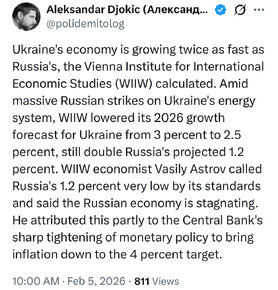
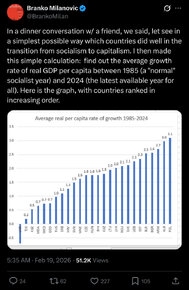
Anyway, there are many parts here that require some preexisting knowledge and understanding/expertise. Some refer to this preexisting conditions as “Russian propaganda” nowadays. And this is fine - I, personally, could not care less what any individual thinks of it (including my posts). My main concern is that this is a groupthink with a group big enough to fuck things up for everyone, pardon my language. That is, how this and other stuff is carried over to a bigger picture, where lives of millions are affected in very negative ways largely because of it. The entire global landscape is being affected by this nonsensical stuff and propaganda. Yes, sure, one can talk about the fact that this is because of the Russian aggression and Russia can go home anytime and whatever else (and they are not wrong), but the reality is somewhat different currently and has been for a while and we are here today staring at this, with many like a deer in the headlights. And I don’t mean stunned and amazed, but like staring onto oncoming traffic and having no effing clue about what is really going on. I understand that four, even three years ago (for those without a slightly deeper education in economics and knowledge of the Russian affairs) it was a reasonable reaction. I would also think that since then one would consider that something is off and instead of referring to everything else as “Russian propaganda” would consider expanding their views and learn and think critically, leaning on facts. Alas, if people simply look and believe stuff like this, for example:
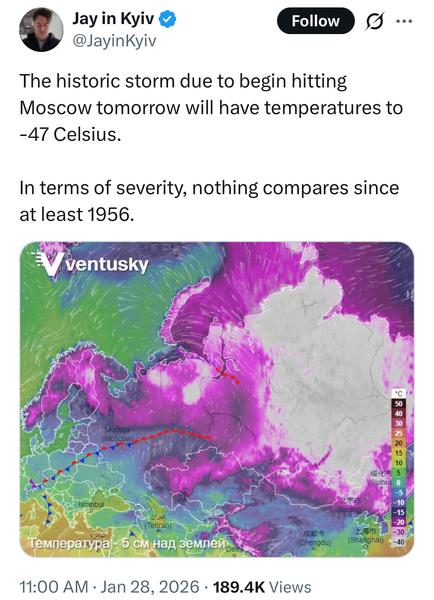
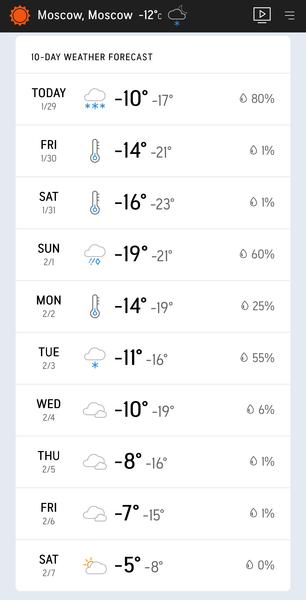
Instead of simply checking the forecast:
What can one do? Probably nothing. More complex stuff seems to be way beyond the capabilities of an average modern individual.