No, why do you think so? i am sharing my honest opinion like every other member of the forumI do not post much in this thread, as the topic does not really hold my interest. Having said that though, I have to as the following question.
Are you posting here in an attempt to troll the forum, or are you trying to provide comic relief with your posts?

You are using an out of date browser. It may not display this or other websites correctly.
You should upgrade or use an alternative browser.
You should upgrade or use an alternative browser.
The Russian-Ukrainian War Thread

Todjaeger
Potstirrer
No, why do you think so? i am sharing my honest opinion like every other member of the forum
Given the content of your posts, or more specifically what you appear to be claiming is happening in the conflict between Ukraine and Russia. If all of NATO was actually fighting Russia, things would almost certainly be quite different. There would likely be a great deal more high value and/or strategic targets being hit in strikes within Russia than Ukraine has managed to date. Also, some of the areas struck would likely be a great distance further away from Ukraine, places like Murmansk or Vladivostok, or even St. Petersburg.
Instead of sanctions, there would likely be a great deal more happening if there was an active conflict between NATO and Russia.
KipPotapych
Well-Known Member
Looks like my (less) vodka math was better than relatively on point, but was exactly@personaldesas, it appears that my less vodka math was relatively on point. One of us (me and Ronald) is wrong about the internal demand here and I am going to say it is me, but will not insist (laughing):
View attachment 55906
PS I am sure he is still using the harvest season numbers for the internal demand and will do so to the mid- or late- November, when the exports will rise sharply all else being equal -> I won’t be surprised if we see half a mil plus bpd heading out of the country.
on point.
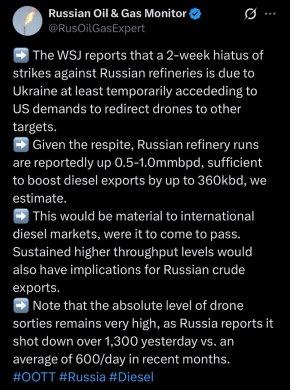
The prudent question is whether the strikes on refineries will intensify after the Republicans lose Congress (though there will still be a couple of months for transition).
What on earth have Saudi or Israel got to do with Russian assaults on Ukraine? At this point in time the USA is unable to muster a coherent statement or position on anything.It is so simple that Israel, S. Arabia and the US cannot understand it.
Yes, fairy tales are simple.
Oh waits it's more what about what about.
I would rather that it was frozen right now than continuing in its current form, I'm pretty sure that most people would. The only country that can do this with unilateral action is Russia. If Ukraine stopped firing into Russian territory Russia would laugh and just carry on bombing and assaulting Ukraine.Maybe, maybe not. Ukraine wants a ceasefire but it's unlikely they would take a permanent peace deal with a new international border along the current LOC. So it may be less of an end to the war and more of a pause. Frozen conflicts in the post-Soviet space have a habit of unfreezing themselves (S. Ossetia, Karabakh, Chechnya etc.) What we do know is that a ceasefire would take a lot of pressure off of Ukraine, and would let them reconstitute their armed forces, badly strained by the fighting, rebuild infrastructure, and receive deliveries of aid and arms without need to carefully squirrel them away from Russian strikes.

rsemmes
Well-Known Member
NATO can do that with unilateral actions too, the only country that can do nothing about it is Ukraine.I would rather that it was frozen right now than continuing in its current form, I'm pretty sure that most people would. The only country that can do this with unilateral action is Russia. If Ukraine stopped firing into Russian territory Russia would laugh and just carry on bombing and assaulting Ukraine.
Asking Google AI (so, Western version of events) about Ukraine's funding, it goes from "desperate" to "collapse", depending on what we do. Mind, not a front line collapse but a social and economic collapse in 2027. Maybe the Ukrainian government thinks that it should negotiate before that?
Obviously, we don't want that, we want a long and slow collapse, we want to keep Ukraine "in the fight". How much money are we willing to part with to achieve that? How much will we (Elections are coming!) spend in 2028 if Ukraine survives 2027?
Can anyone see Russia collapsing because NK is not providing Russia with $100bn in 2027? Wishful thinking or blatant disregard of reality?
Using sources like pravda.com.ua, economist.com and theindependent.
Is "fairytalism" the opposite of whataboutism or just of reality?
personaldesas
Active Member
I’ve been reading more Russian social media this week, since we share plenty of Western social media here:
Last edited:
personaldesas
Active Member
Rybar: Russia has air-defence shortages, which have allowed Ukraine’s Flamingo missiles to score successful hits.
 t.me
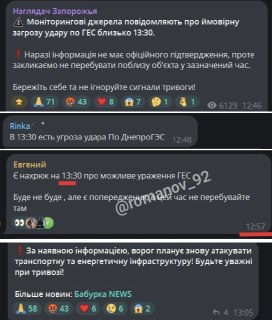
Romanov: Russia’s General Staff leaking strike plans, Ukrainians know target and exact timing of a Russian strike almost two hours in advance.
 t.me
Maxim Kalashnikov: strategic defeat for both Russia and Ukraine. Even taking the rest of the Donbas would not fundamentally change the outcome.
 t.me
Group of Forces West: Russian officer was sent to his death after refusing to help his commander extort money from other soldiers.
 t.me
Рыбарь
«Фламинго» не будет? О заявлении Fire Point и его подоплёке Глава украинской компании Fire Point Ирина Терех заявила, что крылатых ракет «Фламинго» больше не будет, а сами по себе они были политическим проектом для демонстрации возможности ударов вглубь России. В целом это показательная...
t.me
Romanov: Russia’s General Staff leaking strike plans, Ukrainians know target and exact timing of a Russian strike almost two hours in advance.
Romanov Лайт ]ࣩࣩࣩࣩ࣯ࣩࣩࣩࣩࣩࣩࣩࣩࣩࣩࣩࣩࣩࣩࣩࣩࣩࣩࣩࣩࣩࣩࣩࣩࣩࣩ
24.10.2026 Запорожье, временно оккупированная Украиной территория России. Днём прошедших суток в 13:30 ВС России нанесли удар по Днепровской ГЭС. Уже традиционно - особых последствий объект удара не понес и продолжает функционировать. Но интересно не это. Почти за два часа до удара ресурсы...
t.me
Maxim Kalashnikov: strategic defeat for both Russia and Ukraine. Even taking the rest of the Donbas would not fundamentally change the outcome.
Рой ТВ - Максим Калашников
Максим Калашников Поскольку понятно, что нынешняя война на Украине завершится стратегическим поражением и Украины, и РФ, что её исход ясен и никакая передача остатка Донбасса ничего не изменит принципиально, пора подводить некие итоги. И делать выводы. Уже ясно, что постсоветская сырьевая и...
t.me
Group of Forces West: Russian officer was sent to his death after refusing to help his commander extort money from other soldiers.
Группировка войск «Запад»
Очередная трагическая история из войсковой части 31135 (1 мсп). На этот раз о том, как тыловая мразь и вымогатель отправляет на убой честных офицеров за отказ участвовать в поборах: История офицера капитана мобилизованного, с установленной категорией В по ст. 26 и 17. Позывной «Дейл». Танкист...
t.me
Last edited:
KipPotapych
Well-Known Member
On the recent phone call with Putin:
For my English-speaking followers, let's get the facts straight about the Stubb–Støre call with Putin.
New reporting from Finland provides important details missing from much of the international debate. Some of the initial accusations now look rather premature.
First, why did the call happen?
According to President Stubb, Ukraine's peace negotiations were close to collapsing last week, with relations between Kyiv and Washington in serious trouble. Finnish sources suggest there was even a risk of the US disengaging from the process.
At Zelenskyy's request, Finland and Norway organised the Oslo talks with American negotiators Steve Witkoff and Jared Kushner, alongside other European representatives.
The subsequent call to Putin was prepared with Ukraine and the US. According to Finnish sources, key allies were informed beforehand and briefed afterwards. Helsinki also wanted Ukraine to publicly confirm its support for the initiative.
Zelenskyy has since explicitly defended the call and praised its transparency.
Second, the controversy surrounding European coordination deserves clarification.
Danish Prime Minister Mette Frederiksen accused Finland and Norway of acting independently and failing to coordinate with other European countries.
But Stubb and Støre have both stated that allies were informed in advance and received detailed briefings afterwards. New reporting from Finnish news agency STT supports their account.
There is an important distinction between not being informed, not being consulted on the decision, and fundamentally disagreeing with that decision.
Frederiksen's criticism increasingly appears to reflect a disagreement over whether direct contact with Putin should happen at all, rather than simply a lack of notification. Her initial framing therefore risks creating a misleading impression of an uncoordinated diplomatic operation.
Political disagreement should not be confused with evidence that Finland and Norway acted behind their allies' backs.
Third, what actually happened during the call?
Finnish broadcaster Yle and news agency STT have challenged the Financial Times' account of Putin delivering a lengthy history lecture to passive Nordic listeners.
Their sources describe a substantive exchange in which Stubb and Støre questioned Putin about the upcoming Abu Dhabi negotiations and stressed that prolonging the war would not diminish European support for Ukraine.
Freedom of navigation in the Baltic Sea, keeping maritime routes open and Russia's shadow fleet were also discussed.
Finnish-Russian bilateral relations reportedly were not discussed at all. The parties agreed to keep the communication channel available.
Fourth, the risks were understood from the beginning.
Finnish sources say criticism and possible Russian propaganda exploitation were anticipated. One source described the initiative as values-based realism, which sometimes requires accepting political risks and their consequences.
This was a calculated decision, not an improvised attempt to normalise relations with Moscow.
Zelenskyy has also reminded critics that Putin's diplomatic isolation effectively ended with Trump's Alaska summit in 2025. Other European governments have maintained contacts with Russia, sometimes without comparable transparency towards Ukraine.
Ukraine requested diplomatic assistance, and Finland and Norway responded in coordination with Kyiv and Washington.
Supporting Ukraine for as long as necessary must also mean supporting it in the ways Ukraine actually asks for. That includes diplomacy.
Europe needs military strength, economic pressure and diplomatic influence. These are complementary instruments, not competing alternatives.
From here:
Don’t have the time to write a long essay (maybe a short one though, lol), but it is pretty clear that there is a division between those who act in Ukrainian interest (or at least try their best) and those who do not. It could not have been more ridiculous than Ukraine supporting and likely initiating the idea of the call to begin with and the “front-runner supporters” (so far I saw the UK, Denmark, Sweden, and the Balts, of course) complaining or even being outraged about the call taking place. Moreover, spreading bullshit (via Financial Times, for example) in order to derail the effort at the very beginning, as usually.
Some obviously prefer the war to go on until… not sure what words to put here. Also not sure what they are hoping to accomplish. It also appears that some are getting carried far away with their own bullshit, such as “oh, but this will give an opportunity for Putin to spread propaganda”, because that eliminates any possibility of diplomatic efforts. One may wonder, of course, if this is them getting carried away or if this is bullshit by design, circling back to the desire for the continuation of the war.
Another thing is “this lets Putin divide us (further)”… Really? These guys don’t need Putin because they are doing quite well all on their own. Just need a distraction or someone/something to blame. They can’t say “you are (or, worse yet, I am) dividing us because you do not follow my thought process”. Therefore, “it is Putin that sows division among us”, so you better fall in line and we can stand together strong again, as long as it takes.
I haven’t asked in a looong while now, as long as what takes? Has someone defined that yet? I must have missed it. I know we are still at the “aggressor cannot be rewarded” nonsense, but have we yet defined the opposite end of it, as in “the victim cannot/should be…”?
The same goes for “Russia can just stop/leave and then the war stops”. Well, not sure how it is not clear yet, but Russia is not going to do that “just”, the war is here (rather there) and now and tomorrow and every day after, what is the alternative to waiting for them to stop and leave.
You are just descriUpon a pause of the war, Ukraine would immediately redouble its efforts to rearm, would invite foreign troops for ... training, would invite foreign "advisors", would try to integrate its air defence into NATO, would stockpile millions of drones etc. With a constant revanchist attitude of the people against Russia, probably for centuries onwards.
Why would the russians allow that? The best course of action for the russians is to keep grinding Ukraine into nothingness. Until it becomes a permanently destroyed/failed country, forever isolated, with no future and with demographics even much worse than the current situation.
You get more ridiculous by the day.NATO can do that with unilateral actions too, the only country that can do nothing about it is Ukraine.
Asking Google AI (so, Western version of events) about Ukraine's funding, it goes from "desperate" to "collapse", depending on what we do. Mind, not a front line collapse but a social and economic collapse in 2027. Maybe the Ukrainian government thinks that it should negotiate before that?
Obviously, we don't want that, we want a long and slow collapse, we want to keep Ukraine "in the fight". How much money are we willing to part with to achieve that? How much will we (Elections are coming!) spend in 2028 if Ukraine survives 2027?
Can anyone see Russia collapsing because NK is not providing Russia with $100bn in 2027? Wishful thinking or blatant disregard of reality?
Using sources like pravda.com.ua, economist.com and theindependent.
Is "fairytalism" the opposite of whataboutism or just of reality?
rsemmes
Well-Known Member
What, two similar, or equal, things happening in the world at the same time have to do with each other... You wonder!What on earth have Saudi or Israel got to do with Russian assaults on Ukraine? At this point in time the USA is unable to muster a coherent statement or position on anything.
Oh waits it's more what about what about.
Well, if you are able to send the war in Ukraine to a singularity in space and time, any mention of UN, International Law or criminal and illegal invasion (bombing counts?) makes sense; to you, or makes you happy or... something.
If, on the other hand, you think that it is actually happening in the real world, in a world of real politik… Why do you, some people really, pretend to ride such a big horse? And an imaginary horse at that.
Coming back to the real world...
Do you wonder why we, selectively defend/support some countries? Hint: UN, law and all that is just a lullaby. Second hint: There is no worse blind man than the one who doesn't want to see.
That is a long, detailed, well thought argument.You get more ridiculous by the day.
Or not.
rsemmes
Well-Known Member
To the last Ukrainian soldier.Some obviously prefer the war to go on until… not sure what words to put here.
The funding for 2027-2028 will be a nice dividing line. (Wild guess.)
NATO can help a Russian victory. But why would it? Would it benefit anyone other than Putin? Why would NATO act to harm itself, by betraying a friend?NATO can do that with unilateral actions too, the only country that can do nothing about it is Ukraine.
You consistently argue for Russian victory. Why?
personaldesas
Active Member
I haven’t asked in a looong while now, as long as what takes? Has someone defined that yet?
I think the answer is obvious.
On the battlefield, this war looks set to grind on for years. That means it will be decided by staying power. Russia believes it can erode Ukraine’s resistance and support before its own will to fight runs out. Its information campaign is built around that. It pushes the points rsemmes regurgitates here so often: that resistance is pointless and support for it need to stop. Ukraine and its backers are trying to signal the opposite: that Russia’s mistaken to bank on that.
That’s why they say “as long as it takes”.
It’s a position you can disagree with, but the rationale is clear.
Last edited:
personaldesas
Active Member
You consistently argue for Russian victory. Why?
Brace for the mother of all whataboutisms.
You’ll get a string of questions about everything the West has ever done to anyone, a lecture on how anyone who doesn’t accept the inevitability of full Russia’s victory is just delusional, and no actual answer.
Last edited:
personaldesas
Active Member
The same goes for “Russia can just stop/leave and then the war stops”. Well, not sure how it is not clear yet, but Russia is not going to do that “just”, the war is here (rather there) and now and tomorrow and every day after, what is the alternative to waiting for them to stop and leave.
"Russia can just leave" is about who’s responsible. Russia chose to invade, and it can end the invasion by withdrawing. That says nothing about whether it will. "Russia won’t leave" is a serious practical problem, but it answers a different question. It doesn’t make Russia any less responsible, or shift that responsibility onto Ukraine for resisting. That still leaves the practical question of what would make Moscow change course.
And why is Russia’s refusal treated as fixed, while everyone else are expected to adjust? One could just as easily say Ukraine will never cede territory and Russia will have to adjust to that. Either way, one side’s position is non-negotiable and the whole burden falls on the other. Neither position is helpful. Any settlement will mean likely compromises on both sides.
Last edited:
rsemmes
Well-Known Member
I am stating a fact, neither guessing nor stating an intention. I don't say that NATO will do it either; I am pretty sure it will not, purposely, but it may happen anyway.NATO can help a Russian victory. But why would it? Would it benefit anyone other than Putin? Why would NATO act to harm itself, by betraying a friend?
You consistently argue for Russian victory. Why?
I argue for reality.
I have asking about that "silver bullet"... All I can see is Ukraine going down, slowly, but down. $100bn from NK to "save" Russia, anyone?
rsemmes
Well-Known Member
Only that the collapse of Ukraine will make "negotiating" irrelevant."Russia can just leave" is about who’s responsible. Russia chose to invade, and it can end the invasion by withdrawing. That says nothing about whether it will. "Russia won’t leave" is a serious practical problem, but it answers a different question. It doesn’t make Russia any less responsible, or shift that responsibility onto Ukraine for resisting. That still leaves the practical question of what would make Moscow change course.
And why is Russia’s refusal treated as fixed, while everyone else are expected to adjust? One could just as easily say Ukraine will never cede territory and Russia will have to adjust to that. Either way, one side’s position is non-negotiable and the whole burden falls on the other. Neither position is helpful. Any settlement will mean likely compromises on both sides.
I cannot see the collapse of Russia, neither in 2028 nor in 2029.
personaldesas
Active Member
Only that the collapse of Ukraine will make "negotiating" irrelevant.
I cannot see the collapse of Russia, neither in 2028 nor in 2029.
Russia doesn’t need to face collapse for a negotiated settlement to become preferable to continuing the war. Neither does Ukraine.
Last edited:
I speak English, that doesn't mean my loyalty is to England.In Russia, every third person has relatives in Ukraine, and the overwhelming majority of residents of the central and south-eastern regions, including Crimea, prefer Russian in everyday life. Could you not, to me as a resident of the Crimean peninsula, give an example of an “endless partisan war” in Crimea or in the south-east of Ukraine ?
The study "Russian Language Enjoying a Boost in Post-Soviet States," published by Gallup in August 2008.
View attachment 55925
% of those who report speaking Russian at home to some extent, 2024
Mariupol: (98% in 2017)
Severodonetsk: (96% in 2017)
Odessa: 92% (-3%)
Dnipro: 85% (-5%)
Kharkov: 84% (-12%)
Zaporozhye: 84% (-13%)
Nikolaev: 75% (-19%)
Chernigov: 55% (-26%)
Kiev: 54% (-15%)
Sumy: 47% (-33%)
Kropivnitsky: 42% (-29%)
Cherkassy: 37% (+3%)
Poltava: 35% (-9%)
Vinnitsa: 29% (-4%)
Chernovtsy: 28% (-3%)
Uzhgorod: 26% (+10%)
Zhitomir: 22% (-20%)
Khmelnitsky: 12% (-6%)
Ivano-Frankovsk: 6% (+2%)
Lvov: 5% (-5%)
Lutsk: 4% (-4%)
Rovno: 4% (-7%)
Ternopol: 4% (+2%)