The Russian-Ukrainian War Thread

StevoJH

The Bunker Group
@Ikimieli

Just to be clear, Russia is not the Soviet Union. It has nothing like the human, industrial or financial capital that was available to the Soviet Union prior to its breakup or in decades before.

The Soviet Union even without counting the other member nations of the Warsaw Pact had a population similar to or greater then all European NATO members combined. When the Union broke apart, not only did they lose huge amounts of human capital, they also lost huge amounts of Industrial capability in key areas due to key factories being located outside the borders of what later became Russia.

Russia also has severe demographic constraints due to low fertility rates.
 

Feanor

Super Moderator
Staff member
@Ikimieli

Just to be clear, Russia is not the Soviet Union. It has nothing like the human, industrial or financial capital that was available to the Soviet Union prior to its breakup or in decades before.

The Soviet Union even without counting the other member nations of the Warsaw Pact had a population similar to or greater then all European NATO members combined. When the Union broke apart, not only did they lose huge amounts of human capital, they also lost huge amounts of Industrial capability in key areas due to key factories being located outside the borders of what later became Russia.
And the '90s and even early '00s were not great for many Russian industrial enterprises and scientific institutions. It's not just the fall but what happened after the fall that made it so much worse.

Russia also has severe demographic constraints due to low fertility rates.
Russia's demographics are bad and have been for some time. They're partially offset by migration, and Russia has the relatively unique advantage of ethnic Russian, and other culturally close populations providing some of that migration. The problems are however far from unique to Russia, they also apply to many European countries, and notably they apply to Ukraine. In fact Ukraine has drastically worse demographic issues, and they've been exacerbated by this war, not so much by the body count (that never helps but it's small in the grand scheme of things) but rather by the migration and loss of populated territories. In fact for Russia attracting relatively friendly population from Ukraine to Russia has been a crutch in resolving demographic difficulties (another factor that this war substantially disrupts if not ends).

To be clear this is different from the current pattern of Ukrainian citizens, be they Russian or Ukrainian ethnics, returning to occupied areas because they're simply going home. Russia has had a steady stream of Ukrainians immigrating to Russia before this war. Russia still needs Ukrainian citizens to return to the occupied areas, so those areas have functioning economies and some level of infrastructural efficiency. But it doesn't help much with wider demographic issues.
 

KipPotapych

Well-Known Member
In the meantime:

Rubio says Zelensky is a liar, literally:


Someone clearly is. Regardless of who it is, the relationship is going well though.

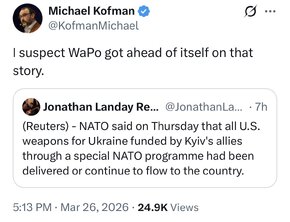
About the article cited yesterday:

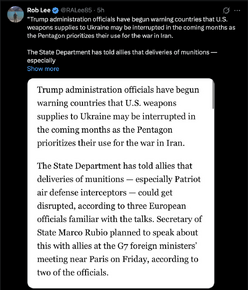
On a related note, the US is contemplating redirecting the weapons they are selling to Europe intended for Ukraine to the Middle East. Notably:

Since last summer, he [Rutte] added, the initiative has supplied about 75 percent of the missiles for Ukraine’s Patriot batteries and nearly all of the ammunition used in its other air defense systems.

https://www.washingtonpost.com/national-security/2026/03/26/us-iran-war-ukraine-missile-defense/
IMG_4577.jpeg

With all due respect to Kofman, they talk about current deliberations about redirecting the weapons, not that the deliveries had already stopped. And I am guessing what I just posted above is not going to help the Ukrainian cause.
 

personaldesas

Active Member
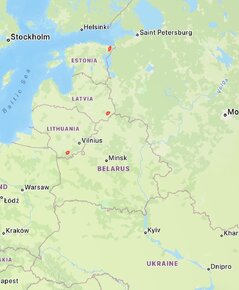
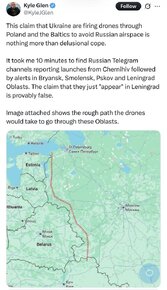
Don’t know what his point is, but it is kind of a significant coincidence that UA drones fall in all three Baltic states simultaneously (within hours). Lithuania especially weird since it doesn’t even have a border with Russia (I do not take Kaliningrad into account because the only way to get there is either over the sea or above Poland).
Are you referring to the possibility that these drones did not get jammed and drift off course or the like, but were deliberately flown over Belarus or the Baltics?
 
Last edited:

personaldesas

Active Member
And the '90s and even early '00s were not great for many Russian industrial enterprises and scientific institutions. It's not just the fall but what happened after the fall that made it so much worse.
It’s actually a topic I find pretty interesting, what exactly went wrong after the collapse, and why Russia ended up developing the way it did.

If you have any literature or book recommendations on that, I’d genuinely appreciate them. A good long-form article or blog post would also be great.

They're partially offset by migration, and Russia has the relatively unique advantage of ethnic Russian, and other culturally close populations providing some of that migration.
I also wonder how much brain drain factors into this. I’ve met a lot of very capable Russians across Europe and SEA, which makes me wonder how much talent has left the country. Is brain drain actually a significant issue for Russia?
 

Feanor

Super Moderator
Staff member
It’s actually a topic I find pretty interesting, what exactly went wrong after the collapse, and why Russia ended up developing the way it did.

If you have any literature or book recommendations on that, I’d genuinely appreciate them. A good long-form article or blog post would also be great.
I'll dig around, I should have some recommendations. There isn't a single easy source, so many things went wrong. The late USSR had it's own set of problems, none of which were really solved by the collapse, and many got worse. There were many problems inherent to open westernized economies and societies, that these countries know how to manage, but Russia didn't. So those problems not only showed up but got really bad, really fast. Take for example organized crime. In the USSR you couldn't really have large scale crime as a business because the currency wasn't convertible. Maybe you can get shipments of drugs into the USSR past the KGB border guards. But then what? You sell them for piles of Soviet rubles that no bank will accept and nobody outside the USSR will take as payment? And if you get caught with foreign currency in the USSR (not drugs, not guns, just the currency) you can go down for currency speculation. It's very hard to run a drug cartel in that environment. Especially when fairly robust Soviet state security agencies are watching, and all of society is a series of interwoven social units with political elements in all of them. The fall of the USSR was also a personal and a societal crisis for many people and a crisis of beliefs and norms in society. I'll give you another example; in my grand parent's apartment building there was a large yard with a playground, park benches and picnic tables, some flower beds, and even some apple trees (and one Apricot tree we all loved). The entire space was cared for and shared by the residents, and for all practical purposes open to all the neighborhood. It wasn't fenced off or protected in any way. The yard of the next building over had a small neighborhood theater stage, and similar facilities to our yard. All of this remained relatively well maintained and intact for decades by the residents with seemingly no major issues. But after the USSR fell, nobody touched any of it again, and it all slowly fell apart. I grew up with these things still present but slowly decaying. I looked at a google street view of the area recently and it looks like the ruins of what was there are still there with no effort to update, maintain or repair any of it. To be clear, it's not like there was some sort of property management company doing it. It was the residents. This social norm, and this cohesion disappeared in most places, often with shocking rapidity. Another thing to consider is that the elements of state security that used to be trusted and helped maintain a predictable shape of society turned into part of the problem. Capitalism took corruption as a favor and gift system and turned it into an economic arrangement. Before you'd take a bottle of cognac so the police would take it easy on you, if the crime wasn't too serious. Now you have law enforcement "farming" bribes from high traffic areas, and often entire neighborhoods pay a monthly collection to the local law enforcement, to ensure they don't try to frame their kids as drug mules, or harass the residents. And in principle, if there's a good relationship between some of the residents and some of the higher ups in the local MVD unit (GUMVD for example) this can be a fairly painless process. But it's a radical change in the relationship.

I also wonder how much brain drain factors into this. I’ve met a lot of very capable Russians across Europe and SEA, which makes me wonder how much talent has left the country. Is brain drain actually a significant issue for Russia?
Yes, brain drain is a significant issue for Russia and has been for decades. It's less so now than it was in the past. There are places in Russia these days (for example Moscow and St. Petersburg, or Nizhniy Novgorod) where life is relatively comfortable and depending on where you live often substantially cheaper, making immigration less attractive. If you have an in-demand profession, you can often live in Russia with a level of comfort and prosperity in principle comparable to western Europe. And if you don't have an in-demand profession, you often have a hard time emigrating anyways. General hostility between Russia and the west also contribute to the difficulty of leaving Russia for the west in the past ~12 years.
 

KipPotapych

Well-Known Member
Are you referring to the possibility that these drones did not get jammed and drift off course or the like, but were deliberately flown over Belarus or the Baltics?
I am saying that it is a weird coincidence to happen in all three states and especially in case of Lithuania:

IMG_4584.jpeg

Is it possible they were jammed and flew off course? Yes. Is it possible that Ukraine sent some drones that way intentionally to avoid RU air defences? Yes. They could deny the intention exactly like it had happened. If these drones were sent that way intentionally, but would have made it to their intended targets, would we hear about these air space violations? Most certainly not, we would have no idea it ever happened. Unless Russians would say that some drones flew in from Estonia (and some epic rumblings about NATO, etc), but we certainly would not believe them. What really happened here, I have no idea.
 

Feanor

Super Moderator
Staff member
I am saying that it is a weird coincidence to happen in all three states and especially in case of Lithuania:

View attachment 54572

Is it possible they were jammed and flew off course? Yes. Is it possible that Ukraine sent some drones that way intentionally to avoid RU air defences? Yes. They could deny the intention exactly like it had happened. If these drones were sent that way intentionally, but would have made it to their intended targets, would we hear about these air space violations? Most certainly not, we would have no idea it ever happened. Unless Russians would say that some drones flew in from Estonia (and some epic rumblings about NATO, etc), but we certainly would not believe them. What really happened here, I have no idea.
There's a good chance Ukraine is going through the Baltic states to hit Russian ports on the Baltic.
 

swerve

Super Moderator
The Soviet Union even without counting the other member nations of the Warsaw Pact had a population similar to or greater then all European NATO members combined.
Actually, in 1989 the USSR had fewer people than the strictly European NATO members, by about 37 million, & 92 million fewer if you include Turkey.
 

personaldesas

Active Member
I'll dig around, I should have some recommendations.
Would be much appreciated! Thank you!

There's a good chance Ukraine is going through the Baltic states to hit Russian ports on the Baltic.
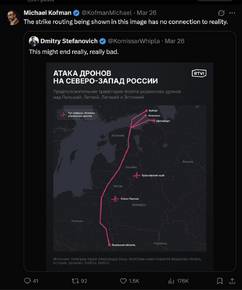
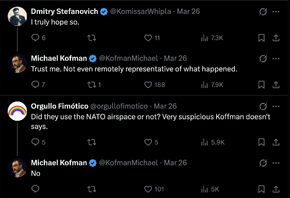
It wouldn’t completely surprise me, but what gives me pause is that analysts like Michael Kofman, who aren’t exactly known for pushing propaganda, have been quite explicit in disputing that. That obviously doesn’t disproof anything at all, but he’s generally pretty measured in what he puts his name behind.


Screenshot 2026-03-27 at 22.21.28.png
Screenshot 2026-03-27 at 22.25.16.png

 
Last edited:

personaldesas

Active Member
Slightly off topic, but I’ve been wondering how things would look in a scenario where Russia achieves something close to a decisive outcome.

A Russian-occupied or Russia-aligned Ukraine, combined with a large, battle-hardened Russian military, doesn’t strike me as a particularly stable end state. It raises the question whether containing that outcome would be significantly more costly for Europe over time than continuing to support Ukraine now.
 

personaldesas

Active Member
Rubio says Zelensky is a liar, literally:


Someone clearly is. Regardless of who it is, the relationship is going well though.

About the article cited yesterday:


View attachment 54570

With all due respect to Kofman, they talk about current deliberations about redirecting the weapons, not that the deliveries had already stopped. And I am guessing what I just posted above is not going to help the Ukrainian cause.
There are reports that impacts will be felt pretty soon.
Screenshot 2026-03-27 at 22.42.12.png
 

KipPotapych

Well-Known Member
It wouldn’t completely surprise me, but what gives me pause is that analysts like Michael Kofman, who aren’t exactly known for pushing propaganda, have been quite explicit in disputing that. That obviously doesn’t disproof anything at all, but he’s generally pretty measured in what he puts his name behind.
Another example:

IMG_4590.jpeg
 

Feanor

Super Moderator
Staff member
Would be much appreciated! Thank you!
Vadim Volkov's Violent Entrepreneurs is not a bad start.

It wouldn’t completely surprise me, but what gives me pause is that analysts like Michael Kofman, who aren’t exactly known for pushing propaganda, have been quite explicit in disputing that. That obviously doesn’t disproof anything at all, but he’s generally pretty measured in what he puts his name behind.


View attachment 54573
View attachment 54574

We won't know for sure unless something leaks out, but I think it's very plausible.
 

Feanor

Super Moderator
Staff member
So the situation on the front appears to have changed, at least temporarily. I'm going to translate a couple of posts, and then talk about their contents in light of recent map updates from suriyak and AMK.

First off, here's one from Fighterbomber;

We have 15% of Donbas left to liberate, and after that the Donbas is free.

In my opinion we have 3 main ways to do this.

First - continue the crawling offensive with inconsistent success, not counting the casualties which will be very large. Based on the current slowed tempo that's 5 years minimum. We can accelerate it a little bit by throwing into the fight everything we've got left of combat equipment and aviation, and if this is done skillfully and with good sense, then with roughly the same casulaties in personnel but also equipment we can liberate these 15%. And then transition to a static defense, accumulating resources.

The second is to transition to a defense yesterday, dig in, and transition to destroying enemy forces and other targets until such a time as they run out of them, or we run out of personnel and weapons. This variant is not time-limited and can last forever. And judging the tendency of expanded strikes on our rears, expanding quantity and radius of strikes, on an infinite timeline, our casualties could be as large or even larger than the first option.

The third variant is a combination of the first two with the use of nuclear weapons and other WMDs. Here our casualties and risks are practically impossible to predict, but we have to remember that every new day of the SMO brings closer the moment when the enemy will have WMDs. And they may use them immediately.

We have to understand that all 3 variants could end not how we want them to, regardless of the price.

In light of reports about strategic initiate, newly liberated old people villages, and a de-facto static front line, I can't imagine in what moment we will transition to an acceptance of the inevitable and move from a crawling standing with pairs to a regime of maximum preservation of our own personnel while dealing maximum damage to the enemy, to force them to negotiate. And continuing negotiations will need to be starting from the de-facto line of contact. And use not military but diplomatic means to decide the fate of the last 15%.

We have to understand that the enemy situation is worse than ours, but they have stability and resources to fight for another couple of years for sure even in their current position, and with increased support they could go for many years.
Of course for every day of war we lose more than Ukraine. In essence Ukraine is gone. Full external control, external financing, destroy industry and agriculture, a dying population, the young fleeing, liquidation of constitutional freedoms and rights, and a lack of any prospects for a normal future.
We still have all that for now. Which is why every day costs us more.

Maybe us, or the enemy, has some sort of clever plan, military genius, or wonder weapon up the sleeve which will come out and radically change the battlefield, but since for 4 years nobody has done so, there are doubts.

Of course this is what I subjectively see based on the situation today, with the information I have. What tomorrow will look like, and how it is "for real" I do not know. Maybe it will be much better, maybe only a little different.

Next here's a two-parter courtesy of CAST, though the original source is a channel called Chadaev. It starts with a discussion of a new Russian drone, but what's after is more interesting. I will translate everything, for context.

Russian scientific-industrial center "Uykushnik" (Velikiy Novgorod) introduces the newest loitering munitions "Duke Vladimir Svyatoslavovich" of an original ring layout with a range of over 50 km, that's already been battle-tested. TASS was informed of this by the head engineer of the team that developed it.
"We're talking about a fundamentally new item "Duke Vladimir Svyatoslavovich". It's already gone through combat trials, and is used in a number of units, for now in limited quantities, mostly to test new design decisions. Development hasn't stopped. Quite the opposite, the system continues developing, new functions are being added including autmated target tracking even with loss of control signal. Full transition to large scale deliveries is planned in the near future. Contracts with the MoD are expected soon." - says the lead engineer.
Earlier it was said that the newest loitering munition can work together with the wire-guided drone "Duke Vandal of Novgorod". The drone was created by the Uykushnik scientific-industrial center (Velikiy Novgorod).

Several theses about our new drone DVS.

1. The current static front line is the result that both sides have maximally concentrated in "isolating the battlefield", so the approaches to the front line. Just as we spoke about at least year's Dronnitsa, by summer 2025 the enemy realized they couldnt' compete with us on wire-guided drones - they also have them but fewer and generally worse. Because of that - Madyar said it openly - they got the idea to outrage us, increasing the kill-zone.

2. Wire-guidance as a technology has one major vulnerability. The further the drone flies, the higher the risk the wire breaks. For every additional kilometer it's several percentage chance increase. This is why the main range of the DVN* was 10-12 km, we confidently out-shot the enemy; as soon as the range became 20-30km, statics were not on our side: radio-controlled drones dont' have this problem. Also the enemy uses the capability of Starlink and their own comms, put re-translators in the sky, and is using air-borne launches to massively use cheap FPV drones at range of 50-60kms, and even further.

3. We're ready for this. We still have difficulties with comms, and more difficulties with heavy drones as carriers (as a mass solution) but we have other trump cards. We solved the problem of deploying a standard copter with 10-inch motors and a payload like a DVN to a relevant distance. Again the DVS is not a wonder weapon on a budget - it's a product not radically different in prince from regular FPV drones. They can be relatively numerous. I won't say however many we need (that's a question of production and scaling) but normal serial quantities.

4. Good - Vladimir was initially deigned as part of an ecosystem of "dukes" - Vandal and Oleg. In essence this is a continuation with new range: and while DVO was recon and target acquisition, DVS is a fully capable striker for medium ranges.
*DVV - Duke Vandal Novgorod a common Russian wire-guided drone.


Feanor

Super Moderator
Staff member
In general the posts above reference a static front line, and to some extent this is true. We're at the end of March and for two months Russian advances have dropped fairly dramatically from ~500kms per month prior to now under 100 sq km in March. However... there are two major issues with assuming the generally static front line, in my opinion. In reality we have continued though admittedly substantially more modest Russian advances in several areas. One is the border area where Russia continues to bite off pieces inconsistently in terms of geography, but consistently in terms of approximate pace (somehow, unclear how the sections are relatively far apart). Another is the Kupyansk area where after the failed, and risky, cross river push into western Kupyansk, Russian forces have finally concentrated on clearing the path to eastern Kupyansk and so far it's working, though slowly. Another area is the Slavyansk-Kramatorsk axis where Russian forces have steadily advanced west of Seversk and north-west of Artemovsk/Bakhmut. They're almost all the way along the canal and an assault on Nikolaevka seems to be imminent. Even north of Pokrovsk Russian forces are inching forward, the front line isn't really static. There are gains. The notable exception to this trend in the Donbas is the greater Konstantinovka area, but this is probably less significant. Advances both towards Slavyansk and Kramatorsk, and north of Pokrovsk, make the Konstantinovka area less and less tenable for long term defense. This suggests FB is dead wrong about his assessment for the last 15% of the Donbas.

So how then are Russian advances so modest? Well they are slower than before. But not this much slower. The Russian gains are offset by the continuing Ukrainian counter-offensive into the flank of East MDs forces in Eastern Zaporozhye. This offensive seemed to slow for a bit, but it's resumed, with Ukrainian forces continuing to push southward. Contrary to some optimistic claims, they still haven't reversed even Russian gains from the last 3 months of 2025, but the territorial change, plus slower Russian offensives elsewhere combine for this picture. So what does this mean? Well... it's hard to be sure. On the one hand Russia has slowed. Russia also slowed the exact same time last year, and there are discussions that Russia does a spring-summer offensive, while being slower in Jan-Mar/Apr. On the other hand Ukraine's push has been relatively successful so far. Rubicon was reportedly redeployed to the area to try and deal with it (though full disclosure, I've lost the link where this was discussed). It seems likely Ukraine's offensive will be halted eventually, and probably at least partially reversed (with an expenditure of considerable resources of course). Could Russia's new speed of advance now be sub-300 sq kms per month due to the changed drone conditions? It could be. Could Ukraine be enabled to launch successful local counter-offensives relying on improved drone capabilities? It's plausible. But it's unclear. Ukraine also had success counter-attacking in Kupyansk last year but it didn't do anything to change the bigger picture.

I think it remains to be seen how Ukraine's push plays out, and this will tell us a lot. I also think that Russia will likely adapt even if there are new drone condition in play, and again the resource advantage is firmly in one direction. I also think some of the pessimism stems from the rather rapid gains in '24 and especially '25, compared to which, the current situation looks almost static. I don't think this changes much about the long term trends. Ukraine is still bleeding population at an unsustainable rate, and I don't see any indication that their manpower situation has reversed itself. I'm still confident that there is a troop density that's just too low to maintain a front line, even with all the drone advances. You still need some actual forces on the ground. We don't know what it is, or when it will be reached, but if Ukraine's Armed Forces keep shrinking, they will reach it at some point. There's also still no evidence of a recruitment crisis for Russia. Though I guess it could not be apparent yet. What is clear that the last 2 months in terms of territorial dynamics have been probably the best for Ukraine since ~April of '24.


personaldesas

Active Member
The third variant is a combination of the first two with the use of nuclear weapons and other WMDs. Here our casualties and risks are practically impossible to predict, but we have to remember that every new day of the SMO brings closer the moment when the enemy will have WMDs. And they may use them immediately.
Is this really how people reason about this conflict?
 
Last edited:

rsemmes

Active Member
Slightly off topic, but I’ve been wondering how things would look in a scenario where Russia achieves something close to a decisive outcome.

A Russian-occupied or Russia-aligned Ukraine, combined with a large, battle-hardened Russian military, doesn’t strike me as a particularly stable end state. It raises the question whether containing that outcome would be significantly more costly for Europe over time than continuing to support Ukraine now.
When the premise is unachievable, it's nearly impossible to look at the scenario. Unless, of course, the whole point it's just a call to arms for EU/NATO against Russia.

It would take weeks, months probably, with all the money and weapons in the pipeline for the Ukrainian population to get to a Germany-1918 situation. Zelensky seems to be more than eager to keep Ukraine "in the fight" until Ukraine can fight no more, but I don't think all the military are that stupid. Is Ukraine actually going to run out of shells and drones? Another 200.000, or 400.000, soldiers are going to decide to go back home the same day?
Does Russia have/is going to get 10 brigades (20?) to launch a Soviet tyle offensive that is going to reach Dnipro? To surround Jarkiv?
Russia is not going to "occupy" Ukraine. Ukraine will need more tha one generation (more than two, probably) to "align" with Russia; unless you see a leader making Poland great again by invading Prussia and Ukraine and you see Russia and Ukraine figting a common enemy.
The US has a professional army (and more "posh" than the Russian army) and it hasn't been invading a new country every year (well...). Battle-hardened contract soldiers who go back home? War doesn't pay for war... (Well, again... the US and oil). Russia has to rebuild its arsenals, rebuild whatever chunk of Ukraine it's getting and, as you know, Russian economy has taken a hit... And Putin is going to get himself into another war? (And (stable) Trump is going for Greenland now that he got some practice?)

I also find interesting your: "This conflict" below... "Reason" like... Hegseth reason... or like "King & Country" reason?
 
Top