The Russian-Ukrainian War Thread

rsemmes

Active Member
Russia got a good chunk of Siversk.

Or Ukraine starts with those local counterattacks, in one more place, or Siversk is gone, soon.
(Soonish, in this war.)
I know...
I wanted a third confirmation but, if Ukraine doesn't start with those Kupiansk/Pokrovsk-style local counterattacks now, it is gone. In 20 days.
And Russia is already on that side of the river to the south, across the Suka.

("The report of my death was an exaggeration". M. Twain)
 
Last edited:

rsemmes

Active Member
Seversk is not gone by either map. Russia has most of it but Ukraine retains the western suburbs, across the river. Suriyak and Kalibrated show a similar picture, with Suriyak showing a small grey zone east of the river (i.e. Russian sweeping operations are still in progress). It's likely Ukraine can't hold Seversk or the hills west of it with the Russian advances around Platonovka-Zakotnoe and Svyato-Pokrovskoe which is in my opinion the real thing to watch. Seversk sits in a lowland. It's not controllable if the enemy holds the heights around it. You can actually see in satellite imagery the Ukrainian strong points immediately west of it, and south-west of it. They're holding the slopes and heights west of the Bakhmutka river valley. This chain of strong posts bends west-ward just north of Fedorovka, which sits in another river lowland. Currently the only route Ukraine has to the strong points west and south-west of Severks is through open fields and a few tree lines within easy drone range, and in some spots in practically direct observation of Russian troops. So they're likely done for in those spots.

EDIT; I spoke too soon, Suriyak is literally updating his map right now. Perhaps Ukraine has withdrawn from all of Seversk after all.
Yes, I've seen a 10' ago update. Russia is across the river, in the city.
 

Feanor

Super Moderator
Staff member
I know...
I wanted a third confirmation but, if Ukraine doesn't start with those Kupiansk/Pokrovsk-style local counterattacks now, it is gone.
And Russia is already on that side of the river to the south, across the Suka.

("The report of my death was an exaggeration". M. Twain)
I don't know that Ukraine has the resources to counter-attack. They have to send forces to conslidate the Gaychur river line in Zaporozhye. They have to keep feeding troops into the Kupyansk meat-grinder, they have to reinforce the Volchansk area, they have to try and hold Konstantinovka and Krasniy Liman. I don't think they have resources to also counter-attack on the flanks of Seversk.

Also nevermind the Sukha, Russia is across Bakhmutovka in the north by Dronovka, and around Platonovka. These rivers are small, and it's winter. They're not particularly large obstacles, certainly very fordable.

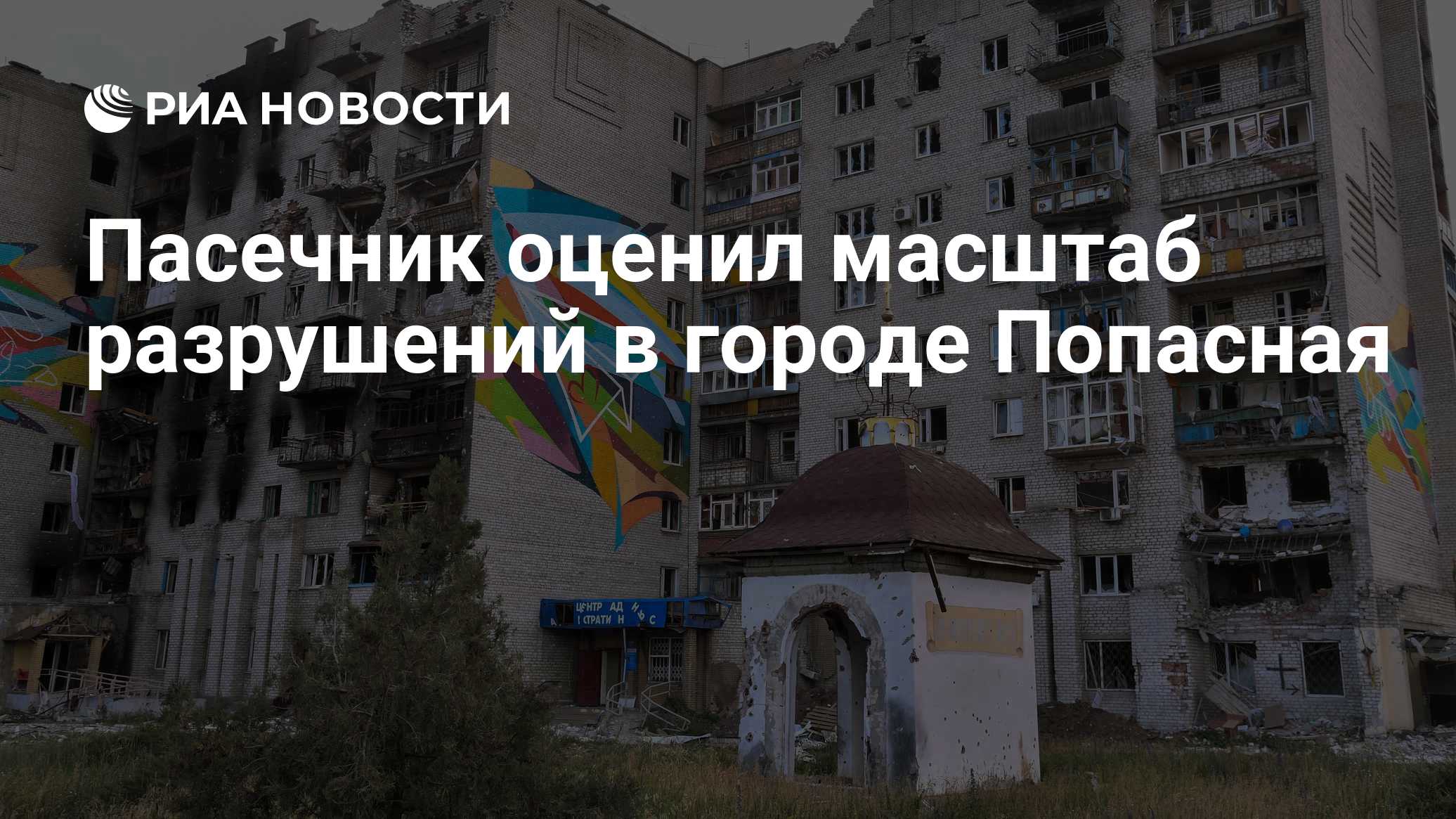
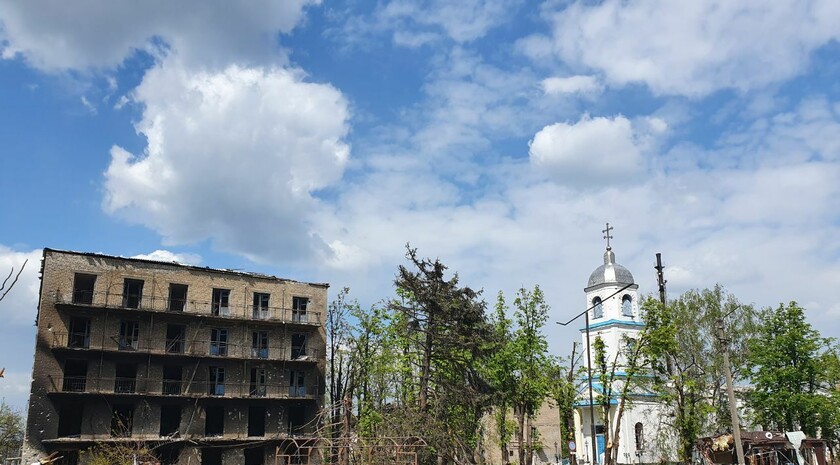
EDIT: Another interesting piece of digging. Popasnaya, the town that was the site of very heavy fighting in 2022 and saw the first large scale use of Wagner fighters, will apparently see at least partial reconstruction after all. It was initially stated by regional authorities that rebuilding the town didn't necessarily make sense. However now plans for limited reconstruction have been announced, tied to the waterworks and rail infrastructure, with housing for the employees to be rebuilt. ~250 people (out of a pre-war ~16 000) still live in the ruins, with apparently no power or water. As of August DNR leadership estimated the town as ~95% destroyed, and the footage, granted from February of this year, confirms as much. Unlike the earlier footage we saw in Pervomaysk, there have been no substantial reconstruction efforts. Note currently the town is still within drone range, being ~20-30 kms from the front line. In fact the current movements around Seversk actually have a lot to do with pushing the front line back from places like Pervomaysk and Popasnaya (and of course Severdonetsk-Lisichansk). Because of the nearness to the front, the city is consiered a closed city and is not accessible to anyone without government-approved reasons for being there, or residents.

It's not clear if the rail infrastructure in the town is already functioning, and if it whether the workers are bused in from Pervomayskoe (~30 minutes away) or live in the ruins locally. I suspect the former, with the reconstruction plans being mainly for their benefit. The westward rail line out of Popasnaya runs to Soledar, before veering southward into Artemovsk/Bakhmut and is not currently active, but likely will become active once the front line shifts to the Kramatorsk and Slavyansk area, putting Artemovsk/Bakhmut further behind Russian lines. However it's possible the lines east, north, and south-west are functioning at least for military logistics. South-west the line runs into Gorlovka, a functioning city in DNR hands since 2014. The eastward line heads into Pervomayskoe/Sokologorsk and then veers south towards Debal'tsevo where it eventually splits. The northern line heads straight into Lisichansk and is likely also not in use due to nearness to the front line.

The last three links are short interviews with locals. They mostly live off of Russian humanitarian aid, delivered twice a month in the form of basic food supplies per person, and medication on a case by case basis. Water comes from wells in the private sector, there are also some water deliveries, but they also take water from a local stream. No reconstruction certificates or compensation payments for destroyed property are being made here at this time, though requests are being accepted. Heating is handled by wood-fire and coal stoves but coal supplies are scarce.

 
Last edited:
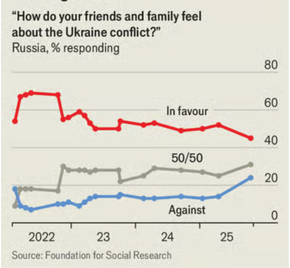
Screenshot 2025-12-11 at 13.41.23.png

Source: https://www.economist.com/europe/2025/12/10/russia-is-not-as-resilient-as-it-wants-you-to-think

It’s not a perfect measure of public sentiment, but it’s still striking how little pro-war support has declined. I’m genuinely curious about the narrative among people in Russia who are willing to pay the costs of waging it.

What do ordinary people feel they’re gaining, or preventing, by backing this war? If anyone has genuine, non-cynical, nonjudgmental, first-hand insight into what the common narratives are, I’d be very interested to hear it.
 

rsemmes

Active Member
View attachment 54021

Source: https://www.economist.com/europe/2025/12/10/russia-is-not-as-resilient-as-it-wants-you-to-think

It’s not a perfect measure of public sentiment, but it’s still striking how little pro-war support has declined. I’m genuinely curious about the narrative among people in Russia who are willing to pay the costs of waging it.

What do ordinary people feel they’re gaining, or preventing, by backing this war? If anyone has genuine, non-cynical, nonjudgmental, first-hand insight into what the common narratives are, I’d be very interested to hear it.
Only Russian people?

Pride and fatalism. Ordinary people don't get into wars, their governments do and it takes many years for ordinary people to stop a war. Ever?
Ordinary people thought that they were going to get cheaper oil by invading Iraq?
Argentinians, under a dictatorship, fought for King and Country. Ordinary people in the UK were fighting to regain the Empire?
In a civil war, what do conscripts expect to gain? Do you think a Russian brain is different to any other human brain?
That (feel) is a question for a psychologist, you're going to get millions of single answers. I think you will find the "common narratives" in History.
 

Musashi_kenshin

Well-Known Member
It’s not a perfect measure of public sentiment, but it’s still striking how little pro-war support has declined. I’m genuinely curious about the narrative among people in Russia who are willing to pay the costs of waging it.
1. The narrative in Russia has been strictly controlled, so people may not fully understand what has been happening and what the sacrifices have been.
2. How far are ordinary Russians suffering? I'm sure they'd be better off without sanctions, but Putin has avoided societal collapse.
3. Russia is still advancing, even if slowly. Stalemate is much easier to deal with than defeat. See how the Iran-Iraq War dragged on for nearly eight years.
 

Feanor

Super Moderator
Staff member
View attachment 54021

Source: https://www.economist.com/europe/2025/12/10/russia-is-not-as-resilient-as-it-wants-you-to-think

It’s not a perfect measure of public sentiment, but it’s still striking how little pro-war support has declined. I’m genuinely curious about the narrative among people in Russia who are willing to pay the costs of waging it.

What do ordinary people feel they’re gaining, or preventing, by backing this war? If anyone has genuine, non-cynical, nonjudgmental, first-hand insight into what the common narratives are, I’d be very interested to hear it.
The impact of the war has been inconsistent and uneven. Some people are better off as a result of the war due to high salaries in the defense industries or even in the military itself. Others are impacted but only somewhat. Much of society can pretend there is no war, or treat the war as something you watch on TV if you want to. Add to that the propaganda and information control, and it makes for a well managed public opinion. This isn't in principle new. Putin and Co. learned this lesson well during the Second Chechen War, and have done a pretty good job managing PR and minimizing the negative impact of some of their decision since then.

I know...
I wanted a third confirmation but, if Ukraine doesn't start with those Kupiansk/Pokrovsk-style local counterattacks now, it is gone. In 20 days.
And Russia is already on that side of the river to the south, across the Suka.

("The report of my death was an exaggeration". M. Twain)
Ok, now Seversk has fallen, and Mirnograd is not far behind.

1. The narrative in Russia has been strictly controlled, so people may not fully understand what has been happening and what the sacrifices have been.
2. How far are ordinary Russians suffering? I'm sure they'd be better off without sanctions, but Putin has avoided societal collapse.
3. Russia is still advancing, even if slowly. Stalemate is much easier to deal with than defeat. See how the Iran-Iraq War dragged on for nearly eight years.
Slowly but faster over time. Russian territorial gains in 2024 were much larger than 2023, and 2025 will have even bigger gains, though the delta is not as dramatic. It's much easier to sell a victory narrative when you're capturing towns, than when you're capturing villages. Being able to talk about taking Pokrovsk, Seversk, Chasov Yar, it all helps. If the trend was in the other direction, it would likely make it harder to sell the war as a tough but ultimately victorious one.
 
1. The narrative in Russia has been strictly controlled, so people may not fully understand what has been happening and what the sacrifices have been.
2. How far are ordinary Russians suffering? I'm sure they'd be better off without sanctions, but Putin has avoided societal collapse.
3. Russia is still advancing, even if slowly. Stalemate is much easier to deal with than defeat. See how the Iran-Iraq War dragged on for nearly eight years.
The impact of the war has been inconsistent and uneven. Some people are better off as a result of the war due to high salaries in the defense industries or even in the military itself. Others are impacted but only somewhat. Much of society can pretend there is no war, or treat the war as something you watch on TV if you want to. Add to that the propaganda and information control, and it makes for a well managed public opinion. This isn't in principle new. Putin and Co. learned this lesson well during the Second Chechen War, and have done a pretty good job managing PR and minimizing the negative impact of some of their decision since then.
I get those points, but they mostly explain why people might stay neutral or tune things out. What I’m trying to understand is why so many seem actively supportive. Indifference makes sense under information control and low personal impact, but active approval suggests people feel there’s something to be gained or protected.
 

Feanor

Super Moderator
Staff member
I get those points, but they mostly explain why people might stay neutral or tune things out. What I’m trying to understand is why so many seem actively supportive. Indifference makes sense under information control and low personal impact, but active approval suggests people feel there’s something to be gained or protected.
Well banning Victory Day celebrations and renaming streets after Nazi collaborators tends to paint the Ukrainian government in a certain light, especially within Russia. Russia in general is a fairly conservative society where support for the military tends to be high. And when you can claim victories and new territories, that tends to be regarded as a positive. The annexation of Crimea for example led to a major boost in ratings for Putin. And the reality of the current war is far removed from most people in Russia, just like it is from most people in the west. It's part of why I try to post about what's going on in the areas Russia has annexed, because it actually has quite the impact on the situation but it's not always well observed. So when Russia rolls over Mariupol', a decent sized city, defeats the evil Azov Nazis, and then rebuilds Mariupol' like a postcard (at least the parts shown on TV), it's easy to sell a narrative about how this is a Russian success, and Russia is doing great. And people start to assume that the picture in Severodonetsk-Lisichansk, Donetsk city, Lugansk, Pokrovsk, etc. looks similar, even when it very much doesn't and Pokrovsk looks more like the ruins of Avdeevka then it does like the rebuilt Mariupol', and will continue to look that way for years. Artemovsk/Bakhmut is a dead city ~2.5 years later. But that part isn't discussed or showcased on Russian television. And Ukraine doing things like going into Kursk region, or indiscriminately shelling Belgorod tends to get people to buy the story of evil Ukrainian fascists. In the video I posted above from Popasnaya, one of the civilians mentions that his son, a civilian, was killed by a Ukrainian drone strike. Except he doesn't say Ukrainian, he says Ukrofascists. And he's a Ukrainian citizen. As a Russian, if you hear about Ukrainian drones attacking ambulances in Aleshki, or buses in Belgorod, or residential buildings in Gorlovka, and you hear the Russian government telling you that this war is about defeating the fascists, it sounds about right.
 

crest

Member
I get those points, but they mostly explain why people might stay neutral or tune things out. What I’m trying to understand is why so many seem actively supportive. Indifference makes sense under information control and low personal impact, but active approval suggests people feel there’s something to be gained or protected.
In addition to the points already made I think a part of it is plain old National pride. After the fall of the Soviets and Russian decline on the world stage it's not unreasonable for Russians to want something they can proudly point to as a sign of national strength.
Kinda like the Germans under Hitler I think this is a attitude well understood the Russian government and the naritive is tailored to supporting a already existing sediment rather then creating and sustaining it artificially.
 

rsemmes

Active Member
Two improvised bombs exploded in Kyiv on Thursday killing a serviceman and wounding four others, including two police officers, in a “terrorist” attack, prosecutors said. “The first explosion occurred while two national guard servicemen were patrolling the area, as a result one of them died,” the Kyiv city prosecutor’s office said, adding that the second bomb was detonated when police and medics were responding to the first.
Like "The General & The Scooter" in Moscow. Is that prosecutor saying that Ukraine is a terrorist state?

Germany summons Russian ambassador over campaign to destabilise country, foreign ministry says
We are getting a breaking news line from Germany.
Germany’s foreign ministry spokesperson has warned that the authorities are “observing a significant increase in Russian hybrid activities,” claiming that a Russian campaign “seeks to destabilise Germany.”
Like attacking Germany's energy supply? Providing funds to the extreme right would count as "destabilising"?

NATO’s Rutte says Europe must prepare for ‘scale of war our grandparents’ endured
and thetimes, BBC, theindependent...
War! The message is clear, even if cannot understand why we are getting the message. When is Russia going to invade (Venezuela?) Poland? The "why" would be useful too.

"But this is not about party politics. It's about whether UK defence has been under-funded for so long that it has now reached the point where the country is dangerously vulnerable in several areas, notably air defence.
Its (British Army) actual deployable strength is only 54,000."

Maybe, that's the answer.

Edit.
Every pound invested in Ukraine today benefits Britain and potentially saves substantially larger expenditures later. These economic and military dividends justify Britain’s commitments not as altruism but as advancement of core national interests.
 

Feanor

Super Moderator
Staff member
Things are heating up in Kupyansk. On the right shore Russia is steadily losing their positions inside Kupyansk and around it. On the left shore Russian forces are gaining ground around Petropavlovka and Kucherovka, pushing southward east of Kupyansk, and eastward out of Kupyansk itself. It may play out that as Ukraine pushes Russia out of western Kupyansk, Russia will consolidate clear routes into eastern Kupyansk, dividing the town along the river. The entire situation is the direct consequence of how Russia's command chose to attack the town. There's still only minimal movement in the Dvurechenskoe area.
 
Last edited:

KipPotapych

Well-Known Member
^ Two right shores, which one is which? :)

I also wonder if Kupyansk was also deprioritized due to the potential “land swaps” over the Zaporozhie direction, where the Russians look to keeping the territories they occupy. This is the about only direction where Ukraine is having a success and I wonder if it is by design: “grind yourself over something you will potentially get back anyway if the negotiations result in something positive, while we grab more of what we will keep” would be a reasonable Russian strategy, no? The attacks, of course, will resume from better positioning once that logic becomes irrelevant - that is, negotiation fail.
 

Feanor

Super Moderator
Staff member
^ Two right shores, which one is which? :)
Fixed, sorry. But it should be obvious which is which based on the locales in question.

I also wonder if Kupyansk was also deprioritized due to the potential “land swaps” over the Zaporozhie direction, where the Russians look to keeping the territories they occupy. This is the about only direction where Ukraine is having a success and I wonder if it is by design: “grind yourself over something you will potentially get back anyway if the negotiations result in something positive, while we grab more of what we will keep” would be a reasonable Russian strategy, no? The attacks, of course, will resume from better positioning once that logic becomes irrelevant - that is, negotiation fail.
I don't think so. Quite the opposite Russian domestic sources proudly declared Kupyansk liberated. This doesn't look like it was done by design. It was either a poor choice by the command in that area, or it was the result of wanting the attack on Kupyansk to coincide with Russian pushes in several other towns to stretch Ukraine thin. If the latter, this was an unfortunate sacrifice to ensure things like the rapid fall of Pokrovsk, and the capture of Seversk. If the former, it was a foolish decision driven by the desire to report gains that look impressive. The entire mess looks particularly bad given that there's no reason it couldn't have been done better, other than a desire to rush the taking of a town.
 
Top