The Russian-Ukrainian War Thread

Feanor

Super Moderator
Staff member

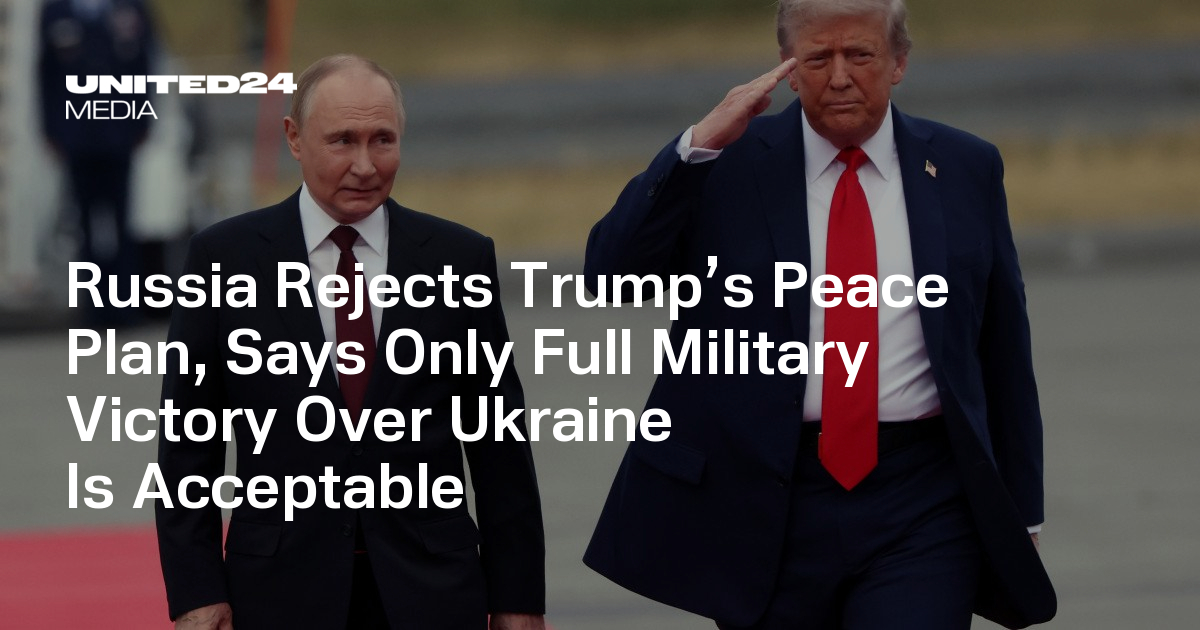
Maybe Trump is slowly aware that Russia is not interested in any kind of cease fire or even peace.
I think it's rhetoric. A Ukrainian legislator recently said that the war will end when Ukraine regains Crimea, so a Russian legislator mirrors the hardline statement. But we have Putin saying that the current peace plan can be the basis for a deal. I think it's clear this is a deal that at least in principle is acceptable to Russia, with details to be discussed.
 

rsemmes

Active Member

Maybe Trump is slowly aware that Russia is not interested in any kind of cease fire or even peace.
Well...


crest

Member
Honestly I think the effect third parties can have on Ukraine is significant but the effects on Russia are not. Not unless there willing to commit troops, Russia can after all just force Ukraine to accept if things keep going the way they are going regardless of any third parties opinion. Sanctions relief well desirable are not strictly speaking nssesary. After all economically speaking Russia is treading water right now if they force Ukraine to surrender they may still face sanctions from a angry west but they won't have wartime costs. Sanctions will eventually be reduced as Russia exports well energy food and minerals. Demand and a discount will in peace time reduce sanctions naturally

In that regard the question isn't what peace deal third parties find acceptable, it's what can be offered to entice Russia to dial back it's maximum goals.
 

rsemmes

Active Member
Europe seems to be unhappy, I wonder if with Peace or with the "essence".

Ukraine says that it supports the “essence” of a peace agreement after intense negotiations between US and Ukrainian officials in Geneva.

Ukraine agreed to the US proposal with only “minor details” outstanding, according to a US official, but Ukrainian President Volodymyr Zelensky said more work needs to be done.

With a bit of lack, there is a plan, that has to be negotiated.
Now Russia is talking about the essence of the Alaska summit. To be honest, I cannot remember... That those at the receiving end will have to make concessions? Is Russia jockeying for an even better position?
At least, Zelenski doesn't seem to be completely delusional (expecting better terms than in Istanbul.) Unless, of course, he is hoping that Russia will refuse to negotiate. (So he will find himself in a better position?)
 

Feanor

Super Moderator
Staff member
Meanwhile Russian forces have entered Gulyaypole from the east. It appears they intend to assault through from the north-east, instead of enveloping the town. While the outskirts are basically rural, the center of town does have a small dense urban core which should be quite defensible. Then again if Ukraine has manpower shortages, it could be easier for Russia to penetrate built up areas with infantry teams infiltrating.
It appears Russia has begun injecting infantry teams across the Gaychur river. Technically this means they've penetrated Ukraine's last major defense line in this area. So far they haven't consolidated there, but given the overall tendencies, it seems unlikely Ukraine will be able to hold on to the line.
 

crest

Member
It appears Russia has begun injecting infantry teams across the Gaychur river. Technically this means they've penetrated Ukraine's last major defense line in this area. So far they haven't consolidated there, but given the overall tendencies, it seems unlikely Ukraine will be able to hold on to the line.
Yeah this is a real problem, without large urban areas or prepared defences drone crews are very vulnerable, not to mention the quality of troops it takes to defend in said areas. I think if Ukraine continues to really on territory defence brigades in the area there are taking a rather large risk.
 

Feanor

Super Moderator
Staff member
Yeah this is a real problem, without large urban areas or prepared defences drone crews are very vulnerable, not to mention the quality of troops it takes to defend in said areas. I think if Ukraine continues to really on territory defence brigades in the area there are taking a rather large risk.
One of the problems Ukraine faces is that urban areas may actually be more difficult to hold against Russian infiltrators. Meaning it might actually be easier for Russia to push through a place like Pokrovsk, then a place like the Serebryanskaya forest.
 

crest

Member
One of the problems Ukraine faces is that urban areas may actually be more difficult to hold against Russian infiltrators. Meaning it might actually be easier for Russia to push through a place like Pokrovsk, then a place like the Serebryanskaya forest.
I think alot of that depends on troop numbers and the preparation, we have seen with adequate preparation and manpower many areas hold for significantly longer then one would expect. tho yes condensing troops does have significant disadvantages, for drone crews tho I think it's a bit different the do need basements and towers to be effective.thry also need power generation. All things much more difficult in open or hastily prepared locations. Well drone range is significant these days I tend to be of the opinion if there having a hard time getting a defensive line to hold now, it's going to be much worse if if the Russians are able to get a significant bridgehead and start expanding.
 

KipPotapych

Well-Known Member
A very reasonable assessment of the Kremlin’s current position from Stanovaya (in her tweet):

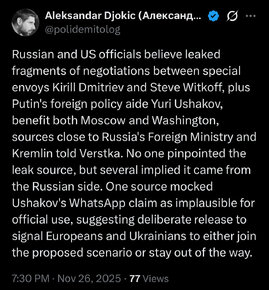
Some brief thoughts on the recent Witkoff–Ushakov–Dmitriev leaks and the broader state of the peace talks.

1. Moscow faces a serious structural problem: whom should it actually talk to on the American side?
- Steve Witkoff is convenient and receptive to Russian ideas, but he is bureaucratically isolated and politically fragile. He takes well-known Russian positions, repackages them, and watches them die almost immediately.
- Trump himself refuses to dive into details.
- Marco Rubio is unenthusiastic about Russian input and struggles to find common ground with Lavrov.

Passing proposals through Witkoff may feel tactically easy, but it lacks any real administrative weight. The latest leaks only exacerbate this weakness.

As for Dan Driscoll, he arrived in Abu Dhabi rather naïvely hoping to meet Russian counterparts (Moscow had ignored his earlier feelers for talks with, say, Belousov). He left empty-handed because he simply wasn’t talking to the right people: the Kremlin still doesn’t know in what capacity he is acting or what mandate he actually carries.

2. There is no question that the 28-point plan reflects a large share of Russian priorities. Yet problems remain:
- Some clauses directly contradict core Russian demands (e.g., the permitted size of the Ukrainian army, the absence of a total ban on long-range weapons).
- The wording leaves considerable latitude for interpretation and risks being substantially diluted once implementation begins.

3. Moscow genuinely doesn’t know what document we are even talking about. 28 points? 19 points? The 19-point paper itself is not finalised because Zelenskyy still needs to raise several acute issues directly with Trump. The Kremlin wants an official, written text with clear status that it can work from. For now, it is simply waiting.

I see nothing at the moment that would force Putin to recalculate his goals or abandon his core demands. Those demands have remained essentially unchanged for over two years (with some adjustments, of course). He feels more confident than ever about the battlefield situation and is convinced that he can wait until Kyiv finally accepts that it cannot win and must negotiate on Russia’s well-known terms. If the Americans can help move things in that direction—fine. If not, he knows how to proceed anyway. That is the current Kremlin logic.


A follow-up question:

Fascinating post. How do you think Trump sending Jared Kushner with Witkoff will work?

And the answer:

I think the issue isn’t really who goes to Moscow—Witkoff and Kushner would simply be there to hear whatever Putin and Ushakov decide to put on the table. The real question is what happens next. Putin isn’t going to offer any major concessions; he’ll stick to his version of the “root causes” and the demands that come with them. So the focus needs to be on what Ukraine is actually prepared to accept, and how Trump might respond to Putin holding his ground. Either the war continues—largely depending on the level of Western military support, which, as we’ve seen, is far from guaranteed—or Ukraine will be forced to give up quite a lot.


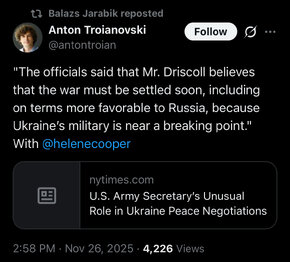
I will add from myself. I see some people wondering why Rubio is not taking over the lead in negotiations with Russia. I believe the answer is that this is for the same reason Kellogg was put to the sidelines: probability of Russia coming to terms with either is virtually zero. In other words, Russia will simply not deal with either of the men as they have nothing to offer to them. I believe Trump realizes this. Hence, it is Witkoff, and now Driscoll, who has not yet earned his place in the talks, as outlined by Tatiana above.

The problem with this is that there are two negotiating teams representing two “plans” that are not acceptable to the opposing sides. Hence, there is and will be no progress. Europeans are now, reportedly, spending (read wasting) their time “hammering out security guarantees and boots on the ground” that Russia will never accept. Rubio and co, including the Ukrainian side, announcing epic progress and great results is also a waste of time because they, from what was reported, reduced the “base for negotiations plan” to something that is a nonstarter for the Russians. That’s just the reality. This is all really weird stuff to me.

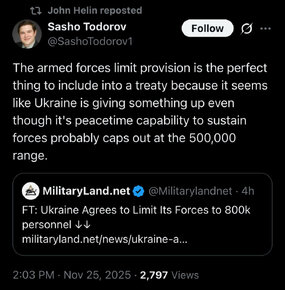
The Euros are constantly saying that Russia is not actually negotiating and not giving anything up. What are they giving up? Are they negotiating? The conundrum is that Russia is willing to continue the war they are “winning” at this time, there is no long-declared stalemate, so they are looking to gain something in return for peace, namely their demands, or something close enough. Nothing less will suffice, this is clear as day. Everyone questioning this should ask themselves, why would less suffice? Just from this alone, it is pretty clear that Ukrainian and European positions are ridiculous. Then, there is this idiotic stuff like “we will pretend that we are giving something up by limiting our forces to something we cannot sustain even today”.

IMG_3007.jpeg

Anyway, the reality is that while Russia has the upper hand that only keeps getting “upper-er” (and someone here has talked about it for a long time now), they will not deviate from their demands much if at all. The question remains whether Trump admin will continue to sell weapons and share intel when this round of talks fails.

To sum up the above, Russia is willing to negotiate peace on mostly their terms; Europe and Ukraine are willing to negotiate Trump for his continuing support. This is what has been happening.

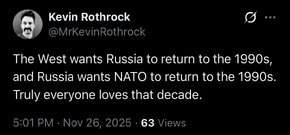
Also interesting:

IMG_3014.jpeg

I wonder, is he saying it just because or is this an actual US intel assessment?

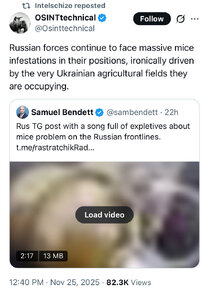
Humour:

IMG_3015.jpeg

IMG_3009.jpeg

Perhaps, the Russians keep fighting just to get to those mice-free Ukrainian-held positions.
 
Last edited:

crest

Member
Not normally a channel I watch but in that s case it's a good view. Putin's response is imop firm and well thought out.


rsemmes

Active Member
Russian officials have claimed they have battlefield momentum in Ukraine, even though their slow progress has been costly in terms of casualties and armour.
(No losses for Ukraine.)
The Institute for the Study of War on Wednesday cast doubt on Russian claims that its invasion is unstoppable as it is still struggling to capture cities in the eastern Donetsk region.
“Data on Russian forces’ rate of advance indicates that a Russian military victory in Ukraine is not inevitable, and a rapid Russian seizure of the rest of Donetsk Oblast (region) is not imminent,” the Washington-based think tank said. “Recent Russian advances elsewhere on the front line have largely been opportunistic and exploited seasonal weather conditions.”
(The dog ate Ukrainian homework.)
Ukraine’s army isn’t only under pressure on the battlefield. Ukraine President Volodymyr Zelenskyy’s government is mired in a major corruption scandal and is short of money.
In a development offering some relief, Ukraine reached an agreement for the International Monetary Fund to provide $8.1 billion over four years.
Ukraine’s state budget and military needs for 2026 and 2027 are estimated at $153 billion.
(Ukraine is running out of paper for its homework.)

From (FT) the horse's mouth...
Russian president insists there is no draft treaty but says 28-point outline could form basis for further talks
In his first public response to a new 28-point text aiming to end the war, Putin said it was too early to describe the document as a treaty.

It seems that Zelenski will have to talk to Putin. Is Boris still around?
 

KipPotapych

Well-Known Member
Some interesting developments reported. True or not, we shall see.

IMG_3026.jpeg

IMG_3025.jpeg

Can’t wait for the whining when Russia hits ships carrying Ukrainian exports. It is Ukraine, after all, that is asking for guaranteed safe navigation through the region, Dnipro including.

IMG_3027.jpeg

Also of interest:

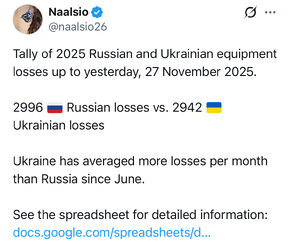
IMG_3024.jpeg

Note that civilian vehicles are not included in the count.
 
Last edited:

KipPotapych

Well-Known Member
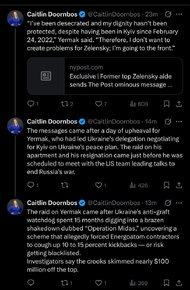
Also, the corruption in the UA ranks is being shifted to the Russian angle, however ludicrous it is this time:

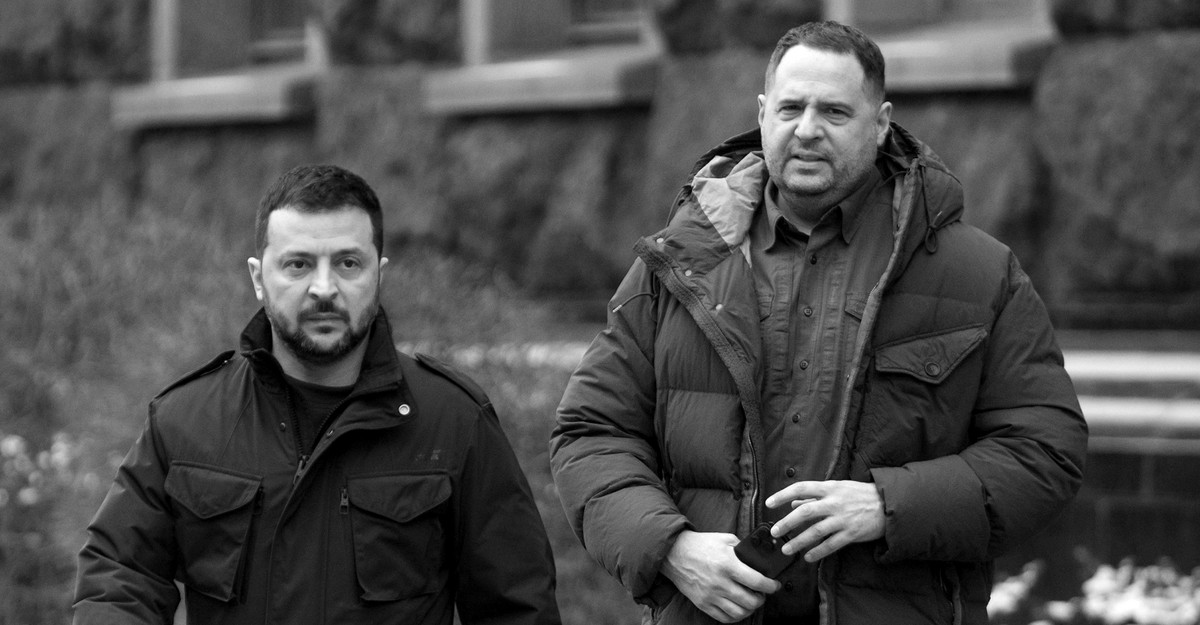
Many believe that Andriy Yermak, head of the Zelensky's Office, is a long-term FSB asset. These suspicions have circulated for years and are backed by a string of his actions: his direct role in sabotaging the 2020 operation to capture Wagner mercenaries, his assurances to President Zelensky that Russia would never invade (even as he served as the main negotiator with Moscow), and the fact that the bloodiest war in Europe since WWII began shortly after his “there will be no invasion” predictions. Virtually everyone implicated in major corruption scandals that have crippled Ukraine’s war effort turns out to be either a close friend or a protégé of Yermak. Even in the anti-corruption agencies that are supposedly investigating him, people executing his wishes have been uncovered. NABU has always worked in coordination with international partners, especially the United States, which helped establish and continues to fund the agency. During the period of close political alignment between the Biden administration and Zelenskyy’s team, entrenched corruption in Ukraine was effectively treated as “business as usual.” As a result, the supposedly “independent” NABU and SAPO often ended up acting as enforcers of the will of Zelenskyy and Yermak, targeting those they were instructed to pursue rather than fighting real corruption within the top leadership. Now, with Donald Trump in office, it has become increasingly clear that numerous corruption networks are finally being brought to light. For that, my applause goes to President Trump. Yermak stays an extremely powerful and dangerous figure whose personal ambitions have already destroyed many careers and lives.

From this tweet by a prominent Ukrainian:


crest

Member
Also, the corruption in the UA ranks is being shifted to the Russian angle, however ludicrous it is this time:

Many believe that Andriy Yermak, head of the Zelensky's Office, is a long-term FSB asset. These suspicions have circulated for years and are backed by a string of his actions: his direct role in sabotaging the 2020 operation to capture Wagner mercenaries, his assurances to President Zelensky that Russia would never invade (even as he served as the main negotiator with Moscow), and the fact that the bloodiest war in Europe since WWII began shortly after his “there will be no invasion” predictions. Virtually everyone implicated in major corruption scandals that have crippled Ukraine’s war effort turns out to be either a close friend or a protégé of Yermak. Even in the anti-corruption agencies that are supposedly investigating him, people executing his wishes have been uncovered. NABU has always worked in coordination with international partners, especially the United States, which helped establish and continues to fund the agency. During the period of close political alignment between the Biden administration and Zelenskyy’s team, entrenched corruption in Ukraine was effectively treated as “business as usual.” As a result, the supposedly “independent” NABU and SAPO often ended up acting as enforcers of the will of Zelenskyy and Yermak, targeting those they were instructed to pursue rather than fighting real corruption within the top leadership. Now, with Donald Trump in office, it has become increasingly clear that numerous corruption networks are finally being brought to light. For that, my applause goes to President Trump. Yermak stays an extremely powerful and dangerous figure whose personal ambitions have already destroyed many careers and lives.

From this tweet by a prominent Ukrainian:

So suspected of treason for many years and still allowed a critical roll? Someone didn't think out there theory before publishing it
 

KipPotapych

Well-Known Member
So suspected of treason for many years and still allowed a critical roll? Someone didn't think out there theory before publishing it
Not a necessary requirement nowadays, it appears. People tend to eat up whatever they are offered. Also, “is it a lie if you yourself believe it?” comes to mind. I actually do not know anymore what is simple propaganda vs people deluding themselves into this alternative reality and actually believing the rubbish they talk about. Go figure.


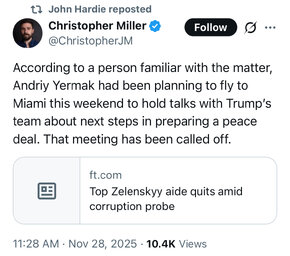
While I believe in coincidences (arguably more so than otherwise occurrences), this is an interesting one. Yermak is gone and I posted above that he is no longer heading to meet the Americans for further discussions. He also stated the following in an interview to the Atlantic, revealed yesterday:

Volodymyr Zelensky, in the next phase of talks to end the war in Ukraine, intends to draw a red line at the most contentious issue on the table: the Russian demand for Ukraine’s sovereign territory. As long as he remains the nation’s president, Zelensky will not agree to give up land in exchange for peace, Ukraine’s chief negotiator, Andriy Yermak, told me today in an exclusive interview.

“Not a single sane person today would sign a document to give up territory,” said Yermak, who has served as Zelensky’s chief of staff, lead negotiator, and closest aide throughout the full-scale war with Russia.

“As long as Zelensky is president, no one should count on us giving up territory. He will not sign away territory,” he told me by telephone from Kyiv. “The constitution prohibits this. Nobody can do that unless they want to go against the Ukrainian constitution and the Ukrainian people.”

On the question of land, Ukraine is prepared to discuss only where the line should be drawn to demarcate what the warring sides control. “All we can realistically talk about right now is really to define the line of contact,” Yermak said. “And that’s what we need to do.”


And

In our interview, Yermak responded at length for the first time to the investigation and the resulting calls for him to step aside. “The pressure is enormous,” he told me. “The case is fairly loud, and there needs to be an objective and independent investigation without political influence.”

By appointing him to lead Ukraine’s negotiating team despite the scandal, Zelensky made clear to the people of Ukraine that Yermak continues to enjoy his trust, he said. The people of Ukraine “see that I have been beside the president all these years during all the most difficult, tragic, and dangerous moments,” Yermak said. “He trusted me with these negotiations that will decide the fate of our country. And if people support the president, that should answer all their questions.”


So he is now gone (maybe) and everyone should probably be surprised he lasted so long despite the tremendous pressure on Zelensky to let the guy go. What is clear is that there is no one in his surroundings that Zelensky trusts more (or even comes close?) than Yermak. Unless my memory is failing me, there were reports from as long as a couple of years ago now that Biden administration suggested to Zelensky that this dude needed to be gone and articles titled “Black cardinal of Ukraine” or something like that, etc.

What we also know now:
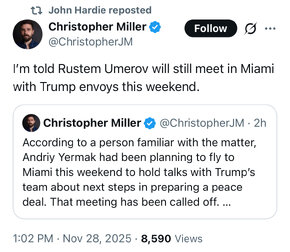
IMG_3028.jpeg

I think it was Miller who also reported that Budanov is meeting the US crew as well, but not really relevant, perhaps. But the coincidental events I mentioned at the beginning of the post… I cited a NYP article a few days ago, in post #13,207, where the following was reported regarding the 28-point plan:

“The plan was drawn up immediately following discussions with one of the most senior members of Zelensky’s administration, Umerov,” one of the officials said. “So Umerov agreed to the majority of this plan, and he made several modifications to it, which we included and presented it to President Zelensky.”

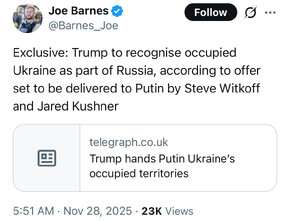
Along with the Telegraph report cited above about Trump’s intent to recognize (still unclear in what way) parts of Ukraine as Russian territory (if at all true, of course; though the WSJ seems to reporting the same ideas now), these things stop being coincidental, perhaps? “Big coincidence - small coincidence” scene from Seinfeld comes to mind, but this is my choice of gif to use here:


The more mind-blowing (not really though) thing:
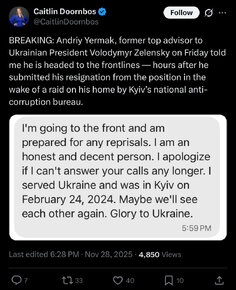
IMG_3033.jpeg
IMG_3034.jpeg

It seems that a whole bunch of “statesmen” accused of corruption and other “mischiefs” in both UA and RU are (at least “planning”) heading to the frontline. Is it the case here or his way to save face and power? Who knows. Miller also reported that he attempted to interview numerous people “in-the-know” about Yermak and was declined due to their uncertainty whether it is actually over for him or he will still retsin his power and ear of Zelensky. He also posted this:
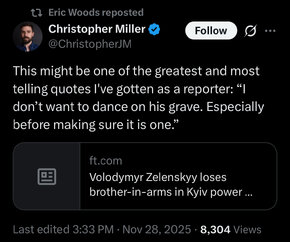
IMG_3032.jpeg

Another turn of the page here. Interesting times for those following the region for a while.

Last thing in this post (I will make another one after). I saw some (many?) people suggesting that pressuring Zelensky this way and assuming he would accept the whatever deal due to the weakness is actually counterproductive and it only makes it that much harder for him to accept the said deal due to the internal politics, etc. I think this is a wrong read of the situation. One read is that this is not just pressure to accept the plan, but get read of the guy and deal with the next one. This would also be in line with Putin’s statement (yet again) that it is impossible to sign any deal with Zelensky because he has no legitimacy, which is on top of the fact that he simply refuses to deal to the liking of Trump. To note here, while Euros talk and complain, they do not matter as far as the deal with Ukraine is concerned. Also of note, they are also now linking security guarantees to Europe to the deal as well, however ridiculous (and pathetic) it sounds:
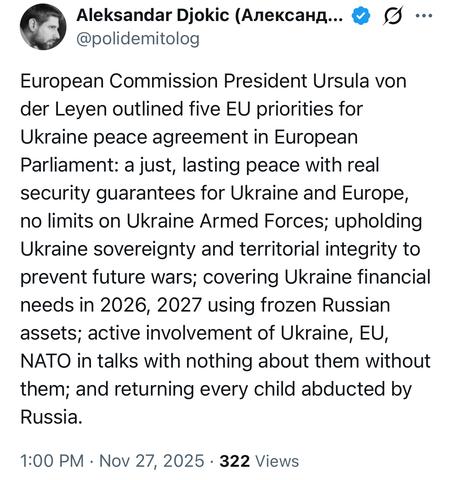


Anyway, “nothing about without” is a whole lot of nonsense from a party that reduced itself to this level in the process. Funny enough, if any deal goes through “behind their back”, their leverage of using the Russian assets is going to be gone. I won’t be surprised that in a rush to avoid that they will try and agree to something irrational they will have to deal with later but without explicit “security guarantees” for themselves. I compared the behaviour to one of a child recently and there so much more to it - like when children whine themselves out of things they had before the event because they chose to whine instead of dealing with the situation amid the calls to do so by a parent.
Anyway…

 

KipPotapych

Well-Known Member
In this post I simply want to quote the entire article from the FT because it is a good one, but behind a paywall that I cannot win to post otherwise. My subscription is still relevant though, apparently, so I am going to use it here. The article is by Franz-Stefan Gady, aka @HoansSolo on Twitter.

In Joseph Heller’s wartime classic, Catch-22, the protagonist Yossarian seeks out the US army surgeon Doc Daneeka to understand why his comrade cannot be grounded despite his obvious unfitness to fly. The doctor explains a brutal paradox: anyone rational enough to want out of combat is, by that very rationality, sane enough to stay in. He “would be crazy to fly more missions and sane if he didn’t, but if he was sane he would have to fly them.” Yossarian marvels, “That’s some catch, that Catch-22.”

Ukraine now faces its own Catch-22: Russia insists that Kyiv’s forces withdraw from all parts of Donetsk they currently hold, including the crucial strongholds of Sloviansk and Kramatorsk, which Russia has failed to seize despite nearly four years of intensive warfare.

Kyiv is sane to reject a plan demanding surrender without resistance — but by continuing to fight, the struggle risks becoming futile as the military outlook darkens, with risks including manpower shortages, equipment loss and Russian advances. If Ukraine continues resisting, worsening battlefield dynamics by 2026 could allow Russia to seize all of Donbas (or even more), eliminating a key obstacle to a ceasefire and leaving Ukraine with the same end result, just on worse terms.

Ukraine, like Yossarian, finds itself trapped in a logic where every rational choice could lead to the same catastrophic result. This dilemma is not new. The Dayton Agreement, brokered in 1995, ended Bosnia’s agonising war after Nato intervened. Alija Izetbegović, Bosnia and Herzegovina’s first president, publicly acknowledged his country’s unsolvable dilemma — unable to achieve a good peace, yet unable to sustain a just war to reach a better outcome. Ukraine faces something eerily similar: forced to pick between defective peace, uncertain enforcement and the risk of fighting only to end up with a worse deal.

The political scientist Dan Reiter argues there are two central conditions when wars end: first, both sides must be confident their opponent won’t violate the resulting peace deal — a commitment problem. Second, there must be credible data on each side’s strength and resolve. Wars of attrition, like Ukraine’s, typically clarify the latter. After years of fighting, a relative military balance of power becomes clear. But the commitment problem almost always persists because both sides must believe agreements won’t be broken as soon as circumstances shift. This is why Ukraine is boxed in so severely.

Peace settlements usually work only when both sides can trust one another, or when a powerful enforcer makes violations prohibitively costly. When enforcement is weak, “successor wars” are likely. Today, the US and Europe lack unified will or capacity to guarantee Ukraine’s future security. Russia sees the conflict as a regional war against Nato — a supposedly existential battle for which Moscow is willing to endure years of bloodshed until its goals are achieved. The commitment problem remains fundamentally unsolved.

Security guarantees have failed before; the Budapest Memorandum of 1994 did nothing to protect Ukraine when Russia invaded Crimea or launched all-out war in 2022. Likewise, the recently proposed peace plan’s vague enforcement clauses won’t solve the fundamental trust deficit. Without ironclad commitments — backed by European boots on the ground, not just promises — Kyiv risks surrendering territory today only for Moscow to strike again when conditions are ripe.

If Ukraine rejects the current proposals and continues fighting, it faces mounting attrition. However, military conditions are not so bad as to warrant a “Diktatfrieden.” The frontline is not in danger of collapsing and Ukraine’s military remains a formidable fighting machine. Russia would be hard pressed to successfully seize Sloviansk and Kramatorsk in 2026. Yet the overall trajectory of the war remains negative for Ukraine. Russia has endured heavy losses, but its ability to absorb them and reinforce troops outstrips Ukraine’s. Should Kyiv lose further territory or see its armed forces depleted, negotiations will shift further in Russia’s favour.

Accepting a peace plan now that surrenders hard-won land, restricts sovereign defence, grants amnesty for war crimes and foregoes Nato protection — all in exchange for uncertain deterrence — could risk a serious rupture in civil-military relations and destabilise Ukraine as a whole. The current military situation does not justify surrendering these territories, and such concessions would almost certainly inflame a “stab-in-the-back” narrative among officers — undermining trust in Ukraine’s civilian leadership.

When negotiating from a weakened position, a country often faces a tragic choice: fight on in hopes of a better deal or accept punishing losses now and risk internal turmoil. Leaders often “gamble for resurrection” — continuing to fight long after defeat seems likely — hoping to stave off blame at home.

Ukraine’s choices could boil down to “bad now, or possibly worse later”. The Donbas can’t be abandoned without a fight, yet fighting threatens the same concessions forced under far uglier conditions while the promise of western support grows shakier and the prospects of a truly just peace recede. Sometimes, the cruel logic of war means that bitter compromise is the only way out — even if you know just how far it falls short.
 

KipPotapych

Well-Known Member
A piece by Zaluzhny at the Telegraph:

Knowing the political goal of a war makes it possible to understand what the enemy is doing, and how to respond.

The conflict in Ukraine has been going on for 12 years, beginning with the 2014 invasion of Crimea. There is no doubt over Russia’s political goal: the abolition of Ukraine as an independent state. Understanding this has to form the basis for building a strategy that will preserve our statehood.

We are in an extremely difficult situation, where a rushed peace will only lead to a devastating defeat and loss of independence.

I became commander-in-chief of the armed forces of Ukraine in August 2021. Although the military was undergoing a transformation and gaining combat experience, it still had many problems. The Russian army was rapidly increasing its forces and supplies. The Kremlin increased the military budget year after year, invested resources in the defence-industrial complex and purchased more weapons and equipment.

Meanwhile the opposite was happening in Ukraine In 2021, the army was allocated even less money than in the previous year. As a result, our military met a full-scale invasion the following year with a huge shortage of everything, from people to weapons.

At the beginning of 2022, the general staff made calculations that showed the total needed to repel aggression – including for the restoration and replenishment of missile and ammunition stocks – was estimated at tens of billions of pounds, which we did not have. And then Russian tanks rolled over the border.

According to the Russian military theorist Alexander Svechin, there are two types of strategy to achieve a political goal: defeat and attrition. The Russian strategy for defeat envisaged clear military actions: a quick strike on the Ukrainian capital and attacks in other directions.

However, this did not go according to plan. The heroism of Ukrainian citizens was the key to a victory that, although cost us the lives of our best and part of our territory, preserved the state and gave us that most important thing – a chance to fight and make peace on our own terms.

From that moment, the enemy’s strategy changed to one of attrition. Russia in 2023 tried to focus on creating a strong defensive lines, which on the one hand was logical, serving to repel our offensive, and on the other hand, distracted our attention from the main goal.

As Ukraine was pushing back, Russia was implementing a war economy, launching propaganda, changing legislation and building strategic reserves, all while dragging us into a new attritional phase of the conflict for which, just like in 2022, we were not ready.

The events of 2024 and 2025, despite minor achievements at the front, indicate the absolute effectiveness of such a strategy for Russia in its efforts to achieve its political goal.

However, a war of attrition is also being waged on the political front and the economic front. Military actions play an important role in achieving political goals, but are not the final phase.

For example, let’s imagine that Russia completely occupied the Donetsk region. The war would not end, because it would not achieve the political goal. Russia seeks to create conditions to achieve the collapse of Ukraine on the military, economic and political fronts simultaneously.

In the absence of a unified vision of a new security architecture on the European continent, without security guarantees and real financial programmes, the war with Russia risks turning into a broader war with over the capture of Eastern Europe.

War does not always end with the victory of one side and the defeat of the other. We Ukrainians strive for complete victory, but we cannot reject the option of a long-term end to the war.

Peace, even in anticipation of the next war, provides a chance for political change, for deep reforms, for full recovery, economic growth and the return of citizens.

It is even possible to speak about the beginning of the formation of a safe, protected state through innovation and technology; of strengthening the foundations of justice through the fight against corruption and the creation of an honest court system; and of economic development, including on the basis of international economic recovery programmes.

But all this is impossible without effective security guarantees.

Such security guarantees could include: Ukraine’s accession to Nato, the deployment of nuclear weapons on Ukrainian territory or the deployment of a large allied military contingent capable of confronting Russia.

However, there is no talk about this today and, therefore, the war will probably continue. Not only militarily, but also on the political and economic fronts. Russia may change the tools and forms of its aggression, but they will all serve the same purpose.

For us in this situation, the main political goal should be to deprive Russia of the opportunity to carry out aggression against Ukraine in the foreseeable future.


Not sure where people take the whole capture Europe from. I can allow for capture Ukraine logic, but where the Europe is coming from I fail to see.

Another article from the Telegraph (I didn’t read). We are back to shovels and whatnot, it appears. Probably an incoming assessment by the UK MoD next week (unless already cited in the article?):

‘Disposable’ soldiers forced into meat grinder assault unequipped as commanders face dwindling supplies from Moscow

Humour:

IMG_3040.jpeg

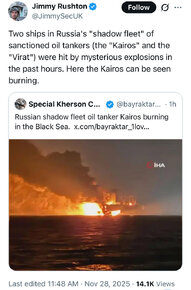
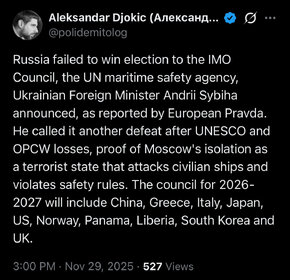
A terrorist state that attacks civilian ships. I believe the two tankers stopped burning not that many hours ago.

China… well, not much needs to be said, I would think, but South China Sea shenanigans, etc.

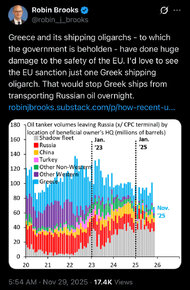
Greece, in addition to selling junk (as well as good) vessels to Russia to operate.

IMG_3041.jpeg

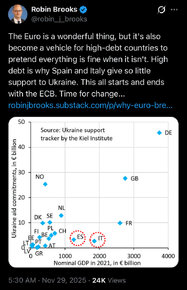
Italy… sent to Russia about $15B in the first year of the invasion alone for the fossil fuels. About 10 times more than their aid sent to Ukraine? The factor is probably significantly higher than 10 if one includes the following almost three years now, but I do not want to look and believe the citation above is sufficient to make the point.

IMG_3042.jpeg

On the subject of what the graph portrays, while here:


Japan with their direct investment into Russian LNG projects.

The USA… Well… Current happenings related to the war directly aside, boat-sinking and survivor-killing shenanigans…

It appears that the terrorist state is not as isolated as Mr. Sybiha believes, while some others are involved in what appears to be terrorist activities themselves, Ukraine including according to his own definition. Tragicomedy.

More humour:

IMG_3017.jpeg
 

KipPotapych

Well-Known Member
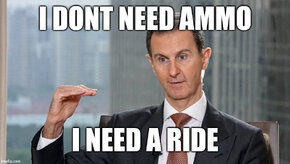
Apologies, but more humour:

IMG_3043.jpeg

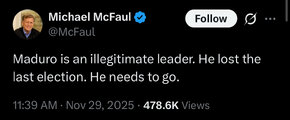
Imagine, McFaul, of all people… with his assessment of this conflict, along with the PhD thesis on great powers’ role in revolutionary movements/regime changes.

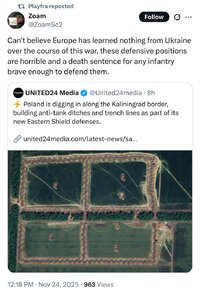
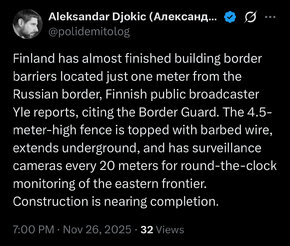
Related to this war and plans for the Euro defense:

IMG_2989.jpeg

IMG_3016.jpeg

There is space for one more attachment, so not directly related to the current discussion (hard to believe it’s been over a year now though; seems like just a few short months):

IMG_3021.jpeg
 

rsemmes

Active Member
This railway is in Poland. That is unprecedented.

The Nordstream sabotage was in international waters. Also, the Russian state owned >50% of the stock in the pipeline, & was at war with Ukraine. Poland is not at war with anyone. And the pipeline was not being used, & a non-Russian alternative was due to open next day. It didn't damage anyone economically at the time, though it could potentially have been damaging if the war had ended quickly.
International Law protects Gambian Ships but not Polish railroads? Everything done in international waters is legal? How much do we care about "legal"?
"We" as in this forum and Western Democracies.
 

Feanor

Super Moderator
Staff member
International Law protects Gambian Ships but not Polish railroads? Everything done in international waters is legal? How much do we care about "legal"?
"We" as in this forum and Western Democracies.
I'm wondering if this is another attempt to sabotage the negotiations Trump is pushing by forcing Russia to escalate. Except I think Russia won't respond right away. They will wait until the negotiations fall through again, and then respond in some fairly disproportionate manner, like attacking multiple ships going to and from Odessa. Or making it a point to hit any ships that stop in the Odessa region ports while they're there.
 
Top