The Russian-Ukrainian War Thread

rsemmes

Active Member
Russia got a good chunk of Siversk.

Or Ukraine starts with those local counterattacks, in one more place, or Siversk is gone, soon.
(Soonish, in this war.)
I know...
I wanted a third confirmation but, if Ukraine doesn't start with those Kupiansk/Pokrovsk-style local counterattacks now, it is gone. In 20 days.
And Russia is already on that side of the river to the south, across the Suka.

("The report of my death was an exaggeration". M. Twain)
 
Last edited:

rsemmes

Active Member
Seversk is not gone by either map. Russia has most of it but Ukraine retains the western suburbs, across the river. Suriyak and Kalibrated show a similar picture, with Suriyak showing a small grey zone east of the river (i.e. Russian sweeping operations are still in progress). It's likely Ukraine can't hold Seversk or the hills west of it with the Russian advances around Platonovka-Zakotnoe and Svyato-Pokrovskoe which is in my opinion the real thing to watch. Seversk sits in a lowland. It's not controllable if the enemy holds the heights around it. You can actually see in satellite imagery the Ukrainian strong points immediately west of it, and south-west of it. They're holding the slopes and heights west of the Bakhmutka river valley. This chain of strong posts bends west-ward just north of Fedorovka, which sits in another river lowland. Currently the only route Ukraine has to the strong points west and south-west of Severks is through open fields and a few tree lines within easy drone range, and in some spots in practically direct observation of Russian troops. So they're likely done for in those spots.

EDIT; I spoke too soon, Suriyak is literally updating his map right now. Perhaps Ukraine has withdrawn from all of Seversk after all.
Yes, I've seen a 10' ago update. Russia is across the river, in the city.
 

Feanor

Super Moderator
Staff member
I know...
I wanted a third confirmation but, if Ukraine doesn't start with those Kupiansk/Pokrovsk-style local counterattacks now, it is gone.
And Russia is already on that side of the river to the south, across the Suka.

("The report of my death was an exaggeration". M. Twain)
I don't know that Ukraine has the resources to counter-attack. They have to send forces to conslidate the Gaychur river line in Zaporozhye. They have to keep feeding troops into the Kupyansk meat-grinder, they have to reinforce the Volchansk area, they have to try and hold Konstantinovka and Krasniy Liman. I don't think they have resources to also counter-attack on the flanks of Seversk.

Also nevermind the Sukha, Russia is across Bakhmutovka in the north by Dronovka, and around Platonovka. These rivers are small, and it's winter. They're not particularly large obstacles, certainly very fordable.

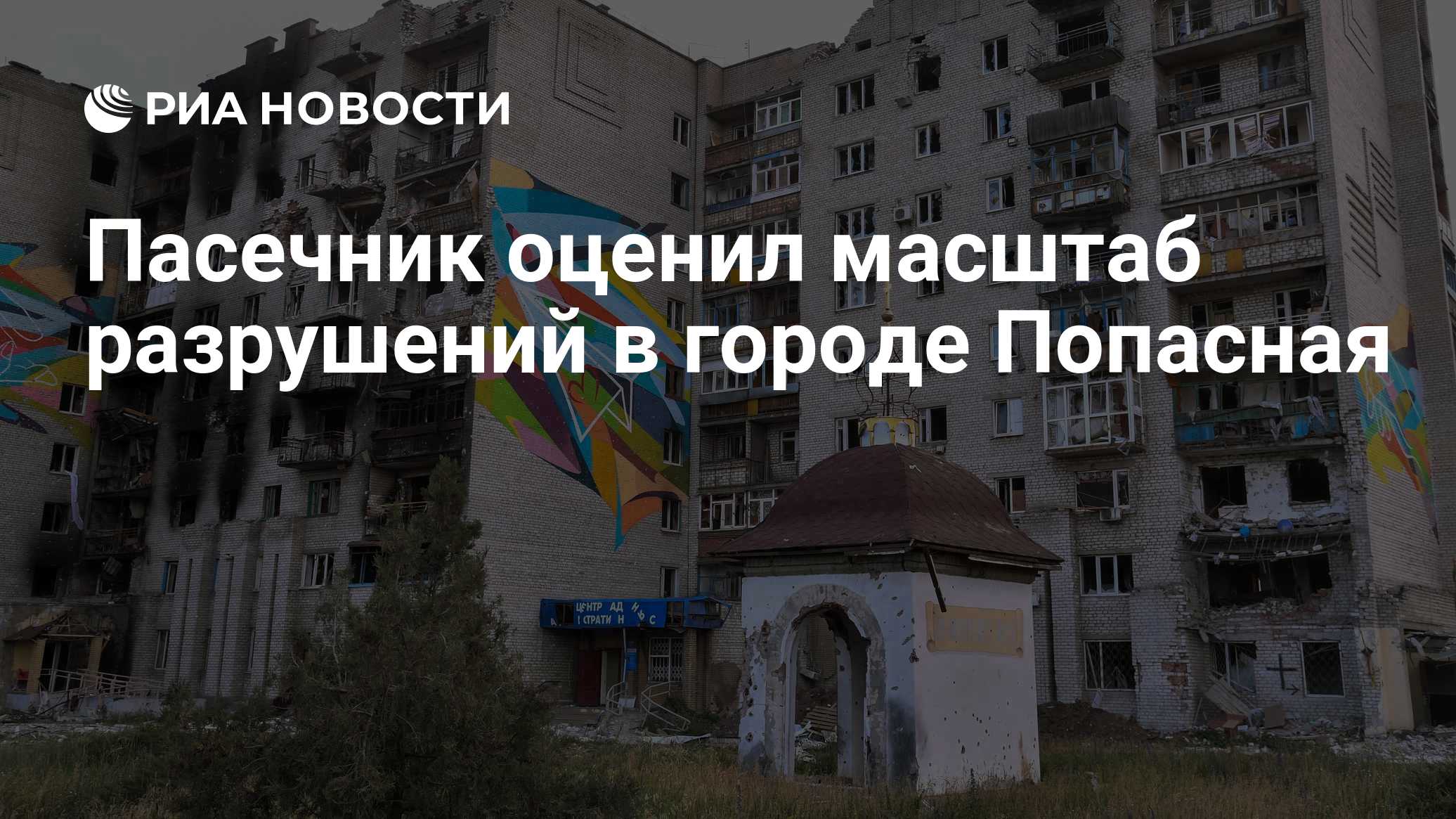
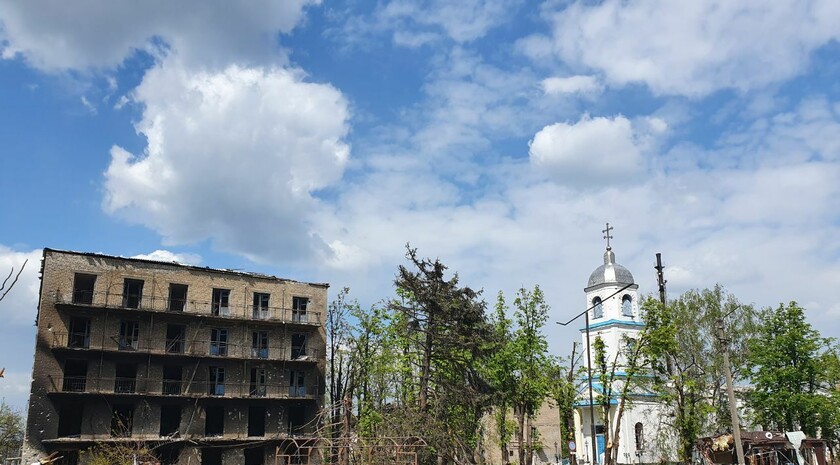
EDIT: Another interesting piece of digging. Popasnaya, the town that was the site of very heavy fighting in 2022 and saw the first large scale use of Wagner fighters, will apparently see at least partial reconstruction after all. It was initially stated by regional authorities that rebuilding the town didn't necessarily make sense. However now plans for limited reconstruction have been announced, tied to the waterworks and rail infrastructure, with housing for the employees to be rebuilt. ~250 people (out of a pre-war ~16 000) still live in the ruins, with apparently no power or water. As of August DNR leadership estimated the town as ~95% destroyed, and the footage, granted from February of this year, confirms as much. Unlike the earlier footage we saw in Pervomaysk, there have been no substantial reconstruction efforts. Note currently the town is still within drone range, being ~20-30 kms from the front line. In fact the current movements around Seversk actually have a lot to do with pushing the front line back from places like Pervomaysk and Popasnaya (and of course Severdonetsk-Lisichansk). Because of the nearness to the front, the city is consiered a closed city and is not accessible to anyone without government-approved reasons for being there, or residents.

It's not clear if the rail infrastructure in the town is already functioning, and if it whether the workers are bused in from Pervomayskoe (~30 minutes away) or live in the ruins locally. I suspect the former, with the reconstruction plans being mainly for their benefit. The westward rail line out of Popasnaya runs to Soledar, before veering southward into Artemovsk/Bakhmut and is not currently active, but likely will become active once the front line shifts to the Kramatorsk and Slavyansk area, putting Artemovsk/Bakhmut further behind Russian lines. However it's possible the lines east, north, and south-west are functioning at least for military logistics. South-west the line runs into Gorlovka, a functioning city in DNR hands since 2014. The eastward line heads into Pervomayskoe/Sokologorsk and then veers south towards Debal'tsevo where it eventually splits. The northern line heads straight into Lisichansk and is likely also not in use due to nearness to the front line.

The last three links are short interviews with locals. They mostly live off of Russian humanitarian aid, delivered twice a month in the form of basic food supplies per person, and medication on a case by case basis. Water comes from wells in the private sector, there are also some water deliveries, but they also take water from a local stream. No reconstruction certificates or compensation payments for destroyed property are being made here at this time, though requests are being accepted. Heating is handled by wood-fire and coal stoves but coal supplies are scarce.

 
Last edited:
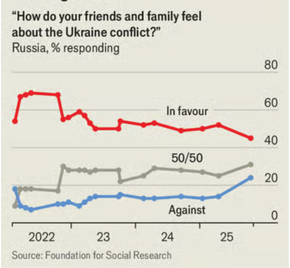
Screenshot 2025-12-11 at 13.41.23.png

Source: https://www.economist.com/europe/2025/12/10/russia-is-not-as-resilient-as-it-wants-you-to-think

It’s not a perfect measure of public sentiment, but it’s still striking how little pro-war support has declined. I’m genuinely curious about the narrative among people in Russia who are willing to pay the costs of waging it.

What do ordinary people feel they’re gaining, or preventing, by backing this war? If anyone has genuine, non-cynical, nonjudgmental, first-hand insight into what the common narratives are, I’d be very interested to hear it.
 

rsemmes

Active Member
View attachment 54021

Source: https://www.economist.com/europe/2025/12/10/russia-is-not-as-resilient-as-it-wants-you-to-think

It’s not a perfect measure of public sentiment, but it’s still striking how little pro-war support has declined. I’m genuinely curious about the narrative among people in Russia who are willing to pay the costs of waging it.

What do ordinary people feel they’re gaining, or preventing, by backing this war? If anyone has genuine, non-cynical, nonjudgmental, first-hand insight into what the common narratives are, I’d be very interested to hear it.
Only Russian people?

Pride and fatalism. Ordinary people don't get into wars, their governments do and it takes many years for ordinary people to stop a war. Ever?
Ordinary people thought that they were going to get cheaper oil by invading Iraq?
Argentinians, under a dictatorship, fought for King and Country. Ordinary people in the UK were fighting to regain the Empire?
In a civil war, what do conscripts expect to gain? Do you think a Russian brain is different to any other human brain?
That (feel) is a question for a psychologist, you're going to get millions of single answers. I think you will find the "common narratives" in History.
 

Musashi_kenshin

Well-Known Member
It’s not a perfect measure of public sentiment, but it’s still striking how little pro-war support has declined. I’m genuinely curious about the narrative among people in Russia who are willing to pay the costs of waging it.
1. The narrative in Russia has been strictly controlled, so people may not fully understand what has been happening and what the sacrifices have been.
2. How far are ordinary Russians suffering? I'm sure they'd be better off without sanctions, but Putin has avoided societal collapse.
3. Russia is still advancing, even if slowly. Stalemate is much easier to deal with than defeat. See how the Iran-Iraq War dragged on for nearly eight years.
 

Feanor

Super Moderator
Staff member
View attachment 54021

Source: https://www.economist.com/europe/2025/12/10/russia-is-not-as-resilient-as-it-wants-you-to-think

It’s not a perfect measure of public sentiment, but it’s still striking how little pro-war support has declined. I’m genuinely curious about the narrative among people in Russia who are willing to pay the costs of waging it.

What do ordinary people feel they’re gaining, or preventing, by backing this war? If anyone has genuine, non-cynical, nonjudgmental, first-hand insight into what the common narratives are, I’d be very interested to hear it.
The impact of the war has been inconsistent and uneven. Some people are better off as a result of the war due to high salaries in the defense industries or even in the military itself. Others are impacted but only somewhat. Much of society can pretend there is no war, or treat the war as something you watch on TV if you want to. Add to that the propaganda and information control, and it makes for a well managed public opinion. This isn't in principle new. Putin and Co. learned this lesson well during the Second Chechen War, and have done a pretty good job managing PR and minimizing the negative impact of some of their decision since then.

I know...
I wanted a third confirmation but, if Ukraine doesn't start with those Kupiansk/Pokrovsk-style local counterattacks now, it is gone. In 20 days.
And Russia is already on that side of the river to the south, across the Suka.

("The report of my death was an exaggeration". M. Twain)
Ok, now Seversk has fallen, and Mirnograd is not far behind.

1. The narrative in Russia has been strictly controlled, so people may not fully understand what has been happening and what the sacrifices have been.
2. How far are ordinary Russians suffering? I'm sure they'd be better off without sanctions, but Putin has avoided societal collapse.
3. Russia is still advancing, even if slowly. Stalemate is much easier to deal with than defeat. See how the Iran-Iraq War dragged on for nearly eight years.
Slowly but faster over time. Russian territorial gains in 2024 were much larger than 2023, and 2025 will have even bigger gains, though the delta is not as dramatic. It's much easier to sell a victory narrative when you're capturing towns, than when you're capturing villages. Being able to talk about taking Pokrovsk, Seversk, Chasov Yar, it all helps. If the trend was in the other direction, it would likely make it harder to sell the war as a tough but ultimately victorious one.
 
1. The narrative in Russia has been strictly controlled, so people may not fully understand what has been happening and what the sacrifices have been.
2. How far are ordinary Russians suffering? I'm sure they'd be better off without sanctions, but Putin has avoided societal collapse.
3. Russia is still advancing, even if slowly. Stalemate is much easier to deal with than defeat. See how the Iran-Iraq War dragged on for nearly eight years.
The impact of the war has been inconsistent and uneven. Some people are better off as a result of the war due to high salaries in the defense industries or even in the military itself. Others are impacted but only somewhat. Much of society can pretend there is no war, or treat the war as something you watch on TV if you want to. Add to that the propaganda and information control, and it makes for a well managed public opinion. This isn't in principle new. Putin and Co. learned this lesson well during the Second Chechen War, and have done a pretty good job managing PR and minimizing the negative impact of some of their decision since then.
I get those points, but they mostly explain why people might stay neutral or tune things out. What I’m trying to understand is why so many seem actively supportive. Indifference makes sense under information control and low personal impact, but active approval suggests people feel there’s something to be gained or protected.
 

Feanor

Super Moderator
Staff member
I get those points, but they mostly explain why people might stay neutral or tune things out. What I’m trying to understand is why so many seem actively supportive. Indifference makes sense under information control and low personal impact, but active approval suggests people feel there’s something to be gained or protected.
Well banning Victory Day celebrations and renaming streets after Nazi collaborators tends to paint the Ukrainian government in a certain light, especially within Russia. Russia in general is a fairly conservative society where support for the military tends to be high. And when you can claim victories and new territories, that tends to be regarded as a positive. The annexation of Crimea for example led to a major boost in ratings for Putin. And the reality of the current war is far removed from most people in Russia, just like it is from most people in the west. It's part of why I try to post about what's going on in the areas Russia has annexed, because it actually has quite the impact on the situation but it's not always well observed. So when Russia rolls over Mariupol', a decent sized city, defeats the evil Azov Nazis, and then rebuilds Mariupol' like a postcard (at least the parts shown on TV), it's easy to sell a narrative about how this is a Russian success, and Russia is doing great. And people start to assume that the picture in Severodonetsk-Lisichansk, Donetsk city, Lugansk, Pokrovsk, etc. looks similar, even when it very much doesn't and Pokrovsk looks more like the ruins of Avdeevka then it does like the rebuilt Mariupol', and will continue to look that way for years. Artemovsk/Bakhmut is a dead city ~2.5 years later. But that part isn't discussed or showcased on Russian television. And Ukraine doing things like going into Kursk region, or indiscriminately shelling Belgorod tends to get people to buy the story of evil Ukrainian fascists. In the video I posted above from Popasnaya, one of the civilians mentions that his son, a civilian, was killed by a Ukrainian drone strike. Except he doesn't say Ukrainian, he says Ukrofascists. And he's a Ukrainian citizen. As a Russian, if you hear about Ukrainian drones attacking ambulances in Aleshki, or buses in Belgorod, or residential buildings in Gorlovka, and you hear the Russian government telling you that this war is about defeating the fascists, it sounds about right.
 

crest

Member
I get those points, but they mostly explain why people might stay neutral or tune things out. What I’m trying to understand is why so many seem actively supportive. Indifference makes sense under information control and low personal impact, but active approval suggests people feel there’s something to be gained or protected.
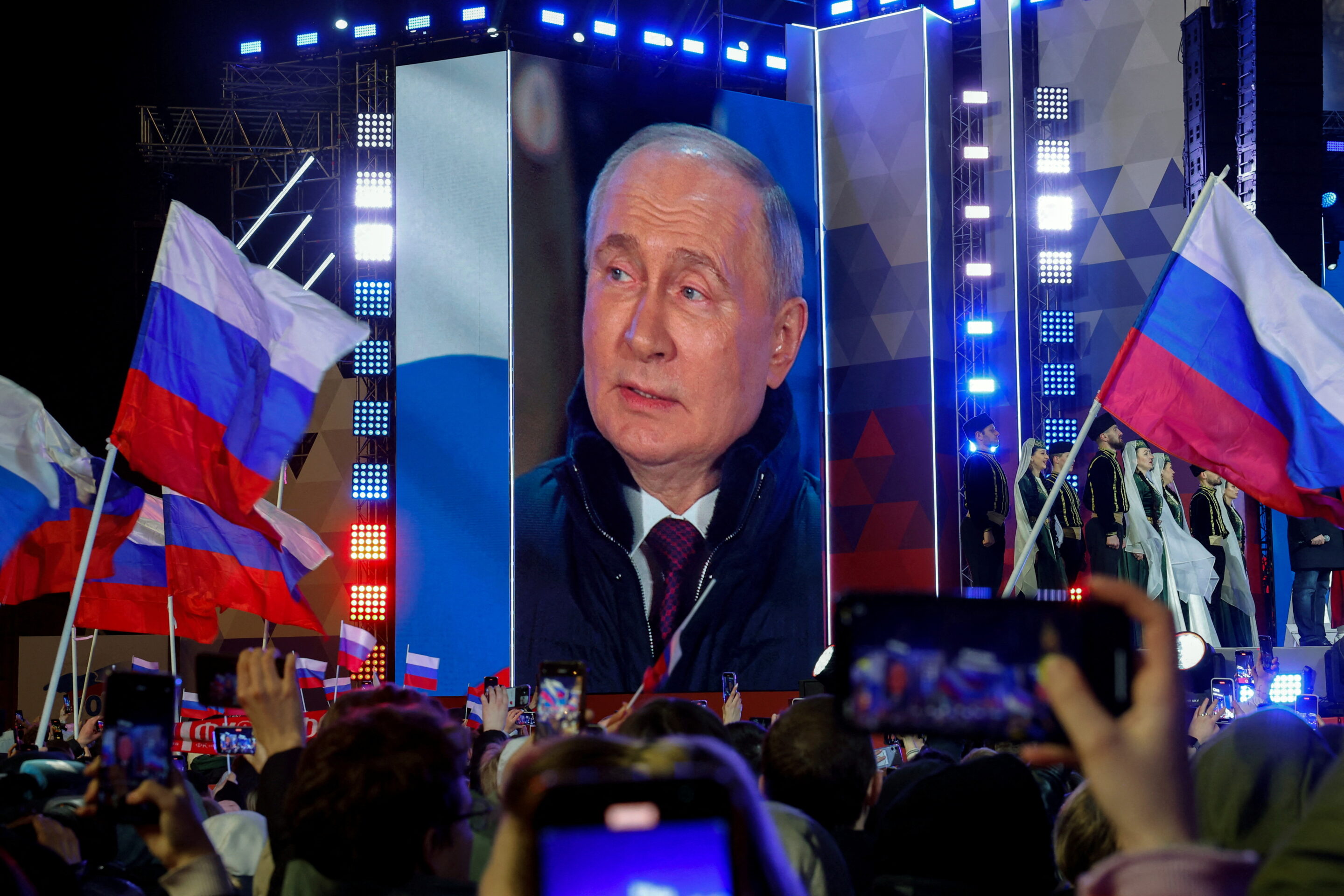
In addition to the points already made I think a part of it is plain old National pride. After the fall of the Soviets and Russian decline on the world stage it's not unreasonable for Russians to want something they can proudly point to as a sign of national strength.
Kinda like the Germans under Hitler I think this is a attitude well understood the Russian government and the naritive is tailored to supporting a already existing sediment rather then creating and sustaining it artificially.
 

rsemmes

Active Member
Two improvised bombs exploded in Kyiv on Thursday killing a serviceman and wounding four others, including two police officers, in a “terrorist” attack, prosecutors said. “The first explosion occurred while two national guard servicemen were patrolling the area, as a result one of them died,” the Kyiv city prosecutor’s office said, adding that the second bomb was detonated when police and medics were responding to the first.
Like "The General & The Scooter" in Moscow. Is that prosecutor saying that Ukraine is a terrorist state?

Germany summons Russian ambassador over campaign to destabilise country, foreign ministry says
We are getting a breaking news line from Germany.
Germany’s foreign ministry spokesperson has warned that the authorities are “observing a significant increase in Russian hybrid activities,” claiming that a Russian campaign “seeks to destabilise Germany.”
Like attacking Germany's energy supply? Providing funds to the extreme right would count as "destabilising"?

NATO’s Rutte says Europe must prepare for ‘scale of war our grandparents’ endured
and thetimes, BBC, theindependent...
War! The message is clear, even if cannot understand why we are getting the message. When is Russia going to invade (Venezuela?) Poland? The "why" would be useful too.

"But this is not about party politics. It's about whether UK defence has been under-funded for so long that it has now reached the point where the country is dangerously vulnerable in several areas, notably air defence.
Its (British Army) actual deployable strength is only 54,000."

Maybe, that's the answer.

Edit.
Every pound invested in Ukraine today benefits Britain and potentially saves substantially larger expenditures later. These economic and military dividends justify Britain’s commitments not as altruism but as advancement of core national interests.
 

Feanor

Super Moderator
Staff member
Things are heating up in Kupyansk. On the right shore Russia is steadily losing their positions inside Kupyansk and around it. On the left shore Russian forces are gaining ground around Petropavlovka and Kucherovka, pushing southward east of Kupyansk, and eastward out of Kupyansk itself. It may play out that as Ukraine pushes Russia out of western Kupyansk, Russia will consolidate clear routes into eastern Kupyansk, dividing the town along the river. The entire situation is the direct consequence of how Russia's command chose to attack the town. There's still only minimal movement in the Dvurechenskoe area.
 
Last edited:

KipPotapych

Well-Known Member
^ Two right shores, which one is which? :)

I also wonder if Kupyansk was also deprioritized due to the potential “land swaps” over the Zaporozhie direction, where the Russians look to keeping the territories they occupy. This is the about only direction where Ukraine is having a success and I wonder if it is by design: “grind yourself over something you will potentially get back anyway if the negotiations result in something positive, while we grab more of what we will keep” would be a reasonable Russian strategy, no? The attacks, of course, will resume from better positioning once that logic becomes irrelevant - that is, negotiation fail.
 

Feanor

Super Moderator
Staff member
^ Two right shores, which one is which? :)
Fixed, sorry. But it should be obvious which is which based on the locales in question.

I also wonder if Kupyansk was also deprioritized due to the potential “land swaps” over the Zaporozhie direction, where the Russians look to keeping the territories they occupy. This is the about only direction where Ukraine is having a success and I wonder if it is by design: “grind yourself over something you will potentially get back anyway if the negotiations result in something positive, while we grab more of what we will keep” would be a reasonable Russian strategy, no? The attacks, of course, will resume from better positioning once that logic becomes irrelevant - that is, negotiation fail.
I don't think so. Quite the opposite Russian domestic sources proudly declared Kupyansk liberated. This doesn't look like it was done by design. It was either a poor choice by the command in that area, or it was the result of wanting the attack on Kupyansk to coincide with Russian pushes in several other towns to stretch Ukraine thin. If the latter, this was an unfortunate sacrifice to ensure things like the rapid fall of Pokrovsk, and the capture of Seversk. If the former, it was a foolish decision driven by the desire to report gains that look impressive. The entire mess looks particularly bad given that there's no reason it couldn't have been done better, other than a desire to rush the taking of a town.
 

KipPotapych

Well-Known Member
^ I would think it was done for the latter, but the former is certainly a possibility as well (wouldn’t be that unRussian, really, as evidenced multiple times over the length of this war).

I think the narrative is also considered to be important at this time, as the (rather unusual) declaration by Gerasimov of the fall of Kupyansk suggests. Neither side appears to be sparing the lives of the troops in attempts to create the narrative. Perhaps, leadership also does not fully recognize the situation on the ground, overestimates the ability of their forces and overestimates the Ukrainian exhaustion.

Maybe, these are also opportunistic advances to see what sticks and Ukrainians took the opportunity and counterattacked where they thought was feasible (helping to create their narrative). In the like of Dobropillia salient where the Russians overextended themselves and Ukraine moved tons of reinforcements to reverse the course. What remains to be seen is if this is a temporary reversal, as Donropillia (partially for now) was (and basically every single other Ukrainian counterattack in the past 1.5-2 years).

On the other hand, these counterattacks certainly play into the Russian strategy of attrition as Ukraine clearly loses more resources, personnel and materiel. Not that they have much choice though, really: constant retreat without even little PR victories is pointless. What’s not though?

Trump declared the other day that Ukraine lost 27,000 men over the “past month”, whatever that means. Is he making up the numbers or is he is telling something that many think is impossible because of “ingenuity” and whatever other reasons?


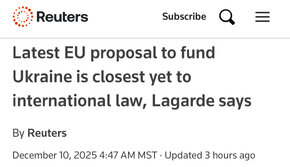
On the Russian assets, the EU put an indefinite freeze on the funds (the original report was by Reuters, but there are no paywalls here):


This headline from a couple of days ago, says it all though:
IMG_3164.jpeg

The article: https://www.reuters.com/business/fi...et-international-law-lagarde-says-2025-12-10/

You can’t make this stuff up. They used a “novel interpretation” of (their own) law to justify it

In a novel interpretation, the Commission argued that the shockwaves unleashed by Russia's full-scale invasion of Ukraine have caused a "serious economic impact" for the EU as a whole, triggering "serious supply disruptions, higher uncertainty, increased risk premia, lower investment and consumer spending", as well as countless hybrid attacks in the form of drone incursions, sabotage and disinformation campaigns.

“Preventing that funds are transferred to Russia is urgently required to limit the damage to the Union's economy," the proposal said in its introduction.

Under the ban, the €210 billion will be released when Russia's actions "have objectively ceased to pose substantial risks" for the European economy and Moscow has paid reparations to Ukraine "without economic and financial consequences" for the bloc.


Italy has joined Belgium in opposing the use of the Russian assets. Bulgaria and Malta did the same. I am guessing the more intense the conversation gets, the more opposition there will be to the loan idea.


In the meantime, a headline (via Google translate from French):

Sanctions: Russin oligarchs claim at least 53 billion before arbitration courts

And another:

Russia Sues Holder of Frozen Assets Europe Wants for Ukraine

To be clear, the Russian Central Bank filed a case against the Euroclear in a court in Moscow. They will move to some other, international, jurisdictions later on, in my opinion.

The “serious economic impact” they are probably referring to:

Around 60%, or about 50bcm, of gas demand lost in Europe between 2021-2025 will probably never return as power-intensive firms in the steel, chemicals and other sectors have relocated outside the bloc, a TotalEnergies executive said on Tuesday.


The same guy from Total, that imports most of the US gas to Europe, says that Europe should not make themselves too dependent on the American gas and should diversify their supplies (kind of a “duh” moment, but good luck with all that).


Kinda related/unrelated… Politico posted their annual version of the most influential people in Europe. Funny how only two Euro leaders come before Putin at number 5 (Frederiksen and Merz at 2 and 3, respectively). Trump taking the first spot and Le Pen at number 4 (Macron is trailing at number 19).


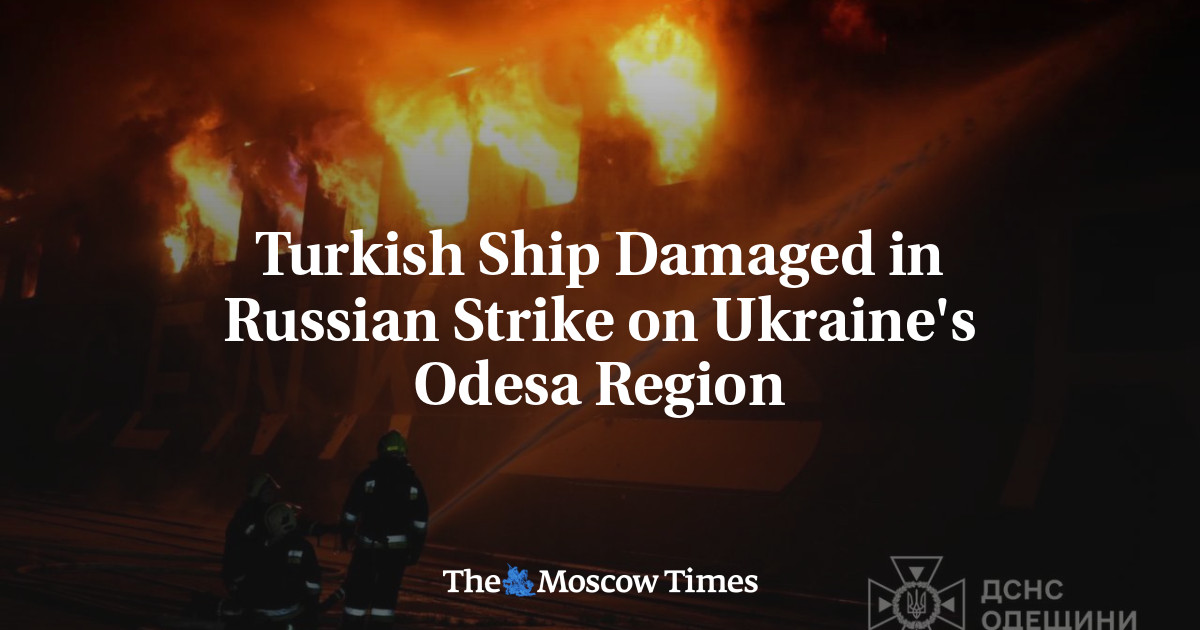
Russia hit a ship in the port of Odessa:


Of course, the whining I was expecting didn't make itself wait with Zelensky declaring that this is not only the evidence that Russia doesn’t want to negotiate, but also attacks a normal life in Ukraine (he is cited in the article linked above).
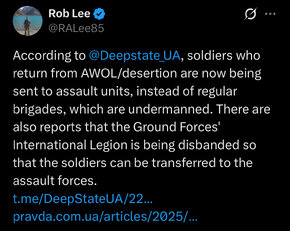

IMG_3171.jpeg

A link to the Deepstate claim (in Ukrainian):


A link to the Pravda article (also in Ukrainian):


Deepstate’s claims were confirmed by a UA MoD official; I have not seen a confirmation of the latter. One would think that this ingenuity will simply lead to the increase in desertion rates, but go figure. I guess desperate times require desperate measures? I still fail to see the logic. Seems to me that mobilization that is already a problem just got that much harder.

A comment from the former commander of the Chosen Company on the international legion news:

How it’ll end up working: a Ukrainian company commander ends up with 1 of each nationality and commits suicide over all the translations.
Vs
English here, Spanish here etc etc.


From his tweet: https://x.com/RyanO_ChosenCoy/status/1999338103882829970

On the same subject, the UA Prosecutor’s General office is putting a stop to publishing AWOL/desertion reports altogether now, so I guess we will not find out how the new rules affect the numbers. The last number released was 21,602 AWOL in October.

Original sources for both of the above are in this tweet by Rob Lee: https://x.com/RALee85/status/1986730880421789927


In Odessa, police opened an investigation after the “mobilization team” had beaten and basically brutally mobilized a defender of Mariupol who was released from the Russian captivity 6 months ago and was in Odessa for rehabilitation. At least some cases draw attention of the authorities.

The source (in Ukrainian): https://censor.net/ua/news/3589958/roman-pokydko-v-odesi-ttsk-pobyly-biyitsya-morskoyi-pihoty


That’d be all for now as I am going to have a beer.and find something to watch and stare at the TV for a couple of hours, probably thinking about other things, haha.

 

KipPotapych

Well-Known Member
Speaking of thinking of something else while watching a movie, I read this interesting article the other day. While many would probably find it as an interesting read (I would think?), I would be interested in hearing @Feanor ‘s thoughts on it (the conclusion is obvious, but he content is what I am interested in hearing the thoughts on).


rsemmes

Active Member
Yes, one day to be proud of the EU.

'At first, the Commission suggested activating Article 31.2 of the treaties to switch the renewal of sanctions from unanimity to a qualified majority. The article is based on "strategic interests and objectives".
Any country can invoke "vital and stated reasons of national policy" to thwart the switch.
The Commission turned to another provision: Article 122, which allows member states to decide "in a spirit of solidarity" on measures "appropriate to the economic situation".
Article 122 has two major practical advantages: it bypasses the European Parliament and it requires just a qualified majority.'
Because bypassing the Parliament is the most honest and democratic way to do things.

"Indefinitely" means that it hasn't to be vote every 6 months. It was used during COVID, it has not been used against US tariffs: "appropriate to the economic situation".
 

Big_Zucchini

Well-Known Member
Yes, one day to be proud of the EU.

'At first, the Commission suggested activating Article 31.2 of the treaties to switch the renewal of sanctions from unanimity to a qualified majority. The article is based on "strategic interests and objectives".
Any country can invoke "vital and stated reasons of national policy" to thwart the switch.
The Commission turned to another provision: Article 122, which allows member states to decide "in a spirit of solidarity" on measures "appropriate to the economic situation".
Article 122 has two major practical advantages: it bypasses the European Parliament and it requires just a qualified majority.'
Because bypassing the Parliament is the most honest and democratic way to do things.

"Indefinitely" means that it hasn't to be vote every 6 months. It was used during COVID, it has not been used against US tariffs: "appropriate to the economic situation".
Why is the EU parliament so involved in sanctions? Every member can just activate whatever sanctions they want, and the EU can be an added layer.

If the point is to punish EU members who still trade with Russia and buy energy from it, then there are faster more reliable ways to do it.
 
Speaking of thinking of something else while watching a movie, I read this interesting article the other day. While many would probably find it as an interesting read (I would think?), I would be interested in hearing @Feanor ‘s thoughts on it (the conclusion is obvious, but he content is what I am interested in hearing the thoughts on).

My sense is that what really changes the perception of Russia versus the interwar states Waller mentions is capability. Many of those regimes were revisionist and willing to use force, but lacked the material and strategic capacity to sustain a large, prolonged external war. Russia has that capacity today, so similar regime logics appear far more aggressive in practice.
 

rsemmes

Active Member
Russian tank production has peaked at nearly 150 per month, while that of other armoured vehicles at 550 per month.

I am still confused, the Red Army is an army based on conscription, "Approximately 75% of Russian land power is currently deployed to Ukraine". That means 5% each for Turkey, China, western Nato, Koenisberg and another 5% just... around? Those units, full of conscripts in training, everywhere in Russia add, how many men?
 
Top