
John Fedup
The Bunker Group
Keeping SeaKings for almost 50 years and our pollies want to try the same thing with fast jets. Bad enough that this is economic folly but as South has pointed out, the capability needed for war won’t be there.


Keeping SeaKings for almost 50 years and our pollies want to try the same thing with fast jets. Bad enough that this is economic folly but as South has pointed out, the capability needed for war won’t be there.

From what I could find the RCAF hornets have the same RWR (ALR-67v3) but I didn’t see anything else about EW suite. Increasingly if you don’t have a Jammer (e.g 8222 for the RAAF), Significant amounts of countermeasures ( BOL), Towed Decoys (not fitted to RAAF classics) it is becomingly difficult to suggest you have a survivable jet, particularly when it is not LO.

The aircraft will be equipped with the following avionics systems: Joint Helmet Mounted Cueing System (JHMCS), a countermeasures Dispensing System AN/ALE-47, a Multifunctional Information Distribution System (MIDS), a Multi-purpose Display Group Upgrade (MDGU) Color Displays and a Cockpit Video Recording System Upgrade (CVRS).
After some digging it does seem the survivability upgrades to the CF-18 have been pretty modest to date. The chaff and flare dispensers were upgraded to the ALE-47 and it seems like the CF-18 uses ALQ-126B and ALQ-162 jammers while the recent FMS purchase request includes Improved Tactical Air Launched Decoys.Finally the Canadian aircraft also featured ALQ-162 electronic warfare jammers to complement the normal ALQ-126B jammer and the ALR-67 Radar Warning Receivers.
As you point out, the timing is going to be critical to concerns about survivability, capability, and sustainability. The plan isn't to have the CF-18 be the RCAF's primary fighter by the 2030s. The purchase of 18 RAAF F-18s may have been contrived at the time but it's now going to be needed to allow flight hours to be extended across more airframes. The purchase also included 7 extra F-18 for spares. No doubt the 36 airframes in best condition out of the 94 operational will be the ones undergoing the HEP Phase 2 upgrades. The first CF-18 replacement aircraft is supposed to delivered in 2025 at the same time as these 36 HEP Phase 2 CF-18s reach FOC so these upgraded CF-18 aren't supposed to defer the need for the CF-18 replacement aircraft but serve alongside them until the last replacement aircraft arrives. Non-upgraded CF-18s will presumably begin retiring soon after 2025 to serve as parts for the upgraded CF-18s. So for missions in contested environments in the late 2020s, it should be the CF-18 replacements that will be deployed rather than the upgraded CF-18s. That's supposed to be the plan anyways.Is the 2022 selection date and the 2025 delivery date for the CF-18 replacement still officially on and not officially deferred? Because if that is the case the above bleak scenario could eventuate. Are they going to perform a USMC C++ type remanufacture on the airframes to extend the lives of the 36 Phase 2 aircraft for couple of thousand hours?

 ottawacitizen.com
Is the 2022 selection date and the 2025 delivery date for the CF-18 replacement still officially on and not officially deferred? Because if that is the case the above bleak scenario could eventuate. Are they going to perform a USMC C++ type remanufacture on the airframes to extend the lives of the 36 Phase 2 aircraft for couple of thousand hours?
In order for the RCAF to achieve a 2025 IOC for a contract signed in 2022, not only would there need to be production slots available for a Canadian order, but also RCAF personnel would need to be trained and transitioned to the new aircraft very rapidly. Given that a decision has yet to be made (or at least announced that it has been made) one does not know what the replacement will be, and therefore cannot make a judgement on how rapid such a transition could be.
The timeline for FOC is going to be tight, regardless of which jet is selected. Of the two main contenders, the F-35 and F18SH, I wonder which jet could be supplied the fastest in the event some disasters occur requiring the immediate replacement of the classics? The F-18 SH likely has the advantage from a FOC POV.
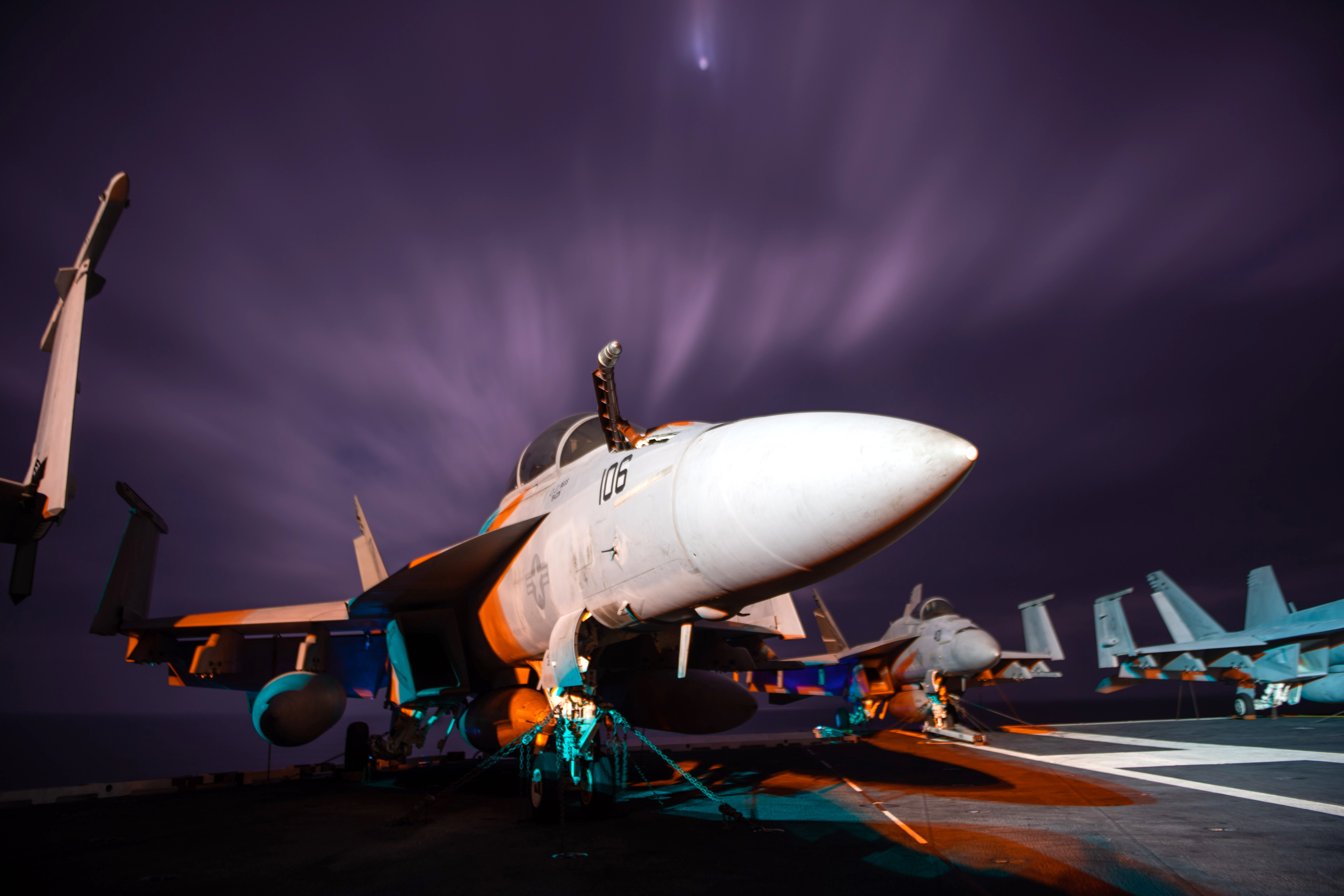
 news.usni.org
The fastest CF-18 replacement is likely the Super Hornet since the USN recently announced they're cancelling their Super Hornet orders starting FY2022 so a Canadian contract signed in 2022 could probably go into production right away with no competition for production slots and in fact would be exactly what Boeing needs to keep the production line open. Hopefully someone in Canadian government figures out to use this as a negotiating advantage.Next year’s order of two dozen F/A-18E/F Super Hornets would be the last on the books for the Navy under this plan. In 2019, Super Hornet maker Boeing won a $4-billion multi-year contract to buy 78 Super Hornets through FY 2021.
According to the justification in the documents, the money the Navy for planned a subsequent multiyear buy of 36 Super Hornets from FY 2022 to 2024 would be rerouted to “accelerated development of Next Generation Air Dominance (NGAD) and other key aviation wholeness investments,” read the documents.
I think negotiating the contract is likely happening in parallel. There wouldn't have been much risk the State Dept would refuse the FMS and Congressional approval is pretty perfunctory where the deal can go ahead if Congress doesn't respond within 15 days of notification and it's already been 6 days.As for the RCAF upgrading Classic Hornets... that DSCA news release mentioned that it had the required State Dept approval. Next on the list would be Congressional approval, as well as negotiations on the actual contract or contracts. including things like offsets. That to me suggests that it could still be a year or more before Canada actually places an order for the kit upgrades, which in turn would push back production of the kit as well as both when aircraft upgrades could start and then be completed.
The fastest CF-18 replacement is likely the Super Hornet since the USN recently announced they're cancelling their Super Hornet orders starting FY2022 so a Canadian contract signed in 2022 could probably go into production right away with no competition for production slots and in fact would be exactly what Boeing needs to keep the production line open. Hopefully someone in Canadian government figures out to use this as a negotiating advantage.
The F-35 could probably be available the next fastest since I believe Turkey's cancelled production slots are still available or even if they've already been reassigned it'll be easier to negotiate for them since other countries would be no worse off than before Turkey left. Production in Canada seems to be a major selling point of the Gripen E bid, but that'll likely delay aircraft availability.
I think negotiating the contract is likely happening in parallel. There wouldn't have been much risk the State Dept would refuse the FMS and Congressional approval is pretty perfunctory where the deal can go ahead if Congress doesn't respond within 15 days of notification and it's already been 6 days.
Kuwait has ordered SHs and I don’t know how many they have already received. Germany intends to buy some as well. SH is also under consideration by Finland and Switzerland so SH production could be stressed depending on which countries decide on it. India is also a possibility, especially wrt to rising tensions with China. What is the current production rate and can it be increased should even half the order potential happen?

Boeing also has a contract to provide 28 Super Hornets – 22 single seat F-18Es and six two-seat F/A-18Fs – to Kuwait by 2022.

 defence-blog.com
“Block 3 delivery is just steps behind and the production lines won’t miss a beat, with the first two US Navy Block 3 test jets delivering in the next two months, followed by delivery of 24 E/F aircraft over the next year for our international customer, Kuwait.”
 news.usni.org
The 78 Block III jets the Navy bought in its multiyear contract should deliver by April 2024, according to the contract announcement from 2019.

According to the German Defence Ministry, a proposal will be submitted to parliament in 2022 or 2023 where it will make a final decision on whether to proceed with the split-buy.

I don't believe Kuwait has received any of it's 28 Super Hornets yet and will receive 24 over the next year with the entire order completed by 2022. The first of the USN's 78 Block III Super Hornets was just delivered and deliveries will end in April 2024. So the current order book is 106 Super Hornets from ~mid-2020 to ~mid 2024 for a current production rate of 26.5 planes/year. It looks like while German requirements call for 45 Super Hornets they won't formally decide on the order until 2022-2023. If Canada can stay on schedule, a Super Hornet bid win announced in 2021 with contract signed in 2022 should be ahead of the Germans. The main risk seems to be from what Finland and Switzerland decide. Boeing previously indicated in 2017 they can scale to 3-4/month to accommodate international orders so there is flexibility there.“As we think about the U.S. Navy’s demands for additional airplanes to address the Super Hornet shortfall, as we think about their international demands, we can see that going up to 3 or 4 per month sometime in the early 20s,” he said.
I do not doubt that contract negotiations are already underway. One of my concerns is that AFAIK they still typically take some time to actually hammer out, particularly if/when offsets have to get factored in. One thing which would be interesting to know is whether or not the APG-79(V)4 is built to order, or if enough modules are already slotted for production that an RCAF order could just get tacked on. If they are built to order and it ends up taking six months to a year or more for the negotiations to be completed and a contract signed that would just push out the date at which the upgrades could start that much further. This is also assuming that Canada does not have another change of gov't which ends up cancelling a signed defence contract. OTOH that drastic an action might enable the RCAF to get a real replacement for the Classic Hornets sooner but stopping some of the delays.
 raytheon.mediaroom.com
EL SEGUNDO, Calif., Jan. 15, 2019 /PRNewswire/ -- The U.S. Marine Corps selected Raytheon's APG-79(v)4 AESA radar to equip its F/A-18C/D classic Hornet fleet. Raytheon (NYSE: RTN) will begin delivering radars in 2020 and complete deliveries by 2022.
Based on the USMC experience, they first selected the APG-79(V)4 in January 2019, the contract wasn't signed until March 2020, and deliveries are beginning this year. That seems to indicate either the APG-79(V)4 can be built and delivered within several months of a signed contract or Raytheon is willing to begin production in absence of a contract. So if production rate can be increased or the USMC agrees to share production, the RCAF selecting it in 2020 could allow for first deliveries by the end of 2021. Otherwise deliveries should begin in 2022 after the USMC's order. Either way, the proposed IOC in 2023 seems realistic.The Naval Air Systems Command (NAVAIR) has awarded Raytheon USD30.2 million to procure AN/APG-79(V)4 AESA radar systems for the first nine USMC F/A-18C/D Hornets, with deliveries to be completed by May 2022.
This first contract comes 14 months after Raytheon announced that it had been selected to fit the AN/APG-79(V)4 AESA radar to 98 of the USMC’s F/A-18C/D fleet, replacing its own AN/APG-73 mechanically scanned radar. According to the company’s statement at the time, deliveries will run from 2020 through to 2022.
Agree, Gripen is out, regardless of where it is assembled. With no production line and Bombardier now consolidating its aerospace operations along with NORAD requirements, it simply isn’t an option IMO.Delivery of SHornets would depend on how else (if anyone) also places orders for them and when. If Canada bites the bullet and make a decision before 2022, then a timely delivery of SHornets would be more likely. My personal preference would be for an interim buy of SHornets or even better would be two squadrons worth of Growlers which could fulfill some of the fighter aircraft needs while the actual long-term fighter replacement continues. This would also be a better option from my POV than attempting further upgrades to an aged fighter fleet that has already seen three decades of service.
I do not doubt that contract negotiations are already underway. One of my concerns is that AFAIK they still typically take some time to actually hammer out, particularly if/when offsets have to get factored in. One thing which would be interesting to know is whether or not the APG-79(V)4 is built to order, or if enough modules are already slotted for production that an RCAF order could just get tacked on. If they are built to order and it ends up taking six months to a year or more for the negotiations to be completed and a contract signed that would just push out the date at which the upgrades could start that much further. This is also assuming that Canada does not have another change of gov't which ends up cancelling a signed defence contract. OTOH that drastic an action might enable the RCAF to get a real replacement for the Classic Hornets sooner but stopping some of the delays.
One conclusion I have reached, based off the Canadian Future Fighter Capability Program site, and I freely admit this is my own opinion, but it seems that the Gripen is out, at least for domestic production. I cannot see how Canada could expect to sign a contract for Gripens in 2022, and then start receiving the first production deliveries in three years from an as-yet-to-be-built domestic production line.

I suggest that you read back through this thread to see why the Gripen isn't a suitable acquisition for the RCAF. Yes economics and politics play their part, but you also have to have the right platform for the capability that you are requiring. It's a bit like taking a a knife to a gunfight if you get it wrong.With the Canadian economy the way it is there's simply no way Canada will buy F-35 or Super Hornet. The only economically viable option is Gripen E. It's a light fighter jet that don't cost that much to buy and service.
I suggest that you read back through this thread to see why the Gripen isn't a suitable acquisition for the RCAF. Yes economics and politics play their part, but you also have to have the right platform for the capability that you are requiring. It's a bit like taking a a knife to a gunfight if you get it wrong.
Canada isn't fighting any country. Canada hasn't fought a war since WW2. Canada don't need spend money on air force. And that's precisely the case. No way Canada will spend money on expensive planes like F-35 or Super Hornet.
l guess you haven’t heard about Korea or Afghanistan.
Really. I think that you need to read your history and actually do some proper research. The Korean War a very minor skirmish, now I've heard everything thing. So I suppose, according to you, WW2 was just a police action.Very minor skirmishes. Canada hasn't been doing a single strike on Qaeda since 2015 when Trudeau was elected. Canada simply has no money for F-35 or Super Hornet. Period. It's that simple. Really.
Canada's CF-18 will eventually be replaced by Gripen E and / or drones. Drones are cheap to operate and easy to train pilots. Just about anyone can fly a drone without strict physical requirements. Even I can fly a drone.

The F-35B is the Harrier replacement VSTOL variant not a 2 Seat OCU Variant of the F-35A, there is no 2 seat F-35, Trg will be done in Simulators then straight into the Single Seat Aircraft. Canada’s original requirement was for a all F-35A fleet.It doesn't matter if Canada participates in wars or not, Canada has a commitment to NORAD. The CF-188A/B+ fleet can no longer meet the needs of defending the northern hemisphere. I predict we will still choose the F-35A/B+ to fulfill this role, especially if Peter McKay is elected as the next Prime Minister of Canada. Personally, I would like to see the RCAF slowly transition away from domestic SAR squadrons, divert that role to the Canadian Coast Guard and other agencies and focus more on combat aircraft, namely fighters, ISR and close support aircraft. However, I don't know to sort out the economics of that idea and I don't think it would ever happen.