View attachment 55174
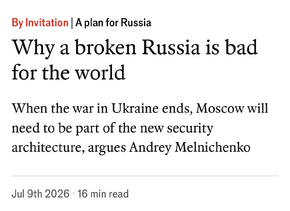
Melnichenko wrote an Article for The Economist
"And it means treating negotiations not as a barter of land for security guarantees but as the foundation for stable—if hostile—relations between Russia and Ukraine and, eventually, Russia and NATO."
Even if a lot of people are a lot happier ignoring reality, usually from a high horse.
"It comprises several layers: the tragedy of peoples who lived for centuries within a shared historical space; a conflict between Russia and the West—a dispute over territory, alliances, historical memory and the future of the world order."
Obviously not, it's only Putin creating an empire.
"Politicians operate through will."
Wrong again, only Putin; Trump is completely different.
"I try to describe the world as a physicist: as it actually is, not as one might wish it to be."
Could he be more wrong than that?
"But Ukrainian security built on the permanent negation of Russia’s sovereign agency is equally unstable."
Wrong once more... Russia has to do what Ukraine says and, specially, what we tell Russia to do.
"Russia has defined its vital interests, possesses the material base to defend them and bears the consequences of its own decisions."
But, Russia is wrong, every other country is irrelevant. The Universe exists only to prove that Russia is wrong.
"A country stripped of strategic autonomy will eventually accept the rules of those who stripped it."
An honest an honorable principle.
"When one side concludes that the other is bluffing or simply incapable of carrying through, it stops seeking a solution at the table. This is not a justification for any particular use of force. It is a description of how diplomatic failure actually occurs: not through bad faith alone, but through the collapse of credibility on both sides. Understanding this mechanism is not the same as endorsing its consequences."
If we, the west, are winning, there is no point in telling Ukraine to negotiate.
"The war in Ukraine is, in Russian eyes, a war against the West as a whole, fought with Western money, weapons and technology. That perception shapes every decision Moscow makes."
How could Russia believe that!
"The roots of the conflict lie partly in a structural imbalance that persisted in Europe after the cold war: Moscow’s security concerns were heard but never seriously addressed."
No, it's Russia's fault. Nothing that we did has anything to do Putin's decisions. We are right, Russia is wrong, there is no other point.
"Its publicly stated terms have narrowed to three: recognition of the territories Russia now claims under its constitution; legal protections for Russian-speaking populations; and a formal commitment to Ukrainian neutrality."
Well, and the Russian Empire, of course.
"In practice, the war has become an instrument of prolonged pressure on Moscow. What security order should ultimately exist in Europe, and what place does Russia hold within it? This suits the West: the heaviest human and economic costs fall on Ukraine and Russia."
How do you dare! What is the point of asking difficult questions when it is obviously working? (Like in Iran.)
"A new European security order in which Russia is a participant rather than a managed object. An economically and technologically superior coalition sustaining an adversary’s army while limiting its own direct involvement will eventually give way to something else. The question is not whether that transition comes, but when and on what terms."
Difficult questions again?
"Any strategy that treats nuclear escalation as a manageable extension of conventional pressure rests on a false assumption: that a complex system can be pushed to the edge and stopped precisely where it is politically convenient."
But why can't we keep pushing the system?
"Not because globalisation did not exist but because it was never neutral. Sanctions showed this plainly. They were written by some, in the interests of some, and can be revised for others by political decision. A fragmented world in which each bloc builds its own rules."
Rules against Russia. (But only because Russia is wrong.)
"The choice for external players is not between a friendly Russia and a hostile one. It is between a Russia whose behaviour is predictable and one whose trajectory is unknown."
Wait, the point is that Russia is wrong, that has nothing to do with it.
Once you are in a high horse in your own fairytale... Why would you deign to look down to reality?