The Russian-Ukrainian War Thread

rsemmes

Active Member
Donald Trump has halted new US military aid for Ukraine. European nations, grappling with stagnant economies and public spending pressures, are not doing nearly enough to fill the gap, according to the Kiel Institut in Germany.
And Ukraine is running out of money fast: Kyiv needs an estimated €136bn in 2026 and 2027 to fund its defence and keep afloat, according to the European Commission. Without new funds by spring, Ukraine risks going bankrupt, unable to pay soldiers, teachers and police.
...
Agreement would trigger an outpouring of relief, but the difficulties would be far from over. Even if EU leaders sign off on the frozen assets idea, it would still need to be turned into law to meet Ukraine’s urgent military and civilian needs by springtime.
It looks like we (decided to) took action, now let's write the law to make it legal. (What it's illegal in some countries.)

No, China and the EU are not providing the same level of support.
 

Aleks.ov

New Member
I agree that the global order is changing and that new centers of power are emerging. I still fail to see how Russia matters more in the new one than it did in the old, or why that would require invading Ukraine.
Yes, I am genuinely surprised.
I understand resentment over sanctions, companies leaving the country, frozen assets, barred athletes, and the way Russians are supposedly portrayed in Western media. What I struggle to understand is how these grievances translate into a widespread willingness to have one’s sons and brothers sent to die in a foreign land (which is not even a Western country). What does that solve?
Personally, I cannot imagine accepting deaths in my family simply because I perceive other countries as disrespectful toward my own. Especially for a country with such a rich history and culture as Russia’s, I find it hard to understand a retreat into such a simplified form of nationalism.
It’s also worth noting that many of these consequences appear to have followed Russia’s actions rather than preceded them, but I’m happy to set that point aside for now.
Unilateral military-political expansion and pressure in the post-Soviet space began long before the conflict in Ukraine, as has been repeatedly written here. Any proposals and projects regarding the security system were simply ignored, and at the highest level, and Ukraine is merely a consequence.
As for the role of financial incentives, the number of Muscovites participating in the SMO is about 90 thousand, and we are talking about the richest region and the most politically liberal one.
 

crest

Member
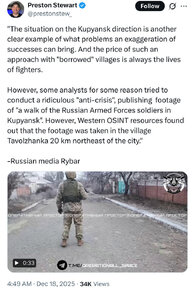
If this is accurate, I wonder why soldiers would make a video containing claims that are so easily disproven.
It wouldn't be the first time, it's not just propaganda either there is financial rewards for taking territory and other actions. That has of course resulted is what I guess is fraud technically. Also a good reason to wait for multiple sources of confirmation in these situations
 

Feanor

Super Moderator
Staff member
It appears the video was not made in Kupyansk.

Yeah, the claims are called into question. I'm not sure it's all that significant. Regardless of that soldiers' statements and that one video, we know Ukraine is advancing in Kupyansk and has almost pushed Russia across the river. That reality can't be contested with one video. If the video was real, it would illustrate the layer-cake of presence in the city, rather than demonstrate confident Russian control.
 

swerve

Super Moderator
Unilateral military-political expansion and pressure in the post-Soviet space began long before the conflict in Ukraine, as has been repeatedly written here. Any proposals and projects regarding the security system were simply ignored, and at the highest level, and Ukraine is merely a consequence.
There was nothing unilateral. It was always multilateral.

Your perspectives are faulty. You see only big countries, acting as monoliths. You ignore the wishes of smaller countries. Estonia, for example, was very keen to join NATO because it felt threatened by Russia, & that feeling was reasonable, because Russia acted threateningly. Separatist groups in the Russian minority in Estonia were supported by Russia, Russia tried to intimidate Estonia, from the early 1990s onwards. It got worse after Putin got into power. Estonia acted rationally in response to this, by seeking protection from friendly countries - i.e. NATO.

Same for most other E. European countries.

That was not "Unilateral military-political expansion". The fact that you, & many of your countrymen, see it as such is a major part of the problem. You do not accept that small countries can have agency, or rights. You see them only as clients of big states, obeying their masters, & if they act against Russia's wishes that must be because they are obeying an enemy of Russia.
 

crest

Member
As cynical as it may sound, what looks like a swap of Venezuela for Ukraine is underway.
I don't know if it's a swap the situation is different as if the us decides to blockade Russia cannot support Venezuela well the same is not true in Ukraine. That is to say the u.s doesnt need to swap not to mention it was quite clean the u.s was looking to get out of Ukraine well before the Venezuela issue took shape
 
It wouldn't be the first time, it's not just propaganda either there is financial rewards for taking territory and other actions. That has of course resulted is what I guess is fraud technically. Also a good reason to wait for multiple sources of confirmation in these situations
Before @rsemmes says it: McNamara fallacy! We have seen it all before by the Americans!
 

KipPotapych

Well-Known Member
You seem to be replying to something else, not what I wrote. My post referred only to what rsemmes wrote about belief, not about anything else. What did you think it meant?
He said that if Russia (anyone else, really) perceives something (Ukraine’s NATO membership in particular in this case) as a threat, then it should be taken as such. Their perception, that is. For them, it is (or nearly) a fact and we should work from that very position. Have I put more into it than what he was saying? I don’t believe I did, but I could, of course, be wrong.

You came back by saying that such position is ludicrous because basically others could be delusional to believe something that we believe is not true -> their belief should be dismissed as nonsense. Have I interpreted it wrong?

Then I said (I am going to modify it a bit, though the point remains exactly the same) that there are two sides that can cause great harm to each other (and the rest of the world) and have their own views of the issues at hand and may even think of each other as being delusional. What is the solution?

It seems to me that it would be irrational to simply dismiss the perception (rather conviction) of the threat of the concerned side. If one keeps dismissing that position, a conflict will emerge sooner or later. Here we are and the solution is being worked out as we “speak”, I guess.
 

KipPotapych

Well-Known Member
I think I could probably beat you at whataboutism competition if it came to that ;).
Why are some references to some historic events are looked down at as “whataboutism”?

Comparing an event or process/consequences to some other event is a rather analytical tool. In this case, for example, the response to “the wealthy ignore, while the poor bear the burden of war” was “sounds like Vietnam, so nothing new” (quotation marks do not indicate direct quotes, fyi). Which is just an observation, to which I could, for example add, or, perhaps, expand, and say this is how wars work in general. Is that a whataboutism? Not really. I am sure a discussion could follow if the parties were interested to continue. Otherwise, I think it is a valid observation.

And on the subject of that discussion. What the Russians did was basically “wagnerizing” their forces in Ukraine post mobilization and post Wagner. This was a natural and obvious development. Once the understanding of a prolonged conflict settled in, as well as understanding of the dangers of Wagner-like organizations, which happened long before the Prigozhin shenanigans, the decision was made to eliminate these middleman organizations and offer contracts to recruit into the Russian Armed Forces directly, on the voluntary basis. It follows that money talks, as it does always, and those in need show up. So it actually is not exactly the same as Vietnam, perhaps, as we are talking about voluntary enrolment here; there is more than one way to skin a cat though.


If this is accurate, I wonder why soldiers would make a video containing claims that are so easily disproven.
It actually wasn’t easy his time, lol. I read numerous accounts of capable geolocators struggling to find the match.

Why? Who knows. Why did the Ukrainians post an AI-generated video in front of the Pokrovsk sign not that long ago? And it was done by one of the most capable units to boot, the post quickly debunked and deleted. Is it whataboutism on my part? Laughing.

What I do not entirely understand about this Kupiansk stuff in particular is that the Russians keep doubling down on the “fact” that they control the entire city and keep doing so on the highest level. First, it was Gerasimov reporting to Putin that it was captured when it was clearly not. A few more episodes after that. Then, Belousov reporting the same yesterday/day before (I cited somewhere above). Today/yesterday Zakharova (of the Ministry of Foreign Affairs) mocked the photo of Zelensky in front of the Kupiansk sign and said again that the city is under full Russian control in spite of the Ukrainian wishes or something like that. Weird stuff, if you ask me. And I fail to understand the rationale behind it.

On the subject of that particular video:

IMG_3213.jpeg
 

KipPotapych

Well-Known Member
On the “reparations loan”. As I predicted, the loan idea had failed and was “postponed”. The alternative agreed to was a $90B interest-free (is there such a thing?) loan, tied to the EU budget, over the next two years:


This is mildly hilarious:

The scheme would “not have any financial obligations of Czech Republic, Hungary and Slovakia”, the leaders agreed. Those three countries had previously said they would not support using EU cash to fund Ukraine.

“They don’t have to pay — but we will make them pay for it [politically],” said a senior European official.


That last paragraph is the hilarious part.

Of note, $90B is not exactly sufficient for the UA budget and military needs for the next two years.
 

Aleks.ov

New Member
There was nothing unilateral. It was always multilateral.
Your perspectives are faulty. You see only big countries, acting as monoliths. You ignore the wishes of smaller countries. Estonia, for example, was very keen to join NATO because it felt threatened by Russia, & that feeling was reasonable, because Russia acted threateningly. Separatist groups in the Russian minority in Estonia were supported by Russia, Russia tried to intimidate Estonia, from the early 1990s onwards. It got worse after Putin got into power. Estonia acted rationally in response to this, by seeking protection from friendly countries - i.e. NATO.
Same for most other E. European countries.
That was not "Unilateral military-political expansion". The fact that you, & many of your countrymen, see it as such is a major part of the problem. You do not accept that small countries can have agency, or rights. You see them only as clients of big states, obeying their masters, & if they act against Russia's wishes that must be because they are obeying an enemy of Russia.
Are you intentionally citing as an example one of the Baltic states where the violation of the rights of the Russian-speaking minority is part of national policy?
 

KipPotapych

Well-Known Member
One more post.

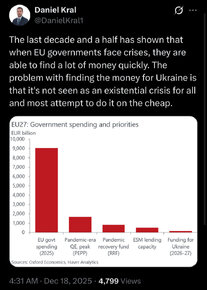
I usually respect Daniel Kral’s opinion, but this one is a miss (or, perhaps, spot on because this has nothing to do with an “existential crisis” as it has been portrayed over the years):


IMG_3216.jpeg

I think that the fact that the number even registers on this scale (note the trillion € scale) is rather respectable, considering no one owes anything to anyone and the “protectors of Europe” rubbish aside.

I am not sure if this is the expectations of something that has nothing to do with reality or what. I think that the chart of security guarantees vs expectations will look quite similar.
 

Aleks.ov

New Member
I don't know if it's a swap the situation is different as if the us decides to blockade Russia cannot support Venezuela well the same is not true in Ukraine. That is to say the u.s doesnt need to swap not to mention it was quite clean the u.s was looking to get out of Ukraine well before the Venezuela issue took shape
It's quite admissible that the Venezuela issue was raised in Anchorage and likely is part of the deal. In Russia, surprisingly restrainedly they comment on the US aggression against a neighboring state.
 

swerve

Super Moderator
He said that if Russia (anyone else, really) perceives something (Ukraine’s NATO membership in particular in this case) as a threat, then it should be taken as such. Their perception, that is. For them, it is (or nearly) a fact and we should work from that very position. Have I put more into it than what he was saying? I don’t believe I did, but I could, of course, be wrong.
That is not what he said. He wrote
"If Russia considers that Ukraine's NATO's membership is a threat, it is a threat.

If he meant what you think he meant, he should have said it. But he didn't.

Have I put more into it than what he was saying?
I think that's exactly what you're doing. You're over-interpreting, to fit it to what you think it should have said. What you say ("if Russia (anyone else, really) perceives something (Ukraine’s NATO membership in particular in this case) as a threat, then it should be taken as such. Their perception, that is. For them, it is (or nearly) a fact and we should work from that very position.") is perfectly good in itself, & I agree with it. But I don't accept it as a valid interpretation of what rsemmes wrote.
 
Top