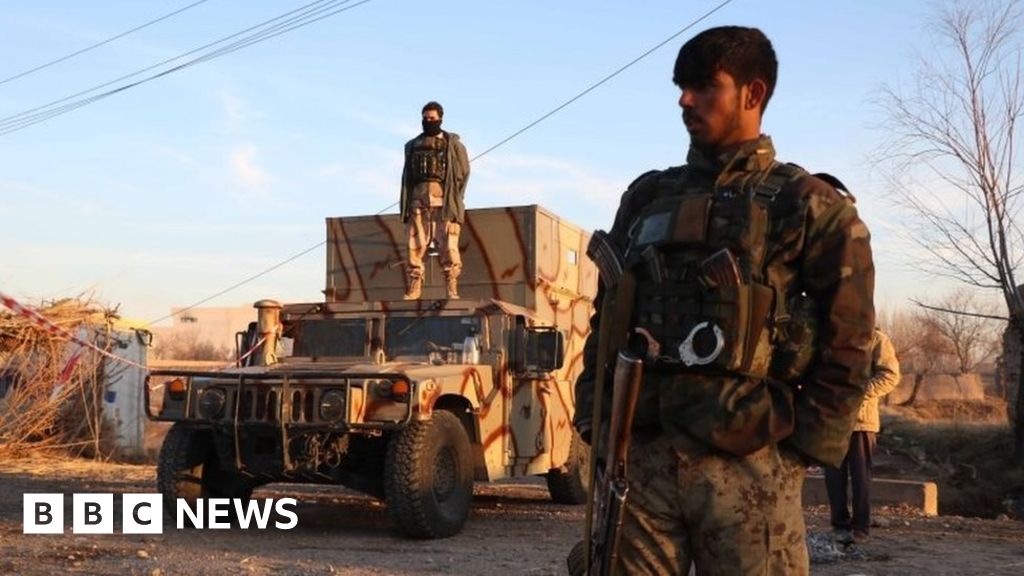
Post 1 of 3: The Adults are back in charge for the upcoming NATO withdrawal of Troops
It looks like we are heading to Obama era. History tells us that the Democrats are likely to increase troop numbers.
1. Good to see common sense being applied. Biden's national security adviser, Jake Sullivan, said that the administration is "taking a hard look at the extent to which the Taliban are in fact complying" with provisions of a U.S.-Taliban deal signed in 2020, under Trump.
2. I disagree with you and will provide some links to explain or provide context. I am even glad to see that the Biden administration is signaling a tougher line with the Taliban than Trump, with top officials warning that a planned U.S. troop withdrawal from Afghanistan in May 2021 could be delayed if the insurgents do not comply with their end of the bargain.
It will be a broken record all over again.
Pakistan will be asked to do more i.e. accept Indian presence and role in Afghanistan at all cost which obviously won't happen.
3. I am not sure what you are whining about. The Pakistani Government has said that it agreed to use leverage to get the Afghan parties and the US in the same room and let the locals decide. India is a sovereign country with its own
policies and agenda in Afghanistan. Indo-Afghan relations is strengthened by the 2011 Strategic Partnership Agreement. In Jun 2016, the US$ 290 million Afghan-India Friendship Dam (AIFD) or Salma Dam, located on the Hari River in Chishti Sharif District of Herat Province in western Afghanistan was opened.
(a) Further, in 2016, India inaugurated the Afghan Parliament building with approx INR 970 crore; announced new 500 scholarships for the children of the martyrs of Afghan Security Forces and gifted four Mi-25 Attack helicopters to the Afghan Air Force.
(b) US$ 1billion development assistance was announced in Sep 2017 by Government of India on a ‘New Development Partnership’. Government of India worked with the Government of Afghanistan to identify priorities and projects where Afghanistan needed India’s assistance.
(c) India agreed to implement important new projects such as road connectivity to Band-e-Amir in Bamyan Province that would promote tourism; low cost housing for returning Afghan refugees in Nangarhar Province to assist in their resettlement; a gypsum board manufacturing plant in Kabul to promote value added local industry development and import substitution; a polyclinic in Mazar-e-Sharif among others. In addition, India also committed to take up additional 116 High Impact Community Development Projects in 34 provinces of Afghanistan.
(d) The US$236 million Shahtoot Dam and drinking water project for Kabul will be built with Indian funds on a tributary of Kabul River, which originates from Sanglakh Range of Hindu Kush Mountain and flows through Kabul, Surobi and Jalalabad in Afghanistan before flowing into Khyber Pakhtunkhwa in Pakistan. Islamabad has been opposing the proposed dam arguing that such projects on the Kabul River and its tributaries in Afghanistan will reduce the flow of water into Pakistan.
Pakistan won't accept Indian consulates in Afghanistan for obvious reasons. Especially when these consulates have US blessing.
Won't accept Indian consulates? That's treating Afghanistan as a subsidiary state, denying its independence. Pakistan has no rights in this matter. Trying to ban Afghanistan having any consulates it wishes to accept is wrong. It is behaving as if Pakistan is Afghanistan's colonial overlord.
That behaviour is unacceptable to everyone else. It puts Pakistan firmly in the wrong.
4. I wish Maximuswarrior could have provided a link on the Pakistani Government’s stance, prior to being banned — his idiotic restatement of a Pakistani meme found in numerous forums seems to be very unreasonable. Like swerve, I hold the view that any responsible adult would not accept this self-serving punditry at face level.
The equation has changed dramatically since the Obama years. Iran, China and Russia are very actively involved in Afghanistan. They are supporting factions. These nations are tacitly in agreement with Pakistan.
5. In paragraphs 1 to 4 above, I searched for evidence to refute your lies or misinformation and provided either relevant links or context. IMO, the quality of your post is so low, it sounds like propaganda written by Pakistan’s Inter-Services Intelligence Directorate or ISI (which shares a link with the Taliban, especially the Haqqani group). I don’t even consider you as an ‘useful idiot’ (to quote Lenin/Stalin) for Iran or the regional spoiler Russia. There are also rumors that the
Haqqani network, traditionally known for having strong ties to Pakistan, is getting closer to Iran as well but that situation will not endure beyond 2021. Let me share my subjective opinion below:
One, Iran and Pakistan’s interests can never align in the long-run — Iran supports the Shi’a Hazaras in their controlled territories and its port competes with Pakistan’s port. Chabahar is Iran's only oceanic port that has particular promise as a means of access to the Indian Ocean for landlocked Afghanistan; and reduce the country’s dependence on the Pakistani port of Gwadar for transit trade. In Nov 2018, the Americans have announced that economic activity related to the development of the Chabahar port would be exempted from certain reinstated sanctions from the Iran Freedom and Counter-Proliferation Act of 2012. In Oct 2017, India's first shipment of wheat to Afghanistan was sent through the Chabahar Port. In Dec 2018, India took over the port's operations. in the case of India, they have also delivered 75,000 MT of Wheat to Afghanistan in 2020. In addition, India has also undertaken supply of certain types of medicines and have provided 50,000 pairs of surgical gloves to Afghanistan in 2020. This ensures that the Afghan Government does not become a puppet of the ISI.
Two, India is also exploring opportunities for cooperation (as limited as they might be) with Iran with regard to the port of Chabahar. Iran recruited Indian firms in the 1990s to lead the Chabahar port project, but increased sanctions by the US made only a partial completion possible. In 2012, after the initial repeal of sanctions under the JCPOA, India invested US$500 billion. The port has faced many bouts of uncertainty, but with the reinstatement of sanctions in Nov 2018, the US holds the decisive power over the port’s future. As a close partner, India is particularly wary of and responsive to U.S. influence. India’s close relationship with the US and Israel make it an unusual partner to Iran but simultaneously the ideal actor to oversee a responsible economic partnership between Iran and Afghanistan.
Three, Tehran has been pursuing a risky policy of “
hedging” in Afghanistan — simultaneously providing support to the Afghan government and the Taliban in the hopes of keeping them divided and influencing political developments once the U.S. draws down its forces. Despite being historically anti-Taliban, Tehran seems to have changed its tune on the understanding that the Taliban would no longer persecute Shi’a Hazaras. The Taliban has also reciprocated, and the reason seems tactical. Ahead of the 2021 intra-Afghan talks, the Taliban has pulled out all the stops to gain legitimacy among Afghan Hazaras.
Four, to some extent, China is interested in having a stable Afghanistan partner to work with after NATO troops pull out (unlike ISI’s agenda) — therefore not aligned with ISI’s interest to destabilise existing the Afghan Government, in its attempt to create strategic depth. India is exploring opportunities for cooperation (as limited as they might be) with China, and find common ground with the US on Afghanistan’s future. This does not mean forcing competing interests to align; it means investing in a wider diplomatic initiative with the view to carve out areas of convergence.



theintercept.com
www.hrw.org