ADF General discussion thread

SammyC

Well-Known Member
I remember reading somewhere and I can’t remember where that Israel’s David’s Sling/Raytheon Stunner Missile was being considered at one stage.
I would suspect it is another medium range option in the mix. I'm thinking more as the Raytheon branded skyceptor, rather than the Rafael stunner/david's sling. It's a deliberately much cheaper missile system, apparently about a quarter the cost of a PAC3.

Raytheon are advertising the skyceptor as an additional integrator with patriot. The principle being it can be used for the low tier medium range threats, leaving the more expensive PAC3s for the tougher targets.

I would suggest that the lower cost has come at lost capability, so being very careful to consider it a full replacement or equal to a PAC3. It is not. But as part of an ecosystem, it is probably a good concept.

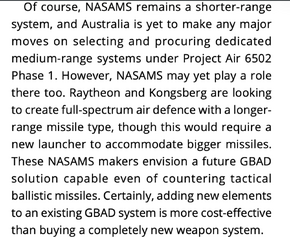
The question is can it be integrated into NASAMS, our preferred platform and factory. The answer is probably yes as Raytheon have a strong stakehold in our existing system. It won't fit in the current launcher, so will need its own, but that should not be a problem.

One thing to note is that I think at the moment, the only production facility for skyceptor is in Israel, so it will need a new production line, either in the US or in Australia if we become a customer. Europe is progressively becomming a larger customer for skyceptor, so there likely will be a larger user community in the near term.

I think one thing to remember is that Australia went to great lengths with NASAMS to develop its own fire distribution centre linked to the CEA radar and developed a factory for future production. It was also designed to link into upcoming battle management systems such as AIR6500. The NASAMS FDC was built by Kongsberg, but the prime was Raytheon. This was expensive and I can only think it was deliberate, with the intention that future systems would leverage this architecture.
 
Last edited:
MARKMILES77

Well-Known Member
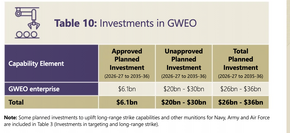
The way I read the table is that the "active missile defence" includes investments from everything from VSHORAD up. So $7-10 billion for everything.

I also noted the wording for NASAMS says ".. the first two batteries now in service...". Given that that I thought we only purchased two batteries, this indicates more might be procured. Perhaps I'm reading to much between the lines.

The wording was also very specific for a "medium range" ground based air defence system. The wording is a bit obtuse. I assume it excludes high end ballistic missile defence, so its not arrow or thaad. But it could be AMRAAM-ER or patriot or both.

Given the problems with patriot availability (and excessive reliance on the Americans), I'm wondering if something like the Japanese new type 03 kai series, which supposedly has a terminal phase ballistic and hypersonic capability might be considered. The Koreans have some interesting air defence missile systems as well.

I can imagine the government would want to commonalise fire control systems and radars, so I wonder if Japan and Korea would let their missiles be integrated with our Kongsberg panel and CEA radars. Could be interesting.

So, if I put some pieces together, a program could be something like
  • Mistral 3 mounted and dismounted systems. Romania bought 300 missile packages for about $1 billion. Sets up Nioa.
  • An additional 2 NASAMS batteries. Another $2 billion. Keeps the South Australian factory open.
  • Upgrade NASAMS to AMRAAM ER (border line medium range system in its own right)
  • The rest on patriot, or a Japanese or Korean proper medium range system. $5-7 billion buys somewhere between 2-4 batteries.
I too noted the phrase "first two batteries", does strongly suggest a plan for further NASAMs batteries.
Extra batteries could be equipped with AMRAAM-ER for a relatively quick increase in capability/range and then
another longer range missile could be added.
Wonder whether Australia might have a desire to have alternative missile suppliers for the NASAMs (i.e. alternative to US sources).
In which case perhaps the IRIS-T SLX might be an option for the medium range system. I believe shorter range IRIS-T missiles (IRIS-T SLS)
have already been intergrated with NASAMs.
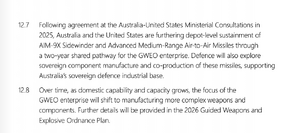
Remembered this, which I think was from Australian Defence Magazine last year:Screenshot 2026-04-18 at 09.15.16.png
 

Murse

New Member
An interesting point Mick Ryan brings up in his analysis, is the lack of mobilisation plans. How do we scale up the manpower and how are we arming them? Do we still have SLR's in packing grease at Macrossan? Yes, im being slightly facetious, but how are our small arms numbers and other bits of kit?
 

StevoJH

The Bunker Group
I wonder if ESSM Block.II could be integrated into NASAMS instead of using it in repackaged form (AMRAAM-ER).

It would reduce the number of individual missiles in service and allow a larger overall pool of missiles available for reload for either NASAMS or RAN Frigates/Destroyers.

--------------------

@Murse I would be more interested in the production capacity that Thales have at Lithgow Arms and their ADI ammunition plant then what 60 year old weapons can be pulled out of storage.

How much work over are those things going to need if they exist, have they been stored properly? Do you go custom machine new parts or cannibalise rifles to get others working?
 
Last edited:

MARKMILES77

Well-Known Member
I wonder if ESSM Block.II could be integrated into NASAMS instead of using it in repackaged form (AMRAAM-ER).

It would reduce the number of individual missiles in service and allow a larger overall pool of missiles available for reload for either NASAMS or RAN Frigates/Destroyers.
Or alternatively intergrate AMRAAM-ER into the Mk-41 launcher.
Then a single Australian factory could be set up to produce AMRAAMs for Air Force and AMRAAM-ER for Army(NASAMs) and Navy Mk-41 launchers. It is even possible AMRAAM-ER could be used as a long range air to air missile and then a single pool of missiles could supply Air Force, Army and Navy?
 

ADMk2

Just a bloke
Staff member
Verified Defense Pro
Or alternatively intergrate AMRAAM-ER into the Mk-41 launcher.
Then a single Australian factory could be set up to produce AMRAAMs for Air Force and AMRAAM-ER for Army(NASAMs) and Navy Mk-41 launchers. It is even possible AMRAAM-ER could be used as a long range air to air missile and then a single pool of missiles could supply Air Force, Army and Navy?
Who is funding this given all the work (and work share) that has gone into ESSM Block II?

No-one.

RAAF is also moving to AIM-260 as it’s principal air to air weapon…
 

StevoJH

The Bunker Group
Or alternatively intergrate AMRAAM-ER into the Mk-41 launcher.
Then a single Australian factory could be set up to produce AMRAAMs for Air Force and AMRAAM-ER for Army(NASAMs) and Navy Mk-41 launchers. It is even possible AMRAAM-ER could be used as a long range air to air missile and then a single pool of missiles could supply Air Force, Army and Navy?
Despite the name, AMRAAM and AMRAAM-ER are actually two different missiles.

AMRAAM-ER is an ESSM missile body with the guidance module of an AMRAAM grafted to the top.

Hence why I suggested looking at the feasibility of integrating ESSM with NASAMS rather then adding an additional Frankenstein missile into service that then needs to be serviced, stored, upgraded etc.
 

Morgo

Well-Known Member
I would suspect it is another medium range option in the mix. I'm thinking more as the Raytheon branded skyceptor, rather than the Rafael stunner/david's sling. It's a deliberately much cheaper missile system, apparently about a quarter the cost of a PAC3.

Raytheon are advertising the skyceptor as an additional integrator with patriot. The principle being it can be used for the low tier medium range threats, leaving the more expensive PAC3s for the tougher targets.

I would suggest that the lower cost has come at lost capability, so being very careful to consider it a full replacement or equal to a PAC3. It is not. But as part of an ecosystem, it is probably a good concept.

The question is can it be integrated into NASAMS, our preferred platform and factory. The answer is probably yes as Raytheon have a strong stakehold in our existing system. It won't fit in the current launcher, so will need its own, but that should not be a problem.

One thing to note is that I think at the moment, the only production facility for skyceptor is in Israel, so it will need a new production line, either in the US or in Australia if we become a customer. Europe is progressively becomming a larger customer for skyceptor, so there likely will be a larger user community in the near term.

I think one thing to remember is that Australia went to great lengths with NASAMS to develop its own fire distribution centre linked to the CEA radar and developed a factory for future production. It was also designed to link into upcoming battle management systems such as AIR6500. The NASAMS FDC was built by Kongsberg, but the prime was Raytheon. This was expensive and I can only think it was deliberate, with the intention that future systems would leverage this architecture.
I would expect any acquisitions of Israeli technology will be politically problematic to say the least for quite some time.

Not saying whether that’s right or wrong, but it’s definitely a thing.
 

Tbone

Active Member
I would expect any acquisitions of Israeli technology will be politically problematic to say the least for quite some time.

Not saying whether that’s right or wrong, but it’s definitely a thing.
If purchased from Raytheon it would be considered a US product.. I’m not sure many people would know its origin to be honest. And if made in Australian factory under contract i don’t think it would be an issue at all.
 
Top