Royal Australian Air Force [RAAF] News, Discussions and Updates

ADMk2

Just a bloke
Staff member
Verified Defense Pro
Sounds very clever.
With the Patriot missile being integrated with the AEGIS system for use aboard naval vessels, potentially would allow a common pool of
Patriot and SM series missiles to be used by both Navy and Army for Air defence.
Would also allow Army to get a medium/long range air defence system into service utilising already purchased SM-2 missiles while they wait in
line for Patriot missiles to be available.
When has the ADF shown the slightest interest in Patriot?

They have literally gone out and built their own “candidate system” that deliberately doesn’t use Patriot…

If ADF wanted to use Patriot, it would seem far more likely to me, they’d just buy Patriot or LTAMDS and PAC-3 or something.

But they haven’t…
 

old faithful

The Bunker Group
Verified Defense Pro
When has the ADF shown the slightest interest in Patriot?

They have literally gone out and built their own “candidate system” that deliberately doesn’t use Patriot…

If ADF wanted to use Patriot, it would seem far more likely to me, they’d just buy Patriot or LTAMDS and PAC-3 or something.

But they haven’t…
No they haven't. They haven't had anything since bloodhound. The ability to use different missiles is a good, flexible idea, regardless if they have the munitions in stock or not. My concern is, if they get this candidate, will it be in meaningful numbers?
 

ADMk2

Just a bloke
Staff member
Verified Defense Pro
No they haven't. They haven't had anything since bloodhound. The ability to use different missiles is a good, flexible idea, regardless if they have the munitions in stock or not. My concern is, if they get this candidate, will it be in meaningful numbers?
That is the same question for any solution. This system hasn’t been chosen “yet” (though it will be a surprise to nobody if it is after all this…) and the basis of provisioning envisaged for this capability also has not yet been released.

Given the funding envelope for this program and the ADF’s “way” of doing things, I imagine the BoP will be similar to NASAMs. 2x operational batteries (Squadrons) and a training element structured into a Regimental sized formation (even if it is called a Wing or whatever in RAAF nomenclature…)
 

MARKMILES77

Well-Known Member
When has the ADF shown the slightest interest in Patriot?

They have literally gone out and built their own “candidate system” that deliberately doesn’t use Patriot…

If ADF wanted to use Patriot, it would seem far more likely to me, they’d just buy Patriot or LTAMDS and PAC-3 or something.

But they haven’t…
They have literally gone out and built their own "candidate system", that potentially, can use multiple missile types, including Patriot, probably also ESSM. Brilliant!
Anyone, who has paid any attention to Ukraine or the Iran conflict, realises the value of a SAM system that has multiple potential missile options, due to the rate at which SAMs are used up.
 

ADMk2

Just a bloke
Staff member
Verified Defense Pro
They have literally gone out and built their own "candidate system", that potentially, can use multiple missile types, including Patriot, probably also ESSM. Brilliant!
Anyone, who has paid any attention to Ukraine or the Iran conflict, realises the value of a SAM system that has multiple potential missile options, due to the rate at which SAMs are used up.
Yes, instead of literally taking the simple, straight forward and likely cheaper path of acquiring Patriot…

Acquiring something else doesn’t suggest overwhelming enthusiasm for the system, noting previous ADF concerns about “legacy” systems capability to deal with future threats, even if there is a theoretical, technical pathway to fire the missile from these launchers. Alternating to a separate, advanced new missile is never a plug and play scenario, and it’s a massive stretch to say at this point, that this will be the case here.
 

StevoJH

The Bunker Group
That system looks like it’s had quite a bit of work on it over a significant length of time.

Definitely doesn’t look like a system bolted together quickly as a proof of concept.

I like the idea of it being able to launch ESSM and SM-2, better to have a larger common pool of interceptors rather than multiple different incompatible interceptors.

Hopefully if chosen enough systems are fielded to cover Amberley, Williamtown, FBE, FBW and probably Tindal.
 

SammyC

Well-Known Member
I'm late to the party on the Derringer launcher, but am I right that this is the first use of the virtualised Aegis for a portable land based system, and the first actual application of a CEA radar (or anything other than SPY1/6/7) connected to Aegis?

If so, that is a substantial step change and an interesting paradigm change. Aegis up to this point has never been a small portable system. Now it can fit on the back of a truck, not just a big destroyer.

Aegis opens up so many other benefits in addition to a large missile library, such as CEC. All of a sudden a shore battery becomes connected with a destroyer, or other radar located forward.

I'm assuming if it can do SM2, then it can also use SM6? Hey presto we have medium range air defence. I know we don't have much inventory of the SM6, but we will in future. If it can be paired with cheaper systems for lower tier threats, then it would be useful.
 

Bob53

Well-Known Member
The questions in my mind are:
1. Why should the Army operate a medium/long range ADS rather than the RAAF? Surely it is more in the operational domain of the RAAF, especially if the IADS is also being managed by The RAAF. A medium/long range ADS could be provided as part of the RAAF elements attached to an Australian Task Force.
2. Has PATRIOT been selected as the medium/long range ADS for the ADF? If it hasn't then there aren't any future orders being placed by the ADF for PAC3 missiles. So why would SM-2s be taken away from the RAN to fill possible ADS launchers, which have not been ordered, to be back filled with a different type of missile which also hasn't been ordered.
On 1. Where would the trucks, logistics support, escort units, area defence units, SHORAD for these systems come from…wouldn’t it mean the RAAF would then have to set up a duplicate force to those that already exist in the army?
 

OldTex

Well-Known Member
On 1. Where would the trucks, logistics support, escort units, area defence units, SHORAD for these systems come from…wouldn’t it mean the RAAF would then have to set up a duplicate force to those that already exist in the army?
The RAAF would need trucks for any deployed element so the trucks for a MRAD would be needed whether it was for a deployed or non-deployed (i.e. base defence) element. The fact they would be the same as the Army uses means that there is a logistic and training saving (just like the ADGs using Bushmasters etc)
 

StevoJH

The Bunker Group
On 1. Where would the trucks, logistics support, escort units, area defence units, SHORAD for these systems come from…wouldn’t it mean the RAAF would then have to set up a duplicate force to those that already exist in the army?
It doesn't really matter if it is operated by the Army or RAAF, they are going to need additional supporting units either way. Even if the units themselves are operated by RAAF ADG's, that doesn't mean they can't be logistically supported by Army assets if that is the most efficient way to do it.

Who operates the assets is most likely going to come down to how they are intended to operate and the training pathway.
 

StingrayOZ

Super Moderator
Staff member
If so, that is a substantial step change and an interesting paradigm change. Aegis up to this point has never been a small portable system. Now it can fit on the back of a truck, not just a big destroyer.

Aegis opens up so many other benefits in addition to a large missile library, such as CEC. All of a sudden a shore battery becomes connected with a destroyer, or other radar located forward.
It is interesting, clearly the aegis integration of CEA equipment is working well. I'm curious how its actually configured, it mentions virtualised, so I wonder if the aegis is hosted remotely. It may be just a demonstration. It may be virtualized locally. I wonder if it runs a custom interface over it.
 

SammyC

Well-Known Member
It is interesting, clearly the aegis integration of CEA equipment is working well. I'm curious how its actually configured, it mentions virtualised, so I wonder if the aegis is hosted remotely. It may be just a demonstration. It may be virtualized locally. I wonder if it runs a custom interface over it.
My understanding of the virtualised system is that it runs locally on standard windows/Intel servers, with compatible software that is adaptable to the application. So in this case the software would have the basic core, but only the applications for equipment that is connected (CEA, SM2 and Derringer). Want to use a different missile, say Tomahawk or ESSM, then download the additional applications. Have a radar update, then download the patch. Have a problem with a local server, switch it out or use a spare.

I could be wrong but I don't think it works remotely, like say an Azure or Microsoft cloud server. I can't see that surviving the first 10 minutes of a conflict.

USS Winston Churchill is fitted with Virtual Aegis and I think future DDGs are slated for it. I think a version of the virtual Aegis was also used on the recent drone firings of SM2 at sea by the USN.
 

StingrayOZ

Super Moderator
Staff member
Aegis moved off custom RISC servers in the mid 2000s AFAIK. Most IT infrastructure is virtualised these days, as it make easier deployment, greater security, etc.

The virtualisation usually separates the interface from the actual combat system. So in Australia's future we have the consoles running 9LV, but that is really just a terminal interface to a server, which then talks to another server which is an Aegis combat system. Once the console is just a terminal window it makes sense to virtualise it. Each console can then become any other type of console or configuration. If the console interface crashes, another can quickly be booted up, and doesn't interfere with anyone else.
Here is an old picture from 10 + years ago, when they first started to open arch the entire thing,
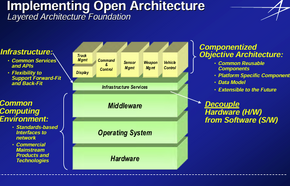
1783912499449.png
Virtualisation usually adds another abstraction layer above the OS and Hardware

I am curious if the RAAF is thinking of having their own combat interface. E7/JORN/Derringer/NASAMS. Or if it intend to use the 9lV, but customised.

I could be wrong but I don't think it works remotely, like say an Azure or Microsoft cloud server. I can't see that surviving the first 10 minutes of a conflict.
Virtualised terminal is virtualised terminal. It doesn't really matter. Presumably the first preference would be local virtualisation, but could be hosted elsewhere, it doesn't have to be in a Microsoft or AWS data centre. It could be in a shipping container 1km away out of the photo op. It could even be on an E7, or a government server elsewhere, but then you are dependant on your wireless communication links.

Part of the CEC is the ability to share radar data between and across the network. Not just there is a target at x,y,z but actual radar data, in a way to improve accuracy, etc. In this way, you are already pretty dependant on your wireless links. Again, if the CEC network drops out, you go back to the information you actually have from your own sensors.


Being Aegis back end, in theory, the Aegis integrated weapons, ESSM, SM-2, SM-6, SM-3 etc are all potentially available.

 

StevoJH

The Bunker Group
Would latency be an issue if Aegis isn’t hosted locally? Or do the newer interceptors with active seekers make that less of an issue?

The cloud based applications I’ve used (healthcare) are noticeably slower to respond than locally hosted if the local setup is on good hardware and a well configured network.
 

StingrayOZ

Super Moderator
Staff member
Would latency be an issue if Aegis isn’t hosted locally? Or do the newer interceptors with active seekers make that less of an issue?
Yes and no. They typically use low latency network links, they usually aren't just sending it through the cloud. Active seekers mean they are less reliant for a kinetic kill in that final phase, so if that data can get them as close as possible that the munitions sensors can lock in, and send them trajectory and threats etc, then most munitions will be able to make that last loop on their own.

Some aspects like the radar and sensor fusion, there is already latency from data processing etc.

Yes, locally hosted is going to be better most of the time, but in some situations, coordinating complicated attacks with multiple munitions from multiple platforms, local means different things.

MQ28 has been seen with meteor missile attached.

The Germans are apparently very excited about it.
 

StevoJH

The Bunker Group
I actually just had a bit of a look, even an ICBM mid-course doing say 15,000mph is *only* moving about 70 metres in say 10 milliseconds.

At a known distance, relatively predictable trajectory etc I suppose that should be relatively easy to correct for.
 

south

Well-Known Member
I actually just had a bit of a look, even an ICBM mid-course doing say 15,000mph is *only* moving about 70 metres in say 10 milliseconds.

At a known distance, relatively predictable trajectory etc I suppose that should be relatively easy to correct for.
Or in other words, it’s a small target moving about 6700m/s in space. Hitting this is a non-trivial problem.
 

MARKMILES77

Well-Known Member
They have literally gone out and built their own "candidate system", that potentially, can use multiple missile types, including Patriot, probably also ESSM. Brilliant!
Anyone, who has paid any attention to Ukraine or the Iran conflict, realises the value of a SAM system that has multiple potential missile options, due to the rate at which SAMs are used up.
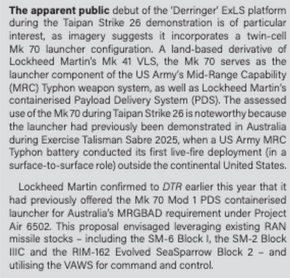
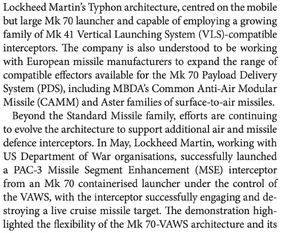
The latest Defence Technology Review has an article which reveals just how versatile a CEA/Aegis/"Derringer" SAM system could be.
It could potentially be capable of launching:
SM-2
SM-6
ESSM
CAMM family of missiles
ASTER family of missiles
Patriot

Screenshot 2026-07-25 at 21.06.02.pngScreenshot 2026-07-25 at 20.52.21.png
 

Takao

The Bunker Group
The latest Defence Technology Review has an article which reveals just how versatile a CEA/Aegis/"Derringer" SAM system could be.
It could potentially be capable of launching:
SM-2
SM-6
ESSM
CAMM family of missiles
ASTER family of missiles
Patriot
There is more too. Any Mk 41 VLS missile is up for shooting, meaning that Tomahawk and other surface-strike missiles are a possibility. And it's not too hard to develop very good decoys for the launcher.

Now you have a launcher that can shoot air or surface targets, and no-one knows until it fires. Even then, the reload could be anything. So, for REDFOR, is that a SAM or SSM launcher? Or is it a decoy? Anything that complicates their decision making cycle is healthy - that it saves BLUEFOR on training and integration is a bonus
 
Top