That was my assumption (perhaps boxers and possibly Atlas units as well), but that is an incredibly opaque way of including it in the budget.More Redbacks i would hope. Its seems so ridiculous having a factory built for such a small number.

There was a seperate line item for the Bushmasters, they get $2-3 billion unapproved planned investment all to themselves, so massive fleet renewal forever. Of note the Redbacks also get an additional $0.7-1billion of unapproved planned investment, its not clear what this will be for.Or Bushmaster replacement, which is a program
That's all extra to the mystery $7-10 billion for combat vehicle systems.
My guess would be upgrades due to a (edit) rolling maul of,... unexpected obsolescence covering more than just armour and IFVs.Hey, question
In the IIP26, table 5 on page 65 details the combined arms land force investments. One of them is titled "combat vehicle systems". There is nil current approved spend, but $7-10 billion in the unapproved planned spend. So it is a major item.
There does not seem to be a reference to this in the text. What is it relating to?
Last edited:
Agree a good one to point out.My guess would be upgrades due to a revolving door of unexpected obsolescence covering more than just armour and IFVs.
Combat vehicle systems.- 7 to 10 bn unapproved planned investment.
Given those other vehicles in the graph have a budget, one could assume the Combat vehicle systems thing is for something else.
Maybe SamB is correct in that it's a pool of cash to maintain and upgrade Army’s existing vehicle fleet of which there are probable a couple of thousand of all shapes, weight and size.
Such a large sum does ignite the fantasy fleet flame though.
Will those Huntman , Redback and Boxer factories shut the door when the vehicles are delivered.
At least a German boxer order delays that decision.
Federal election in two years time
Let’s see what happens by 2028
Cheers S
It would be foolish in the extreme to focus on continuous shipbuilding and continuous munitions production but not also continuous land vehicle production.
There's not a coherent strategy around this (at least not a public one I have seen) but I expect the Government has at least enough sense to keep the various production lines hot.
There's not a coherent strategy around this (at least not a public one I have seen) but I expect the Government has at least enough sense to keep the various production lines hot.

Todjaeger
Potstirrer
Not necessarily. It really depends on what the build and replacement cycles are for various pieces of kit, as well as what it costs to get a build capability started and then what it would cost to sustain.It would be foolish in the extreme to focus on continuous shipbuilding and continuous munitions production but not also continuous land vehicle production.
There's not a coherent strategy around this (at least not a public one I have seen) but I expect the Government has at least enough sense to keep the various production lines hot.
Take MBT's for instance, ~90 Leopard I MBT's entered Army service in 1977 and retired in 2007, 30 years later. Australia would have been hard pressed to stand up a MBT production capability and keep it going. Only 90 units were needed, and they were kept in service for 30 years. Even if Australia had built them as opposed to imported, and it took a decade to build a total of 90 tanks (or nine per year...) there would still have been 20 years where the production facility would have been idle.
One of the other areas where vehicles are a bit different from vessels is that a number of vehicles need to be deployed together as a unit to delivery functional capabilities, whilst a vessel might be deployed on it's own, or with a much smaller number of other assets. This in turn impacts how replacement cycles impact vessel's vs. vehicles. A 15 year build run for 8+ vessels works, but taking 15 years to build enough armoured vehicles to replace a type in service does not really work, especially if there are only a relatively small number in service to begin with.
Now before people suggest looking at the Bushmaster... I would suggest people look also look at the numbers in service vs. the number ordered, built and delivered to Army. Army ordered over 1,000 units, but only has around ~760-ish in service. Yes, some of the older units are or were likely retired and replaced with newer units, some were lost in service, and others sold or transferred to other nations, but the basic gist is that gov't ordered significantly more than Army actually uses. In the case of the Bushmaster, this can more or less work, because the Bushmaster itself is not as complicated and expensive a piece of kit as an IFV or MBT. In 2022 a Bushmaster had a rough cost of AUD$2.5 mil. that same year, the export cost for an M1A2 SEPv3 was ~USD$24 mil. or about AUD$34.6 mil. at the then avg exchange rate.
Even with all that, Australia might have close to AUD$1 bil. in Bushmasters parked without every having actually entered service, but were ordered simply to keep the Bushmaster line ticking along. Not sure that can realistically be done with something like the AS21 Redback, since the production facility is only expected to take about two years to deliver the 129 ordered. Some time ago I had run the numbers, and it looked like the production rate was to be ~5 units per month. Even if production following completion of the order was reduced to one per month, or 20% of the 'normal' production rate, that would be a dozen IFV's per year beyond what had been ordered. Could that really be kept going for a decade or two, in an effort to maintain a domestic, Australian armoured vehicle production capability?
Does Australia, the ADF and Army have the size/mass and budget specifically order 'extra' units to keep a production site going? Given all the other needs in Defence, I tend to think that there really is not enough.
I take your points (which are all good), about the whether the Army in peacetime could use the output of ongoing production lines. I think the answer is, ordinarily, absolutely not. But I worry that we are massively undercooked on materiel in the event of a major contingency.Not necessarily. It really depends on what the build and replacement cycles are for various pieces of kit, as well as what it costs to get a build capability started and then what it would cost to sustain.
Take MBT's for instance, ~90 Leopard I MBT's entered Army service in 1977 and retired in 2007, 30 years later. Australia would have been hard pressed to stand up a MBT production capability and keep it going. Only 90 units were needed, and they were kept in service for 30 years. Even if Australia had built them as opposed to imported, and it took a decade to build a total of 90 tanks (or nine per year...) there would still have been 20 years where the production facility would have been idle.
One of the other areas where vehicles are a bit different from vessels is that a number of vehicles need to be deployed together as a unit to delivery functional capabilities, whilst a vessel might be deployed on it's own, or with a much smaller number of other assets. This in turn impacts how replacement cycles impact vessel's vs. vehicles. A 15 year build run for 8+ vessels works, but taking 15 years to build enough armoured vehicles to replace a type in service does not really work, especially if there are only a relatively small number in service to begin with.
Now before people suggest looking at the Bushmaster... I would suggest people look also look at the numbers in service vs. the number ordered, built and delivered to Army. Army ordered over 1,000 units, but only has around ~760-ish in service. Yes, some of the older units are or were likely retired and replaced with newer units, some were lost in service, and others sold or transferred to other nations, but the basic gist is that gov't ordered significantly more than Army actually uses. In the case of the Bushmaster, this can more or less work, because the Bushmaster itself is not as complicated and expensive a piece of kit as an IFV or MBT. In 2022 a Bushmaster had a rough cost of AUD$2.5 mil. that same year, the export cost for an M1A2 SEPv3 was ~USD$24 mil. or about AUD$34.6 mil. at the then avg exchange rate.
Even with all that, Australia might have close to AUD$1 bil. in Bushmasters parked without every having actually entered service, but were ordered simply to keep the Bushmaster line ticking along. Not sure that can realistically be done with something like the AS21 Redback, since the production facility is only expected to take about two years to deliver the 129 ordered. Some time ago I had run the numbers, and it looked like the production rate was to be ~5 units per month. Even if production following completion of the order was reduced to one per month, or 20% of the 'normal' production rate, that would be a dozen IFV's per year beyond what had been ordered. Could that really be kept going for a decade or two, in an effort to maintain a domestic, Australian armoured vehicle production capability?
Does Australia, the ADF and Army have the size/mass and budget specifically order 'extra' units to keep a production site going? Given all the other needs in Defence, I tend to think that there really is not enough.
I don't think this means that we need to have the full kit for multiple armored brigades lying around (although perhaps we do), but I think it would be very prudent to have enough Boxers, Bushmasters, Hawkeis, MAN HXs, small arms, drones (offensive and interceptor) and perhaps M777s & VSHORAD to be able to fit out two divisions (or whatever the mobilisation boffins conclude is adequate) of conscripted motorised infantry. This would still be well short of the 12 divisions we fielded in WW2, but obviously the world has changed.
So I think the question isn't "do we have enough for 1st Division in peace time and a bit for 2nd Division to practice on" but "do we have enough for 1st Division, a fully mobilised second division, and however many infantry divisions we want to conscript, or have latent manufacturing capacity to surge in a reasonable timeframe?"
My answer to that question is to keep the lines rolling, and sell the surplus, or park it in a shed. I'm not a big fan of waste, but given the environment we're heading into I think it would be wise not to diminish our manufacturing capacity or warstocks at all.
Does anyone think that the reason behind opening up these factories is to safeguard against potential world wide conflict? It gives not only the military company options but there country another safe location to continue the supply of weapons and armoury. Also giving Australia slow output workforce thy can ramp up production quickly if conflict occurs. The hard yards are done factory a skilled staff have been obtained. The GOTD will just keep the facilities ticking over to ensure they are ready when orders come in or conflict occurs!
I would be very surprised if the ADF has enough equipment to deploy the entire 1st Division simultaneously let alone fill out the To&E for 2nd Division.So I think the question isn't "do we have enough for 1st Division in peace time and a bit for 2nd Division to practice on" but "do we have enough for 1st Division, a fully mobilised second division, and however many infantry divisions we want to conscript, or have latent manufacturing capacity to surge in a reasonable timeframe?"
If the Government wanted to fund the Army properly, 1st Division would be a trio of identically equiped Armoured (Heavy) or even Mechanised (Medium) brigades each with full supporting elements, plus independent Battalions or even Companies to maintain individual capabilities that may need to be expanded at some point. You can always strip equipment from a Heavy or Medium Brigade to make a Light Brigade, its a bit harder to turn a Light Infantry brigade into a Heavy Brigade when you don't have the equipment. Light infantry is definately cheaper though.....
2nd Division *should* have all the supporting elements and equipement in place to stand up 5-7 Identically equiped Motorised Infantry Brigades, even if some of the units are at Cadre strength and need to be filled out by calling up standby reserves.
Australia to sell fleet of Bushmaster armoured vehicles to the Dutch
OK, so we are getting another 268 Bushmasters, selling a number to the Netherlands, and upgrading the Hawkeis and the trucks. This will keep Thales Bendigo factory going through to 2033. I'm wondering how much of the new Bushmasters are allocated to retirements (I think about 300 are from the 2004 first batch vintage), or possibly further gifting to pacific islands.
I figured there would be a commitment to the Bushmasters, the IIP telegraphed this. I would be interested in what $400 million buys to upgrade the Rheinmetal truck fleet and Hawkeis. Its being done through the OEMs, so it does not sound like weapon upgrades, feels structural improvements. Any thoughts?
OK, so we are getting another 268 Bushmasters, selling a number to the Netherlands, and upgrading the Hawkeis and the trucks. This will keep Thales Bendigo factory going through to 2033. I'm wondering how much of the new Bushmasters are allocated to retirements (I think about 300 are from the 2004 first batch vintage), or possibly further gifting to pacific islands.
I figured there would be a commitment to the Bushmasters, the IIP telegraphed this. I would be interested in what $400 million buys to upgrade the Rheinmetal truck fleet and Hawkeis. Its being done through the OEMs, so it does not sound like weapon upgrades, feels structural improvements. Any thoughts?
Last edited:
Based on Conroy's statement about the fitment of RWS/lasers to the new order it sounds like it's tied into the LAND 156 project (counter drone).Australia to sell fleet of Bushmaster armoured vehicles to the Dutch
OK, so we are getting another 268 Bushmasters, selling a number to the Netherlands, and upgrading the Hawkeis and the trucks. This will keep Thales Bendigo factory going through to 2033. I'm wondering how much of the new Bushmasters are allocated to retirements (I think about 300 are from the 2004 first batch vintage), or possibly further gifting to pacific islands.
I figured there would be a commitment to the Bushmasters, the IIP telegraphed this. I would be interested in what $400 million buys to upgrade the Rheinmetal truck fleet and Hawkeis. Its being done through the OEMs, so it does not sound like weapon upgrades, feels structural improvements. Any thoughts?
He seems to have unintentionally dropped a point on the LAND 8113-2 project as well though.
It's not a bad thing to keep the fleet age down by maintaining production and there's no shortage of willing recipients for the old stuff.
Google AI told me the below program of works for the Hawkeis. So it looks like a bunch of general vehicle improvements, electronics, protection, plus preparation for a decent RWS. The EOS R400 was purchased under a different program I think to this.
Key Upgrades and Enhancements:
Key Upgrades and Enhancements:
- Braking System Remediation: Following safety issues that halted acceptance in 2022, braking system modifications are critical for operational safety.
- Protection and Survivability: Integration of applique armour and electronic countermeasure systems to protect against mines and improvised explosive devices (IEDs).
- Weapon Systems: Installation of EOS R400 remote weapon stations (RWS) for 12.7 mm M2 machine guns or automatic grenade launchers.
- C4I Connectivity: Integration of Digital Terminal Control System (DTCS) for seamless air, artillery, and naval coordination, enhancing situational awareness.
- Role Configuration: Vehicles are undergoing upgrades to transition from "basic" to "mission-ready" configurations, including specialized trailer integration for electronic warfare or surveillance.
- Power Upgrades: Upgrading power systems to support advanced electronic loads and improved load handling.
sounds like the rws mounted in its natural position and a new secondary mount at the back for a laser -probably lightweight fractl. Power pack might be fixed to the back of the truck?Based on Conroy's statement about the fitment of RWS/lasers to the new order it sounds like it's tied into the LAND 156 project (counter drone).
He seems to have unintentionally dropped a point on the LAND 8113-2 project as well though.
It's not a bad thing to keep the fleet age down by maintaining production and there's no shortage of willing recipients for the old stuff.
-Sky News AUS
Defence Industry Minister Pat Conroy said the order would see Thales begin production on a “next generation Bushmaster” that would give the ADF the “best capability in the world”.
Asked what the new Bushmasters would have that the current ones do not, Mr Conroy said the plan was to "mount lasers on these vehicles to destroy drones".
“What you're seeing with modern warfare is everything needs more power, more computing. So the next generation will have more power," he said.
“It will also have modifications at the back, which means you can swap in and out modules more effectively.
"Because one thing we'll be fitting onto these is remote weapon stations to deal with drones; including directed energy weapons - lasers, for want of a better word.
"And obviously you need plenty of juice to do that."
-Thales
Capability enhancements include improved protection and mobility, advanced digital systems, and increased adaptability to meet the evolving needs of defence operations including:
- Increased capacity for carrying personnel and increased tow capacity
- Stronger additional armour
- Ability to carry more powerful weapons systems, including roof mounted effectors
- Opportunity to integrate a wide range of sensors and effectors to efficiently defeat threats
- A fully modular crew cabin allowing for versatile configurations based on user needs
- Designed for export with left-hand drive capability and next-gen comms interfaces.
Last edited:
[/QUOTE]Google AI told me the below program of works for the Hawkeis. So it looks like a bunch of general vehicle improvements, electronics, protection, plus preparation for a decent RWS. The EOS R400 was purchased under a different program I think to this.
Key Upgrades and Enhancements:
- Braking System Remediation: Following safety issues that halted acceptance in 2022, braking system modifications are critical for operational safety.
- Protection and Survivability: Integration of applique armour and electronic countermeasure systems to protect against mines and improvised explosive devices (IEDs).
- Weapon Systems: Installation of EOS R400 remote weapon stations (RWS) for 12.7 mm M2 machine guns or automatic grenade launchers.
- C4I Connectivity: Integration of Digital Terminal Control System (DTCS) for seamless air, artillery, and naval coordination, enhancing situational awareness.
- Role Configuration: Vehicles are undergoing upgrades to transition from "basic" to "mission-ready" configurations, including specialized trailer integration for electronic warfare or surveillance.
- Power Upgrades: Upgrading power systems to support advanced electronic loads and improved load handling.
Time frames were already behind in a number of domains. According to the Defence Minister Richard Marles, the ADF had 10 lost years of defence spending, while also having to redirect resources into AUKUS, which has limited the ADF's flexibility and presence today, which must be addressed with equal urgency. On top of all that, the ten-year FOC cycle has to be reduced to meet operational challenges right now. The days of cheap energy and easy security are over. Australia's trade needs to be highly monitored from non-traditional adversaries, including "state-sponsored" fishing fleets and green men or whatever. Among other things, it is arguable SEA 3000 should be accelerated and expanded alongside the above enhancements.
This is an amazing sentence. I love it.Asked what the new Bushmasters would have that the current ones do not, Mr Conroy said the plan was to "mount lasers on these vehicles to destroy drones".
FRICKIN' LASERS.
I'm seeing it now, the Lasermaster!This is an amazing sentence. I love it.
FRICKIN' LASERS.
It's gunna need a bigger engine to provide that much power
Is there anywhere on a Bushmaster to fit an APU?I'm seeing it now, the Lasermaster!
It's gunna need a bigger engine to provide that much power

OldTex
Well-Known Member
At one point the self-recovery winch was replaced with an APU on some versions of the Bushmaster, usually on C2 or EW versions (although there may be others as well)Is there anywhere on a Bushmaster to fit an APU?
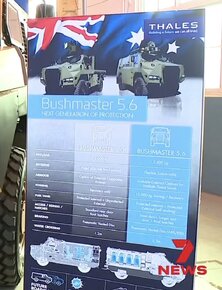
Bushmaster 5.0
Payload - 3,600kg
Interior - Fixed (Discrete Hard points)
Armour - Options of External composite armour
Towing - Recovery Only
Fuel Tank - Protected Internal / Unprotected External
Access / Egress / Hatches - Standard Rear Door + Roof Hatches
Braking - Pneumatic Vented Disc
Water Crossing - 1.2m
Bushmaster 5.6
Payload - 5,400kg
Interior - Flexible (Cabin rail)
Armour - Scalable external options for multiple threat levels
Towing - 15,000kg Towing / Recovery
Fuel Tank - Protected Internal / Protected External (Self sealing?)
Access / Egress / Hatches - Front Doors + Larger Rear Door + Roof Hatches
Braking - Pneumatic Vented Disc ABS / EBD
Water Crossing - 1.5m
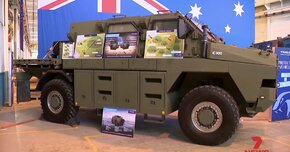
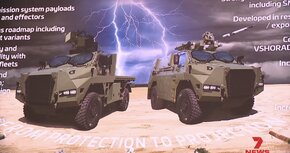
pics - 7 news
Weird 4 door variant with space for cargo.
Payload - 3,600kg
Interior - Fixed (Discrete Hard points)
Armour - Options of External composite armour
Towing - Recovery Only
Fuel Tank - Protected Internal / Unprotected External
Access / Egress / Hatches - Standard Rear Door + Roof Hatches
Braking - Pneumatic Vented Disc
Water Crossing - 1.2m
Bushmaster 5.6
Payload - 5,400kg
Interior - Flexible (Cabin rail)
Armour - Scalable external options for multiple threat levels
Towing - 15,000kg Towing / Recovery
Fuel Tank - Protected Internal / Protected External (Self sealing?)
Access / Egress / Hatches - Front Doors + Larger Rear Door + Roof Hatches
Braking - Pneumatic Vented Disc ABS / EBD
Water Crossing - 1.5m
pics - 7 news
Weird 4 door variant with space for cargo.
Attachments
-
 235.7 KB Views: 63
 -
 282.9 KB Views: 64
 -
 147.3 KB Views: 62