Soon production will ramp up to 300 rockets a year ffs.....Local production (assembly?) of GMLRS to commence shortly, they've got this up and running a lot quicker than I anticipated.
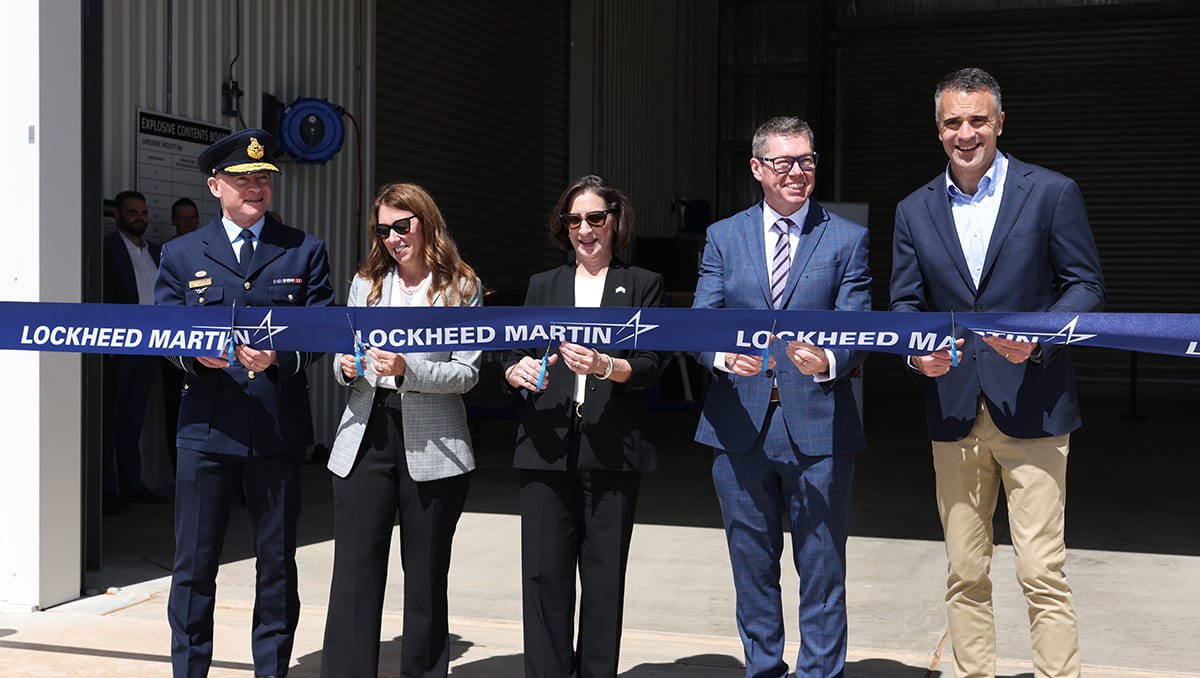
Australia kicks off local GMLRS production
Australia will begin manufacturing Guided Multiple Launch Rocket System (GMLRS) missiles this month following the opening of a new production facility at Port Wakefield in South Australia.www.defenceconnect.com.au

I assume you feel 300 is insufficient?Soon production will ramp up to 300 rockets a year ffs.....
How much should we pay now for GMLRS rockets that we can’t currently use or store? I can imagine Army’s training requirements as with every other corps, will involve minimal actual live firing of anything except reduced range practice rockets. If the Regiment fires more than a couple of dozen or so live GMLRS rockets per year, it will be the best funded Regiment we’ve ever had…
How much EO storage capacity should we then build? What sort of warstock would you deem sufficient?
How much are you willing to spend on ordnance we only “might“ need one day and what gives way to allow this to be funded?
How much surge capacity does this facility have? Can it expand it all?
Just whinging about quantities doesn’t add much to the debate...
I'm with old faithful. 300 does seem low. I would have thought there is excess demand for these from the increasing number of global HiMARS, M270 and the European GMARS launchers (everybody seems to have one now) to establish a larger production run.I assume you feel 300 is insufficient?
How much should we pay now for GMLRS rockets that we can’t currently use or store? I can imagine Army’s training requirements as with every other corps, will involve minimal actual live firing of anything except reduced range practice rockets. If the Regiment fires more than a couple of dozen or so live GMLRS rockets per year, it will be the best funded Regiment we’ve ever had…
How much EO storage capacity should we then build? What sort of warstock would you deem sufficient?
How much are you willing to spend on ordnance we only “might“ need one day and what gives way to allow this to be funded?
How much surge capacity does this facility have? Can it expand it all?
Just whinging about quantities doesn’t add much to the debate...
I get that the real prize is PrSM manufacture, however the GMLRS are kind of the potatoes (of a meat and potatoes metaphore). GMLRS is supposed to be a cheap, mass produced missile. I kind of think we should have a large shed of them. Right next to the large shed full of 155mm shells.
Perhaps more important though is the depth of the supply chain behind this factory. If I remember the earlier plan was to commence with assembly of overseas made parts only. I assume this is what has been announced and that probably is the reason for the low production (this would still be the crawl phase of the crawl, walk, run strategy)
If we use the 300 annual orders to then stand up local sub manufacturing, such as the rocket motor etc, then OK. These suppliers probably need time to get ready so could not manage large orders.
I still have not seen any public information on rocket motor manufacture. Have I missed something on that?
Apart from the logistical issues and the cost issues of building munitions we don’t need and can’t presently use (in any sort of cost effective manner) I am quite certain L-M has not licenced us to export GMLRS in competition to their own production.I'm with old faithful. 300 does seem low. I would have thought there is excess demand for these from the increasing number of global HiMARS, M270 and the European GMARS launchers (everybody seems to have one now) to establish a larger production run.
I get that the real prize is PrSM manufacture, however the GMLRS are kind of the potatoes (of a meat and potatoes metaphore). GMLRS is supposed to be a cheap, mass produced missile. I kind of think we should have a large shed of them. Right next to the large shed full of 155mm shells.
Perhaps more important though is the depth of the supply chain behind this factory. If I remember the earlier plan was to commence with assembly of overseas made parts only. I assume this is what has been announced and that probably is the reason for the low production (this would still be the crawl phase of the crawl, walk, run strategy)
If we use the 300 annual orders to then stand up local sub manufacturing, such as the rocket motor etc, then OK. These suppliers probably need time to get ready so could not manage large orders.
I still have not seen any public information on rocket motor manufacture. Have I missed something on that?
Global demand may well be high and in time we may well see orders placed, but no company starts building huge production numbers from scratch and neither will GWEO.
It’s no different to the artillery round issue. We were going to produce 10,000 rounds a year. Everyone b*tched and moaned about how few that is, based off Ukrainian wartime usage rates of artillery, whilst completely ignoring the fact that we are not at war, that we are not being provided wartime levels of funding and resourcing and Ukraine itself didn’t even manufacture 10,000 rounds of 155mm artillery ammunition before the war started either.
Our artillery production is also being scaled to increase capacity to 100,000 rounds per year if it becomes necessary and likewise I imagine GMLRS production will have an ability to scale up as well.
But no-one starts out like that and suggestions we should are futile. The need isn’t there, the funding isn’t there, the resourcing isn’t there and two months ago we weren’t capable of producing a single GMLRS rocket. Going from that to a sustained 300 missiles a year is a big achievement, but it is a starting point, not likely the end point.
Issues such as the lack of domestic rocket motor production as you point out mean that we aren’t really producing “anything” ourselves - yet. Arguing we should be scaling up before we can even do things like that are pointless.
Much better doing what we are doing, which is building out the capability to produce a sustainable production line, continue to produce the capability to build all the elements of the chosen systems and develop the longer term ability to scale up when we need to.
I see your pount AD, but 300 per year, eventually, does not mean 300 in the 1st year of production. I would have thought, that , given the world situation atm, and with our total lack of ability to really last any conflict with a near peer enemy for more than a few days in reality, and considering we will soon have @90 himars units, a capacity to store several thousand rounds would be reasonable, as well as the ability to produce or aquire several thousand rounds in short time would be required.
Always a difficult question as to how much stock of any munition type one should keep.I see your pount AD, but 300 per year, eventually, does not mean 300 in the 1st year of production. I would have thought, that , given the world situation atm, and with our total lack of ability to really last any conflict with a near peer enemy for more than a few days in reality, and considering we will soon have @90 himars units, a capacity to store several thousand rounds would be reasonable, as well as the ability to produce or aquire several thousand rounds in short time would be required.
Be that a bullet of a high end missile and everything in between.
Active conflict highlights the staggering demand of meeting supply of munitions.
Re GMLRS, this is very early days.
I’m confident it will evolve as capability is rolled out.
That said, I do take the point of the 300 number.
If we’re to fill all 42 of the first tranche of M142’s we have change from the proposed 300 of 48 rockets.
Hmmmmmmm!
I think most would agree it’s not the final number or aspiration going forward.
Cheers S
True, additionally however local production is not our only method of acquisition, by my count, we have already (or are) procuring over 1500x GMLRS / ER-GMLRS rounds directly from L-M as part of our existing capability, based on FMS announcements so far.I see your pount AD, but 300 per year, eventually, does not mean 300 in the 1st year of production. I would have thought, that , given the world situation atm, and with our total lack of ability to really last any conflict with a near peer enemy for more than a few days in reality, and considering we will soon have @90 himars units, a capacity to store several thousand rounds would be reasonable, as well as the ability to produce or aquire several thousand rounds in short time would be required.
No, 300x rounds may not arrive in the first year additionally 300x rounds of what? GMLRS? ER-GMLRS? Unitary warhead variants, alternate warhead variants? From a steady production POV, 30 a month or so seems a reasonable target for a production capability that is literally starting from scratch. At that rate and given the inventory we have acquired (and may acquire more still) we will hit that “several thousand rounds” inventory within several years of production even at the current peace time rate. Based on what we are doing with domestic artillery ammunition production capability I have no doubt increased production capacity is being “baked into” this program and would be activated quickly if needed. Even adding a night shift etc would hurry things up, if necessary. It seems as if the plan is to get us to the point where we can eventually produce up to 4000x rounds per year.
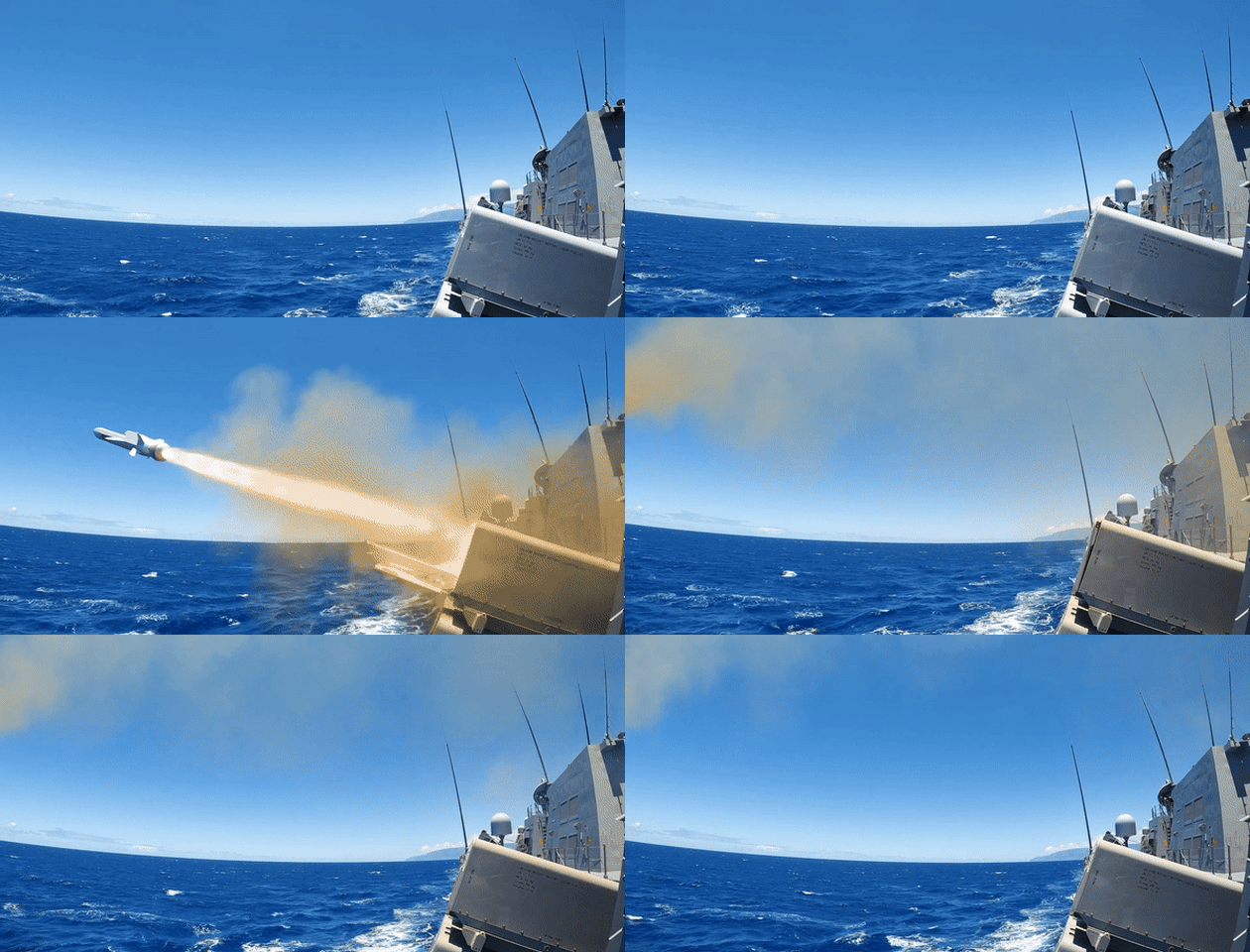
GWEO plans under the microscope - Australian Defence Magazine
ADM Correspondent Max Blenkin picks apart today’s GWEO announcements, made by Minister for Defence Industry during his address at the National Press Club | Max Blenkin
 www.australiandefence.com.au
My point is simply moaning about numbers is useless. Of course if we are at war we will need more of everything, just like Ukraine does. But “everything” takes money, time and resources and investing too much in one thing, takes money, time and resources away from something else.
We all want more but a balance has to be struck. What‘s important now, is shoring up our production capacity so we can go it alone if it
becomes absolutely necessary and be able to ramp up to wartime production numbers as we need to.
Additionally, I’m sure you know, you can’t just plonk advanced missiles or other EO in a warehouse. Dedicated EO magazines, storage and distribution systems are required to support this product and to get them where they need to be.
Now we actually have a (seems to me) fairly comprehensive program to build that with some 11 new (IIRC) EO facilities being created by defence and distributed around the country-side. Again, will take time to roll these out…
Missiles, before the capacity to safely store, maintain, train and distribute is definitely a cart before the horse scenario….
With 90 launchers …we would probably want to give them a chance to live fire a few different rounds per crew… say 4-6 missiles each … per year… it’s not exactly high tempo training.I see your pount AD, but 300 per year, eventually, does not mean 300 in the 1st year of production. I would have thought, that , given the world situation atm, and with our total lack of ability to really last any conflict with a near peer enemy for more than a few days in reality, and considering we will soon have @90 himars units, a capacity to store several thousand rounds would be reasonable, as well as the ability to produce or aquire several thousand rounds in short time would be required.

Todjaeger
Potstirrer
I went back through the article to try and see what it said about production, specifically the ability to expand it. The numbers are a bit sketchy, but given that "full rate" production is set to begin by the end of 2025, and here it is a quarter of the way through December... The Port Wakefield facility itself per the article will,I assume you feel 300 is insufficient?
How much should we pay now for GMLRS rockets that we can’t currently use or store? I can imagine Army’s training requirements as with every other corps, will involve minimal actual live firing of anything except reduced range practice rockets. If the Regiment fires more than a couple of dozen or so live GMLRS rockets per year, it will be the best funded Regiment we’ve ever had…
How much EO storage capacity should we then build? What sort of warstock would you deem sufficient?
How much are you willing to spend on ordnance we only “might“ need one day and what gives way to allow this to be funded?
How much surge capacity does this facility have? Can it expand it all?
Just whinging about quantities doesn’t add much to the debate...
that suggests to me that the facility might not have much room for expansion of production capacity. If the 20 positions are all in a single shift, with the facility under current plans to run 5 days/week, as opposed to 24/7, then production capacity might be able to be tripled.directly create about 20 manufacturing jobs at Port Wakefield...
What would also be good to know is what the plans or expectations are for peacetime usage of munitions during training and exercises. Not sure where exactly the 300/yr figure came from, but if each of the ~90 units were to fire the equivalent of a full six rocket salve between training and exercises over the course of a year, that along is about 540 rockets. Now I tend to suspect that the RAA will not fire that many rockets annually (remember, BANG on exercises?) but that could still end up with Australia having some issues building up a peacetime munitions warstock, never mind being able to replace expended rockets during an actual conflict.
Ok, so the initial report I read said production will be 300 per year, surprise surprise, why on earth did I take what some idiot journalist say as fact, I am kicking myself for that, I know better.
FMS has been approved for 300 missiles, the factory aims to produce 4000 missiles per year from 2029.
FMS has been approved for 300 missiles, the factory aims to produce 4000 missiles per year from 2029.
300x pods, not missiles. There are 6x missiles per pod…Ok, so the initial report I read said production will be 300 per year, surprise surprise, why on earth did I take what some idiot journalist say as fact, I am kicking myself for that, I know better.
FMS has been approved for 300 missiles, the factory aims to produce 4000 missiles per year from 2029.
And we don’t have 90 launchers and may not ever.
We currently have somewhere between 4 and 8…
Last edited:
Aardvark144
Active Member
So the additional 48 HIMARS approved by Congress on 30 Sep 25 are not in addition to the original 42 (20+22) ordered earlier?300x pods, not missiles. There are 6x missiles per pod…
And we don’t have 90 launchers and may not ever.
We currently have somewhere between 4 and 8…
Last edited:
Yes I realise that we are waiting for the Himars order to be delivered.300x pods, not missiles. There are 6x missiles per pod…
And we don’t have 90 launchers and may not ever.
We currently have somewhere between 4 and 8…
The initial report I read was that the production was for 300 missiles a year, not 300 pods.
I did some research myself, which turned out the production should reach 4000 missiles a year by 2029, that did not specify which missile though. It could be the 300 atacms or whatever the acronym is, the long range jobbies, and the rest the 70km range jobs, who knows....

FoxtrotRomeo999
Active Member
My understanding is that LAND 8113 Phase 1 is to provide 42 Himars for the First Long Range Fires Regiment and that LAND 8113 Phase 2 may additionally provide 48 Himars for the Second Long Range Fires Regiment (as far as I can tell, no decision has been made yet on the platform for the Second Long Range Fires Regiment though approval has been given by the US for a Himars purchase). The following is from Lockheed Martin delivers 750th HIMARS launcher - APDRSo the additional 48 HIMARS approved by Congress on 30 Sep 25 are not in addition to the original 42 (20+22) ordered earlier?
In January 2023, the Commonwealth of Australia (CoA) announced the purchase of 20 HIMARS and associated hardware, under LAND8113-Phase 1. In August 2023, the CoA announced the purchase of an additional tranche of launchers and associated hardware – a final total of 42 HIMARS. The HIMARS capability being acquired by the Australian Army represents a generational shift in strike capability. The first eight launchers have been delivered early and on-budget with further deliveries expected in 2026.
In December 2024, Lockheed Martin was announced as one of two preferred options to satisfy requirements outlined under LAND8113-Phase 2 – Second Long-Range Fires Regiment. Lockheed Martin is proposing an additional tranche of HIMARS launchers with PrSM Increment 2 to provide an unmatched anti-access/area denial capability for the Australian Defence Force. A decision related to an additional long-range fires regiment is expected in 2026.

AndyinOz
Active Member
https://www.dsca.mil/Press-Media/Ma...a-m142-high-mobility-artillery-rocket-systems the DSCA had already looked over a possible arms sale to Australia and determined it should be approved. Whilst not a confirmation of a sale should the GotD see fit to go ahead the US authorities don't seem to see an impediment to it.
Yes they will be additional systems if selected, but that decision hasn’t been made yet.So the additional 48 HIMARS approved by Congress on 30 Sep 25 are not in addition to the original 42 (20+22) ordered earlier?
Army has Project LAND 4100 Phase 2 which is to provide a Regiment plus training elements to provide a land based anti-ship missile strike capability.
Lockheed Martin‘s HIMARS / Precision Strike Missile Increment 2 is one contender, Thales / Kongsberg Strikemaster / Naval Strike Missile is the other.
Government as yet hasn’t publicly decided which solution it will pursue. Both systems have pros and cons. I lean towards the HIMARS solution because of it’s flexibility and because of it’s overall capability which I and others deem to be substantially greater than the Strikemaster / NSM solution, but that isn’t the only criteria obviously.
If the HIMARS based solution is chosen, we have requested up to 48x HIMARS vehicles through the US Foreign Military Sales system, add these onto our existing order of 42x HIMARS and you get the 90x launch systems mentioned.
But it hasn’t been approved yet, scuttlebutt suggested the decision may be handed down in the November / December timeline, but as yet we have seen nothing on this project.

Takao
The Bunker Group
Minor amendment. LAND 4100 Phase 2 was subsumed into the broader LAND 8113 project in 2024, specifically Phase 2. LAND 8113 Phase 2 was stood up to improve and enhance the long-range strike capability delivered by Phase 1. This means that the anti-ship capability is not the main driver anymore.Army has Project LAND 4100 Phase 2 which is to provide a Regiment plus training elements to provide a land based anti-ship missile strike capability.
Landing Craft Medium contract signed.
‘Construction of the first LCM is scheduled to commence in 2026 with the eighteenth and final vessel scheduled for delivery in 2032.’
‘The LCM, being built for the Australian Army, will be manufactured in steel and capable of projecting loads up to 80 tonnes.’
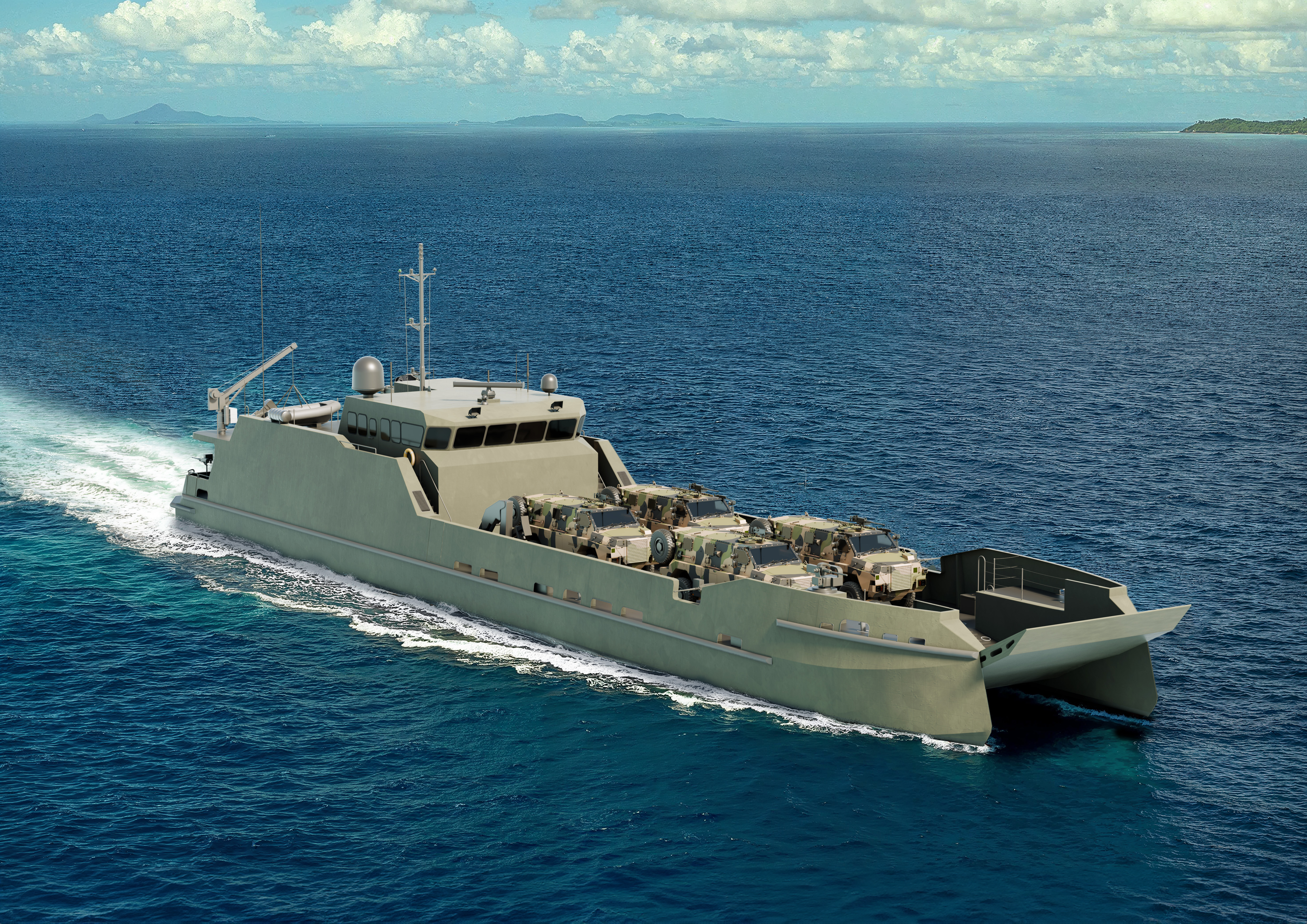
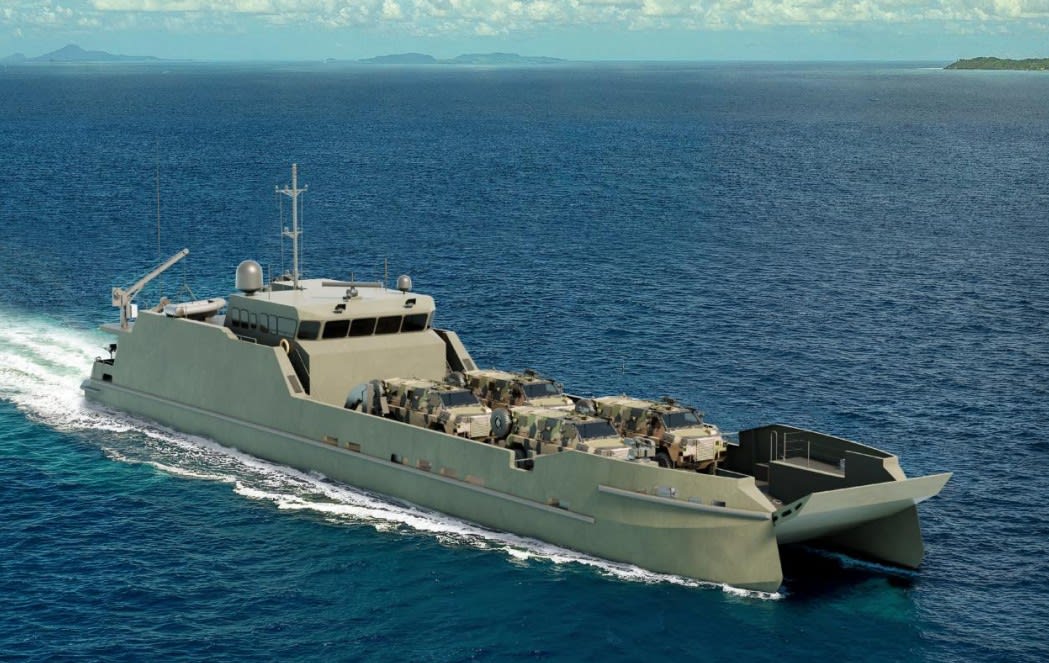
-Looks like the first LCM will no longer be delivered in 2026 and the original design had a capacity to transport around 100tons. If the new 80ton limit is true, it would mean it is no longer capable of transporting 2 IFVs. The range also significantly less than advertised, now only 1200nm(was 2,000-2,800nm previously).
LCM = 55m long, 10.5m beam, 1.7m draft.
 www.austal.com
 www.defenceconnect.com.au
‘Construction of the first LCM is scheduled to commence in 2026 with the eighteenth and final vessel scheduled for delivery in 2032.’
‘The LCM, being built for the Australian Army, will be manufactured in steel and capable of projecting loads up to 80 tonnes.’
-Looks like the first LCM will no longer be delivered in 2026 and the original design had a capacity to transport around 100tons. If the new 80ton limit is true, it would mean it is no longer capable of transporting 2 IFVs. The range also significantly less than advertised, now only 1200nm(was 2,000-2,800nm previously).
LCM = 55m long, 10.5m beam, 1.7m draft.
Austal Defence Australia awarded Landing Craft Medium Design and Build Contract
Austal Limited (ASX: ASB) is pleased to announce that it has been awarded a $1.029 billion Design and Build Contract for Landing Craft Medium (LCM) under the Strategic Shipbuilding Agreement (SSA) signed with the Commonwealth of Australia.
Austal to design, build Landing Craft Medium vessels under $1.03bn Australian contract
Austal has announced the award of a $1.03 billion contract to design and build Landing Craft Medium vessels under the Strategic Shipbuilding Agreement signed with the Commonwealth of Australia.
www.defenceconnect.com.au
Last edited:

Murse
Member
Plenty of room for Himars+, but my concern with this is the "detailed design" aspect of the media release. I thought it had already been designed by Birdon? I hope I'm wrong, but I don't expect to see them in the water until 2029.Landing Craft Medium contract signed.
‘Construction of the first LCM is scheduled to commence in 2026 with the eighteenth and final vessel scheduled for delivery in 2032.’
‘The LCM, being built for the Australian Army, will be manufactured in steel and capable of projecting loads up to 80 tonnes.’
-Looks like the first LCM will no longer be delivered in 2026 and the original design had a capacity to transport around 100tons. If the new 80ton limit is true, it would mean it is no longer capable of transporting 2 IFVs. The range also significantly less than advertised, now only 1200nm(was 2,000-2,800nm previously).
LCM = 55m long, 10.5m beam, 1.7m draft.
Also, has there been any information on basing in SE Qld? The refurbishing of the Cairncross dock seems like a bit of a coincidence.
The design is not complete, the whole program has been taken over by Austal. Birdons focus appears to be the U.S market atm.Plenty of room for Himars+, but my concern with this is the "detailed design" aspect of the media release. I thought it had already been designed by Birdon? I hope I'm wrong, but I don't expect to see them in the water until 2029.
Also, has there been any information on basing in SE Qld? The refurbishing of the Cairncross dock seems like a bit of a coincidence.
I think we will see atleast 1 by end 2027 and then 3+ every year from then on.
Funnily enough Singapore is showing interest in an updated Navantia Australia LC design, the Kodal 500.(bigger, different to the lmv offered to Aus)