
The Russian-Ukrainian War Thread
KipPotapych
Well-Known Member
A good article from the Hill on the Nord Stream blow-up:
Funny how at about the same time the article is posted, others push some completely illogical and nonsensical theories about the incident:
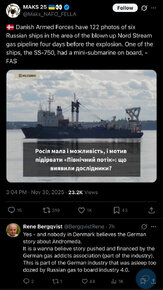
Again, I find it hard to distinguish between simple propaganda and complete delusion of the authors. I think there is an important difference. It appears that a widespread delusion is the most likely condition here.
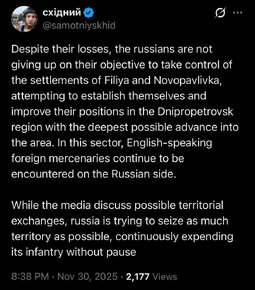
An interesting detail in this post by a UA soldier (drone operator, I believe, whose few interviews and articles in FT and WP I cited previously):
Lindsay Graham reacts to the latest article by Zaluzhny I cited yesterday, equating nuclear weapons placement in Ukraine and Ukraine’s accession into NATO as not exactly possible.
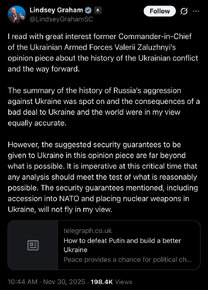
Note that he was (pretended to be?) a staunch supporter of the Ukrainian NATO membership until very recently and proposed to put it into law in the US (along with some Dem, whom I do not remember).
Stumbled upon this today in comments to some post that I do not recall:
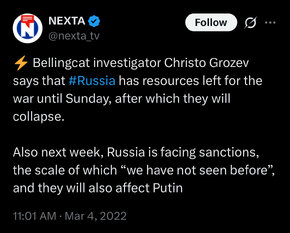
What I find amazing is that people still see these individuals (like Grozev) as some authority with external knowledge. More often than not, they don’t have that knowledge and simply spread propaganda of the day. But it is a funny post from nearly 3.75 years ago. Aged well though.
On the subject of rail sabotage in Poland. They keep charging Ukrainians working on behalf of Russians. Three was the count last I heard:
Kazakhstan does not like Ukraine hitting Novorossiysk oil terminal in Russia. This is for a reason, as roughly 80% of its oil exports exit through the terminal.
Kazakhstan "expresses its protest over yet another deliberate attack on the critical infrastructure of the international Caspian Pipeline Consortium in the waters of the Port of Novorossiysk," the ministry said.
"We view what has occurred as an action harming the bilateral relations of the Republic of Kazakhstan and Ukraine, and we expect the Ukrainian side to take effective measures to prevent similar incidents in the future."
Ukraine said its actions were not directed against Kazakhstan or third parties and were only aimed at repelling what it called "full-scale Russian aggression".
"Ukraine hits back at the aggressor," Ukraine's foreign ministry said.
An excerpt from a Russian propaganda article from Reuters:
Pavlo Broshkov had high hopes when he joined the Ukrainian army in March as a fresh-faced recruit eager to defend his country and earn a bumper bonus to buy a home for his wife and baby daughter.
Three months later, the 20-year-old lay broken and prone on the battlefield, his dreams in tatters.
"I understood this was the moment I would be torn to pieces," he told Reuters. "I was not afraid of death. I was afraid of not seeing my wife and child again."
Broshkov is among hundreds of 18 to 24-year-olds who have volunteered to fight on the front lines this year, lured by generous pay and perks in a national youth recruitment drive designed to breathe fresh life into Ukraine's aged and exhausted armed forces of about one million.[…]
Reuters tracked the fortunes of Broshkov and 10 of his comrades who were among a few dozen raw recruits that received a crash-course in warfare at a military training camp in spring before being deployed to the front.
None of the 11 are still fighting. Four have been wounded, three are missing in action, two are absent without leave (AWOL), one fell sick and another recruit has killed himself, according to interviews with soldiers, their relatives and government records.
The fates of the soldiers provide a snapshot of the carnage wrought on Ukraine by the grinding war against Russia, in which both sides closely guard casualty figures.
Reuters was unable to contact the other recruits who attended the spring training camp and couldn't determine whether the 11 cases reflect broader levels of attrition in the conflict, which has dragged on for almost four years.
The Ukrainian military and the 28th Brigade where the recruits served didn't reply to requests for comment for this article.
“Hundreds” that signed up since spring. “Received a crush-course in warfare” before being sent to the front. “None” are still fighting due to being killed, wounded, suicide, falling sick, or simply leaving. Sounds like someone is being “thrown to the meat grinder without training” for personal gain, etc. I wonder if people would perceive things differently if the same terms were applied to both sides of the equation (they are the same in reality, there is no magic).
Funny how at about the same time the article is posted, others push some completely illogical and nonsensical theories about the incident:
Again, I find it hard to distinguish between simple propaganda and complete delusion of the authors. I think there is an important difference. It appears that a widespread delusion is the most likely condition here.
An interesting detail in this post by a UA soldier (drone operator, I believe, whose few interviews and articles in FT and WP I cited previously):
Lindsay Graham reacts to the latest article by Zaluzhny I cited yesterday, equating nuclear weapons placement in Ukraine and Ukraine’s accession into NATO as not exactly possible.
Note that he was (pretended to be?) a staunch supporter of the Ukrainian NATO membership until very recently and proposed to put it into law in the US (along with some Dem, whom I do not remember).
Stumbled upon this today in comments to some post that I do not recall:
What I find amazing is that people still see these individuals (like Grozev) as some authority with external knowledge. More often than not, they don’t have that knowledge and simply spread propaganda of the day. But it is a funny post from nearly 3.75 years ago. Aged well though.
On the subject of rail sabotage in Poland. They keep charging Ukrainians working on behalf of Russians. Three was the count last I heard:
Kazakhstan does not like Ukraine hitting Novorossiysk oil terminal in Russia. This is for a reason, as roughly 80% of its oil exports exit through the terminal.
Kazakhstan "expresses its protest over yet another deliberate attack on the critical infrastructure of the international Caspian Pipeline Consortium in the waters of the Port of Novorossiysk," the ministry said.
"We view what has occurred as an action harming the bilateral relations of the Republic of Kazakhstan and Ukraine, and we expect the Ukrainian side to take effective measures to prevent similar incidents in the future."
Ukraine said its actions were not directed against Kazakhstan or third parties and were only aimed at repelling what it called "full-scale Russian aggression".
"Ukraine hits back at the aggressor," Ukraine's foreign ministry said.
An excerpt from a Russian propaganda article from Reuters:
Pavlo Broshkov had high hopes when he joined the Ukrainian army in March as a fresh-faced recruit eager to defend his country and earn a bumper bonus to buy a home for his wife and baby daughter.
Three months later, the 20-year-old lay broken and prone on the battlefield, his dreams in tatters.
"I understood this was the moment I would be torn to pieces," he told Reuters. "I was not afraid of death. I was afraid of not seeing my wife and child again."
Broshkov is among hundreds of 18 to 24-year-olds who have volunteered to fight on the front lines this year, lured by generous pay and perks in a national youth recruitment drive designed to breathe fresh life into Ukraine's aged and exhausted armed forces of about one million.[…]
Reuters tracked the fortunes of Broshkov and 10 of his comrades who were among a few dozen raw recruits that received a crash-course in warfare at a military training camp in spring before being deployed to the front.
None of the 11 are still fighting. Four have been wounded, three are missing in action, two are absent without leave (AWOL), one fell sick and another recruit has killed himself, according to interviews with soldiers, their relatives and government records.
The fates of the soldiers provide a snapshot of the carnage wrought on Ukraine by the grinding war against Russia, in which both sides closely guard casualty figures.
Reuters was unable to contact the other recruits who attended the spring training camp and couldn't determine whether the 11 cases reflect broader levels of attrition in the conflict, which has dragged on for almost four years.
The Ukrainian military and the 28th Brigade where the recruits served didn't reply to requests for comment for this article.
“Hundreds” that signed up since spring. “Received a crush-course in warfare” before being sent to the front. “None” are still fighting due to being killed, wounded, suicide, falling sick, or simply leaving. Sounds like someone is being “thrown to the meat grinder without training” for personal gain, etc. I wonder if people would perceive things differently if the same terms were applied to both sides of the equation (they are the same in reality, there is no magic).

- Thread Starter Thread Starter
- #13,263
Ukrainian counter-attacks are developing around western and south-western Kupyansk. It seems unlikely they'll be able to dislodge Russia completely, but it's not out of the realm of possibility. This comes as Russia continues to try and break Ukrainian positions on the left shore of the Oskol. This is a direct consequence of the awkward manner in which Russian command chose to attack Kupyansk. Theoretically the solution is to expand the area of control north and north-west of Kupyansk, but the Russian lines would have to push downward from pretty far north, and it's not clear troops are available for that.
KipPotapych
Well-Known Member
I am not sure if people actually lack the ability to think clearly and analyze what they are posting and reposting or, again, deluded themselves to the point they are completely blind and completely blocked the aforementioned ability. Let’s very briefly and quickly examine the following chart reposted by Tatarigami (presumably a rational UA analyst):
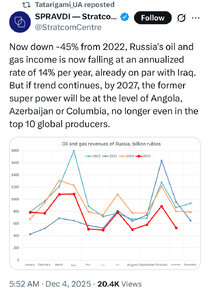
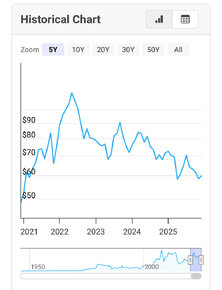
I don’t want to go looking for the data on Iraq’s oil royalties, as well as others’, because that has no relevance to anything, but the propaganda aspect of the presentation above. Let’s look at the core data and how it relates to reality (whether the above numbers are accurate or not is also largely irrelevant). I have discussed it here from another angle, the big oil profits, previously and, probably, some other perspective. Here is another, but also reality. Below is the chart representing historic crude oil price (the last five years):
Source: Crude Oil Prices (1946-2025)
To note, oil peaked at nearly $120 per barrel in 2022. I do not believe I need to verbally explain the implications of what the chart represents.
Here is yet another perspective, from another government’s angle that also heavily relies on revenues from hydrocarbon sales (but is not at war):
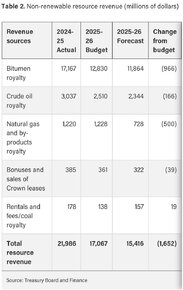
We can see that the revenue is down, year to year, 22% according to the expectations (that is, numbers estimated in the budget) and 30% looking the actual forecast. The numbers are from my home province of Alberta, Canada. Funny enough, we have been facing extremely comparable situation to that of Russia’s, but for decades. We also sell our oil at a discount to the US and that discount varies depending on demand and other factors (we are basically being blackmailed by the Americans because we put ourselves in the situation we are in, selling absolute majority of our oil to the US and lacking infrastructure to do otherwise, yet stubbornly refusing to rectify the issue). To make things more interesting, while getting a bit sidelined, the US buys our oil at a substantial discount, which allows it to export their own oil or process ours and export oil products for a significant profit. This process is what creates trade surplus in Canada in our trade with the US, which Trump further uses to impose tariffs on our products. We are basically being tariffed for letting the Americans to profit greatly from our own resources (there is no surplus if hydrocarbons are removed from the trade balance). To look at even a bigger picture, there seems to be one side (the same one) that is seeking and receiving profit, regardless of the situation in the world. And this, of course, is by design.
Source: Revenue
Is the “annualized14% drop per year” as bad as the original post implies? Another side of reality:
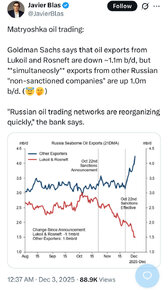
That is a guy from Bloomberg’s oil desk, not some propagandist from either side. You cannot sanction any set of oil companies because “other” companies will appear to sell the exact same oil. The sanctions must be implemented on the source rather than distribution - that is, secondary sanctions - in order for them to be effective as intended, but that is not going to happen. Even if it were, we are back to restricting a finite supply and there will be ways to circumvent around it. This is a futile game. Sanctions will not be more effective than they are now. In other words, Russia will keep selling oil via various channels and at varied discounts.
I said before that if the oil prices persist at low levels, as some desire for them to do, the implication here is not only lower Russian revenue from fossil fuel sales, but a bigger picture of the state of the world economy, that directly affects the assistance Ukraine is receiving. I will probably make another post later, looking at it from yet another angle of reality and how it affects the other side of this equation.
I don’t want to go looking for the data on Iraq’s oil royalties, as well as others’, because that has no relevance to anything, but the propaganda aspect of the presentation above. Let’s look at the core data and how it relates to reality (whether the above numbers are accurate or not is also largely irrelevant). I have discussed it here from another angle, the big oil profits, previously and, probably, some other perspective. Here is another, but also reality. Below is the chart representing historic crude oil price (the last five years):
Source: Crude Oil Prices (1946-2025)
To note, oil peaked at nearly $120 per barrel in 2022. I do not believe I need to verbally explain the implications of what the chart represents.
Here is yet another perspective, from another government’s angle that also heavily relies on revenues from hydrocarbon sales (but is not at war):
We can see that the revenue is down, year to year, 22% according to the expectations (that is, numbers estimated in the budget) and 30% looking the actual forecast. The numbers are from my home province of Alberta, Canada. Funny enough, we have been facing extremely comparable situation to that of Russia’s, but for decades. We also sell our oil at a discount to the US and that discount varies depending on demand and other factors (we are basically being blackmailed by the Americans because we put ourselves in the situation we are in, selling absolute majority of our oil to the US and lacking infrastructure to do otherwise, yet stubbornly refusing to rectify the issue). To make things more interesting, while getting a bit sidelined, the US buys our oil at a substantial discount, which allows it to export their own oil or process ours and export oil products for a significant profit. This process is what creates trade surplus in Canada in our trade with the US, which Trump further uses to impose tariffs on our products. We are basically being tariffed for letting the Americans to profit greatly from our own resources (there is no surplus if hydrocarbons are removed from the trade balance). To look at even a bigger picture, there seems to be one side (the same one) that is seeking and receiving profit, regardless of the situation in the world. And this, of course, is by design.
Source: Revenue
Is the “annualized14% drop per year” as bad as the original post implies? Another side of reality:
That is a guy from Bloomberg’s oil desk, not some propagandist from either side. You cannot sanction any set of oil companies because “other” companies will appear to sell the exact same oil. The sanctions must be implemented on the source rather than distribution - that is, secondary sanctions - in order for them to be effective as intended, but that is not going to happen. Even if it were, we are back to restricting a finite supply and there will be ways to circumvent around it. This is a futile game. Sanctions will not be more effective than they are now. In other words, Russia will keep selling oil via various channels and at varied discounts.
I said before that if the oil prices persist at low levels, as some desire for them to do, the implication here is not only lower Russian revenue from fossil fuel sales, but a bigger picture of the state of the world economy, that directly affects the assistance Ukraine is receiving. I will probably make another post later, looking at it from yet another angle of reality and how it affects the other side of this equation.

Ananda
The Bunker Group
Something that I have been talk in this thread and Russia thread from begining of this war. Hydrocarbon is finite commodities, and market will find whatever supply they want in the end. Taking out Russian Hydrocarbon supply from Global market (through sanction and geopolitic coercion) is only for delusional people minded. Even if Euro land somehow manage to get rid of Russian hydrocarbon, they are going to pay higher prices for the alternatives sources and Russian hydrocarbon will find others that will take them.You cannot sanction any set of oil companies because “other” companies will appear to sell the exact same oil. The sanctions must be implemented on the source rather than distribution - that is, secondary sanctions - in order for them to be effective as intended, but that is not going to happen.
So no matter EU say, it does not matter. Because EU can not control Global Market, no matter how some delusional politicians in Brussels think so.
personaldesas
Active Member
You’re right that oil is a global commodity and that supply reroutes when only part of the market imposes restrictions. But the conclusion that “sanctions don’t matter” doesn’t follow from that. Russian oil still finds buyers, shortages are avoided, but Russia pays an economic penalty for this rerouting. The Urals discount versus Brent widened, and profits in the hydrocarbon sector fell accordingly.Something that I have been talk in this thread and Russia thread from begining of this war. Hydrocarbon is finite commodities, and market will find whatever supply they want in the end. Taking out Russian Hydrocarbon supply from Global market (through sanction and geopolitic coercion) is only for delusional people minded. Even if Euro land somehow manage to get rid of Russian hydrocarbon, they are going to pay higher prices for the alternatives sources and Russian hydrocarbon will find others that will take them.
So no matter EU say, it does not matter. Because EU can not control Global Market, no matter how some delusional politicians in Brussels think so.
If the goal was to “remove Russian hydrocarbons from the market,” then sanctions obviously didn’t achieve that. If the goal was to reduce Russia’s income, they were at least partially effective, because Russia now sells much of its oil at lower net prices.
It’s also worth noting that grouping oil and gas together as “hydrocarbons” in this context is misleading. Gas is not nearly as fungible as oil. Unlike oil, most of the pipeline gas Russia previously sold to Europe could not be rerouted elsewhere.

rsemmes
Active Member
It is true that details are important.You’re right that oil is a global commodity and that supply reroutes when only part of the market imposes restrictions. But the conclusion that “sanctions don’t matter” doesn’t follow from that. Russian oil still finds buyers, shortages are avoided, but Russia pays an economic penalty for this rerouting. The Urals discount versus Brent widened, and profits in the hydrocarbon sector fell accordingly.
If the goal was to “remove Russian hydrocarbons from the market,” then sanctions obviously didn’t achieve that. If the goal was to reduce Russia’s income, they were at least partially effective, because Russia now sells much of its oil at lower net prices.
It’s also worth noting that grouping oil and gas together as “hydrocarbons” in this context is misleading. Gas is not nearly as fungible as oil. Unlike oil, most of the pipeline gas Russia previously sold to Europe could not be rerouted elsewhere.
Are we selling the idea that those sanctions are effective and that Ukraine is winning the war? Are we (the media, in general) providing a rational assessment that those sanctions are annoying Russia, that Ukraine is losing the war and that we (~NATO) are buying more expensive gas from US so we have less money for Ukraine? We are financing 2/3 or its budget now (26/27), from a 50% before.
I think the "detail" of those sanctions not winning the war for Ukraine is important too.
"Ukraine must cede territory to achieve peace."
En Bruselas nadie lo afirma abiertamente. Ningún gobierno quiere cargar con la frase políticamente tóxica de que Ucrania deberá ceder parcelas de su soberanía para lograr la paz. Pero, en privado, entre diplomáticos y asesores de seguridad, esa percepción gana terreno: la guerra no se acercará a su fin sin concesiones, y Rusia está tratando las exigencias territoriales como la base de todo acuerdo.

Europa asume en silencio que Ucrania podría ceder territorio para lograr la paz con Rusia
Varios representantes de países europeos indicaron que, con Trump empujando hacia un acuerdo rápido, Kiev podría verse obligada a sacrificar parte de su terr...
 www.mundiario.com
Europa asume que Ucrania debe ceder territorio si quiere la paz. (Front page of the printed edition.)
Periódico El País (España). Periódicos de España. Toda la prensa de hoy. Kiosko.net
If we are trying to keep Ukraine "in the fight", we are winning.
- Thread Starter Thread Starter
- #13,268
The goal, presumably, was to stop Russia's war efforts. In this regard the sanctions have failed. They certainly have done economic damage to Russia, though the extent of the damage isn't completely clear, and the extent of the damage hasn't been enough to shake the resolve of Russian leadership.You’re right that oil is a global commodity and that supply reroutes when only part of the market imposes restrictions. But the conclusion that “sanctions don’t matter” doesn’t follow from that. Russian oil still finds buyers, shortages are avoided, but Russia pays an economic penalty for this rerouting. The Urals discount versus Brent widened, and profits in the hydrocarbon sector fell accordingly.
If the goal was to “remove Russian hydrocarbons from the market,” then sanctions obviously didn’t achieve that. If the goal was to reduce Russia’s income, they were at least partially effective, because Russia now sells much of its oil at lower net prices.
It’s also worth noting that grouping oil and gas together as “hydrocarbons” in this context is misleading. Gas is not nearly as fungible as oil. Unlike oil, most of the pipeline gas Russia previously sold to Europe could not be rerouted elsewhere.
EDIT: An interesting video from a Russian film crew documenting reconstruction efforts of Russian workers from Kaluga region working in Lugansk region, specifically the Pervomaysk (Sokologorsk), Gorskoe, and Zolotoe area. Zolotoe was one of the spots where Russia was attempting to encircle a Ukrainian element during the fighting around Lisichansk. The video is from February of 2024, which is ~1.5 years after the fighting ended in that area. Yet parts of the towns are still empty and it took until that month to start heating the school. Note while the director of the school interviewed appears to be a local, the doctors interviewed in the later part are Russian doctors working here. Plenty of the buildings are still damaged or even destroyed, even as some buildings are rebuilt. Unlike Mariupol', this isn't a PR priority for the Russian government. I think what we have in this video, despite being nearly 2 years old, is probably a better representation of the state of Russian reconstruction efforts in captured areas. I also suspect that ~30kms from the line, which is where this is, is about as close as Russian reconstruction efforts are going to get. Also, please note this area was only fought over for weeks, in some cases several months. Places where the fighting lasted years at or near the immediate vicinity will be much worse.
VK.com | VK
 vk.com
EDIT2: And another interesting piece of news also about Pervomayskoe/Sokologorsk. The city administration website is publishing lists of apartments that are currently deemed abandoned with a 30 notice to appear of anyone considering themselves an owner. Presumably if they don't appear, the apartments will be seized and sold or used as some sort of state-sponsored housing. It's noteworthy that the owners are instructed to appear with a Russian passport*, or legal documents certifying a legal entity owns the apartment (like a company). They're also instructed to bring documentation that proves ownership in any way (presumably Ukrainian ownership documents will do) and proof that utilities debts for the apartments have been paid. Presumably utility debts is how they're tracking abandoned housing. It's not clear what happens if you show up with everything but no Russian passport, only a Ukrainian one. I was fairly confident that something like this would take place in annexed areas at some point but I'm surprised to see this is already happening. This is an area Russia took back in 2022, so at this point it's been ~3.5 years and people have had quite a bit of time to adapt. But I'm sure there are still many internally displaced persons from this area that haven't returned, but may like to at some point. All the apartments are in just two buildings but a quick search indicates many other such notices going back to August 2024. It will be interesting to see how Russia handles the eventual return of people whose residences fell under these rules and were seized. It's also not clear what Russia can do with large numbers of empty apartments, and presumably even single family homes. Even with the fighting, many areas will have far more housing than population.
*They mean internal passport, Russia's national ID system inherited from the Soviet days and used in many post-Soviet states to this day.
О ВЫЯВЛЕНИИ ЖИЛЫХ ПОМЕЩЕНИЙ, ИМЕЮЩИХ ПРИЗНАКИ БЕСХОЗЯЙНОГО ИМУЩЕСТВА » Администрация города Первомайска ЛНР
С целью реализации закона Луганской Народной Республики «Об особенностях выявления, использования и признания права муниципальной собственности муниципальных образований Луганской Народной Республики на жилые помещения, имеющие признаки бесхозяйного имущества, расположенные на территории Луганской
 pervomaysklnr.su
Last edited:
personaldesas
Active Member
If the benchmark is “end the war,” then yes, sanctions haven’t achieved that. If the benchmark is “raise the cost of the war and degrade Russia’s long-term economic and military capacity,” then there is a good argument to be made that they’ve been at least partially effective.The goal, presumably, was to stop Russia's war efforts. In this regard the sanctions have failed. They certainly have done economic damage to Russia, though the extent of the damage isn't completely clear, and the extent of the damage hasn't been enough to shake the resolve of Russian leadership.
I imagine that they will probably encourage ethnic Russian's (from Russia itself) into the areas to strengthen their hold/claims, isn't that how so many ethnic Russians ended up in the various states neighboring Russia whilst they were all part of the USSR?The goal, presumably, was to stop Russia's war efforts. In this regard the sanctions have failed. They certainly have done economic damage to Russia, though the extent of the damage isn't completely clear, and the extent of the damage hasn't been enough to shake the resolve of Russian leadership.
EDIT: An interesting video from a Russian film crew documenting reconstruction efforts of Russian workers from Kaluga region working in Lugansk region, specifically the Pervomaysk (Sokologorsk), Gorskoe, and Zolotoe area. Zolotoe was one of the spots where Russia was attempting to encircle a Ukrainian element during the fighting around Lisichansk. The video is from February of 2024, which is ~1.5 years after the fighting ended in that area. Yet parts of the towns are still empty and it took until that month to start heating the school. Note while the director of the school interviewed appears to be a local, the doctors interviewed in the later part are Russian doctors working here. Plenty of the buildings are still damaged or even destroyed, even as some buildings are rebuilt. Unlike Mariupol', this isn't a PR priority for the Russian government. I think what we have in this video, despite being nearly 2 years old, is probably a better representation of the state of Russian reconstruction efforts in captured areas. I also suspect that ~30kms from the line, which is where this is, is about as close as Russian reconstruction efforts are going to get. Also, please note this area was only fought over for weeks, in some cases several months. Places where the fighting lasted years at or near the immediate vicinity will be much worse.
VK.com | VK
EDIT2: And another interesting piece of news also about Pervomayskoe/Sokologorsk. The city administration website is publishing lists of apartments that are currently deemed abandoned with a 30 notice to appear of anyone considering themselves an owner. Presumably if they don't appear, the apartments will be seized and sold or used as some sort of state-sponsored housing. It's noteworthy that the owners are instructed to appear with a Russian passport*, or legal documents certifying a legal entity owns the apartment (like a company). They're also instructed to bring documentation that proves ownership in any way (presumably Ukrainian ownership documents will do) and proof that utilities debts for the apartments have been paid. Presumably utility debts is how they're tracking abandoned housing. It's not clear what happens if you show up with everything but no Russian passport, only a Ukrainian one. I was fairly confident that something like this would take place in annexed areas at some point but I'm surprised to see this is already happening. This is an area Russia took back in 2022, so at this point it's been ~3.5 years and people have had quite a bit of time to adapt. But I'm sure there are still many internally displaced persons from this area that haven't returned, but may like to at some point. All the apartments are in just two buildings but a quick search indicates many other such notices going back to August 2024. It will be interesting to see how Russia handles the eventual return of people whose residences fell under these rules and were seized. It's also not clear what Russia can do with large numbers of empty apartments, and presumably even single family homes. Even with the fighting, many areas will have far more housing than population.
*They mean internal passport, Russia's national ID system inherited from the Soviet days and used in many post-Soviet states to this day.
О ВЫЯВЛЕНИИ ЖИЛЫХ ПОМЕЩЕНИЙ, ИМЕЮЩИХ ПРИЗНАКИ БЕСХОЗЯЙНОГО ИМУЩЕСТВА » Администрация города Первомайска ЛНР
С целью реализации закона Луганской Народной Республики «Об особенностях выявления, использования и признания права муниципальной собственности муниципальных образований Луганской Народной Республики на жилые помещения, имеющие признаки бесхозяйного имущества, расположенные на территории Луганской
- Thread Starter Thread Starter
- #13,271
I suspect we will see some movement of population but I don't think it will be on a particularly large scale. I'm not aware of a deliberate Soviet policy of moving ethnic Russians into areas as part of a colonization effort (Crimea excepted), but I do know that plenty of movement of peoples did take place in the USSR. The USSR however also had a positive population growth. Russia does not. They can "colonize" relatively small areas, but the large territories they've declared annexed are probably a bridge too far. I think Russia will face demographic challenges in the newly annexed areas and this makes me think Russia will be willing to accommodate the return of internally displaced persons, provided they accept Russian citizenship. In fact I wouldn't be surprised if they seize the apartments, place them into a real estate reserve, and then hand them out to returning populations as a way to entice people back into the area. One of the problem Russia faces right now is that in a building with say ~100 apartments, there are let's say 50 actually occupied. But the rest are accumulating debts in terms of utilities, HOA fees, and property taxes. And they're often in bad shape, sometimes damaged by the fighting, causing problems for the entire building. If you seize them, you can repair them, and either list them for sale or use them as state housing. The same applies to private residences. If you look at Volnovakha for example, that town fell very early in the war. And it's been mostly rebuilt after the fighting. But here and there you see destroyed houses in the private sector right next to shiny new houses. The destroyed ones belong to people who either died in the fighting and no heirs have come forward, or people who fled and did not return. Leaving them as permanent ruins is obviously a bad idea, and this war is starting to drag on to the point where municipal, county (район) and regional authorities need to address the issue. Russian federal authorities don't always understand this, but the local ones do quite well. It's why Lugansk regional administration almost immediately stated that after the heavy fighting there would be no point in rebuilding Popasnaya, for example. And today I believe it's still mostly ruins and UXO with only some cleanup for main roads.I imagine that they will probably encourage ethnic Russian's (from Russia itself) into the areas to strengthen their hold/claims, isn't that how so many ethnic Russians ended up in the various states neighboring Russia whilst they were all part of the USSR?
rsemmes
Active Member
That looks a lot like: We (~Europe) will fight to the last Ukrainian soldier.If the benchmark is “end the war,” then yes, sanctions haven’t achieved that. If the benchmark is “raise the cost of the war and degrade Russia’s long-term economic and military capacity,” then there is a good argument to be made that they’ve been at least partially effective.
KipPotapych
Well-Known Member
According to the EC (bolding is theirs):If the benchmark is “end the war,” then yes, sanctions haven’t achieved that. If the benchmark is “raise the cost of the war and degrade Russia’s long-term economic and military capacity,” then there is a good argument to be made that they’ve been at least partially effective.
The measures are designed to achieve the EU policy objective of ending Russia’s war of aggression against Ukraine, through maximising pressure on Russia and using all tools available to diminish Russia’s ability to wage its illegal war of aggression.
Sanctions are effective and cost Russia, there is no question about that. Are they effective relative to the stated goal? That is debatable. If the benchmark rests where you put it, then the answer is probably yes. There is, however, the other side of the coin, of course.
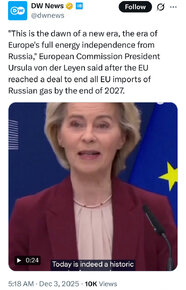
They keep signing this song about independence and rainbows. While it is understandably not kosher (or is it?) buying gas from Russia while it is waging war against Ukraine and used its gas as leverage against Europe, the supplies have been steady for decades before 2022 (disputes with Ukraine aside, which was more due to Ukraine being an unreliable transit provider). The current suppliers?
Qatar threatened to cut EU LNG supplies over sustainability law, letter shows
EU plans changes to sustainability law as US, Qatar increase pressure
Didn’t take very long to use the leverage. There was one other instance Qatar threatened to cut supplies to the EU last year as well, whatever the reason was, I do not remember. I don’t even want to talk about the Americans: imagine being dependent on the same source for energy, weapons, etc. Especially in the current environment and provided the latest national security strategy of the supplier (koxinga provided some excerpts and commentary in the US defence thread).
Furthermore, while I had previously talked about hundreds of billions of dollars (trillions by now) in subsidies Europe had to shell out due to high energy prices, are there any other costs to this new era of independence? Well, efficiency, they say, provided for reasonable gas prices. This is the efficiency they are talking about:
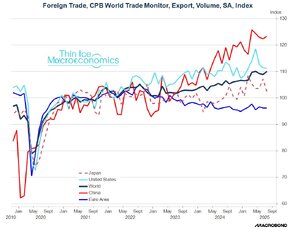
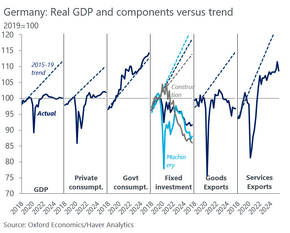
These are real consequences of independence from relatively cheap pipe gas from and trade with the Russian Federation. Government spending is booming though! Another graphic:
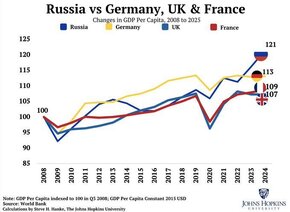
Note the cost of Crimea annexation that is clearly visible on the RU line. I provided a much better graphic for this in the Russia thread a long while ago.
So yes, things are debatable and there are good arguments. In the meantime…
Russian MIC is still growing and so is its production (you fellas are going to have to use some type of translate from Russian here though):
The biggest, alleged, advantage that Ukraine had in drone superiority over Russia is gone and this is still work in-progress for the Russians and evolving:
Russia has centralized what began as a patchwork of volunteer drone groups into a state-backed system that is training pilots, ramping up production, and specializes in hunting Ukrainian drone operators and the networks that support them. Ukrainian soldiers and experts say that shift is rapidly eroding Ukraine’s early edge in drone warfare and poses a growing threat to its ability to hold the line.
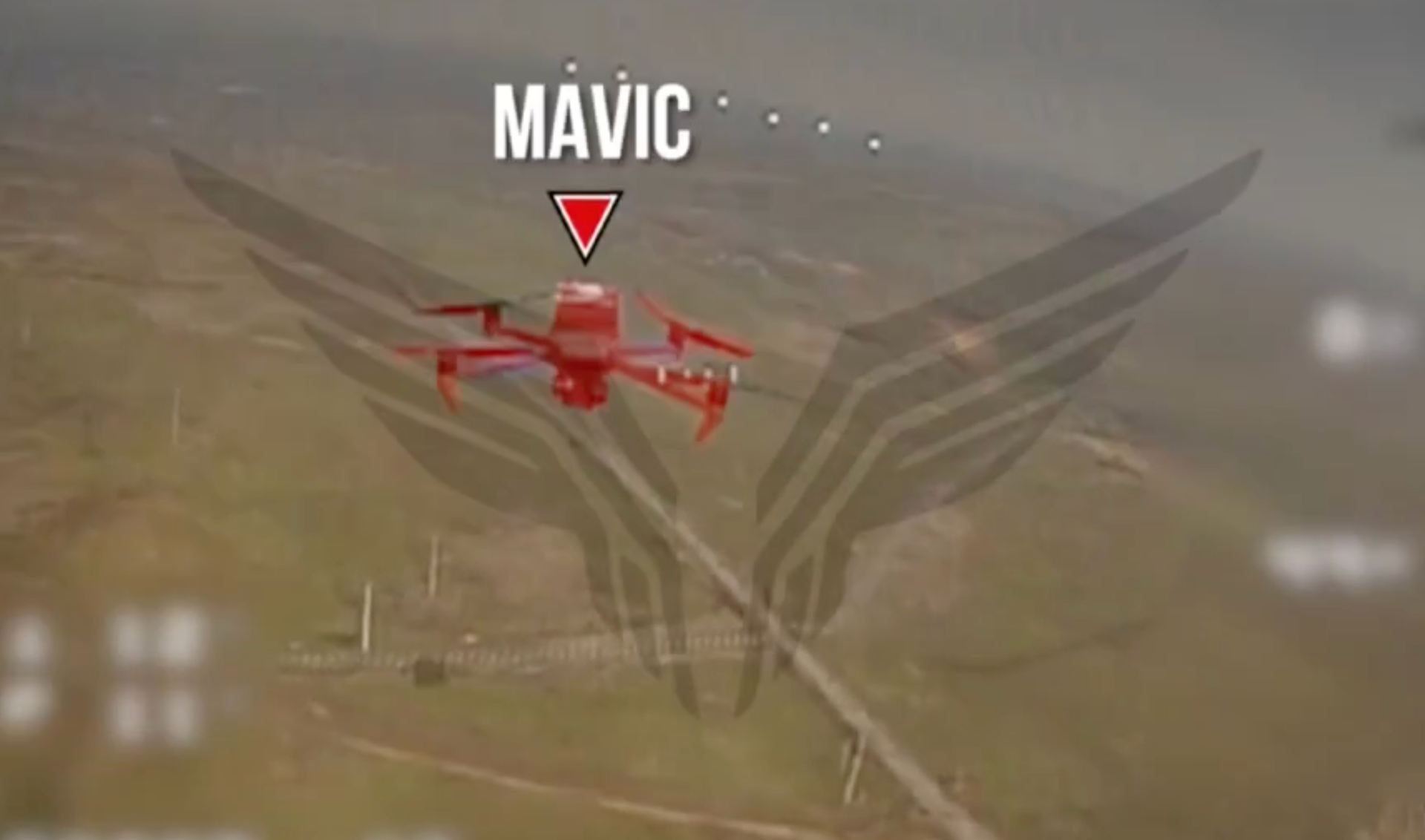
Deadly, elite, and scaling — inside Russia’s Rubikon front-line drone system
Russia has centralized volunteer drone units like Rubikon into a professional system that is eroding Ukraine’s early edge in UAV warfare and threatening its front lines.
 kyivindependent.com
Ukrainian troops in Myrnohrad appear to be actually encircled for the first time since the… about beginning. Appears to be a negotiation tactic for Ukraine when more or less real negotiations take place. They talked about their ability rotating (one-way) troops in, literally last week:
NATO says Myrnohrad is "largely surrounded" and Russians control over 95% of Pokrovsk
A senior NATO official has said that Ukrainian defence forces in Myrnohrad have been "largely surrounded" and are reliant on drones for supplies, and has stated that Russian troops control more than 95% of the city of Pokrovsk.
 www.pravda.com.ua
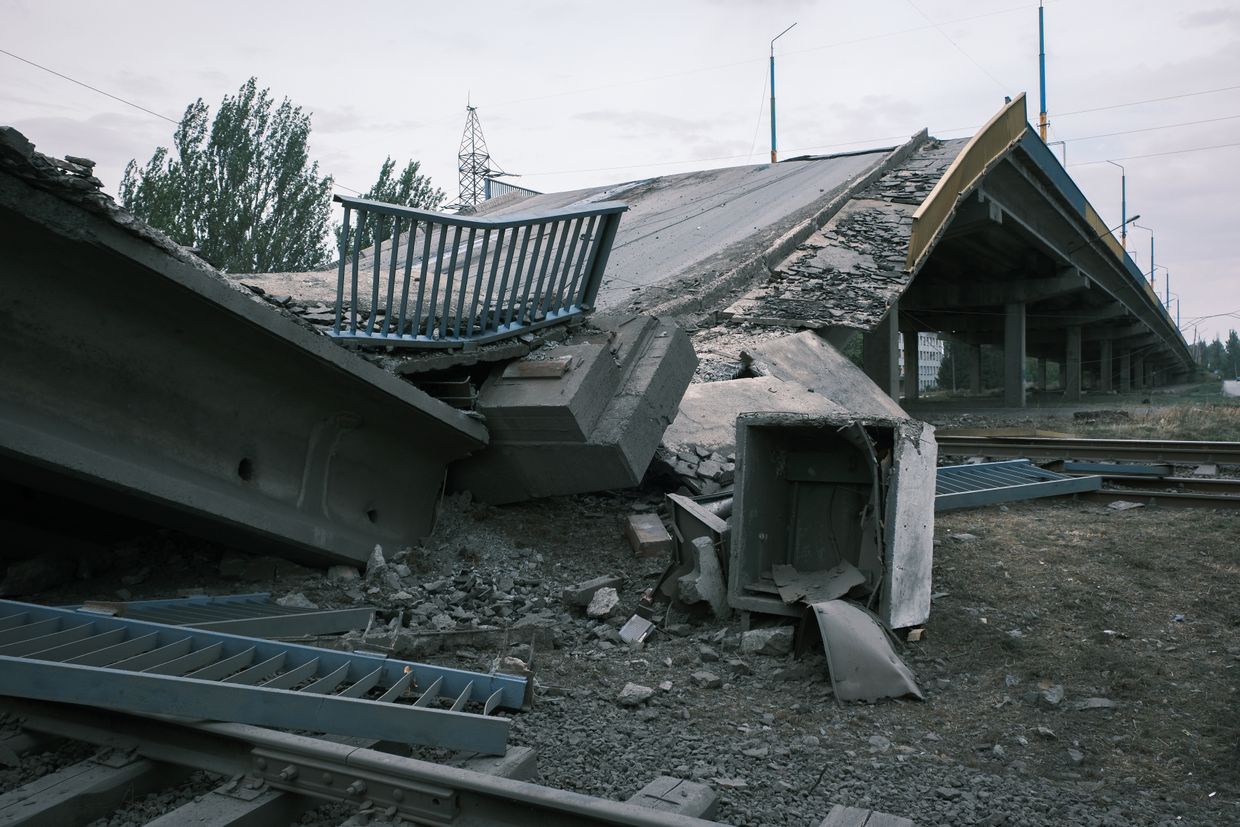
As Russia takes Pokrovsk, sister city Myrnohrad stares down encirclement
Ukraine's great fortress city of Pokrovsk has officially fallen — as far as Moscow is concerned. More than five weeks after Russian troops first started to swarm into the southern outskirts of the Donetsk Oblast city, Pokrovsk has been decisively overrun, although Kyiv still claims a presence...
kyivindependent.com
Russian fleet of armoured vehicles is potentially larger today than it was in 2022:
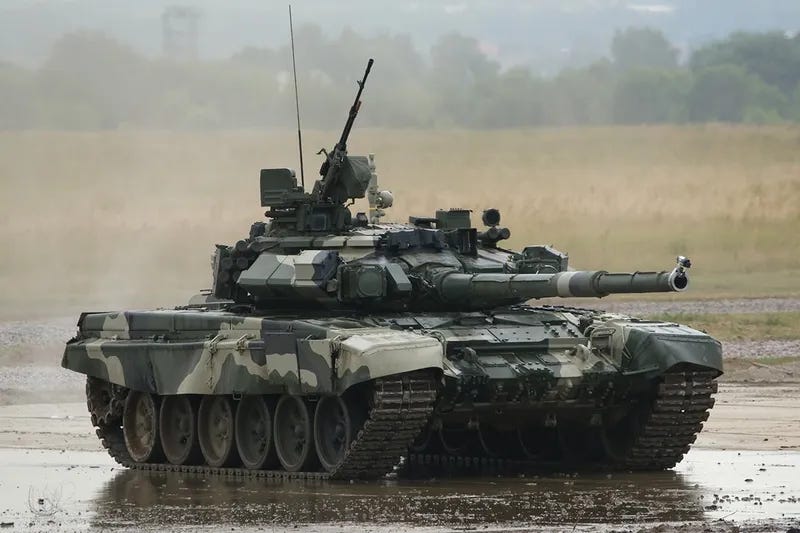
Analysis: Russian Armored Vehicle Fleet, 2022–2025
A production level geared for endurance
Russia is now arming Shaheds with air-to-air missiles:
Russia is trying to hit Ukrainian helicopters and other aircraft midair with Shahed drones, deputy defense chief says
Lt. Col. Yurii Myronenko told Business Insider that Russia is testing new deep-strike weapons, including modified Shaheds and new models.
 www.businessinsider.com
The Shaheds are also now (confirmed) controllable (speculation long debated) and hit, for instance, Ukrainian mobile air-defense units. I lost the link, sorry, but Feanor will probably include it in his next update (or I can look it up if necessary).
Ukrainska Pravda posts articles about how Ukrainian lies and propaganda are going to cost the country the war (have to use translate of some kind):
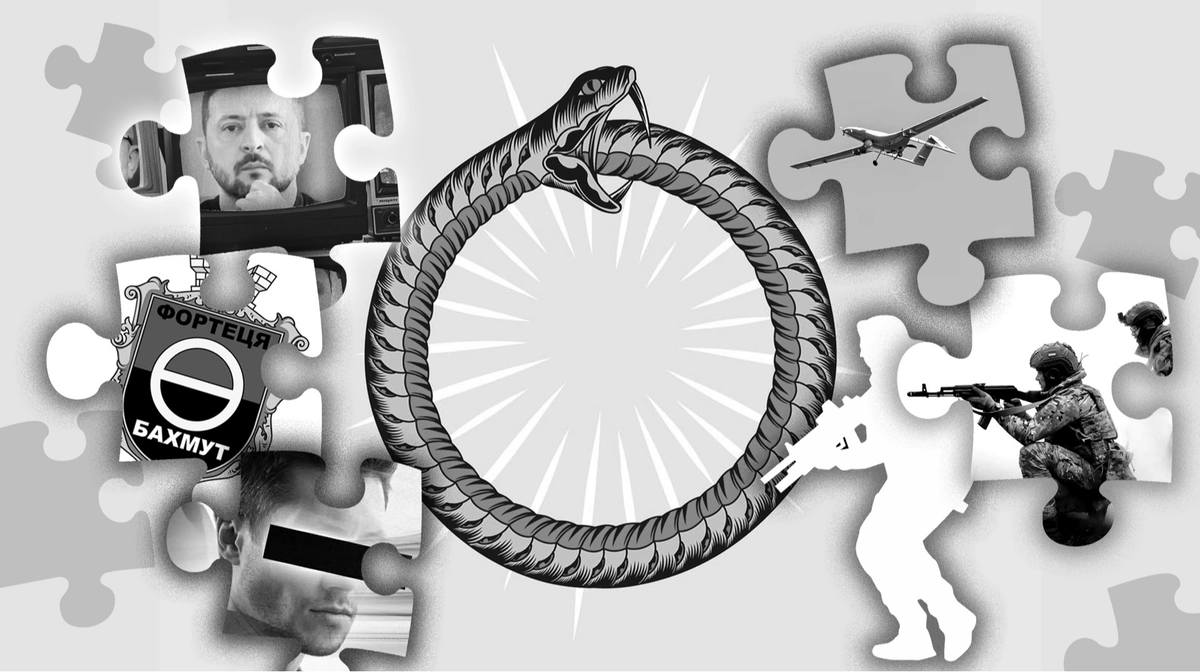
"Ложь нас медленно сжирает". Как правда становится жертвой войны
"Украинская правда" решила разобраться, из чего состоит пазл большой и малой лжи во время российско-украинской войны.
www.pravda.com.ua
Reuters keeps posting Russian propaganda articles, now about Russian spare refining capacity to offset the damage from the UA strikes:
And about the dire situation in Ukrainian demographics. They call it population collapse (which I talked about on numerous occasions for years here):
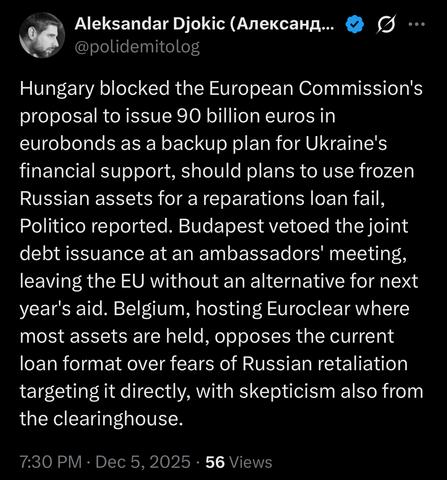
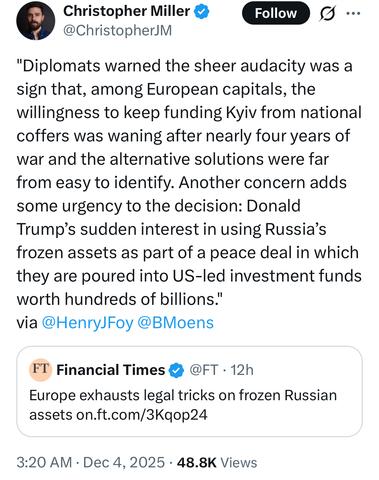
Belgians (for a good reason) and Americans (for not a good reason) are set on keeping the Russian assets frozen and unavailable to Ukraine:

How Belgium became Russia’s most valuable asset
Belgian Prime Minister Bart De Wever is unmoved in his opposition to a raid on Moscow’s funds held in a Brussels bank to support a loan to Ukraine.
 www.politico.eu
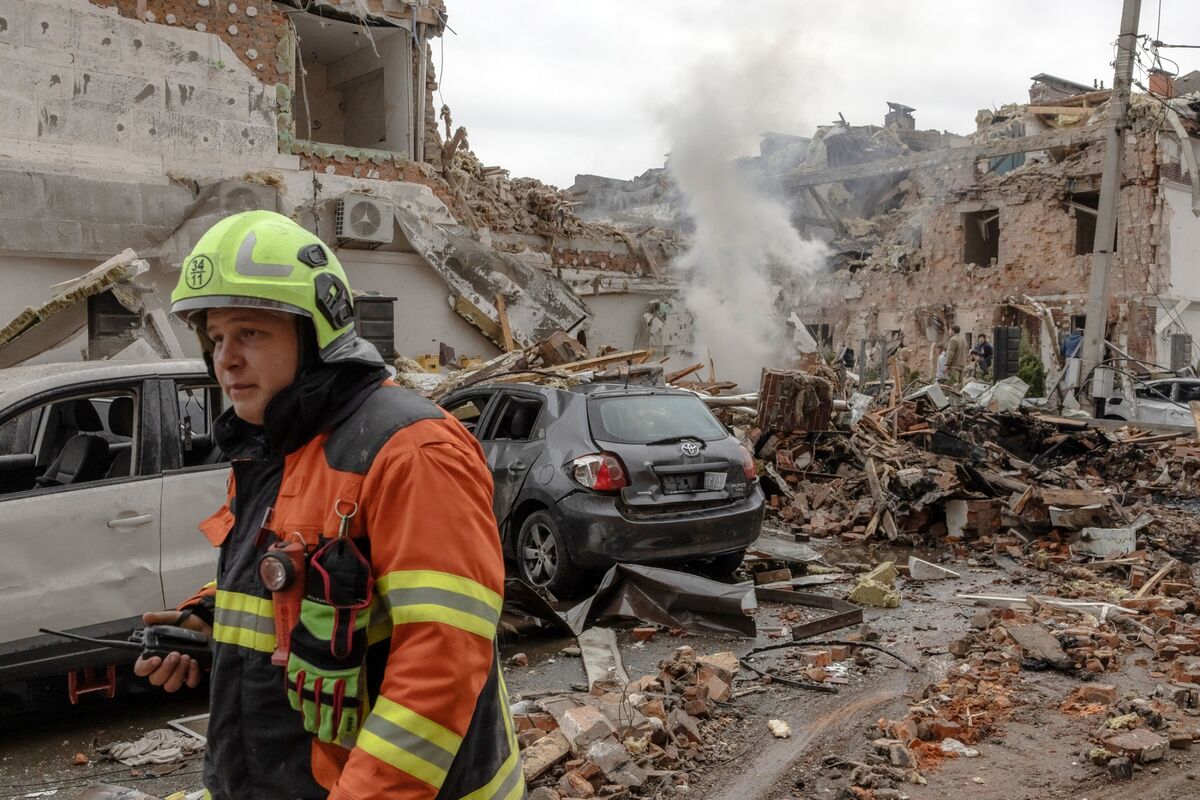
US Urged Europeans to Oppose EU Plan for Loan to Support Ukraine
The US lobbied several countries in the European Union in an effort to block EU plans to use frozen Russian central bank assets to back a massive loan to Ukraine, according to European diplomats familiar with the matter.
 www.bloomberg.com
And
And
Ukrainian grain (and other) exports taking the sea route are likely to suffer greatly due to the actions of Ukrainians themselves:

Thread by @exit266 on Thread Reader App
@exit266: War Risk Insurance It’s been a minute, let’s talk about it.⬇️ Ships sailing through conflict zones are required to carry War Risk Insurance. For a while when the Ukrainian Corridor started it was so expensi...…
 threadreaderapp.com
Italy says there should be no purchases of weapons for Ukraine while negotiations are ongoing (an indication of what is going to happen once some peace is agreed to):
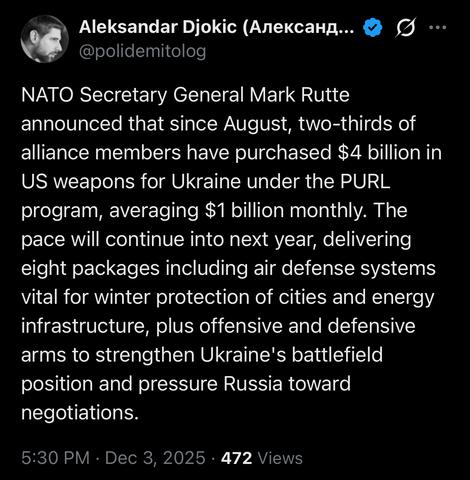
Rutte says that one 2/3 of NATO members contributed about $1B per month for purchases of weapons since August and the pace is to continue (tragicomedy):
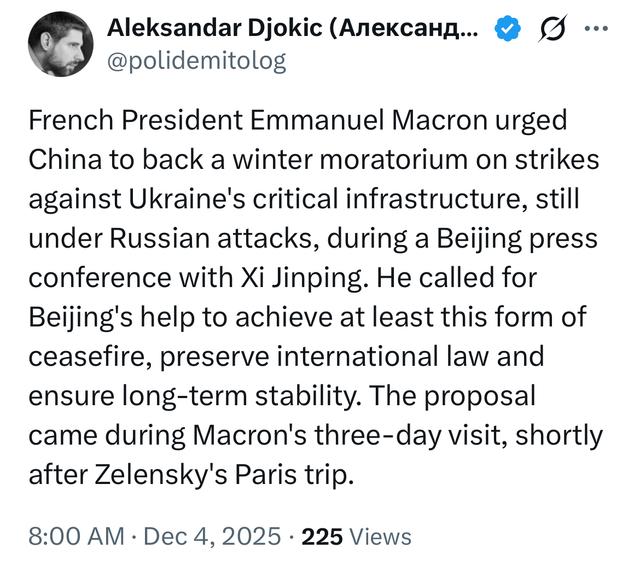
Macron asked Xi to at least back moratorium on Russian strikes against UA critical infrastructure for the winter (with the currently ongoing bombardment Xi either has no say or was not very excited about the idea):
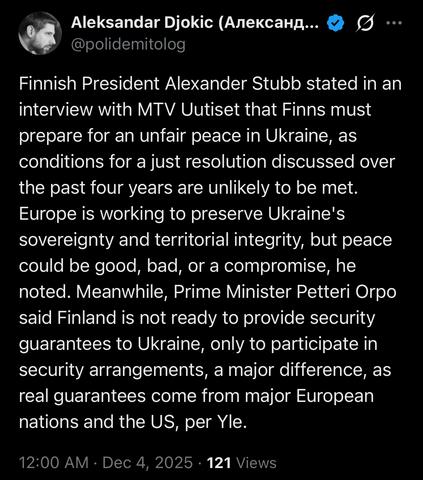
Stubb called on Finns to prepare for an unfair peace in Ukraine:
And so on. And I mean it because this is just two or three (incomplete, because I have much more) days worth of news that only I saw.
So what’s working and what’s not is up for debate and time will tell. Some things are pretty clear, but are either overlooked for a reason or the widespread delusion strikes once again.
It's a minor point perhaps but the UK imported virtually 0 gas from Russia, any knock on impact to the UK is because of international price increases.According to the EC (bolding is theirs):
The measures are designed to achieve the EU policy objective of ending Russia’s war of aggression against Ukraine, through maximising pressure on Russia and using all tools available to diminish Russia’s ability to wage its illegal war of aggression.
Sanctions are effective and cost Russia, there is no question about that. Are they effective relative to the stated goal? That is debatable. If the benchmark rests where you put it, then the answer is probably yes. There is, however, the other side of the coin, of course.
View attachment 53976
They keep signing this song about independence and rainbows. While it is understandably not kosher (or is it?) buying gas from Russia while it is waging war against Ukraine and used its gas as leverage against Europe, the supplies have been steady for decades before 2022 (disputes with Ukraine aside, which was more due to Ukraine being an unreliable transit provider). The current suppliers?
Qatar threatened to cut EU LNG supplies over sustainability law, letter shows
EU plans changes to sustainability law as US, Qatar increase pressure
Didn’t take very long to use the leverage. There was one other instance Qatar threatened to cut supplies to the EU last year as well, whatever the reason was, I do not remember. I don’t even want to talk about the Americans: imagine being dependent on the same source for energy, weapons, etc. Especially in the current environment and provided the latest national security strategy of the supplier (koxinga provided some excerpts and commentary in the US defence thread).
Furthermore, while I had previously talked about hundreds of billions of dollars (trillions by now) in subsidies Europe had to shell out due to high energy prices, are there any other costs to this new era of independence? Well, efficiency, they say, provided for reasonable gas prices. This is the efficiency they are talking about:
View attachment 53977
View attachment 53978
These are real consequences of independence from relatively cheap pipe gas from and trade with the Russian Federation. Government spending is booming though! Another graphic:
View attachment 53979
Note the cost of Crimea annexation that is clearly visible on the RU line. I provided a much better graphic for this in the Russia thread a long while ago.
So yes, things are debatable and there are good arguments. In the meantime…
Russian MIC is still growing and so is its production (you fellas are going to have to use some type of translate from Russian here though):
The biggest, alleged, advantage that Ukraine had in drone superiority over Russia is gone and this is still work in-progress for the Russians and evolving:
Russia has centralized what began as a patchwork of volunteer drone groups into a state-backed system that is training pilots, ramping up production, and specializes in hunting Ukrainian drone operators and the networks that support them. Ukrainian soldiers and experts say that shift is rapidly eroding Ukraine’s early edge in drone warfare and poses a growing threat to its ability to hold the line.
Deadly, elite, and scaling — inside Russia’s Rubikon front-line drone system
Russia has centralized volunteer drone units like Rubikon into a professional system that is eroding Ukraine’s early edge in UAV warfare and threatening its front lines.
Ukrainian troops in Myrnohrad appear to be actually encircled for the first time since the… about beginning. Appears to be a negotiation tactic for Ukraine when more or less real negotiations take place. They talked about their ability rotating (one-way) troops in, literally last week:
NATO says Myrnohrad is "largely surrounded" and Russians control over 95% of Pokrovsk
A senior NATO official has said that Ukrainian defence forces in Myrnohrad have been "largely surrounded" and are reliant on drones for supplies, and has stated that Russian troops control more than 95% of the city of Pokrovsk.
As Russia takes Pokrovsk, sister city Myrnohrad stares down encirclement
Ukraine's great fortress city of Pokrovsk has officially fallen — as far as Moscow is concerned. More than five weeks after Russian troops first started to swarm into the southern outskirts of the Donetsk Oblast city, Pokrovsk has been decisively overrun, although Kyiv still claims a presence...
Russian fleet of armoured vehicles is potentially larger today than it was in 2022:
Analysis: Russian Armored Vehicle Fleet, 2022–2025
A production level geared for endurancesubstack.com
Russia is now arming Shaheds with air-to-air missiles:

Russia is trying to hit Ukrainian helicopters and other aircraft midair with Shahed drones, deputy defense chief says
Lt. Col. Yurii Myronenko told Business Insider that Russia is testing new deep-strike weapons, including modified Shaheds and new models.
The Shaheds are also now (confirmed) controllable (speculation long debated) and hit, for instance, Ukrainian mobile air-defense units. I lost the link, sorry, but Feanor will probably include it in his next update (or I can look it up if necessary).
Ukrainska Pravda posts articles about how Ukrainian lies and propaganda are going to cost the country the war (have to use translate of some kind):
"Ложь нас медленно сжирает". Как правда становится жертвой войны
"Украинская правда" решила разобраться, из чего состоит пазл большой и малой лжи во время российско-украинской войны.
Reuters keeps posting Russian propaganda articles, now about Russian spare refining capacity to offset the damage from the UA strikes:
And about the dire situation in Ukrainian demographics. They call it population collapse (which I talked about on numerous occasions for years here):
Belgians (for a good reason) and Americans (for not a good reason) are set on keeping the Russian assets frozen and unavailable to Ukraine:
How Belgium became Russia’s most valuable asset
Belgian Prime Minister Bart De Wever is unmoved in his opposition to a raid on Moscow’s funds held in a Brussels bank to support a loan to Ukraine.
US Urged Europeans to Oppose EU Plan for Loan to Support Ukraine
The US lobbied several countries in the European Union in an effort to block EU plans to use frozen Russian central bank assets to back a massive loan to Ukraine, according to European diplomats familiar with the matter.
And
And
Ukrainian grain (and other) exports taking the sea route are likely to suffer greatly due to the actions of Ukrainians themselves:
Thread by @exit266 on Thread Reader App
@exit266: War Risk Insurance It’s been a minute, let’s talk about it.⬇️ Ships sailing through conflict zones are required to carry War Risk Insurance. For a while when the Ukrainian Corridor started it was so expensi...…
Italy says there should be no purchases of weapons for Ukraine while negotiations are ongoing (an indication of what is going to happen once some peace is agreed to):
Rutte says that one 2/3 of NATO members contributed about $1B per month for purchases of weapons since August and the pace is to continue (tragicomedy):
Macron asked Xi to at least back moratorium on Russian strikes against UA critical infrastructure for the winter (with the currently ongoing bombardment Xi either has no say or was not very excited about the idea):
Stubb called on Finns to prepare for an unfair peace in Ukraine:
And so on. And I mean it because this is just two or three (incomplete, because I have much more) days worth of news that only I saw.
So what’s working and what’s not is up for debate and time will tell. Some things are pretty clear, but are either overlooked for a reason or the widespread delusion strikes once again.
KipPotapych
Well-Known Member
^ if I recall correctly (and I probably do), the UK imported about 5% of their gas from Russia before the invasion. Due to the nature of the geography and, hence, existing LNG infrastructure, it was a relatively easy and quick (but just as painful) process of dropping the Russian gas imports for you guys. Though there is still, without a doubt, gas of Russian origin coming into the country due to the way the market works; such as gas purchased at the spot somewhere in the EU that may have come from Russia would be one and most obvious example. It is just the nature of the game and it is hard, if not impossible, to do something about that. Everyone is in this same bucket, knowingly and purposefully or otherwise.
Regardless, this has little to no effect on the prices you pay. Everyone tapped to the same faucet will pay the same market price and it is subsidies that make the difference for the consumers at the other end (though not really because subsidies are paid by the same consumers in the form of taxation and scarcity of social services, usually with interest when the debt is repaid at some point in the future - which now seems to be a perpetual process).
The biggest issue I take/see with this whole post-invasion setup is that while Europe pays through the nose for the gas they consume, along with the oil at “market” prices, places like China, India, Turkey, and a whole bunch of others are either making bank reselling these same products, processed or not (including to you guys) or making the Euro’s industry unable to compete since energy costs are a significant part of the equation. And it is actually both aforementioned process that are taking place simultaneously. The charts I cited above are a great illustration of that.
Furthermore, as I mentioned in the previous post, this so-called independence, while becoming even more dependent on the US, is complete insanity, in my opinion. One can easily argue that it is worse than the way things worked previously, when Russian gas and oil, to a lesser degree, were part of the game. First of all, by greatly reducing imports of the Russian gas and cutting trade to almost nonexistent in comparison to what it was, Europe lost (simply gave up) all the leverage they had over Russia. Note that Americans didn’t because still import the crucial components for their industries and whatnot, such as titanium, fertilizer, uranium, etc. When Ukraine (potentially with the American involvement) blew up the Nord Stream, with absolutely no consequences, it should be noted, Russia lost all their leverage with Europe as well. When something like this happens, neither side has any leverage at their disposal, there is no space for negotiations, which is quite apparent now, isn’t? Russian gas should have always remained a part of the equation and a mechanism, such as price cap or something similar, should have been implemented. Like @personaldesas said above, it is much harder for Russia to do something about their gas that was sent via pipe to Europe. This was a great leverage that was simply given up by Euros, who also closed all channels of communication and made it known, completely irrationally, in my opinion, that they will not settle until “Russia is defeated” first on the battlefield, then “strategically”, when the former became no longer a viable option (never was, in my opinion). Yeah, sure, Ukrainians would complain and whine, but it would have been better than what is happening now, including their own sake, whether they agree with it or not. Europe would have more leverage and pull over both, Russia and the USA, and, unsurprisingly, China. I would go as far as proposing a hypothesis, for the lack of a better word, that the conflict could have been wrapped up by now and, perhaps, a long time ago if that were the case. Just think about it, critically and rationally, settle your thoughts, etc. One, of course, first and foremost, needs to put aside their (maybe?) convictions that Russians are some barbarians that need to be dealt with as such and so on. This is all noise and nonsense that leads nowhere, as, again, we have been witnessing for years now.
Ukraine was dealt a bad hand, they are the only ones in this situation who have no cards at all. Their only card is the alleged full commitment of Europe to some futile cause. There is no strategy, there is still no plan B, nothing, but taking the events as they are unfolding and reacting, usually in an irrational way. Now they (the EU and G7, though I am sure none but EU actually is) are reportedly discussing replacing the price cap with a complete ban on maritime shipments of the Russian oil, for example. What are they gonna do, go to war with Russia over the oil they ship with their shadow fleet and otherwise? Here is the article (or one of them):
And here is a summary:
Ukraine was dealt a bad hand and it is up to us (I am going to include Canada into “us”, though we have no say at all) to provide for the best possible outcome for Ukraine and us. By blindly supporting who knows what, some unrealistic dreams, we actually deprive the Ukrainians of assessing the reality and seeing things through in a rational way and trying to figure it out. Russia will keep trashing Ukraine “as long as it takes” (yes, irony), our involvement notwithstanding. Things are going to get worse. For everyone, including Russia, but mainly Ukraine. We need to deal with that fact, not some… I don’t even know what it is we are dealing with anymore under the disguise of some future action we are to take that will suddenly make Putin/Russians/whatever realize that this war is too expensive and not worth the cause, etc, and Putin/Russians/whatever will agree to freeze the line where it is (could be way beyond what they are asking now, as it is now way beyond what they were asking before) vs previous plan (?) of them withdrawing from Ukraine altogether upon the same realization. It seems to me that there is only one serious party here and it ain’t us, however damaging and, maybe, catastrophic (doubtful, in my opinion) the current events are for that party (maybe that is where we actually stand though and we are the rational ones?).
So anyway, these are my thoughts on the subject that I can discuss with more depth, data, and details, but I think this is sufficient for an open forum. The main take away is that Europe (the EU plus UK, that should have never left the block to begin with with) should have taken the path of having their own voice, gain more independence from the US via heavy investment into their MIC, while keeping communications open with and retaining the leverage over Russia via purchases of cheaper natural gas and investing the “profits” (I am going to call the tremendous and completely unnecessary subsidies, probably approaching 8-10 times the monetary value of help sent to Ukraine) into the MIC, as well as UA defense and, most crucially, development. There would be no need to even contemplate the use of the frozen Russian assets (the righteousness and rule-of-law altitude/stance left intact and untarnished), the extreme right/left popularity would be left in check, and so on. And hey, maybe enough people would not even get completely delusional as to confusing drones with stars, helicopters and airplanes - that would remain the American thing or the “Jersey thing”, we could call it, but not anymore. Shame. I am going to copy-paste an article on the subject of the latter in a separate post below (translated from Dutch).
Regardless, this has little to no effect on the prices you pay. Everyone tapped to the same faucet will pay the same market price and it is subsidies that make the difference for the consumers at the other end (though not really because subsidies are paid by the same consumers in the form of taxation and scarcity of social services, usually with interest when the debt is repaid at some point in the future - which now seems to be a perpetual process).
The biggest issue I take/see with this whole post-invasion setup is that while Europe pays through the nose for the gas they consume, along with the oil at “market” prices, places like China, India, Turkey, and a whole bunch of others are either making bank reselling these same products, processed or not (including to you guys) or making the Euro’s industry unable to compete since energy costs are a significant part of the equation. And it is actually both aforementioned process that are taking place simultaneously. The charts I cited above are a great illustration of that.
Furthermore, as I mentioned in the previous post, this so-called independence, while becoming even more dependent on the US, is complete insanity, in my opinion. One can easily argue that it is worse than the way things worked previously, when Russian gas and oil, to a lesser degree, were part of the game. First of all, by greatly reducing imports of the Russian gas and cutting trade to almost nonexistent in comparison to what it was, Europe lost (simply gave up) all the leverage they had over Russia. Note that Americans didn’t because still import the crucial components for their industries and whatnot, such as titanium, fertilizer, uranium, etc. When Ukraine (potentially with the American involvement) blew up the Nord Stream, with absolutely no consequences, it should be noted, Russia lost all their leverage with Europe as well. When something like this happens, neither side has any leverage at their disposal, there is no space for negotiations, which is quite apparent now, isn’t? Russian gas should have always remained a part of the equation and a mechanism, such as price cap or something similar, should have been implemented. Like @personaldesas said above, it is much harder for Russia to do something about their gas that was sent via pipe to Europe. This was a great leverage that was simply given up by Euros, who also closed all channels of communication and made it known, completely irrationally, in my opinion, that they will not settle until “Russia is defeated” first on the battlefield, then “strategically”, when the former became no longer a viable option (never was, in my opinion). Yeah, sure, Ukrainians would complain and whine, but it would have been better than what is happening now, including their own sake, whether they agree with it or not. Europe would have more leverage and pull over both, Russia and the USA, and, unsurprisingly, China. I would go as far as proposing a hypothesis, for the lack of a better word, that the conflict could have been wrapped up by now and, perhaps, a long time ago if that were the case. Just think about it, critically and rationally, settle your thoughts, etc. One, of course, first and foremost, needs to put aside their (maybe?) convictions that Russians are some barbarians that need to be dealt with as such and so on. This is all noise and nonsense that leads nowhere, as, again, we have been witnessing for years now.
Ukraine was dealt a bad hand, they are the only ones in this situation who have no cards at all. Their only card is the alleged full commitment of Europe to some futile cause. There is no strategy, there is still no plan B, nothing, but taking the events as they are unfolding and reacting, usually in an irrational way. Now they (the EU and G7, though I am sure none but EU actually is) are reportedly discussing replacing the price cap with a complete ban on maritime shipments of the Russian oil, for example. What are they gonna do, go to war with Russia over the oil they ship with their shadow fleet and otherwise? Here is the article (or one of them):
And here is a summary:
Ukraine was dealt a bad hand and it is up to us (I am going to include Canada into “us”, though we have no say at all) to provide for the best possible outcome for Ukraine and us. By blindly supporting who knows what, some unrealistic dreams, we actually deprive the Ukrainians of assessing the reality and seeing things through in a rational way and trying to figure it out. Russia will keep trashing Ukraine “as long as it takes” (yes, irony), our involvement notwithstanding. Things are going to get worse. For everyone, including Russia, but mainly Ukraine. We need to deal with that fact, not some… I don’t even know what it is we are dealing with anymore under the disguise of some future action we are to take that will suddenly make Putin/Russians/whatever realize that this war is too expensive and not worth the cause, etc, and Putin/Russians/whatever will agree to freeze the line where it is (could be way beyond what they are asking now, as it is now way beyond what they were asking before) vs previous plan (?) of them withdrawing from Ukraine altogether upon the same realization. It seems to me that there is only one serious party here and it ain’t us, however damaging and, maybe, catastrophic (doubtful, in my opinion) the current events are for that party (maybe that is where we actually stand though and we are the rational ones?).
So anyway, these are my thoughts on the subject that I can discuss with more depth, data, and details, but I think this is sufficient for an open forum. The main take away is that Europe (the EU plus UK, that should have never left the block to begin with with) should have taken the path of having their own voice, gain more independence from the US via heavy investment into their MIC, while keeping communications open with and retaining the leverage over Russia via purchases of cheaper natural gas and investing the “profits” (I am going to call the tremendous and completely unnecessary subsidies, probably approaching 8-10 times the monetary value of help sent to Ukraine) into the MIC, as well as UA defense and, most crucially, development. There would be no need to even contemplate the use of the frozen Russian assets (the righteousness and rule-of-law altitude/stance left intact and untarnished), the extreme right/left popularity would be left in check, and so on. And hey, maybe enough people would not even get completely delusional as to confusing drones with stars, helicopters and airplanes - that would remain the American thing or the “Jersey thing”, we could call it, but not anymore. Shame. I am going to copy-paste an article on the subject of the latter in a separate post below (translated from Dutch).
KipPotapych
Well-Known Member
Analysis of sixty drone incidents in Europe: a lot of panic and little evidence
Drone notifications shut down airports across Europe and cause unrest. Trouw analyzed about sixty incidents. This shows a lot of confusion, regular false alarm and hardly any harsh evidence for Russian involvement.
'Exclusive footage shows huge drone above Zaventem Airport'. A terrifying video appeared earlier this month on the website of the Belgian newspaper Het Laatste Nieuws. That happened after air traffic from Zaventem National Airport was shut down twice on the evening of November 4 due to reports of drones.
The images show a flying object with lights. Some Dutch media also published about the video. The unrest was great, as Belgium was flooded with drone sightings at airports and military objects at the time of this incident.
But two weeks later, the flying object on the images turns out not to be a drone at all. It was a police helicopter, research by the VRT shows. Videos of two other 'drone incidents' around Belgian military bases in the days after also turn out to be a false alarm, the fact checkers conclude. It was a police helicopter and a DHL cargo plane landing.
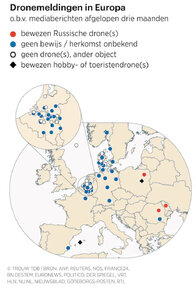
Drones everywhere in Europe
The Belgian video footage illustrates the panic about the wave of drone reports that has been holding Europe for months. The sightings shut down airports for hours and cause unrest around ports, military bases and other (critical) infrastructure. But the question is whether they were drones. What ultimately yielded police investigation into all these incidents?
Using platform Dronewatch, Trouw mapped out about sixty incidents with drones in eleven European countries. These took place in the last three months. The conclusion: a lot of confusion and ambiguity and regular false alarms. No hard evidence has been provided for Russian involvement, which some authorities and experts point out in the vast majority of cases.
In about forty incidents, the origin is still unclear or no evidence has been found at all for drones in the airspace. An example is Oslo, where drone reports shut down air traffic at the end of September, affecting thousands of travelers. The police later found no confirmation that drones were actually flying. The same applied to reports at the airport of Sweden's Gothenburg in early November.
In at least fourteen cases, it turned out to be something completely different afterwards. For example, people in Belgium looked at (small) planes and helicopters for drones, while the flying objects in South Limburg and the Danish Billund were stars. The Norwegian police concluded that a suspicious 'drone' at an oil platform in the North Sea was probably a ship.
A number of times it has been found that drone flights were the work of a hobbyist or that it later turned out to be a tourist. In an incident in Warsaw where a drone flew over government buildings, Polish police arrested a Ukrainian and a 17-year-old girl from Belarus. There is no evidence for espionage.
Russian involvement
The authorities and experts regularly spoke about the involvement of 'a state actor' and Russia in incidents in Denmark, Belgium and Germany. This happened without waiting for the results of (police) investigation.
Spying and causing unrest with unmanned planes fits into the hybrid warfare of the Russians, is a frequently heard lecture. For example, Moscow would possibly use accomplices in Europe who shot small unmanned aircraft or drones would be launched from ships.
But an analysis of the sixty incidents shows little hard evidence of Russian involvement. An exception are incidents in Poland, Romania and Moldova, where Russian drones have indeed entered the airspace in recent months. For example, debris was found and in Poland Dutch F-35s shot Russian drones from the sky.
Attack or regular plane?
Although there is a lack of strong evidence in incidents elsewhere, Danish Prime Minister Mette Frederiksen spoke shortly after observing drones at Copenhagen airport at the end of September of “an attack on Danish critical infrastructure”. To this day, however, it is unclear whether the sightings in Copenhagen were drones. Many reports were attributable to regular air traffic, according to a reconstruction of the Danish channel TV2.
“Our suspicion is that Russia is behind most of these drone flights,” Chancellor Friedrich Merz said after incidents at Munich Airport in early October, without providing evidence. Belgium also pointed to possible Russian involvement, and spoke of 'professional' pilots who 'flew in formation', although handy hobbyists can too.
Lack of drone detection
Dutch authorities are cautious with conclusions after drone incidents last weekend at Volkel airbase and Eindhoven Airport. According to Defense, 'weapons have been used', but no object has been removed from the air.
The Royal Netherlands Marechaussee says that drones have actually been seen, but according to a spokesman there is “no reason to panic for the time being”. At the moment it seems to be private or hobby drones with unclear origin. The spokesman adds that the military police have recently received many reports, but that it is not always a drone. "The cause of this can of course be all the attention, also in the media."
Defense Minister Ruben Brekelmans said in the debate on Wednesday that the investigations are still ongoing. But he tempered expectations. Detective work in Denmark, Norway, Belgium and Germany for drone incidents has “not yielded a very clear picture,” he said.
Authorities are almost blind to drones in many places and must rely on (unreliable) human observations. Therefore, experts point out the importance of good drone detection. In Belgium, that seems to have helped. It has been quiet there in recent weeks, exactly after additional drone detection has been installed. That may mean that malicious people have been put off, but just as well that those other alarmist reports may not have represented so much after all.
P. S. from me: I have no idea what the map shows and didn’t bother translating it separately. All bolding is from the article (I only modified the “foreword” into italics).
Drone notifications shut down airports across Europe and cause unrest. Trouw analyzed about sixty incidents. This shows a lot of confusion, regular false alarm and hardly any harsh evidence for Russian involvement.
'Exclusive footage shows huge drone above Zaventem Airport'. A terrifying video appeared earlier this month on the website of the Belgian newspaper Het Laatste Nieuws. That happened after air traffic from Zaventem National Airport was shut down twice on the evening of November 4 due to reports of drones.
The images show a flying object with lights. Some Dutch media also published about the video. The unrest was great, as Belgium was flooded with drone sightings at airports and military objects at the time of this incident.
But two weeks later, the flying object on the images turns out not to be a drone at all. It was a police helicopter, research by the VRT shows. Videos of two other 'drone incidents' around Belgian military bases in the days after also turn out to be a false alarm, the fact checkers conclude. It was a police helicopter and a DHL cargo plane landing.
Drones everywhere in Europe
The Belgian video footage illustrates the panic about the wave of drone reports that has been holding Europe for months. The sightings shut down airports for hours and cause unrest around ports, military bases and other (critical) infrastructure. But the question is whether they were drones. What ultimately yielded police investigation into all these incidents?
Using platform Dronewatch, Trouw mapped out about sixty incidents with drones in eleven European countries. These took place in the last three months. The conclusion: a lot of confusion and ambiguity and regular false alarms. No hard evidence has been provided for Russian involvement, which some authorities and experts point out in the vast majority of cases.
In about forty incidents, the origin is still unclear or no evidence has been found at all for drones in the airspace. An example is Oslo, where drone reports shut down air traffic at the end of September, affecting thousands of travelers. The police later found no confirmation that drones were actually flying. The same applied to reports at the airport of Sweden's Gothenburg in early November.
In at least fourteen cases, it turned out to be something completely different afterwards. For example, people in Belgium looked at (small) planes and helicopters for drones, while the flying objects in South Limburg and the Danish Billund were stars. The Norwegian police concluded that a suspicious 'drone' at an oil platform in the North Sea was probably a ship.
A number of times it has been found that drone flights were the work of a hobbyist or that it later turned out to be a tourist. In an incident in Warsaw where a drone flew over government buildings, Polish police arrested a Ukrainian and a 17-year-old girl from Belarus. There is no evidence for espionage.
Russian involvement
The authorities and experts regularly spoke about the involvement of 'a state actor' and Russia in incidents in Denmark, Belgium and Germany. This happened without waiting for the results of (police) investigation.
Spying and causing unrest with unmanned planes fits into the hybrid warfare of the Russians, is a frequently heard lecture. For example, Moscow would possibly use accomplices in Europe who shot small unmanned aircraft or drones would be launched from ships.
But an analysis of the sixty incidents shows little hard evidence of Russian involvement. An exception are incidents in Poland, Romania and Moldova, where Russian drones have indeed entered the airspace in recent months. For example, debris was found and in Poland Dutch F-35s shot Russian drones from the sky.
Attack or regular plane?
Although there is a lack of strong evidence in incidents elsewhere, Danish Prime Minister Mette Frederiksen spoke shortly after observing drones at Copenhagen airport at the end of September of “an attack on Danish critical infrastructure”. To this day, however, it is unclear whether the sightings in Copenhagen were drones. Many reports were attributable to regular air traffic, according to a reconstruction of the Danish channel TV2.
“Our suspicion is that Russia is behind most of these drone flights,” Chancellor Friedrich Merz said after incidents at Munich Airport in early October, without providing evidence. Belgium also pointed to possible Russian involvement, and spoke of 'professional' pilots who 'flew in formation', although handy hobbyists can too.
Lack of drone detection
Dutch authorities are cautious with conclusions after drone incidents last weekend at Volkel airbase and Eindhoven Airport. According to Defense, 'weapons have been used', but no object has been removed from the air.
The Royal Netherlands Marechaussee says that drones have actually been seen, but according to a spokesman there is “no reason to panic for the time being”. At the moment it seems to be private or hobby drones with unclear origin. The spokesman adds that the military police have recently received many reports, but that it is not always a drone. "The cause of this can of course be all the attention, also in the media."
Defense Minister Ruben Brekelmans said in the debate on Wednesday that the investigations are still ongoing. But he tempered expectations. Detective work in Denmark, Norway, Belgium and Germany for drone incidents has “not yielded a very clear picture,” he said.
Authorities are almost blind to drones in many places and must rely on (unreliable) human observations. Therefore, experts point out the importance of good drone detection. In Belgium, that seems to have helped. It has been quiet there in recent weeks, exactly after additional drone detection has been installed. That may mean that malicious people have been put off, but just as well that those other alarmist reports may not have represented so much after all.
P. S. from me: I have no idea what the map shows and didn’t bother translating it separately. All bolding is from the article (I only modified the “foreword” into italics).
KipPotapych
Well-Known Member
One more thing since I stumbled upon it now:
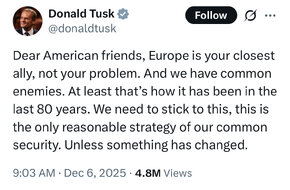
Something must have changed, as things do in time (especially in the span of 80 years that Tusk is referring to). I guess these can be thrown into the same “misunderstanding” of the events:
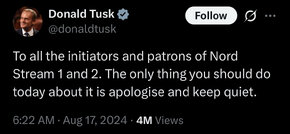

See, I personally wish we had or had by now built the infrastructure to ship you all Euro friends the gas you want and need, help each other out, and make bank in the process. Alas… All by design of the smart and stupidity of the rest (us including).
Edit: Ok, my apologies, but I could not resist, especially with the one spot remaining for an attachment…
Instead of the aforementioned latter, we are dating Katy Perry and thanking the ghosts of the past for their “continued commitment to the international rules-based order and better future for everyone”. Imagine being that disconnected, not only from the global events, but also the state of affairs in the country that you led for nearly a decade. Now that is a real shame (for us, surely).

Something must have changed, as things do in time (especially in the span of 80 years that Tusk is referring to). I guess these can be thrown into the same “misunderstanding” of the events:
See, I personally wish we had or had by now built the infrastructure to ship you all Euro friends the gas you want and need, help each other out, and make bank in the process. Alas… All by design of the smart and stupidity of the rest (us including).
Edit: Ok, my apologies, but I could not resist, especially with the one spot remaining for an attachment…
Instead of the aforementioned latter, we are dating Katy Perry and thanking the ghosts of the past for their “continued commitment to the international rules-based order and better future for everyone”. Imagine being that disconnected, not only from the global events, but also the state of affairs in the country that you led for nearly a decade. Now that is a real shame (for us, surely).
Last edited:
Although Russia is selling hydrocarbons it has for the first time commenced physical sales of its gold reserves,Russia was believed to have 300 hundred billion dollars worth of gold
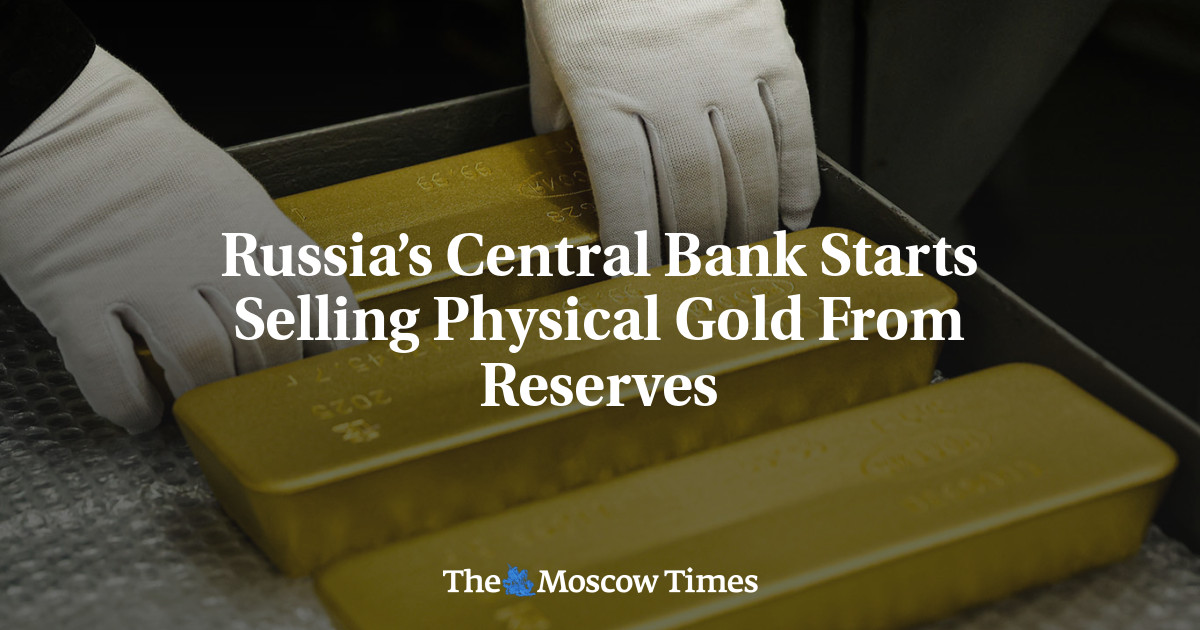
 www.themoscowtimes.com
Russia’s Central Bank Starts Selling Physical Gold From Reserves - The Moscow Times
Russia’s Central Bank has for the first time begun selling physical gold from its reserves as part of Finance Ministry operations to fund the state budget, the Bank said on Wednesday.
www.themoscowtimes.com
personaldesas
Active Member
Just a side note: it’s much easier to follow if we use primary sources or the actual reports (when possible), rather than screenshots of commentators’ tweets. That way everyone can verify the info.

John Fedup
The Bunker Group
I am just glad abomination junior is gone. He was and still is a walking, talking, sack of excrement.