
You are using an out of date browser. It may not display this or other websites correctly.
You should upgrade or use an alternative browser.
You should upgrade or use an alternative browser.
Juan Carlos / Canberra Class LHD
- Thread starter BOFORS
- Start date
- Status
- Not open for further replies.
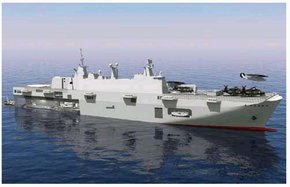

I don't think 30kts is a requirement for a modern carrier. Speed helps launch, speed helps land, speed helps protect. But the F-35 and its modern systems, landing and taking off are not going to be a problem, they will be fine.
As I recall the Canberra class has a top speed of 20+kts, and I recall something about it maxing out at 22+ kts on trials (but I can't find any link). 20kts would be fast enough. More likely it will cruise around at its economical speed of 15kts, even in carrier mode.
The problem is our amphibious needs are not met with 1 LHD. Our need is a full house ARG. For that we need to deploy 2 LHD's and 1 LPD and we are still short with that arrangement using 100% of our amphibious ships. Also we can't currently really keep a LHD in a forward operating posture (like at Townsville or more recently - Manus Island) which would be highly beneficial for the Army and Navy.
We also have 2000 US marines at Darwin now.
We also have a massive Singapore defence arrangement in Queensland. With up to 14,000 troops and equipment.
We also are responsible for training forces in the Pacific. We are likely to be the primary security partner for a range of nations in Asia.
The LPD capabilities verse the LHD are next level. There is a reason why we didn't go with just 4 x LPD's. In terms of deployment speed from landing craft, air operations, capacity and flexibility. Choules can't embark a helicopter, the LHD can hangar 18 and launch 6 at a time. 1 landing craft verse 4. LHD is faster.Embarked forces 350 verse 1,100. Will the LPD be able to handle larger landing craft?
There is nothing wrong with Choules, as an LPD. She was a great buy and a great ship. But that doesn't solve our amphibious problem alone. She was designed to work in support of larger ships.
Ideally you would have 3 LHD's and Choules could fill in at a pinch if a LHD is out. Now with 4 major amphibious ships, you can manage to have 3 available and manage which 3 you need. If you need all 3 LHD's, with time and planning, you can have 90,000 tons of amphibious capability. Augment that with some specialised longer range landing ships, and you are building a very full spectrum force.
We will attempt the ARG again at TS19. With Adelaide, Canberra and Choules. This is still the capability we need, we now need to work out how to keep it and make it viable.
VIDEO: RIMPAC Showcases the Evolution, Expansion of Australia's Amphibious Force - USNI News
Perhaps another consideration in the discussion of a possible f35b acquisition is would the method of Shipboard Rolling vertical Landings as just trialled by the R.N be desirable there are some concerns that smaller carriers would not have the deck space to do this .

SpazSinbad
Active Member
My verdict 'seaspear'? That is correct. The QE & PoW CVFs have been built to accommodate a potential SRVL from the getting go time (briefly interrupted by the F-35C madness). One issue is the width of the landing area. The CVFs have WIDTH in spades ('never mind the quality - feel the width' an old vaudeville joke when holding a bolt of WIDE but lousy cloth).
The WIDTH allows aircraft to be parked out of harms way to port with some to starboard in spaces available. When trialling the SRVL with ordinary F-35Bers in the SIM there was concern about how the Bees to the left of the landing lane were at right angles. Parking them with noses at a more 45 degree angle with rear in the wind helped reduce not only their width but the pilot impression of the landing lane WIDTH. One has to only compare the width of a CVF against an LHA/LHD - there is a safety factor involved with need for some 'space' to recover from lineup error or a burst tyre or brake problem (however the F-35B has computer controlled brakes which should alleviate most issues except perhaps the burst tyre).
Usually as has been noted in real SRVLs the landing braking to a stop distance is not an issue (except perhaps in wild weather at heavy landing weights yet to be tested but simulated).
Over these many years info about SRVLs has been collected to be posted in a small PDF here.....
F-35B SRVL INFO 18 Oct 2018 PRN pp 200.PDF [prn means 'reprinted' so any URL links are not live]
http://www.f-16.net/forum/download/file.php?id=28580 (PDF 9.5Mb 200 pages SRVL info)
IF you dare jump here for some WHARTON sim videos & graphic explaining the vHUD pilot view:
F-35B UK SRVL info - Updated when new/old info available - General F-35 Forum
You may have to scroll down the page (depends on your browser etc) to see two videos + view graphic.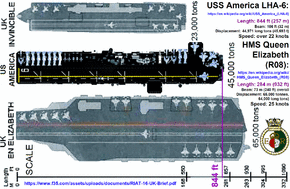
The WIDTH allows aircraft to be parked out of harms way to port with some to starboard in spaces available. When trialling the SRVL with ordinary F-35Bers in the SIM there was concern about how the Bees to the left of the landing lane were at right angles. Parking them with noses at a more 45 degree angle with rear in the wind helped reduce not only their width but the pilot impression of the landing lane WIDTH. One has to only compare the width of a CVF against an LHA/LHD - there is a safety factor involved with need for some 'space' to recover from lineup error or a burst tyre or brake problem (however the F-35B has computer controlled brakes which should alleviate most issues except perhaps the burst tyre).
Usually as has been noted in real SRVLs the landing braking to a stop distance is not an issue (except perhaps in wild weather at heavy landing weights yet to be tested but simulated).
Over these many years info about SRVLs has been collected to be posted in a small PDF here.....
F-35B SRVL INFO 18 Oct 2018 PRN pp 200.PDF [prn means 'reprinted' so any URL links are not live]
http://www.f-16.net/forum/download/file.php?id=28580 (PDF 9.5Mb 200 pages SRVL info)
IF you dare jump here for some WHARTON sim videos & graphic explaining the vHUD pilot view:
F-35B UK SRVL info - Updated when new/old info available - General F-35 Forum
You may have to scroll down the page (depends on your browser etc) to see two videos + view graphic.
Last edited:

Todjaeger
Potstirrer
I don't think 30kts is a requirement for a modern carrier. Speed helps launch, speed helps land, speed helps protect. But the F-35 and its modern systems, landing and taking off are not going to be a problem, they will be fine.
As I recall the Canberra class has a top speed of 20+kts, and I recall something about it maxing out at 22+ kts on trials (but I can't find any link). 20kts would be fast enough. More likely it will cruise around at its economical speed of 15kts, even in carrier mode.
The problem is our amphibious needs are not met with 1 LHD. Our need is a full house ARG. For that we need to deploy 2 LHD's and 1 LPD and we are still short with that arrangement using 100% of our amphibious ships. Also we can't currently really keep a LHD in a forward operating posture (like at Townsville or more recently - Manus Island) which would be highly beneficial for the Army and Navy.
We also have 2000 US marines at Darwin now.
We also have a massive Singapore defence arrangement in Queensland. With up to 14,000 troops and equipment.
We also are responsible for training forces in the Pacific. We are likely to be the primary security partner for a range of nations in Asia.
The LPD capabilities verse the LHD are next level. There is a reason why we didn't go with just 4 x LPD's. In terms of deployment speed from landing craft, air operations, capacity and flexibility. Choules can't embark a helicopter, the LHD can hangar 18 and launch 6 at a time. 1 landing craft verse 4. LHD is faster.Embarked forces 350 verse 1,100. Will the LPD be able to handle larger landing craft?
There is nothing wrong with Choules, as an LPD. She was a great buy and a great ship. But that doesn't solve our amphibious problem alone. She was designed to work in support of larger ships.
Ideally you would have 3 LHD's and Choules could fill in at a pinch if a LHD is out. Now with 4 major amphibious ships, you can manage to have 3 available and manage which 3 you need. If you need all 3 LHD's, with time and planning, you can have 90,000 tons of amphibious capability. Augment that with some specialised longer range landing ships, and you are building a very full spectrum force.
We will attempt the ARG again at TS19. With Adelaide, Canberra and Choules. This is still the capability we need, we now need to work out how to keep it and make it viable.
VIDEO: RIMPAC Showcases the Evolution, Expansion of Australia's Amphibious Force - USNI News
A couple of points of distinction. First, the Bay-class HMAS Choules is a Landing Ship Dock (LSD), not a Landing Platform Dock (LPD) like the USN's San Antonio-class or the RN's Albion-class. The second is that HMAS Choules brings a somewhat different capability to the amphibious operations table than the Canberra-class LHD does, so stating or advocating to replace the Bay-class with another Canberra-class, or especially a modified Canberra-class, does not really make sense from a planning perspective IMO.
Per the RAN page on the LHD's, up to 110 vehicles total can be transported between the light and heavy vehicle decks, depending on size and configuration. At the same time, the RAN page for HMAS Choules indicates that it can transport up to 150 light vehicles, or 32 M1A1 Abrams MBT's. What that suggests to me is that the LHD's are designed to transport and then land most of the troops and with vehicle support, while the LSD is intended to land mostly vehicles. From my recollection of discussions held on the forum at the time the LHD decision was announced, the planning centered around an LHD and LSD working together on an op, or an LHD establishing an initial landing, with additional kit to be brought in by the LSD afterwards.
Also, while the LHD's can indeed hangar up to 18 medium helicopters, that is only by using both the hangar and light vehicle deck. If the light vehicle deck is occupied by helicopters (or other aviation assets) then either no light vehicles are embarked, or they are relocated to the heavy vehicle deck and occupy space that otherwise could be used by a heavy vehicle.
With the RAN (and thus the ADF) being now reduced to just three ocean-going amphibious/sealift vessels, I do believe more vessels are needed, especially given what the current tempo of operations and exercises have been for them. The same tempo of operations and training/exercises is also a significant part of why I feel trying to use the LHD's, or even an additional modified version of one, to embark and operate F-35's, would be a bad idea.
If the ADF/RAN did actually have three Canberra-class LHD's, that should be enough to guarantee an LHD would be available for if not already on a deployment, with another in a maintenance cycle, and the third either in a pre-deployment workup, training, or post-deployment recovery phase. If the RAN tried to have one in training for amphibious ops, with a second training for F-35B ops, that would make it difficult for the third LHD to meet both the deployment and it's own maintenance requirements.
Side note, looking at the Spanish Armada page for the Juan Carlos I here, it does indeed appear that the configuration between the Spanish and RAN vessels are quite different. The JC1 can operate up to 30 medium/heavy helicopters, or up to 12 F-35B/AV-8B+ STOVL jets, while a Canberra-class can hangar up to 18 medium helicopters (again, using both the hangar and adjacent light vehicle deck) with landing spots on the flight deck for an additional six medium helicopters, or four CH-47 Chinook helicopters. What that indicates to me, is that the Spanish LHD has a greater aviation capability than the RAN version, and even with that apparently greater capability, at best a dozen STOVL jets can be embarked.
From my POV, a dozen embarked F-35B's is not really worth the loss of the other aviation capabilities and/or the vehicle space aboard a RAN LHD unless there were other aviation assets to provide complimentary capability coverage to make the F-35B operations worthwhile. After all, if the embarked F-35B's were to be expected to provide a CAP/air defence capability, plus a strike/CAS capability, more than a dozen jets would be required for anything other than extremely short operations. After all, at least six (likely more IMO) jets would be required to enable a two-jet CAP flight aloft 24/7.
For those who have not realized it yet, I am not fundamentally opposed to Australia developing and having a fast jet or fixed-wing aircraft carrier capability, since that could provide so many potential options to Australia in terms of defence and foreign policy. What I do not want to see, is Australia "robbing Peter to pay Paul" by re-directing resources away from a currently existing, much utilized and lMO already under-resourced capability, so that a new capability can be kind of raised. IMO it would be better for fixed-wing carrier ops to be properly resourced rather than competing with the ADF's amphibious forces for use of the LHD's.
SpazSinbad
Active Member
Regarding the 'fixed wing aviation capability' of JCI in 'aircraft carrier mode' vaguely I recall that something has to be done to that great big hole in the stern to NOT let water in so as to use the space for STUFF. As I'm not familiar with our LHDs (only seen from afar) I have no idea what that entails. It is allowed for and must be done when alongside. I could find a reference but this will be some time from now.....
SpazSinbad
Active Member
I'm having difficulty finding a reference/explanation of how JCI converts to 'aircraft carrier mode'. From memory the stern dock gate is locked (only when alongside - not at sea).
The full quote from the 'Todjaeger' reference above is:
The full quote from the 'Todjaeger' reference above is:
"AIRCRAFT "Capability for up to 30 medium and heavy helicopters for amphibious operations or 10/12 F-35B or AV-8B+ and similar number of helicopters [10/12] in her aircraft-carrier configuration." LHD "Juan Carlos I" (L-61) - Ships - Armada Española - Ministerio de Defensa - Gobierno de España
Be careful what you wish for! BEERSHEBA is not a deployable force. I apologise if I am teaching you to suck eggs, but the Brigades as they are now are not deployable, they are only raise-train-sustain. When BEERSHEBA rolled out, the AHQ details was so poor that instead of explaining the purpose (highly valuable, guarantees every soldier / officer in the Brigades is familiar with all equipment) they just ordered the BEERSHEBA Brigade to be used for everything. AHQ and FORCOMD has been fighting a PR campaign for the past 2 - 3 years to make people understand that 1 / 3 / 7 Bde right now cannot deploy and fight.
For a deployable force, it will be task orientated. Assuming 3 Bde is the Ready Brigade, if the threat demands a Regt of tanks (for instance), then 1 Armd Regt and 2/14 LHR will give up their tank Sqn to 2 Cav. Likewise, if we need additional signals capability, 1 or 7 CSR may cut elements, Squadrons or the entire regiment to 3 Bde.
To that extent, I think the RAN already has this. Our FFGs, AORs, PB, DDGs, LHDs and SSs have all worked together at points and there is sufficient resources to enable sailors to be familiar with working with these assets. The throwing together you mention is business as normal - the ADF is in the business of providing options to government, and that needs the ability to throw something together. Combined arms is a way of life, for white, green and blue suiters.
Hi Takao
Thanks for the post.
I take no offence and will continue the chat in the Aust Army thread
Regards S
A couple of points of distinction. First, the Bay-class HMAS Choules is a Landing Ship Dock (LSD), not a Landing Platform Dock (LPD) like the USN's San Antonio-class or the RN's Albion-class. The second is that HMAS Choules brings a somewhat different capability to the amphibious operations table than the Canberra-class LHD does, so stating or advocating to replace the Bay-class with another Canberra-class, or especially a modified Canberra-class, does not really make sense from a planning perspective IMO.
Per the RAN page on the LHD's, up to 110 vehicles total can be transported between the light and heavy vehicle decks, depending on size and configuration. At the same time, the RAN page for HMAS Choules indicates that it can transport up to 150 light vehicles, or 32 M1A1 Abrams MBT's. What that suggests to me is that the LHD's are designed to transport and then land most of the troops and with vehicle support, while the LSD is intended to land mostly vehicles. From my recollection of discussions held on the forum at the time the LHD decision was announced, the planning centered around an LHD and LSD working together on an op, or an LHD establishing an initial landing, with additional kit to be brought in by the LSD afterwards.
Also, while the LHD's can indeed hangar up to 18 medium helicopters, that is only by using both the hangar and light vehicle deck. If the light vehicle deck is occupied by helicopters (or other aviation assets) then either no light vehicles are embarked, or they are relocated to the heavy vehicle deck and occupy space that otherwise could be used by a heavy vehicle.
With the RAN (and thus the ADF) being now reduced to just three ocean-going amphibious/sealift vessels, I do believe more vessels are needed, especially given what the current tempo of operations and exercises have been for them. The same tempo of operations and training/exercises is also a significant part of why I feel trying to use the LHD's, or even an additional modified version of one, to embark and operate F-35's, would be a bad idea.
If the ADF/RAN did actually have three Canberra-class LHD's, that should be enough to guarantee an LHD would be available for if not already on a deployment, with another in a maintenance cycle, and the third either in a pre-deployment workup, training, or post-deployment recovery phase. If the RAN tried to have one in training for amphibious ops, with a second training for F-35B ops, that would make it difficult for the third LHD to meet both the deployment and it's own maintenance requirements.
Side note, looking at the Spanish Armada page for the Juan Carlos I here, it does indeed appear that the configuration between the Spanish and RAN vessels are quite different. The JC1 can operate up to 30 medium/heavy helicopters, or up to 12 F-35B/AV-8B+ STOVL jets, while a Canberra-class can hangar up to 18 medium helicopters (again, using both the hangar and adjacent light vehicle deck) with landing spots on the flight deck for an additional six medium helicopters, or four CH-47 Chinook helicopters. What that indicates to me, is that the Spanish LHD has a greater aviation capability than the RAN version, and even with that apparently greater capability, at best a dozen STOVL jets can be embarked.
From my POV, a dozen embarked F-35B's is not really worth the loss of the other aviation capabilities and/or the vehicle space aboard a RAN LHD unless there were other aviation assets to provide complimentary capability coverage to make the F-35B operations worthwhile. After all, if the embarked F-35B's were to be expected to provide a CAP/air defence capability, plus a strike/CAS capability, more than a dozen jets would be required for anything other than extremely short operations. After all, at least six (likely more IMO) jets would be required to enable a two-jet CAP flight aloft 24/7.
For those who have not realized it yet, I am not fundamentally opposed to Australia developing and having a fast jet or fixed-wing aircraft carrier capability, since that could provide so many potential options to Australia in terms of defence and foreign policy. What I do not want to see, is Australia "robbing Peter to pay Paul" by re-directing resources away from a currently existing, much utilized and lMO already under-resourced capability, so that a new capability can be kind of raised. IMO it would be better for fixed-wing carrier ops to be properly resourced rather than competing with the ADF's amphibious forces for use of the LHD's.
Hi Todjaeger
My take is that both the Canberra's and the Juan Carlos have the same deck and Hangar / Vehicle deck dimensions.
From that I guess the Carrying capacity should be identical across the Class weather it be for aircraft or vehicles.
I've seen many references to what can be carried, so the question I would ask for aircraft operations is, what is for transport only and what is for flight operations? Do you want to just transport aircraft like Atlantic Conveyor did in the FI with every thing packed in tight, or actually do flight operations which require space to move stuff.
In regards to storage of stuff, be it in the Hangar / garage or the flight deck, there will always not be enough space, so therefore its a balancing act of compromise.
The ships ability to carry containers, gets in its way to carry vehicles, which gets in the way to carry helicopters, which get in the way to carry F35B Fixed wing planes.
I'm very comfortable with the ship carry exclusively anyone only of the above; but recognise in reality there will be a mixture of assets based on the mission at hand.
As an aviation asset only, I would be content with no vehicles or troops carried.
9 x F35B and 9 x Romeos plus 3 NRH90 for SAR / logistics would not be unrealistic.
That's pretty good coverage for Air and Sea defence.
24 / 7 for short periods
Not to mention escort helicopters
It's not a Nimitz, nor is it pretending to be, but what it is, is a sovereign capability much greater than what we have at the moment.
Regards S
I recall reading something along those lines, years ago. Special equipment loaded, something like containerised storage, for which there are fitting points, electricity & other connections where needed (not necessarily fitted to the Oz LHDs), & the stern gate then sealed shut. IIRC it was days rather than hours to do it all. Can't remember all the details.Regarding the 'fixed wing aviation capability' of JCI in 'aircraft carrier mode' vaguely I recall that something has to be done to that great big hole in the stern to NOT let water in so as to use the space for STUFF. As I'm not familiar with our LHDs (only seen from afar) I have no idea what that entails. It is allowed for and must be done when alongside. I could find a reference but this will be some time from now.....
That was for operations as an auxiliary aircraft carrier, when the Armada's dedicated carrier wasn't available, not needed for an emergency landing of an F-35B, or whatever. Of course, there's no main carrier now.
SpazSinbad
Active Member
My post was about JCI aircraft capacity and 'why is it so' perhaps explaining to doubters about the quote from JCI website about aircraft carrying ability. What is needed and what is not on our LHDs is another matter that seems no one can provide details, so not only we can speculate 'not fitted for' but also 'fitted with but unused' and the devil take the hindmost. However long it takes JCI to convert to 'aircraft carrier mode' is also irrelevant, my point was / is it cannot be done at sea.
We may well be entering a new era for the auxillary carrier.I recall reading something along those lines, years ago. Special equipment loaded, something like containerised storage, for which there are fitting points, electricity & other connections where needed (not necessarily fitted to the Oz LHDs), & the stern gate then sealed shut. IIRC it was days rather than hours to do it all. Can't remember all the details.
That was for operations as an auxiliary aircraft carrier, when the Armada's dedicated carrier wasn't available, not needed for an emergency landing of an F-35B, or whatever. Of course, there's no main carrier now.
South Korea is exploring the possibility of converting their Dokdo assault ships, the Japanese want to convert their Helicopter Carriers, you have Turkey, Spain and even Singapore all either operating, building or at least exploring the possibility of operating F-35s from auxiliary carriers. Even the US has deployed F-35Bs from its LHAs ahead of the F-35C operating from its fleet carriers.
Tony Abbott explored and rejected that option a few years ago but with the continued naval buildup in our region it may well be something that could be looked at again. At the moment Australia just has to sit back and access how successfully other countries are at converting their amphibs into Auxillary Carriers.
I suspect the crunch will come when Australia moves to replace the Super Hornets. In fact it seems hard to justify replacing 24 Super Hornets with 28 F-35s unless you are going to introduce an additional capability to the ADF.
Tony Abbotts captains call interference was not a cohesive plan. Blind freddy knows its not really possible to give the LHD's a massive mission like carrier operations, without taking something off them, with the same number of platforms. No one wanted the existing platforms burdened with something without any additional funding, capability, platforms etc. I don't think much should be read into that assessment about the capability of the JC1 platform itself.
As I mentioned, we don't have enough platform capability for the amphibious capability we are building now. The is the possibility to reduce crew Choules, and still operate it, the RNA operated her with around 50 crew, not the 170 odd the RAN operates her with. Indeed she is a LSD (my bad), with no hangar, and cannot organically embark a helicopter. I am not proposing removal of Choules from government control, just shuffling things around.
Turkey intends to operate as a carrier (so they say, I fairly sceptical of a lot of Turkeys announcements), the JC1 platform would seem to be suitable in that role. You could then do a full and proper assessment, for very little money, and compare this to other options. IMO it is worthwhile to do that before committing even if that is the preferred intention.

The above picture shows one configuration, although I don't think the Spanish have operated this way with the harriers, preferring more space and more flexibility. So this is very much designer boasting maximum. As a pure carrier, the configuration is not optimal. You have the lower deck basically unused, with limited lifts to get access to it. Lift that only lift a single aircraft, etc.
This could be optimised and you could tweak the design and make a more effective carrier. Or you could have a more clean sheet specialised design. Or a bigger design. With different spectrum abilities on the amphibious scale.
But how much carrier capability does Australia really need?
Sure if the AUnzUS relationship had completely split, and the region was terrible, then yeh, acquire a QEII or two and do it properly, get 100 F-35B's and organic AEW, and go the whole hog.
If all we want is some light sea control, to deter bombers, surveillance aircraft, AEW etc and project power into voids in our immediate region like the southern part of the South China Seas, some of the far Indian ocean territory and the South Pacific and maybe a taskforce or convoy. Then a JC1 would probably be enough to embark up to 6 aircraft, transport F-35B's around the region to the further flung islands, be ready to instantly deploy to suddenly friendly airbases and offer a permanent presence that would then be supported by multiple squadrons of land based aircraft.
Australia seeking such mild capability, clearly defensive, isn't going to worry the neighbours or China. It takes the polarity of the situation. Anything that requires more than that, we would be tapping the US or UK or France and asking them to match our "carrier commitment". Which is easy to agree to, as we have already deployed a carrier and assets to operate/protect it.
As I mentioned, we don't have enough platform capability for the amphibious capability we are building now. The is the possibility to reduce crew Choules, and still operate it, the RNA operated her with around 50 crew, not the 170 odd the RAN operates her with. Indeed she is a LSD (my bad), with no hangar, and cannot organically embark a helicopter. I am not proposing removal of Choules from government control, just shuffling things around.
Turkey intends to operate as a carrier (so they say, I fairly sceptical of a lot of Turkeys announcements), the JC1 platform would seem to be suitable in that role. You could then do a full and proper assessment, for very little money, and compare this to other options. IMO it is worthwhile to do that before committing even if that is the preferred intention.
The above picture shows one configuration, although I don't think the Spanish have operated this way with the harriers, preferring more space and more flexibility. So this is very much designer boasting maximum. As a pure carrier, the configuration is not optimal. You have the lower deck basically unused, with limited lifts to get access to it. Lift that only lift a single aircraft, etc.
This could be optimised and you could tweak the design and make a more effective carrier. Or you could have a more clean sheet specialised design. Or a bigger design. With different spectrum abilities on the amphibious scale.
But how much carrier capability does Australia really need?
Sure if the AUnzUS relationship had completely split, and the region was terrible, then yeh, acquire a QEII or two and do it properly, get 100 F-35B's and organic AEW, and go the whole hog.
If all we want is some light sea control, to deter bombers, surveillance aircraft, AEW etc and project power into voids in our immediate region like the southern part of the South China Seas, some of the far Indian ocean territory and the South Pacific and maybe a taskforce or convoy. Then a JC1 would probably be enough to embark up to 6 aircraft, transport F-35B's around the region to the further flung islands, be ready to instantly deploy to suddenly friendly airbases and offer a permanent presence that would then be supported by multiple squadrons of land based aircraft.
Australia seeking such mild capability, clearly defensive, isn't going to worry the neighbours or China. It takes the polarity of the situation. Anything that requires more than that, we would be tapping the US or UK or France and asking them to match our "carrier commitment". Which is easy to agree to, as we have already deployed a carrier and assets to operate/protect it.

TBH, and I've said this before, I think that IF the CoA decides to operate fixed wing aviation at sea, then IMHO a dedicated CV is the best and only option because converting the LHD's to undertake such a mission would be expensive and time consuming, even as a stop gap measure. Yes the Spanish Armada did fly Harriers off JCI when Príncipe de Asturias was unavailable, but the Harrier is a different bird to the F-35B, which has different more advanced requirements. Secondly, there is a significant amount about the internal fitout / layout of both the JCI and Canberra Class that we just don't know, so making a valid compare and contrast between the two is quite difficult indeed. About 80% of what is being posted regarding the layout / fitout to support arguments in this ongoing discourse, is pure supposition based on little valid data. This achieves nothing and doesn't advance anyones arguments or cause. We all just end up running around in circles like headless chooks.
Therefore if it is decided that a dedicated CV is required, then what form should this take and what design would meet the needs of the ADF? My suggestion would be a variant of the Adelaide Class LHD without the well dock, with a larger flight deck area allowing for parking port and starboard, and two deck edge lifts going to two hangar decks. Not being a ships engineer / designer I defer to those more knowledgeable than me, but would it be possible to extend the flight deck outboard both port and starboard by a reasonable distance without creating to much of a stability problem? Or would the ships hull design length, breadth, and depth have to be scaled up to achieve the required buoyancy in order to achieve the desired stability?
Therefore if it is decided that a dedicated CV is required, then what form should this take and what design would meet the needs of the ADF? My suggestion would be a variant of the Adelaide Class LHD without the well dock, with a larger flight deck area allowing for parking port and starboard, and two deck edge lifts going to two hangar decks. Not being a ships engineer / designer I defer to those more knowledgeable than me, but would it be possible to extend the flight deck outboard both port and starboard by a reasonable distance without creating to much of a stability problem? Or would the ships hull design length, breadth, and depth have to be scaled up to achieve the required buoyancy in order to achieve the desired stability?
Last edited:
Tony Abbotts captains call interference was not a cohesive plan. Blind freddy knows its not really possible to give the LHD's a massive mission like carrier operations, without taking something off them, with the same number of platforms. No one wanted the existing platforms burdened with something without any additional funding, capability, platforms etc. I don't think much should be read into that assessment about the capability of the JC1 platform itself.
As I mentioned, we don't have enough platform capability for the amphibious capability we are building now. The is the possibility to reduce crew Choules, and still operate it, the RNA operated her with around 50 crew, not the 170 odd the RAN operates her with. Indeed she is a LSD (my bad), with no hangar, and cannot organically embark a helicopter. I am not proposing removal of Choules from government control, just shuffling things around.
Turkey intends to operate as a carrier (so they say, I fairly sceptical of a lot of Turkeys announcements), the JC1 platform would seem to be suitable in that role. You could then do a full and proper assessment, for very little money, and compare this to other options. IMO it is worthwhile to do that before committing even if that is the preferred intention.
The above picture shows one configuration, although I don't think the Spanish have operated this way with the harriers, preferring more space and more flexibility. So this is very much designer boasting maximum. As a pure carrier, the configuration is not optimal. You have the lower deck basically unused, with limited lifts to get access to it. Lift that only lift a single aircraft, etc.
This could be optimised and you could tweak the design and make a more effective carrier. Or you could have a more clean sheet specialised design. Or a bigger design. With different spectrum abilities on the amphibious scale.
But how much carrier capability does Australia really need?
Sure if the AUnzUS relationship had completely split, and the region was terrible, then yeh, acquire a QEII or two and do it properly, get 100 F-35B's and organic AEW, and go the whole hog.
If all we want is some light sea control, to deter bombers, surveillance aircraft, AEW etc and project power into voids in our immediate region like the southern part of the South China Seas, some of the far Indian ocean territory and the South Pacific and maybe a taskforce or convoy. Then a JC1 would probably be enough to embark up to 6 aircraft, transport F-35B's around the region to the further flung islands, be ready to instantly deploy to suddenly friendly airbases and offer a permanent presence that would then be supported by multiple squadrons of land based aircraft.
Australia seeking such mild capability, clearly defensive, isn't going to worry the neighbours or China. It takes the polarity of the situation. Anything that requires more than that, we would be tapping the US or UK or France and asking them to match our "carrier commitment". Which is easy to agree to, as we have already deployed a carrier and assets to operate/protect it.
Hi stingray
Certainly agree with the gist of your comment.
Important you mention the worry the neighbours comment.
While we should run our own race, prudence suggests we do need to be mindful what the consequences are for what we purchase.
Our local neighbours understand our geography and needs, but even they will have a limit of tolerance to a build up of a power projection capacity.
As an advocate for the LHD with fixed wing capacity I'm mindful of that fine line of defence and offence perception.
It's a tricky balancing act.
A certain Indonesian general has already questioned our need for such a ship.
No doubt more for domestic political traction than anything else. but it does become a weapon of diplomacy.
If I recall a former defence Minister made a special trip to Indonesia when we acquired additional F111's to explain our needs and pacify any fears such a purchase would make to the relationship.
While both sides know the game one still has to play by the rules.
Getting three Nimitz battlegroups would certainly raise an eyebrow.
Getting a third LHD we could politically sell overseas.
The difficulty would be selling the idea to our own public.
Regarding the above graphic,I'm guarded as to its scale and layout.
Looks a bit optimistic.
Regards Stampede
SpazSinbad
Active Member
'Stampede' said: "...Getting a third LHD we could politically sell overseas. The difficulty would be selling the idea to our own public." Ye gods it is difficult enough to sell it on this forum.
Yes as the moditator mentioned 'not knowing details' of differences between JCI and our LHDs makes argumentation a circle, signifying little. Anyway China has motivated Japan and so may China motivate us in a similar FLEET AIR DEFENCE direction. Sure a third LHD would be great - however just because Spain has not operated F-35Bs from JCI does not mean that 'with the knowledge available when that ship was designed' that it was NOT designed to handle F-35B ops. It was. However Spain is skint - in future they may allow the USMC or UK Joint Force to carry out some cross decking - but of course the JCI deck probably needs some 'hole avoiding' non-skid technology at least.
Having a purpose designed third LHD for Oz would be nice but like others I cannot really even imagine what that may mean in reality. Bear in mind the CVF - WIDE deck - purpose designed for F-35B to maximise sortie rate. Some say 'steel is cheap' whilst others say 'never mind the quality - feel the width'. It is the vibe - I rest my case m'lud.

We may well be entering a new era for the auxillary carrier.
South Korea is exploring the possibility of converting their Dokdo assault ships, the Japanese want to convert their Helicopter Carriers, you have Turkey, Spain and even Singapore all either operating, building or at least exploring the possibility of operating F-35s from auxiliary carriers. Even the US has deployed F-35Bs from its LHAs ahead of the F-35C operating from its fleet carriers.
The Japanese, Singapore and Australia should get on the same page then and work on a common joint venture design, build and sustainment project.

t68
Well-Known Member
The Japanese, Singapore and Australia should get on the same page then and work on a common joint venture design, build and sustainment project.
Yes a common design would be good with the Japanese having recent experience , maybe a slightly enlarged Izumo would be the ticket, where to build will be the tough choice.
But I would dearly love to see it happen
Last edited:
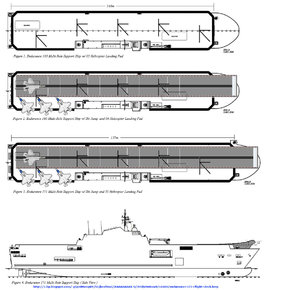
Well there is an image floating around of a Singapore Technologies E-170 design with the F-35B in mind, but that's all it is.
- Status
- Not open for further replies.