Royal Canadian Navy Discussions and updates

FormerDirtDart

Well-Known Member
An ice capable amphibious ship would be dual use, military and civilian. Emergency resupply voyages to the Arctic in winter currently is not possible. The two AORs are for the RCN replenishment at sea requirements. They likely would see limited time in the Arctic unless there is a long term deployment of future River class ships in the summer months.
A couple images were posted over on SecretProjets from DAVIE a couple weeks ago. Don't know their origins so don't want to violate any rules here posting them. But I will drop the link
They depict the G-LAM (Global, Logistics, Aviation, Medical -Support Platform) and the G-LAAM which I figure the AA is amphibious assault as it includes a welldeck and the other doesn't
And a "G-LAAM ship" search on Google produces a bevy of images
 
Are they looking to conduct amphibious ops in the Winter? What do they do now in terms of winter amphibious ops? What is their current requirement and how exactly is it being met? I thought they basically didn't have any amphibious capability?

If its resupply, presence, science, basing, then a polar ship might be more useful. 25,000t polar ship with great icebreaking capabilities and some amphibious capabilities could fill that. Helicopters and ice vehicles (although again, heavy vehicles are probably a no no).

If its actual amphibious landings, that would need to be a pretty serious ship. If they wanted to land a tank on an island, then that would basically require cushioned landing craft.
This whole thing is nothing but a thought experiment from the head of the RCN, largely in response to both political parties making armed heavy icebreakers for the RCN part of their campaigns in the last Federal Election. It's almost certainly an attempt by the RCN to "get ahead" of a potential forced procurement of a ship design the Navy doesn't want, and to transform it potentially into something far more versatile and usable. Overall I wouldn't look too far into this whole thing, the Canadian Coast Guard is already in the middle of procuring a huge number of new capable icebreaker designs which all feature extensive cargo carrying capability for limited Arctic supply work.

Amphibious operations in the Canadian Arctic, especially in Winter, is basically fantasy. If the Russian's or Chinese invade, we'd be dispatching the RCAF/USAF to bomb them into oblivion and then deploying Search & Rescue assets to clean up whatever remains. The purpose of these platforms is to provide humanitarian support and sealift capability to the North and given the very limited port infrastructure present, it'll likely be so that you need amphibious capabilities to actually land the gear. That doesn't mean combat operations, but more cargo and humanitarian support work.

The RCN is juggling 15 destroyers, 12 submarines, 2 Joint Support Ships and the remainder of its existing fleet, while talking about things like a drastically expanded inshore training fleet, a number of corvettes and additional logistics vessels. There is already a lot of funded and unfunded items on their plate, don't expect this thing to show up anytime soon, if at all.

I just worry about Canadian defence procurement where they try to put too many capabilities in one ship. Didn't we go through with this with the big honking ship and that became the JSS and then that became the two tankers.
Fundamentally Canada does not have the manpower or money to afford making specialist Arctic only RCN vessels, it would be a waste. Anything we procure generally has to serve our goals at home and abroad, so generally our equipment is more generalist.

Even when the mistral ships were being offered for crazy low drive away prices, Canada didn't seem that interested. Aren't the AOR the amphibious ships and aren't they yet to be commissioned.
We never purchased the Mistrals because even though they were cheap, they would have been total white elephants for the RCN. There was no RCAF or Army assets to operate amphibiously and no seeming want to cooperate to develop that, trying to wrangle all three services together for a task like that would be herculean. They would be unable to do work in the Arctic, we didn't have the dockyard space to house them, we didn't have the escorts to properly protect them, we didn't have the logistics vessels to properly support them, we didn't have the personnel to operate them and we didn't have the money required to make them work.

It was a good idea for people who had no clue about the state of the Navy at the time, and just wanted the national prestige boost which a flat top brings.
 

StingrayOZ

Super Moderator
Staff member
They depict the G-LAM (Global, Logistics, Aviation, Medical -Support Platform) and the G-LAAM which I figure the AA is amphibious assault as it includes a welldeck and the other doesn't
Ok they are two interesting concepts. Not sure how much planning has gone into mounting that 57mm, not sure how serviceable that would be in icey conditions. Do you need a 57mm on an amphib? The machinery space seems to be blocking the well dock? They are very, uhuh, innovative.. Do docks work well in icey polar conditions?

Overall I wouldn't look too far into this whole thing, the Canadian Coast Guard is already in the middle of procuring a huge number of new capable icebreaker designs which all feature extensive cargo carrying capability for limited Arctic supply work.
More smaller ships would seem to be perhaps the more useful way to go. A singular ship doesn't provide a lot of redundancy also training/logistics/upgrade issues. Plus existing design, low risk, more ships, greater presence.
The RCN is juggling 15 destroyers, 12 submarines, 2 Joint Support Ships and the remainder of its existing fleet, while talking about things like a drastically expanded inshore training fleet, a number of corvettes and additional logistics vessels. There is already a lot of funded and unfunded items on their plate, don't expect this thing to show up anytime soon, if at all.
The air force and army have their priorities as well. Plus aren't all those ships being built locally as well?
Fundamentally Canada does not have the manpower or money to afford making specialist Arctic only RCN vessels, it would be a waste. Anything we procure generally has to serve our goals at home and abroad, so generally our equipment is more generalist.
They would be highly specialised. High risk, unique, platforms. The CONOPs, doctrine and entire strategy around them and the idea of ice amphibious landings would have to be developed. As you mentioned, airpower would seem to be the obvious choice

Canada as a major nation should, IMO have some sort of amphibious capability. They are very useful assets. Australia has found its LHD's to be extremely useful for regional and local HDAR, presence, international engagement, possibly as a ASW platform. Its not just about amphibious landings on your own continent. It would be great to see Canada engage with such ops in Europe or in the pacific with such capabilities.
We never purchased the Mistrals because even though they were cheap, they would have been total white elephants for the RCN. There was no RCAF or Army assets to operate amphibiously and no seeming want to cooperate to develop that, trying to wrangle all three services together for a task like that would be herculean.
It has to be joint. Australia's amphibious capability had strong input from the army. It was after East Timor when we realised, we needed a more serious approach. It was after East Timor that the Army, Navy and Airforce got more of a combined motivation to work together, sort of. I was wondering if the recent developments south of Canada had perhaps forced services to work together and realise real and useful capability. For Australia, back in 1999 when we asked the Americans to provide all the amphibious lift capability, air defence, ASW for our fleet so we could go into a civil conflict in South East Asia, in the 4th most populous nation on the planet, and things got complicated.

Very interested what Canada does in this space. From a country that had to build amphibious capability from scratch, has 6million square km of polar territory, and a population 50% smaller than Canada's.
 
Ok they are two interesting concepts. Not sure how much planning has gone into mounting that 57mm, not sure how serviceable that would be in icey conditions. Do you need a 57mm on an amphib? The machinery space seems to be blocking the well dock? They are very, uhuh, innovative.. Do docks work well in icey polar conditions?
There are entrance doors on the enclosed forecastle for crew to get up there and service the gun if required, so there isn't anything particularly wrong with the arrangement. The Dutch JSS Karel Doorman is being retrofitted with a 76mm gun and RAM launcher and given how both of these vessels are similarly large and important assets, the armament seems entirely justified. Modern vessels are able to have some interesting arrangements with their machinery spaces, which are far forward and feed backwards to the propellers which aren't in the way of the well dock. I can't say about well docks in icy conditions personally.

More smaller ships would seem to be perhaps the more useful way to go. A singular ship doesn't provide a lot of redundancy also training/logistics/upgrade issues. Plus existing design, low risk, more ships, greater presence.
Part of the difference is smaller vessels require more crew, more maintenance, additional berthing space and all of the fixings for separate vessels. We wouldn't need multiples of these vessels and frankly, we couldn't afford to operate them all. The Navy doesn't want to be getting into the game of operating a bunch of cargo icebreakers, and part of this "program" does ultimately boil down to a big Northern prestige flagship.

The air force and army have their priorities as well. Plus aren't all those ships being built locally as well?
Everything besides the submarines will be built locally, yes.

They would be highly specialised. High risk, unique, platforms. The CONOPs, doctrine and entire strategy around them and the idea of ice amphibious landings would have to be developed. As you mentioned, airpower would seem to be the obvious choice

Canada as a major nation should, IMO have some sort of amphibious capability. They are very useful assets. Australia has found its LHD's to be extremely useful for regional and local HDAR, presence, international engagement, possibly as a ASW platform. Its not just about amphibious landings on your own continent. It would be great to see Canada engage with such ops in Europe or in the pacific with such capabilities.
The benefit to GLAM especially is that its not an overly specialized vessel by its nature, and we can get proper use out of it elsewhere. Something like a proper large Polar icebreaker has very minimal use cases outside of the Arctic, as its specialized hull form and overall design make them dreadful sea vessels and very inefficient. Similarly to our Arctic and Offshore Patrol Ships, GLAM is a more balanced design which can operate in the North, but isn't specialized to the point that North Atlantic operations are also off the table. It has the capabilities to do replenishment at sea and sealift to Europe, which provides the RCN with a valuable capability outside of the Arctic as well. It's very hard to justify something without versatility to the RCN when it will be stuck doing Arctic work constantly and nothing else.

Canada is frankly in a different geographic and geopolitical scenario than Australia, and this should be taken into account. Unlike Australia, Canada does not have a substantial archipelago within its own control we have to be overly concerned about, alongside another series of archipelagos abroad that we need to be able to deploy manpower into. How we conduct international engagement is different, we have existing/future vessels that can do HADR and frankly, the amount of drain on the services an proper amphibious capability would be far out weights any advantages it provides, in my humble opinion.

I do think Canada should have some kind of domestic sealift capability to bring the Army to Europe on our own terms, something similar to what the British did with the Point-class sealift ship. That is a far more reasonable capability than going fully into an amphibious requirement.

It has to be joint. Australia's amphibious capability had strong input from the army. It was after East Timor when we realised, we needed a more serious approach. It was after East Timor that the Army, Navy and Airforce got more of a combined motivation to work together, sort of. I was wondering if the recent developments south of Canada had perhaps forced services to work together and realise real and useful capability. For Australia, back in 1999 when we asked the Americans to provide all the amphibious lift capability, air defence, ASW for our fleet so we could go into a civil conflict in South East Asia, in the 4th most populous nation on the planet, and things got complicated.

Very interested what Canada does in this space. From a country that had to build amphibious capability from scratch, has 6million square km of polar territory, and a population 50% smaller than Canada's.
There really isn't that can happen which will make Canada want to invest the incredible amount of effort into doctrine, procurement, development and fielding of an amphibious capability. It doesn't offer us anything of tangible value right now, and would only serve to hinder our current way of operation and future procurements. Even in the Arctic aspect, I think one could argue that investments into airfields and RCAF platforms to airlift items there if required is more worthwhile and cost effective than an amphibious capability.
 

StingrayOZ

Super Moderator
Staff member
The benefit to GLAM especially is that its not an overly specialized vessel by its nature, and we can get proper use out of it elsewhere. Something like a proper large Polar icebreaker has very minimal use cases outside of the Arctic, as its specialized hull form and overall design make them dreadful sea vessels and very inefficient.
Polar vessels are often very hard to manoeuvre are pretty terrible at everything else. It the artic likely being essentially ice free (certainly not enough ice for most of the summer to warrant a dedicate summer time icebreaker). I wonder.

It might be cheaper and less risk to be a dedicated polar research ice breaker type vessel. And a normal amphibious ship rather than roll the two duties together and get something not good at either.

Russians are building a LHD type ship. Other options would be smaller beaching ships, which may be more suitable, given stronger hulls etc.

Canada is frankly in a different geographic and geopolitical scenario than Australia, and this should be taken into account.
Yes, but Australia has tried different strategies.

Australia was able to get on without amphibious capability of any note for a long time. As we had adopted continental defence. We stay here, and defend the continent. Nothing can touch us. Why worry. We have air superiority over our region, we have F-111 that could make long range strikes against, well anyone, particularly from Butterworth. A 2000lb jdam into window so to speak to quote an Indonesian turn of phrase.

The reality was the world changed.

We need to secure our region and our allies, particularly as the US might not be doing that at all. We certainly don't want another mighty powers to interfere into our region, our friends and our affairs. By taking up this space, the US doesn't have to be prevalent and where it is, it can be on our terms and flexible.

East Timor changed that.

The distance from Dilli, East Timor to Sydney is similar to the distance from Caracas, Venezuela to Ottowa. ~100km difference.
If we want the world to reflect in the values that we hold, we have to be able to influence world events.
Unlike Australia, Canada does not have a substantial archipelago within its own control we have to be overly concerned about, alongside another series of archipelagos abroad that we need to be able to deploy manpower into.
Arctic Archipelago - Wikipedia
I dunno.. Seems like a big bit of territory to just let other people take. A large piece of territory with no amphibious capability. That Greenland space looks, interesting. Exactly how will the Americans determine which parts are Canada, which parts are Denmark and Which parts are the new US territory of Greenland.

You mention going into Europe. Does that include Greenland? Remote areas. What about Canadian interests in the Pacific?

The other aspect about East Timor that was a wild lesson. Is how incapable everyone is without the US logistics and backbone and Command and control. Even if you have 20 willing nations, you need someone to turn up and be that backbone. In SHTF situations, regular logistics and port facilities are often the first to go.
 
Polar vessels are often very hard to manoeuvre are pretty terrible at everything else. It the artic likely being essentially ice free (certainly not enough ice for most of the summer to warrant a dedicate summer time icebreaker). I wonder.

It might be cheaper and less risk to be a dedicated polar research ice breaker type vessel. And a normal amphibious ship rather than roll the two duties together and get something not good at either.

Russians are building a LHD type ship. Other options would be smaller beaching ships, which may be more suitable, given stronger hulls etc.
Polar Classes are a sliding scale, the higher the Polar class and the more demanding requirements for Arctic operations which need to be met, and therefore the more extreme the tradeoffs required. GLAM is proposed as a Polar Class 4, which while more than capable of Arctic operations throughout the Summer and Fall months while also into the Spring/Winter to some degree, still isn't specialized to the point of say a Polar Class 3 or 2 heavy icebreaker where operations elsewhere become unduly compromised. Our Arctic and Offshore Patrol Ships are designed to operate in the Arctic throughout the Summer and Fall, and are equipped to Polar Class 4/5 standards, they are still able to operate relatively well abroad and have deployed to Japan, Europe, Central America, South America and even down into Antarctica. It is not out of the realm of plausibility that GLAM can have Arctic capability, while still being usable as a sealift and resupply vessel by the RCN elsewhere.

I've stated previously the Arctic is not becoming ice free anytime soon and even in the Summer, icebreakers are required for safe work in many places. Canada already has a huge fleet of icebreakers coming in the future, there really isn't a need for any dedicated polar research icebreakers. We're looking at two PC2 Polar Icebreakers, six PC3 Program Icebreakers, up to sixteen PC4 Multi-Purpose Icebreakers and a total of eight PC4/5 AOPS for the RCN/Coast Guard.

It doesn't make sense for Canada to split this ship into two, when we really don't have a use for a traditional landing ship and something like smaller beaching ships are fundamentally not very workable in the conditions of the Arctic. A Russian LHD in the Arctic is frankly nothing more than a target for the RCAF.

Yes, but Australia has tried different strategies.

Australia was able to get on without amphibious capability of any note for a long time. As we had adopted continental defence. We stay here, and defend the continent. Nothing can touch us. Why worry. We have air superiority over our region, we have F-111 that could make long range strikes against, well anyone, particularly from Butterworth. A 2000lb jdam into window so to speak to quote an Indonesian turn of phrase.

We need to secure our region and our allies, particularly as the US might not be doing that at all. We certainly don't want another mighty powers to interfere into our region, our friends and our affairs. By taking up this space, the US doesn't have to be prevalent and where it is, it can be on our terms and flexible.

East Timor changed that.

The distance from Dilli, East Timor to Sydney is similar to the distance from Caracas, Venezuela to Ottowa. ~100km difference.
If we want the world to reflect in the values that we hold, we have to be able to influence world events.
Again as I stated, Canada and Australia have two deeply different geopolitical and geostrategic environments and thus a lot of the concerns really don't carry over. Australia is isolated into the Pacific away from the vast majority of any capable allies, Canada sits right beside the worlds premier superpower and is heavily integrated with them, while all of our European allies are across the Atlantic. Canada doesn't especially have regional security ambitions past our own territory at home, and the work we do abroad is alongside our various allies. The US will always be prevalent in our spaces, as we share a border and our territories with them by proximity. No major enemies are anywhere near Canada and they also do not have the ability to meaningfully encroach onto our territories. We aren't regional policemen and don't want to take up such a role.

Arctic Archipelago - Wikipedia
I dunno.. Seems like a big bit of territory to just let other people take. A large piece of territory with no amphibious capability. That Greenland space looks, interesting. Exactly how will the Americans determine which parts are Canada, which parts are Denmark and Which parts are the new US territory of Greenland.

You mention going into Europe. Does that include Greenland? Remote areas. What about Canadian interests in the Pacific?

The other aspect about East Timor that was a wild lesson. Is how incapable everyone is without the US logistics and backbone and Command and control. Even if you have 20 willing nations, you need someone to turn up and be that backbone. In SHTF situations, regular logistics and port facilities are often the first to go.
If people want to come into the Canadian Arctic and start taking territory, feel free. The RCAF will be out to bomb you or rescue you, likely both in most scenarios. The Canadian Arctic is an incredibly inhospitable environment with absolutely minimal infrastructure, the price to actually set up a force there to take and hold territory compared to the costs is laughable. The Arctic is largely a self reinforcing protection onto itself and when it needs assistance, we have an entire airforce and especially NORAD to enforce its sovereignty. Even a current US administration will not permit hostile powers to encroach into North America, and the response will be fairly swift.

Being able to land troops and Army resources in the Arctic is of very limited value, as conditions and infrastructure there are not conducive to any type of operation for any length of time, even by specialist forces. Future capabilities like HIMARS with land attack and anti-shipping capabilities can be quickly airlifted via the RCAF, and warships deployed further into the North can assist with sensors and anti-ship/land attack platforms. We do not need amphibious capability to defend the Arctic with the Army, the head of the RCN is largely talking about it for humanitarian and other purposes.

The Army is entirely involved with their large scale deployment to Latvia to square off against Russia, having sealift capability to make sure we have an avenue to move our equipment there on our own timelines is important. I don't see the CAF being particularly interested in Greenland as unlike the Europeans, we have to live with the Americans everyday and the friction likely isn't worth it. Canadian interests in the Pacific are entirely focused around the RCN, with maybe some expeditionary RCAF deployments in the future if required.

 

StingrayOZ

Super Moderator
Staff member
I do agree that Canada and Australia see themselves having very different roles and different needs.

It will be interesting to see how this develops with time, the difficulty is currently its hard to see which norms that currently exist persist into the future and what completely changes.

I am surprised that there is such a strong feeling of eternal and enthusiastic support for NORAD and the American alliance. As Australians we spend much of our time both limiting the American responsibilities and interest in our region and also engaging with them. We have done this since WW2, seeking the right type of engagement on our terms. The last thing pretty much anyone wants is uncontrollable American interest in our region and the baggage (dictated terms) that comes with that, even in good times. The current US situation seems to indicate that is a wise choice. But we are usually pretty far away from the US (except for US Samoa).

I am also surprised that the obvious front for Canada is Latvia, while Denmark, Netherlands, France, Germany will secure Greenland. As a non-NATO country, NATO fascinates me in how it works and how that impacts and shapes each nations needs and developments and capabilities. If that remains so then yes, a refocus to amphibious operations makes little sense as Canada will be focused on the upcoming continental high intensity war on the Continent.

Also the vessel types interest me. Our Kiwi friends often pull similar requirements, HMNZS Canterbury was a 9000t MRV sealift ship that also had ice strengthening. But the Canadian requirements and ships seem far more heavily modifications and ice capable. There are other southern Hemisphere countries that are also looking at such things, particularly with the apparent breakdown of national borders, Antarctica has always been a hotspot for territorial disputes.
 

John Fedup

The Bunker Group
I am surprised that there is such a strong feeling of eternal and enthusiastic support for NORAD and the American alliance.
I am sure strong enthusiastic support has been lacking since GW2 but Trump has turned support to outright anti-Americanism, at least amongst the Canadian electorate. NORAD is still deemed important and valuable by our military but I assume privately many senior sirs are becoming concerned with the $hitshow south of the border,
 
I am surprised that there is such a strong feeling of eternal and enthusiastic support for NORAD and the American alliance. As Australians we spend much of our time both limiting the American responsibilities and interest in our region and also engaging with them. We have done this since WW2, seeking the right type of engagement on our terms. The last thing pretty much anyone wants is uncontrollable American interest in our region and the baggage (dictated terms) that comes with that, even in good times. The current US situation seems to indicate that is a wise choice. But we are usually pretty far away from the US (except for US Samoa).
It has been an exceptionally valuable and worthwhile alliance, especially for a nation that previously has been happy to shirk its defence responsibilities. We share a border and having an entirely interoperable sensor, intelligence and response force across the entire North American envelope is basically a unique relationship compared to any other the Americans have. Australia has the benefit of distance and the ability to keep the Americans at arms reach if they please, we don't particularly have that ability. We are America's closest ally, which is why this deranged treatment and abuse hits so many Canadians especially closely.

I am also surprised that the obvious front for Canada is Latvia, while Denmark, Netherlands, France, Germany will secure Greenland. As a non-NATO country, NATO fascinates me in how it works and how that impacts and shapes each nations needs and developments and capabilities. If that remains so then yes, a refocus to amphibious operations makes little sense as Canada will be focused on the upcoming continental high intensity war on the Continent.
That is where our standing NATO commitment is, as other nations in Europe have similar deployment to the various neighboring nations to protect them against Russia. Greenland is obviously important and Canada regularly is present there with airforce personnel and CF-18's as part of NATO/NORAD alongside serious Canadian Coast Guard icebreaking/Naval support when required, but it isn't a relevant area that needs protection. Unlike some of the bluster ongoing, neither Russia nor China is present there nor has the ability to take Greenland without getting jumped by NATO en mass.
 
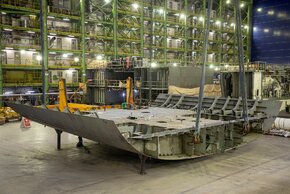
_(4_of_4).jpg

From the Irving Shipbuilding Twitter, progress on the first River class Destroyer.

“Last week, we successfully lifted and flipped the first unit for the first River-class destroyer, the future HMCS Fraser. Work is steadily progressing on this unit and the program, as we look to lay the keel for the first ship of the Royal Canadian Navy's future fleet later this year.”
 

StingrayOZ

Super Moderator
Staff member
Unlike some of the bluster ongoing, neither Russia nor China is present there nor has the ability to take Greenland without getting jumped by NATO en mass.
I don't think the Russians are particularly interested in Greenland. A frozen polar island with no inhabitants. Russia has plenty of frozen territory. They would rather take Berlin than take Greenland. If you are going to fight NATO, at least fight to get the good parts. China has never indicated any interest, not only that, but its too far, too cold and has nothing they are interested in. There aren't even mines to extract these theoretical resources, China could much easier build mines in Africa and not only not fight anyone, but have other countries help.

From the Irving Shipbuilding Twitter, progress on the first River class Destroyer.
Ok I hope there are regular twitter updates.. Canada and Australia can now be benchmarked against each other on this build.
 

John Fedup

The Bunker Group
Ok I hope there are regular twitter updates.. Canada and Australia can now be benchmarked against each other on this build.
Expecting Trump will screw the River program with sanctions on critical components. He and his fellow %uckwits in the WH will eventually do the same to the Hunter build and look for AUKUS to be derailed, a combination of Trump BS and the American industrial base not performing (maybe UK as well). Perhaps the latter can be avoided by giving up all Antarctica claims and allowing NZ to become a US territory.
 

StingrayOZ

Super Moderator
Staff member
Expecting Trump will screw the River program with sanctions on critical components. He and his fellow %uckwits in the WH will eventually do the same to the Hunter build and look for AUKUS to be derailed, a combination of Trump BS and the American industrial base not performing (maybe UK as well). Perhaps the latter can be avoided by giving up all Antarctica claims and allowing NZ to become a US territory.
Realistically, for these programs, they should probably have already ordered and start receiving all critical US equipment right now. You would want them in Canadian warehouses ready to go.

Trump and WH have already looked at derailing AUKUS. They assessed it not to be worth it. AUKUS has lots of challenges, but it does look like we are getting a Virginia submarine. Australia alliance doesn't really revolve around the president and WH treaties. Its very engaged with the USN. WH and Trump are risks, but so too are the UK and even AU. Hence why we are also refitting the Collins. Hence why we have a deal with the Japanese.

Its not just Trump you need to worry about for US supply. If things heat up geopolitically, the US may cancel all international orders and take everything domestically. Anything that is not in country could be cancelled. Even if it is in country, the Americans can demand to have it come back. Not just for crazy reasons. If they go to war with China, or China invades Taiwan, these are pretty big reasons.

US isn't interested in NZ or Antarctica. They try to minimise their expense down there. They are completely reliant on NZ to even get to the south.

NZ has a much larger, closer and crazier nation to worry about anyway. One that threatens their existential existence at every stage.
 
Expecting Trump will screw the River program with sanctions on critical components. He and his fellow %uckwits in the WH will eventually do the same to the Hunter build and look for AUKUS to be derailed, a combination of Trump BS and the American industrial base not performing (maybe UK as well). Perhaps the latter can be avoided by giving up all Antarctica claims and allowing NZ to become a US territory.
I don't expect this to occur, given how AUKUS has continually progressed through Trump's term largely unmolested. For all of his bluster and various issues, Trump has not interfered in purchases and transfers of technology to his western allies. Denmark has continued to purchase US military equipment even during this Greenland debacle, with Trump not looking to interfere with. Many of the River class components have had their contracts signed years ago and the equipment is already being produced. There is basically no way to Canada to pivot away from the AEGIS-SPY-7 combination on the River class, as the design was fundamentally changed around those systems to adopt them. You'd be looking effectively at program collapse if they needed to be switched out.
 

John Fedup

The Bunker Group
I don't expect this to occur, given how AUKUS has continually progressed through Trump's term largely unmolested. For all of his bluster and various issues, Trump has not interfered in purchases and transfers of technology to his western allies. Denmark has continued to purchase US military equipment even during this Greenland debacle, with Trump not looking to interfere with. Many of the River class components have had their contracts signed years ago and the equipment is already being produced. There is basically no way to Canada to pivot away from the AEGIS-SPY-7 combination on the River class, as the design was fundamentally changed around those systems to adopt them. You'd be looking effectively at program collapse if they needed to be switched out.
You are correct about the kit orders being built now but not yet delivered but you can’t assume Trump won’t derail things. More importantly, as has been pointed out by StingrayOZ, undelivered kit may be diverted to US projects should a China-US conflict arise.
 
Top