
You are using an out of date browser. It may not display this or other websites correctly.
You should upgrade or use an alternative browser.
You should upgrade or use an alternative browser.
Royal Australian Navy Discussions and Updates 2.0
- Thread starter OPSSG
- Start date
Shades of the 60s and earlier, eBay back to 1911, when we took RN designs virtually unchanged.
Dropping 9LV etc into the Meko wouldn’t be change - they are designed to accept that. Particularly if we actually got the 210.
To your point spoz, my understanding is that the Swan class DEs , the Adelaide class FFGs, and lastly the Hobart class DDGs (the steam powered ones), were all purchased largely unchanged from the parent design. So this strategy of "as is procurement" is not a new concept.
Redlands18
Well-Known Member
Perth class not Hobart class, US built Charles F Adams design but with two Ikara launchers instead of ASROC fitted amidships.To your point spoz, my understanding is that the Swan class DEs , the Adelaide class FFGs, and lastly the Hobart class DDGs (the steam powered ones), were all purchased largely unchanged from the parent design. So this strategy of "as is procurement" is not a new concept.
I appreciate ‘as is‘ procurement.
I think in selecting a design we should be mindful of their original design philosophies, based on operating from home waters.
Australia will likely want to push these things further afield, so i think emphasis should be placed in features enhancing operational resilience, which in itself is a force/effect magnifier.
so hull size for later growth (refit) margins, range and VLS magazine size needs to be prioritised.
It should be considered that with the retirement of some of the ANZACs there will be surplus, recently updated and near new Combat System elements available to fit to the new frigates, which ever is selected.
Way back when there was first talk of OCVs (whatever acronym we were using) to replace the Armidales, I was speculating that systems removed from the retiring FFGs and being made surplus by ANZAC upgrades could be reused on the OCVs. The phased retirement of the ANZACs gives us a similar, actually a better opportunity to do this.
Combat System elements are traditionally government furnished equipment (GFE), that is, the Commonwealth needs to procure it and provide it to the shipbuilder. There is probably a lot more flexibility in this area than many realise.

Biggest ship?so hull size for later growth (refit) margins, range and VLS magazine size needs to be prioritised.
It may not be that that is the actual ship. That is what Navantia was pushing for before, when it was a corvette, and the minimum the government would be happy with.I think there is still ambiguity as to what zero change means for ALFA3000 and Meko 200. Zero change from what exactly?
However, if they changed the proposal to F-110, and Australia actually gets the first 3 ships, well, lets just say, it would be an interesting proposal to assess. From my reading, there is enough wiggle room to do that. Not sure if Spain and Navantia want that, so this would provide an easy and polite way to be "unselected".. Also Hunter program would likely have further panic attacks. But at this stage, who cares, if the hunter is going ahead anyway. Does it matter if tier II is a 5500t Japanese design, or a 6100t Spanish design?
Okay there are issues about money and crewing, but the ship is being built right now, it would have commonality, Navantia has a support network. If Spain threw in a refurbished F-105 to sweeten it. Maybe with a crew too!
Throwing Spain into the mix is a good thing even if we don't select them. They are aggressive negotiators and say things people want to hear. Benchmarking designs, even the Alfa3000 proposal would need to happen to quieten them down. There is a lot of pressure on Navantia, they would have to do something, spectacular to get into the running.
I imagine the Japanese and Koreans would bend time and space itself to seal the deal. But they can't give up their navies. But lets have a frank and open discussion before the war about everything we can do to help each other.
At this point I wouldn't rule anything completely off the table. 3 weeks. I imagine those preparing bids will over work their coffee machines, and every night would be a pizza at the desk night. I imagine phones will be running red hot between manufacturers, contractors, government officials and defence uniform people
but putting forward a larger more capable vessel wouldn’t help Navantia win based on the apparent selection criteria (same issue applies to Meko 210). If however Alfa3000 means 9LV and CEAFAR then it might have an advantage on maintenance/ support systems.It may not be that that is the actual ship. That is what Navantia was pushing for before, when it was a corvette, and the minimum the government would be happy with.
it would seem strange to drop the Egyptian preferred CMS into a RAN Meko 200.
Biggest ship?
It may not be that that is the actual ship. That is what Navantia was pushing for before, when it was a corvette, and the minimum the government would be happy with.
However, if they changed the proposal to F-110, and Australia actually gets the first 3 ships, well, lets just say, it would be an interesting proposal to assess. From my reading, there is enough wiggle room to do that. Not sure if Spain and Navantia want that, so this would provide an easy and polite way to be "unselected".. Also Hunter program would likely have further panic attacks. But at this stage, who cares, if the hunter is going ahead anyway. Does it matter if tier II is a 5500t Japanese design, or a 6100t Spanish design?
Okay there are issues about money and crewing, but the ship is being built right now, it would have commonality, Navantia has a support network. If Spain threw in a refurbished F-105 to sweeten it. Maybe with a crew too!
Throwing Spain into the mix is a good thing even if we don't select them. They are aggressive negotiators and say things people want to hear. Benchmarking designs, even the Alfa3000 proposal would need to happen to quieten them down. There is a lot of pressure on Navantia, they would have to do something, spectacular to get into the running.
I imagine the Japanese and Koreans would bend time and space itself to seal the deal. But they can't give up their navies. But lets have a frank and open discussion before the war about everything we can do to help each other.
At this point I wouldn't rule anything completely off the table. 3 weeks. I imagine those preparing bids will over work their coffee machines, and every night would be a pizza at the desk night. I imagine phones will be running red hot between manufacturers, contractors, government officials and defence uniform people
Too much crew required on the F110, still 150-170.
F105 in the deal would give them a boost though on top of the Tasman corvette/frigate? proposal. F105 still has 12+ years of life left, Upgrade to Hobart level may be too costly though. Navantia I think is unlikely given the issues we have had with multiple classes.
Crew approx
Mogami - 90-110
FFM - 90-110
Alfa 3000(Tasman) - 100-120
A140 - 100-120
MEKO A200 - 120-140
Chungnam FFX III - 120-140
MEKO A210 - 130-150
Daegu FFX II - 140-160
F110 - 150-170
Constellation - 200-220

d-ron84
Active Member

Australian Navy capability head : ‘zero-change’ is right strategy for Tier 2 general purpose frigate - Naval News
The Royal Australian Navy’s two-star capability head has made a robust defence of the ‘shrink-wrapped’ procurement strategy being pursued for the accelerated acquisition of 11 new Tier 2 general purpose frigates.www.navalnews.com
I feel as if we are backing ourselves into a corner with this zero change policy. Its too large of a project to get it wrong.
Noting the above, I'm interested to hear your thoughts?
Potential weapons/CMS each platform may have etc.
Lack of future growth margins are obviously an area of concern noting the relatively small size of the potential vessels..
100% agree with you, our whole surface platform training pipeline is based around CEAFAR and 9LV (DDGs are fitting 9LV)
I know that it says it in black & white, but I can't see us just chucking in a new system and new way of doing things.
I think that whoever says they can build it when we want, with the weapons systems we use, they'll get the project.
If there is a way to have the CEA and SAAB gear on there, we will.
The AUKUS Subs are going to be big.
at 10,000 tonnes, triple a Collins, will our new subs give triple the capability? Endurance, yes, anything else?
As an aside, this is quite the change in Australian naval hardware. From 6x 3300 tonne diesel subs, to subs in between the US and Russian ones. I honestly hadn't thought about this, only the "nuclear" engine part, giving long endurance (better very late than never?). No wonder China is unhappy with us.
Redlands18
Well-Known Member
They are developing a new seven cell VLS system that will each fit three missiles as well as freeing up the Torpedo room for Torpedoes only (20-25?) or Anti-ship missiles if they develop a Harpoon replacement that can be fired from torpedo tubes. The ability to recharge sub-surface drones in the future will be crucial, and as you could imagine an SSN has a huge advantage. A Blk 4 Virginia can carry 12 Tomahawks without eating into Torpedo and SSM numbers (25 total), start carrying Tomahawks on the Collins and you have to lose Torpedoes and Harpoons and they can only carry 22 max weapons. I would call a Virginia three times more capable let alone an SSN-AUKUS.at 10,000 tonnes, triple a Collins, will our new subs give triple the capability? Endurance, yes, anything else?
As an aside, this is quite the change in Australian naval hardware. From 6x 3300 tonne diesel subs, to subs in between the US and Russian ones. I honestly hadn't thought about this, only the "nuclear" engine part, giving long endurance (better very late than never?). No wonder China is unhappy with us.
Too much crew required on the F110, still 150-170.
F105 in the deal would give them a boost though on top of the Tasman corvette/frigate? proposal. F105 still has 12+ years of life left, Upgrade to Hobart level may be too costly though. Navantia I think is unlikely given the issues we have had with multiple classes.
Crew approx
Mogami - 90-110
FFM - 90-110
Alfa 3000(Tasman) - 100-120
A140 - 100-120
MEKO A200 - 120-140
Chungnam FFX III - 120-140
MEKO A210 - 130-150
Daegu FFX II - 140-160
F110 - 150-170
Constellation - 200-220
That would be a concern, but Spain has a navy, they could share some crew to assist. I don't think its the deal breaker.
I really don't know how much risk is in the Avante 3000 proposal. Or how much capability. Spain could mitigate the Avante3000 proposal with lending us F-105/F-110 until ship is FOC. All wild speculation, but I would expect all sides to bend over backwards to offer deals and assurances. I agree, Navantia existing issues isn't exactly blowing peoples minds. But they are the devil we know. But the Avante doesn't seem perfect for this project, and it looks like the Japanese may have been in mind while writing it up.
Germany may be able to wrangle something similar. Who knows. The were very aggressive on price during the submarine contract.
I just hope we get the good stuff out of the project.
Combat systems are less of a huge hurdle than they used to be. These days they are very much virtualized consoles running a on a thin client, and x86 server stuff in cabinets. Changing between setups is getting more like choosing between linux and windows, its mostly in the software. Weapon integration and sensor integration is another issue all together. So while the combat system doesn't have to be matching, sensors and weapons do. There won't be time to re-engineer new stuff onto the first few ships, or do the integration work in software. VLS aren't really a problem, but guns, cameras, coms, EW etc is. Some use common protocols, particularly if they are from the same manufacturer, so if they are using a Terma something and we want a Terma something that is perhaps not a deal breaker. If they are using Thales something, and we want Thales something something, again, perhaps not a deal breaker.
Quadruple the time on station, triple the transit speed, more than three times harder to detect, and ten times harder to get a firing solution on. Significant firepower. It would have to be pretty bloody amazing, to tear us away from what ever the US Is building and from existing Virginias. But maybe that is all merging together.at 10,000 tonnes, triple a Collins, will our new subs give triple the capability? Endurance, yes, anything else?
Quadruple the time on station, triple the transit speed, more than three times harder to detect, and ten times harder to get a firing solution on. Significant firepower. It would have to be pretty bloody amazing, to tear us away from what ever the US Is building and from existing Virginias. But maybe that is all merging together.
Thanks. Nicely reinforces what I said- no wonder China is unhappy with us
Shorter dreadnought without the vpm I reckon, around 120-125m in length, 9,000-10,000 ton. Hopefully 30+ Torpedoes, extra large torpedo tube for drones, 4 or more VLS tubes for missiles or drones, crew 120 or less, less than the Virginias or dreadnoughts 135-145. Possibly seabed warfare component like a future Virginia class submarine.
Something similar to Navy Lookout concept.

 www.navylookout.com
Something similar to Navy Lookout concept.
Australia to join Royal Navy SSN(R) submarine programme - Navy Lookout
The leaders of Australia, Britain and the US met today at a summit in San Diego to discuss the AUKUS pact. The centrepiece of the agreement is the deal to supply nuclear-powered submarines to the Royal Australian Navy (RAN). Here we examine the implications of the announcements and look at the...
www.navylookout.com
While small in number, they are real wild cards, a single submarine, can sink a million tonnes of shipping a month easy. A single sub can be basically war ending in of itself.Thanks. Nicely reinforces what I said- no wonder China is unhappy with us
also...
At some point, he said, the US Navy would have 440 Australians on 25 attack submarines, with each fully integrated crew including two or three Australian officers, seven nuclear enlisted and nine non-nuclear enlisted sailors. ‘They will do everything that we do’.

Submarine agency chief: Australia’s SSNs will be bigger, better, faster | The Strategist
The nuclear-powered, conventionally armed submarines to be built under the AUKUS agreement are on track to be the world’s most advanced fighting machines, says Australian Submarine Agency Director-General Jonathan Mead. ‘They’ll have greater firepower, a ...
 www.aspistrategist.org.au
So while we only have one submarine in the future, will will have a dozen submariners on half the US sub fleet (which is most of the pacific subs), speaks very clearly about US-AU alliance commitment. Also once we get our SSN, sonar and auditory signatures will be the same as the US subs, so firing on an what China may think is Australia, but firing on a US sub, hmm, gives pause. So deterrent to China to stop messing with Australian assets is very high. Its a pretty special deal. There are advantages now, and in the future.

To your point spoz, my understanding is that the Swan class DEs , the Adelaide class FFGs, and lastly the Hobart class DDGs (the steam powered ones), were all purchased largely unchanged from the parent design. So this strategy of "as is procurement" is not a new concept.
Yes, and the earlier T12s, Darings, and Battles. Served in all of em except the FFGs, and I was involved in acquiring those. And of course further back all the way to the pre WW1 River Class Destroyers. But over the years, at least since WW2 we have increasingly been modifying the designs to meet our particular needs.
Steve’s comments seem to indicate that we won’t be doing that with these ships; which will be interesting if, for example, we don’t provide 240 volt domestic power, or require our people to eat exclusively with chopsticks on food cooked in galleys optimised for non western food tastes, and many other things. There will have to be some level of change, it’s deciding what is essential and not merely nice to have, and then not allowing additional change, that is critical in ensuring a build proceeds smoothly and on time. Assuming the shipbuilder is competent, of course.
This article goes into the wages paid to skilled workers on these submarines ,Im not sure what Australians would earn doing the same role as their American counterparts on the Virginia class ,I dont believe its a wage that would encourage Australians to work in American shipyards on the Virginia class ,somewhere there might be a graph on labour costs of these boats comparing American and Australian
Subs builders chase talent with barista wages
Matthew CranstonUnited States correspondent
Jan 27, 2023 – 7.00am
Save
Share
Newport News, Virginia | At 4pm down at the dock of Huntington Ingalls shipbuilding yard in southern Virginia, 18-year-old electrical apprentice Tim Cannady joins hundreds of workers clocking off from an arduous shift on the nuclear-powered aircraft carrier USS John F. Kennedy, sponsored by America’s ambassador to Australia Caroline Kennedy.
He loves his work, waking up at 4am for the hour-long commute there, knowing that in four years his formal qualification will mean he will be part of the 10 million man-hours that go into building a nuclear-powered Virginia class submarine – the kind that Australia is seeking to purchase under the trilateral AUKUS agreement.
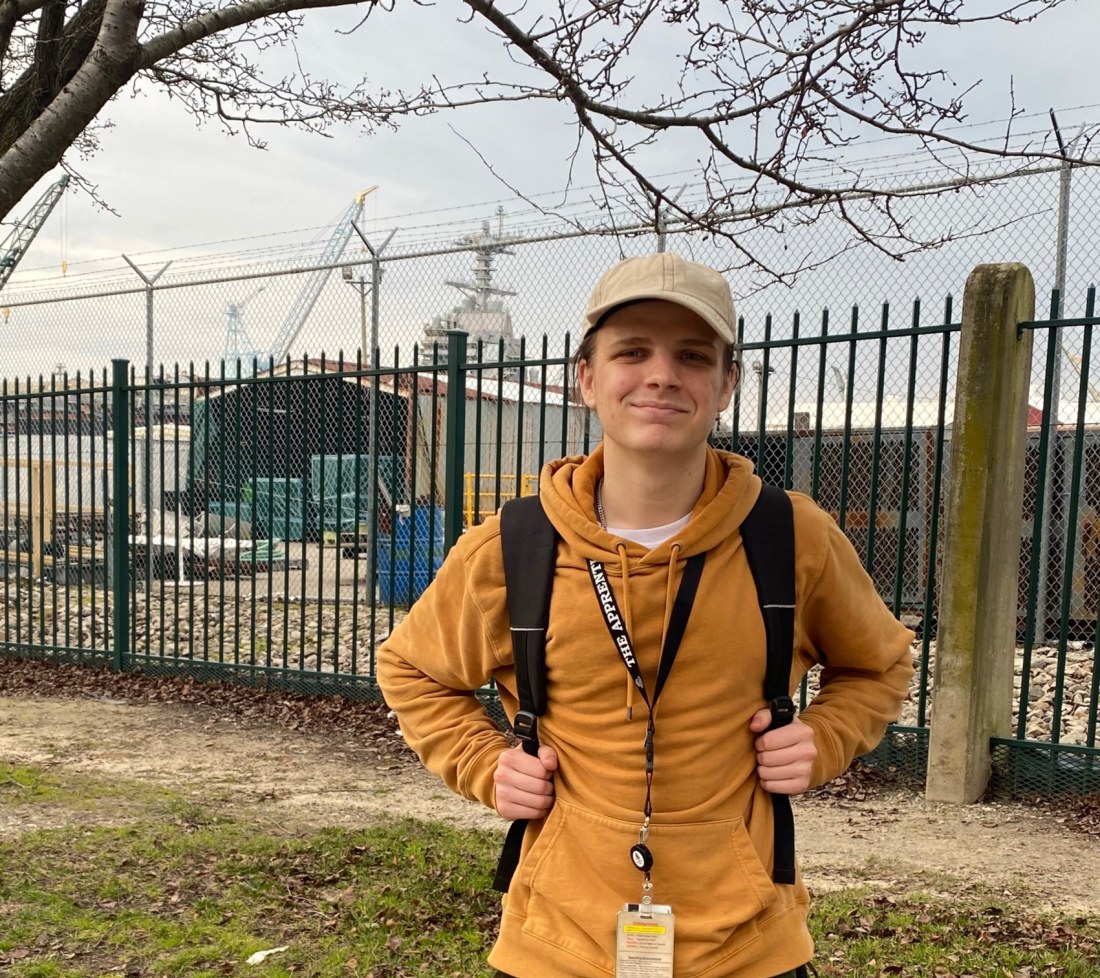
Electrical apprentice Tim Cannady at the Huntington Ingalls shipyard at Newport News, Virginia. Matthew Cranston
“The nuclear submarines are why I want to be here,” Cannady says standing in front of the double-fenced security of one of only two nuclear submarine building yards in America. “I can start on them as soon as I have finished my four years.”
His skills and ambition are the most critical resource shortage currently plaguing the US navy and look set to be a major factor in why Australia is unlikely to announce a major purchase of the Virginia class submarines when the Albanese and Biden governments reveal their AUKUS strategy in several weeks time.
So critical is this workforce shortage that the US can now only produce two Virginia class submarines per year – a far cry from the 273, albeit less sophisticated diesel powered subs, that were built in just four years following the attack on Pearl Harbour. How did America’s industrial strength disappear?
A big reason is that the cost and complexity of building these 7800 tonne monsters of the sea has been intensifying for years. The Navy is pushing to increase production from the current rate of about two per year to five, just to maintain America’s existing fleet structure. That schedule is also being crunched by maintenance backlogs on existing boats and ships, according to a report last month by the US Congressional Budget Office.
And whatever scope the US has to ramp up its industrial capacity to something approaching a war-footing runs headlong into America’s ongoing fiscal woes, including yet another looming debt ceiling crisis.
According to the budget office report, each new boat could cost between $US6.2 billion ($8.7 billion) and $US7.2 billion per boat, materially higher than the US Navy’s $US5.6 billion estimate.
While these challenges are bad news for Australian hopes, Canberra’s willingness to spend more money on submarines could help crack-open the US market for skills. It may even play into Labor’s hands by bolstering the argument that more of the work could be done in Australia.
Subs builders chase talent with barista wages
Matthew CranstonUnited States correspondent
Jan 27, 2023 – 7.00am
Save
Share
A job posting for a marine electrician at Newport News required to install, test, and troubleshoot marine navigation, communication and propulsion control systems is advertised at US$19 ($27) per hour. But at such a rate that electrician would be earning less than the average barista at a cafe in Bondi Beach according to Australian recruitment agency Indeed. Average Starbucks Barista hourly pay in Washington is about $US15.01, which is 17 per cent above the national average and arguably a lot more comfortable work than shipyards.
Subs builders chase talent with barista wages
Matthew CranstonUnited States correspondent
Jan 27, 2023 – 7.00am
Save
Share
Newport News, Virginia | At 4pm down at the dock of Huntington Ingalls shipbuilding yard in southern Virginia, 18-year-old electrical apprentice Tim Cannady joins hundreds of workers clocking off from an arduous shift on the nuclear-powered aircraft carrier USS John F. Kennedy, sponsored by America’s ambassador to Australia Caroline Kennedy.
He loves his work, waking up at 4am for the hour-long commute there, knowing that in four years his formal qualification will mean he will be part of the 10 million man-hours that go into building a nuclear-powered Virginia class submarine – the kind that Australia is seeking to purchase under the trilateral AUKUS agreement.
Electrical apprentice Tim Cannady at the Huntington Ingalls shipyard at Newport News, Virginia. Matthew Cranston
“The nuclear submarines are why I want to be here,” Cannady says standing in front of the double-fenced security of one of only two nuclear submarine building yards in America. “I can start on them as soon as I have finished my four years.”
His skills and ambition are the most critical resource shortage currently plaguing the US navy and look set to be a major factor in why Australia is unlikely to announce a major purchase of the Virginia class submarines when the Albanese and Biden governments reveal their AUKUS strategy in several weeks time.
So critical is this workforce shortage that the US can now only produce two Virginia class submarines per year – a far cry from the 273, albeit less sophisticated diesel powered subs, that were built in just four years following the attack on Pearl Harbour. How did America’s industrial strength disappear?
A big reason is that the cost and complexity of building these 7800 tonne monsters of the sea has been intensifying for years. The Navy is pushing to increase production from the current rate of about two per year to five, just to maintain America’s existing fleet structure. That schedule is also being crunched by maintenance backlogs on existing boats and ships, according to a report last month by the US Congressional Budget Office.
And whatever scope the US has to ramp up its industrial capacity to something approaching a war-footing runs headlong into America’s ongoing fiscal woes, including yet another looming debt ceiling crisis.
According to the budget office report, each new boat could cost between $US6.2 billion ($8.7 billion) and $US7.2 billion per boat, materially higher than the US Navy’s $US5.6 billion estimate.
While these challenges are bad news for Australian hopes, Canberra’s willingness to spend more money on submarines could help crack-open the US market for skills. It may even play into Labor’s hands by bolstering the argument that more of the work could be done in Australia.
Subs builders chase talent with barista wages
Matthew CranstonUnited States correspondent
Jan 27, 2023 – 7.00am
Save
Share
A job posting for a marine electrician at Newport News required to install, test, and troubleshoot marine navigation, communication and propulsion control systems is advertised at US$19 ($27) per hour. But at such a rate that electrician would be earning less than the average barista at a cafe in Bondi Beach according to Australian recruitment agency Indeed. Average Starbucks Barista hourly pay in Washington is about $US15.01, which is 17 per cent above the national average and arguably a lot more comfortable work than shipyards.

John Fedup
The Bunker Group
It is a shame the 5EYES can’t coordinate a program to enhance the pool of skilled labour for their collective MIC needs.
Austal FY 2024 Investor update.
Pipeline and Opportunities.
-4 RAN Evolved Cape Class patrol boat(58m) > 2024-2025
-11 ABF Evolved Cape Class patrol boat(58m) > 2025-2030
-18 Landing craft Medium(50m) > 2025-2032
-8 Landing craft Heavy(70m est) > From 2026, beyond 2034
-8 General Purpose Frigate(130m est) > From 2029, beyond 2034
-6 LOSV(70m est) > From 2031, beyond 2034
Looks like they might be building alot more Capes.
Last edited: