Royal Australian Navy Discussions and Updates 2.0

Reptilia

Well-Known Member
If we can get close to that drumbeat it would be a miracle. There just needs to be the will to do it. They have it, we need it. It can be done.
As it stands today…

(Tier 1 ships)Osborne South - 3 decades of work.
2024 - Construction start on Hunter
2032 - Hunter 1
2036 - Construction start on Hobart replacement
2042 - Hunter 6
2044 - Hobart replacement 1?
2054 - Hobart replacement 6?

(Tier 1 Submarines)Osborne North - 3+ decades of work.
2030 - Construction start on SSN AUKUS
2043 - SSN AUKUS 1
2055 - SSN AUKUS 5
+3 to replace the Virginias (outside of the $368 billion)
2064 - SSN AUKUS 8

(Tier 2 and 3 ships)Henderson - 2 decades of work.
2031 - Construction start on Mogamis
2036 - Mogami 4
2050 - Mogami 11

We are missing a large shipyard for 200m+ defence/commercial vessels which I’m sure will come in time on the east coast.
 

iambuzzard

Well-Known Member
Trying to get to that drumbeat will just kill the yard once the build is finished.

If you launch a ship every 2 years the yard is going to be out of work in less then 20 years and no doubt the government will neglect to order anything to keep them going.
But, if government can think rationally we would continue to build evolved Mogamis after the contract as ships age and need replacing. This design will evolve over time into better ships.
The problem is our politicians only think one dimensionally, they have no concept of long term. We must have a continuous build in the yards with new contracts for new hulls.
The US and Japan can do it, why can't we. Or are we too stupid?
 

Todjaeger

Potstirrer
But, if government can think rationally we would continue to build evolved Mogamis after the contract as ships age and need replacing. This design will evolve over time into better ships.
The problem is our politicians only think one dimensionally, they have no concept of long term. We must have a continuous build in the yards with new contracts for new hulls.
The US and Japan can do it, why can't we. Or are we too stupid?
Japan manages a continuous build in part because they appear to have largely structured their naval forces (and certainly their subs) around a build cycle where this is achievable. The US OTOH has the USN which is simply massive (though the JMSDF is no small entity either, having nearly as many active personnel as are active in the ADF), and even with ~30 year service lives for many ships, work needs to keep up at two yards just to maintain the fleet size more or less.

Given that many frigate or destroyer-sized/roled vessels are designed and built for an overall service life of around 30 years, Australia would struggle to maintain a continuous shipbuilding programme given the number of such vessels in RAN service. It could be done, but there would need to be not only continuous shipbuilding activity, but also economic and especially political support for this to happen. Unfort with changes in gov't and the resulting changes in nat'l centres of political power, trying to keep a plan adopted by one gov't going years or even decades later has been a problem. Absent changes to either overall fleet size, service life cycles, or a combination, gaps will appear between when build programmes complete and the next class build starts. It does seem that within these gap periods, various GOTD's have not been interested in spending coin to sustain facilities, esp if the facilities might not be advantageous for the various seat or office holders.
 

SammyC

Well-Known Member
But, if government can think rationally we would continue to build evolved Mogamis after the contract as ships age and need replacing. This design will evolve over time into better ships.
The problem is our politicians only think one dimensionally, they have no concept of long term. We must have a continuous build in the yards with new contracts for new hulls.
The US and Japan can do it, why can't we. Or are we too stupid?
https://www.defence.gov.au/about/strategic-planning/2024-naval-shipbuilding-sustainment-plan

Going back to the 2024 naval shipbuilding sustainment plan, this provided both Henderson and Osborne a steady program out to 2050, on the current 6 Hunters, 11 Mogamis, 6 LOCSVs and new destroyers. Further with submarines, which go closer to 2060. So there is a long term plan, that if extended results in replacing ships built at the onset by its very timeframe.

The IIP provides a more detailed 10 year snapshot, and is evolved every two years. We should remember that the 2026 IIP was a reasonably decent increase in spending over the 2024 IIP. I suspect the 2028 IIP will be an increase again. The increase over time has been substantial, with the 2016 IIP having a full spend of $196 billion, updated in 2020 to $270 billion, further increased in 2024 to $330 billion, and finally in 2026 to $425 billion. Matching this, in 2016 the defence budget was $32 billion, and is expected to be in the order of $70 billion in the upcoming budget for FY27. The government is putting its money where its mouth is with both long term and immediate funding.And its across both Labor and Coalition systems. Inflation over this time is about 37%, so the investment increase well outpaces inflation..

With this, is the investment in maintenance, not just the Henderson maintenance facility, but the upgrades to most naval bases around Australia, and into the pacific region. The investment in trade schools. And the investment in Regional Maintenance Centres. This says that we will be able to properly look after all the new gear coming online. I'm personally more interested in this, as it is the bit both the US and UK got drastically wrong.

I would suggest that the shipbuilding plan has been developed to provide a minimum sustainable program, with flexibility to change as requirements alter (so too has the army vehicle, and by the looks the ammunition and missile programs). Need to increase tempo, then add additional shifts. Need to evolve systems, then update ships in batches.

Big ship replacement (oilers and LPDs) remains a mystery, however, given Adelaide is 2015 vintage, one might imagine that a 2028 IIP would include its replacement plan. I could not see why this might involve a further upgrade to Osborne to create a third production line, which then rolls into the oiler replacement.

I suspect the government is not talking about Mogami or Hunter fleet renewal, because it does not need to, its too far out, but the plan would indicate there are provisions beyond 2025 for this need.
 

Morgo

Well-Known Member
Fair question, but predicting twenty years out is very problematic.

A lot will happen within that timeframe.


Cheers as
The simple answer is we need a substantially larger fleet anyway, so the art is making it politically impossible for a government to not keep an order book flowing as it would negatively impact multiple electorates.

Far easier said than done of course.
 

Morgo

Well-Known Member
But, if government can think rationally we would continue to build evolved Mogamis after the contract as ships age and need replacing. This design will evolve over time into better ships.
The problem is our politicians only think one dimensionally, they have no concept of long term. We must have a continuous build in the yards with new contracts for new hulls.
The US and Japan can do it, why can't we. Or are we too stupid?
We shouldn’t forget that, just like the Japanese with the Mogamis, the British, the Canadians and the Norwegians are all also in the same boat with us with a common hull form. I don’t know how much growth potential there is in the Type 26 base design and we’ve obviously heavily Australianised it, but we’re missing a significant opportunity if we don’t continue as much common development as possible.

Two continuous shipbuilding lines building flights of evolved Mogamis and Hunters - that we have evolved with our partners - could (and probably should) form the backbone of the RAN for half a century.

And this seems to be where we’re heading.
 

Stampede

Well-Known Member
The simple answer is we need a substantially larger fleet anyway, so the art is making it politically impossible for a government to not keep an order book flowing as it would negatively impact multiple electorates.

Far easier said than done of course.
I don’t doubt the fleet will grow and older ships will be replaced.
Just saying ship numbers and classes will evolve.
Will we get 11 Mogami
Maybe just 8 or maybe batches and evolution for 11 plus. Who knows in 2026!
Same with Hunters and every grey floating thing in service.

I’m against planning but rather just mindful things evolve with time.

Look at plans and white papers of twenty years ago.

Some stuff is realised and others are not.

Again it’s not good or bad just how it is.


Looking at you AUKUS!
What will you look like in forty years
Finally 8 SSNs of some other mix

Cheers S.
 

Wombat000

Well-Known Member
I’m just curious as to how practical the Hunters mission bay will prove to be, in a Tier 1 ship?
It’s a lot of potential void space.
I’m wondering if there will already be incentive to move to the AWD concept earlier and occupy that space with the extra VLS instead?
Will Hunters evolve early if designs and integration allowances are accounted for?

My thinking is the Tier 1 Hunters will in practice be focused more on blue water ops, leaving the Mogami Tier 2s to the more littorals where it’s stern mission bay flexibility might be more practical.
 

SammyC

Well-Known Member
I don’t doubt the fleet will grow and older ships will be replaced.
Just saying ship numbers and classes will evolve.
Will we get 11 Mogami
Maybe just 8 or maybe batches and evolution for 11 plus. Who knows in 2026!
Same with Hunters and every grey floating thing in service.

I’m against planning but rather just mindful things evolve with time.

Look at plans and white papers of twenty years ago.

Some stuff is realised and others are not.

Again it’s not good or bad just how it is.


Looking at you AUKUS!
What will you look like in forty years
Finally 8 SSNs of some other mix

Cheers S.
If we align properly with Japan, then we should be able to take advantage of their improvements. I would suspect by 2030, Japan will be producing a third generation Mogami, either to expand their own fleet (replace their originals, or for export). We should be able to incorporate this into at least the last five Australian built units. Thereafter who knows.

I always had the view that it makes sense to transition the Hunter program into a destroyer derivative, I think the Brits might do the same.

The last four AUKUS SSNs would likely be an updated batch on the first four as well.
 

SammyC

Well-Known Member
I’m just curious as to how practical the Hunters mission bay will prove to be, in a Tier 1 ship?
It’s a lot of potential void space.
I’m wondering if there will already be incentive to move to the AWD concept earlier and occupy that space with the extra VLS instead?
Will Hunters evolve early if designs and integration allowances are accounted for?

My thinking is the Tier 1 Hunters will in practice be focused more on blue water ops, leaving the Mogami Tier 2s to the more littorals where it’s stern mission bay flexibility might be more practical.
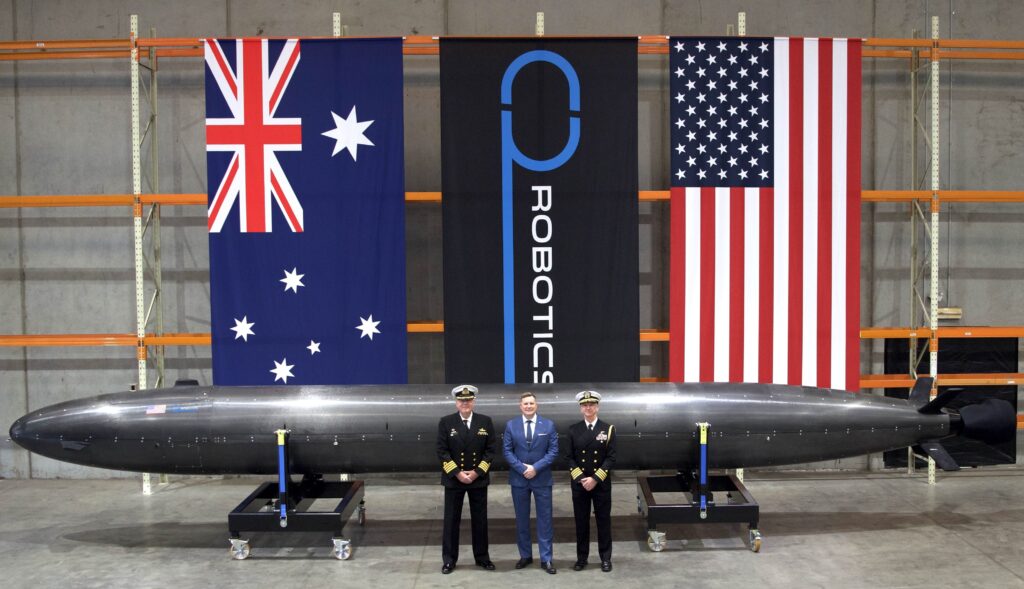
I think it is an evolving capability, that we don't fully understand. My own view is that the mission bay will be massively capable for drones. The Speartooth seems made for the Hunter. It weights in the order of a couple of tonnes, and a dozen could be held in the bay. A Hunter could patrol a region with several of these in the water out to around a 1000km.

I still have the view that onboard VLS capability is becoming less important as offboard missile drones come online. A Hunter or a Mogami travelling with several 8/16 cell missile drones for strike and defence, plus a few more over the horizon surface ISR drones with variable depth sonars, plus multiple speartooths out beyond that boundary, becomes a very capable and distributed force.

I think something like the above, once mature, starts to become very competitive against something like a type 55 and will be a problem for a submarine

I would suggest Hunters get used in open hostile waters, as part of a strike force, or independently, whereas Mogamis get used for escorts in more protected waters for civilian and army transports.
 
Top