Royal Australian Air Force [RAAF] News, Discussions and Updates

SammyC

Well-Known Member
Good to see a combat version of the ghost bat now in development. Its still very lightly armed with only 2 AIM120s but that is still a dangerous platform. I wonder if the gen III will get an upgraded engine to go with the larger frame.

Might have to wait for the fourth generation for something with a strike capability and able to hold a JSM.

Seems a suprisingly fast turn around for the Government who only a few months ago had a published position of focusing on ISR.

Now that the ghost bat is getting bigger, I wonder if a version of the ghost bat could be a tanker. The Stingray from what I've read is very expensive, upwards of $150 m per unit, whereas the ghost bat has a build cost (excluding R&D) of apparently in the order of $20 m.
 

hauritz

Well-Known Member
The 2030s could be an interesting period as far as further development of the Ghost Bat and its successors are concerned.

The replacement of the Rhinos and Growlers would be an opportunity for Australia to either further develop the Ghost Bat or come up with an entirely different design as the unmanned component of this replacement.

A generic larger airframe may eventually go on to at least partially replace a number of other aircraft types such as tankers, transports and patrol aircraft as well.

Certainly the development of the Ghost Bat has been rapid. The reality that we might no longer be able to depend on the US for our security should be enough of an incentive to continue this development.
 

Bob53

Well-Known Member
Bigger wings, bigger fuselage and heavier airframe is going to increase drag, let’s not get too carried away… More fuel is not one for one more range.
Haven’t seen anything about a heavier or bigger fuselage? …or do you mean the added weight of larger wings, fuels and weapons bay?
 

Bob53

Well-Known Member
Good to see a combat version of the ghost bat now in development. Its still very lightly armed with only 2 AIM120s but that is still a dangerous platform. I wonder if the gen III will get an upgraded engine to go with the larger frame.

Might have to wait for the fourth generation for something with a strike capability and able to hold a JSM.

Seems a suprisingly fast turn around for the Government who only a few months ago had a published position of focusing on ISR.

Now that the ghost bat is getting bigger, I wonder if a version of the ghost bat could be a tanker. The Stingray from what I've read is very expensive, upwards of $150 m per unit, whereas the ghost bat has a build cost (excluding R&D) of apparently in the order of $20 m.
It’s not a government decision. Block 3 developments is a Boeing decision/program. Australia has block 1 and 2. No orders as yet further block 3.
 

SammyC

Well-Known Member
It’s not a government decision. Block 3 developments is a Boeing decision/program. Australia has block 1 and 2. No orders as yet further block 3.
https://www.minister.defence.gov.au...12-09/funding-boost-australian-made-ghost-bat

My understanding was the last agreement between the Government and Boeing was for six block IIs and a single prototype block III, all to be delivered over the next three years. That order for seven drones was valued at $1.4B, so I assume it includes the R&D for the block III as well.
 

ADMk2

Just a bloke
Staff member
Verified Defense Pro
Haven’t seen anything about a heavier or bigger fuselage? …or do you mean the added weight of larger wings, fuels and weapons bay?
if you mount an internal weapons bay capable of deploying AMRAAM missiles or Small Diameter Bombs into a fuselage that can’t presently accommodate such, then the size and weight of the airframe is going to increase. So will larger wings and increased internal fuel storage. In addition drag will increase from these changes and either increased engine power will be required or the current engine will likely have to “burn hotter” to provide the same aero-performance. There is no such thing as a free lunch.

As such, as I pointed out, you cannot simply multiple range and fuel and come up with “xx” increase in range, and pretend it’s anything other than a complete guess, absolutely loaded with caveats.

It’s likely more fuel will add more range. It’s also just as likely increased fuel is needed to offset the weight and drag increases of the bigger aircraft, and as such range “predictions” of any worth, should include such considerations.
 
Last edited:

Bob53

Well-Known Member
if you mount an internal weapons bay capable of deploying AMRAAM missiles or Small Diameter Bombs into a fuselage that can’t presently accommodate such, then the size and weight of the airframe is going to increase. So will larger wings and increased internal fuel storage. In addition drag will increase from these changes and either increased engine power will be required or the current engine will likely have to “burn hotter” to provide the same aero-performance. There is no such thing as a free lunch.

As such, as I pointed out, you cannot simply multiple range and fuel and come up with “xx” increase in range, and pretend it’s anything other than a complete guess, absolutely loaded with caveats.

It’s likely more fuel will add more range. It’s also just as likely increased fuel is needed to offset the weight and drag increases of the bigger aircraft, and as such range “predictions” of any worth, should include such considerations.
Understand your points about added fuel. Wings and weight Pretty sure Boeing is saying there is currently room for a weapons bay and it could be retro fitted To block 1 & 2 versions.
 

Attachments

Last edited:

ThunderChunder

New Member
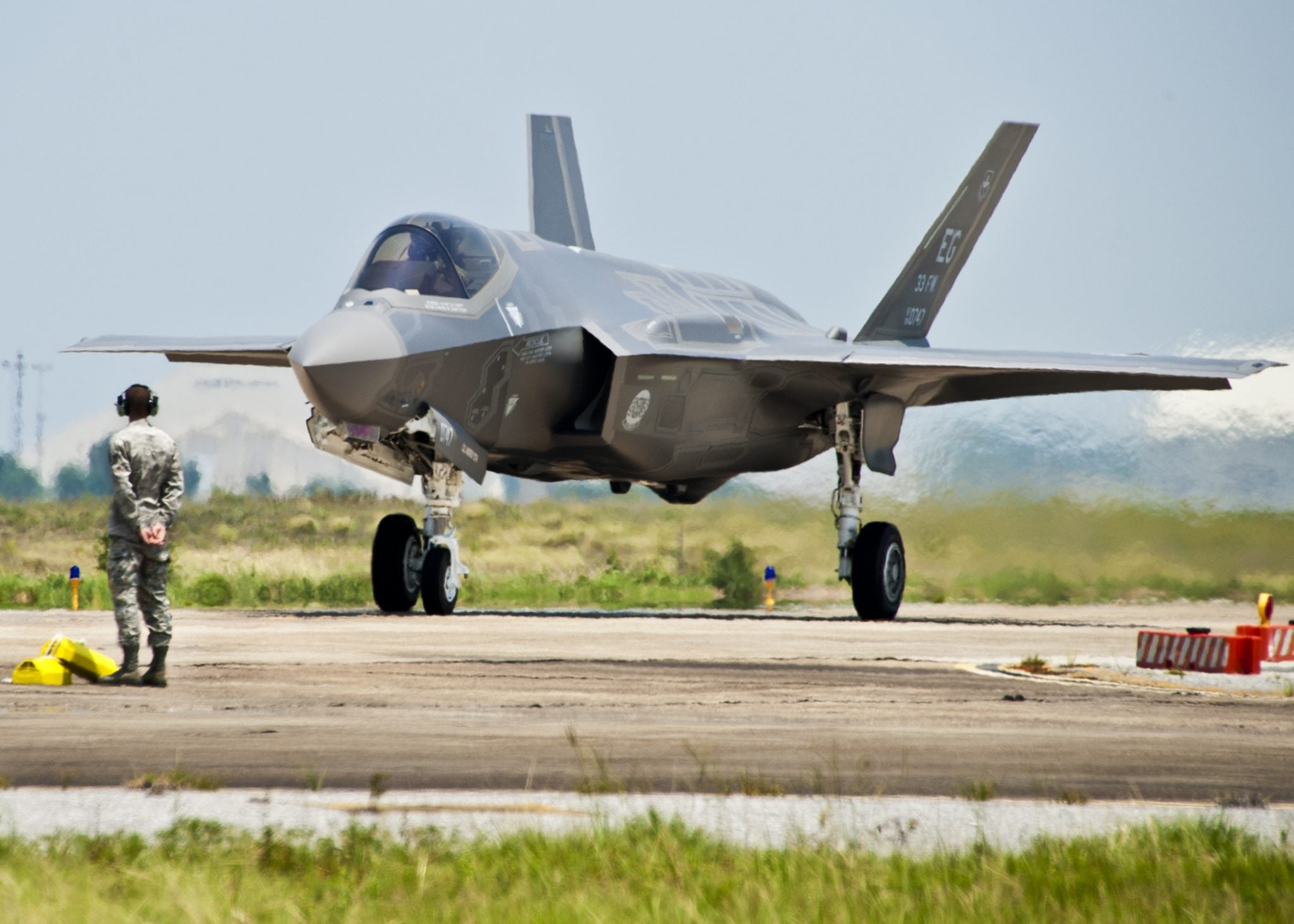
In news that has major impacts to the RAAF, the F-35 programme continues to find new ways to surprise people at the depth of its problems:


Radar mountings in the nose of the Lockheed Martin F-35 fighter are different for the current AN/APG-81 by Northrop Grumman and the future AN/APG-85 radar, also by Northrop Grumman–a difference which has helped complicate fielding of the new radar which was to deliver with F-35 Lot 17 but may now instead deliver later, possibly in Lot 20 in the next two years.

“The APG-81 is different than the APG-85, and therefore delivering the aircraft, as currently configured, with an APG-85 radar versus an APG-81 radar is challenging,” Rep. Rob Wittman (R-Va.) said in an interview off the House floor on Feb. 3.

“The bulkhead configuration is key because for both of the radars, they are very different,” he said. “Remember, the bulkhead configuration allows the placement of the radar towards the attitude of the array, and the attitude of the array makes all the difference in the world about how the radar operates.”

A dual mount to accommodate either the APG-85 or the APG-81 would take two years to field, a source told sister publication Defense Daily.

“I know all about it, but the delivery of the aircraft is classified,” Wittman said when asked whether he knew if it were true that Lockheed Martin has been delivering F-35s to the military services since last June without radars, including all F-35As. “I can’t speak to the condition of the aircraft so you’ll have to go to the Air Force, the customer, and ask them about that.”


Wittman, the chair of the House Armed Services Committee’s Tactical Air and Land Forces panel, has been bird-dogging the F-35 program and the contractor team since the fall of 2024 on delays in the delivery of the APG-85, including what he said have been monthly phone calls since then with the head of the F-35 program executive office. Marine Lt. Gen. Gregory Masiello became the F-35 program executive officer in July last year. He succeeded Air Force Lt. Gen. Michael Schmidt, now retired, who served as the head of the F-35 Joint Program Office between July, 2022 and July, 2025.

“I spoke to Lockheed yesterday, and they’re working with Northrop to get APG-85 delivered even faster,” Wittman said on Feb. 3. “They’re doing some things to try and integrate it with Technology Refresh-3 [TR-3] and Block 4.”

Nearly a year and a half ago, Wittman said that he had met with Northrop Grumman to discuss the need to reduce test time for the APG-85, which he said had increased from three days to 78 days—part of a wider set of challenges involved in building a Gallium Nitride-based radar needing upgraded cooling and power in the F-35’s nose.

Wittman said that “they’ve condensed the testing regime” and “have been able to truncate some of those things” to accelerate delivery. “We’ve been on Lockheed, as well as Northrop to continue to compress the schedule,” he said. “I’d like to see them compress it even more. I think they can do that.”

The APG-85 is to deny adversary use of the electromagnetic spectrum and to allow better weapons accuracy and targeting of adversary airborne and surface radars at greater ranges.

“It’s an incredibly advanced radar,” Wittman said of the APG-85. “The arrays on it give it much more power which is why we have to upgrade the engine. I think we need about 82 kilowatts of power versus what it’s producing right now. The APG-85 is key to Block 4, and it’s key to TR-3 software upgrade capabilities and integration with the imaging system, the Distributed Aperture System.”

More than two and a half years ago, now retired Air Force Lt. Gen. Richard Moore, then the service’s deputy chief of staff for plans and programs, said that “we are getting very close to the new radar on the F-35” and that the APG-85 would be “a dramatic increase in our ability” over the APG-81 radar, which Northrop Grumman builds in Linthicum, Md.

“It’s my hope they do it [delivery of APG-85] as fast as humanly possible and have the system perform,” Wittman said on Feb. 3. “I don’t want it delivered, if it’s gonna be operationally deficient because then the aircraft sits on the tarmac.”

F-35 deliveries to U.S. units in the field since last June have had the APG-85 mountings, which do not fit the APG-81. But, the radar-less F-35 deliveries have not affected sales to foreign partner nations which have the APG-81 on their jets, the source said, adding that, without a radar, there had to be additional weight added in the nose for aircraft balance during flight. Radar-less F-35s have been able to fly, as long as they are accompanied by other F-35s, data linked and equipped with the APG-81, the source said.

On Feb. 3, an Air Force spokeswoman said that the Air Force’s, Navy’s, and Marine Corps’ joint development and integration of the advanced APG-85 will help defeat “current and projected adversarial air and surface threats.”

“This advanced radar will be compatible with all variants of the F-35 aircraft,” according to the Air Force. “Due to program security reasons, we are protecting any additional information with enhanced security measures.”

F-35 deliveries restarted in July 2024 after a halt in late 2023 due to software problems with TR-3, which is to allow the integration of dozens of new sensors and weapons for the Block 4 upgrade.

In January 2023, Northrop Grumman disclosed the development of the APG-85 for Block 4 F-35s beginning with Lot 17, but the company and the F-35 program have not revealed funding levels nor contract details for the radar.

It appears that they have been delivering jets with weighted ballast in the nose, instead of radars. So far, this only affects US deliveries, and it is unknown if they're going to deliver APG-85 for foreign export.

Moreover, the issue is what happens to all those jets that are prior to Lot 17. The radar on the F-35 is integrated into the fuselage of the jet, so the mounting differences lead me to believe the previous articles about fuselage changes being required for the F-35 were alluding to this. If that fuselage change to be compatible with both radars cannot be retrofit to lower lot aircraft, then that means all the RAAF jets received will not be compatible with APG-85.

I'm stunned that we are in a world where we are delivering production jets off the line with ballast instead of a radar. But that also explains the RAAF decision two years ago to continue on with the Super Hornet fleet until 2040 and look at all other options in the 2030s. It makes it clear to me now that was the right decision, as committing to buying another F-35 squadron today when the dust hasn't even been settled on TR-3 - and who knows how long integrating a brand new radar will take, as this isn't a trivial effort - especially when next generation options may be around the corner, would be foolish.
 

MARKMILES77

Well-Known Member
Good to see a combat version of the ghost bat now in development. Its still very lightly armed with only 2 AIM120s but that is still a dangerous platform. I wonder if the gen III will get an upgraded engine to go with the larger frame.

Might have to wait for the fourth generation for something with a strike capability and able to hold a JSM.

Seems a suprisingly fast turn around for the Government who only a few months ago had a published position of focusing on ISR.

Now that the ghost bat is getting bigger, I wonder if a version of the ghost bat could be a tanker. The Stingray from what I've read is very expensive, upwards of $150 m per unit, whereas the ghost bat has a build cost (excluding R&D) of apparently in the order of $20 m.
Not convinced it carries Two AIM-120s.
It was only stated that the Batch III will have "a weapons bay" that can carry a single AIM-120 or two SDBs.
There seems to be a general assumption that what was meant was "twin" weapons bays that can each carry an AIM-120 but that was not what was said.
 

Sandson41

Member
Not convinced it carries Two AIM-120s.
It was only stated that the Batch III will have "a weapons bay" that can carry a single AIM-120 or two SDBs.
There seems to be a general assumption that what was meant was "twin" weapons bays that can each carry an AIM-120 but that was not what was said.
Yes, all articles I've read agree on that statement. One big missile, or two SDBs.

I recall that Boeing Australia have said they can fit other weapons if desired, and also that the program's software is platform agnostic, so they can scale up if needed. No indication of that yet of course.

Incidentally, it seems we bought a bunch of SDBs back in the day:
Small Diameter Bomb (SDB) for Australia - Australian Defence Magazine
Microsoft Word - Australia_17-44
 

hauritz

Well-Known Member
Yes, all articles I've read agree on that statement. One big missile, or two SDBs.

I recall that Boeing Australia have said they can fit other weapons if desired, and also that the program's software is platform agnostic, so they can scale up if needed. No indication of that yet of course.

Incidentally, it seems we bought a bunch of SDBs back in the day:
Small Diameter Bomb (SDB) for Australia - Australian Defence Magazine
Microsoft Word - Australia_17-44
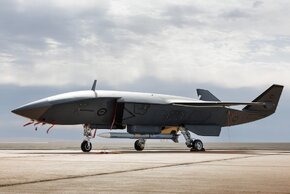
The shown configeration of Ghost Bat and the AIM-120 had the missile offset in a way that suggested that a second missile could have been mounted alongside it.

G7svXdmbwAAqaRS.jpeg

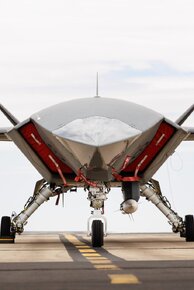
From a more side on view you can see that the missile is mounted just in front of the rear wheel with just enough clearance to allow the wheel to retract. The problem is the front wheel bay. The missile extends to almost the front wheel. There simply wouldn't be enough room for a centre mounted missile unless it was positioned well behind the front wheel otherwise it would interfere with the front wheel being retracted. Going back to the front view you see the other problem which is that the missile is mounted directly under the air intake and infact extends in front of that intake.

G7svXdbbMAADLPa-1536x1025.jpeg

This seems to present a problem since there is no room for two internal weapons bay under the air intakes. The only option would seem to be centerline weapons bay set back behind the front wheel in a fairly narrow space between the two rear wheels.

When you look at the length of the AIM-120 (3.66 meters) and the length of the GBU-39 (1.8 meters) it appears that you are indeed looking at a single weapons bay mounted towards the rear capable of holding either a single AIM-120 or two tandem mounted GBU-39s.
 
Last edited:

Stampede

Well-Known Member
The shown configeration of Ghost Bat and the AIM-120 had the missile offset in a way that suggested that a second missile could have been mounted alongside it.

View attachment 54301

From a more side on view you can see that the missile is mounted just in front of the rear wheel with just enough clearance to allow the wheel to retract. The problem is the front wheel bay. The missile extends to almost the front wheel. There simply wouldn't be enough room for a centre mounted missile unless it was positioned well behind the front wheel otherwise it would interfere with the front wheel being retracted. Going back to the front view you see the other problem which is that the missile is mounted directly under the air intake and infact extends in front of that intake.

View attachment 54302

This seems to present a problem since there is no room for two internal weapons bay under the air intakes. The only option would seem to be centerline weapons bay set back behind the front wheel in a fairly narrow space between the two rear wheels.

When you look at the length of the AIM-120 (3.66 meters) and the length of the GBU-39 (1.8 meters) it appears that you are indeed looking at a single weapons bay mounted towards the rear capable of holding either a single AIM-120 or two tandem mounted GBU-39s.
One or two weapon bays?

I’d like to think two, but I get the challenges mentioned.

If you are designing such a platform from scratch with the now accepted knowledge it will carry weapons internally, logic would suggest a capability more than one SAM of two SDBs.
I’m pitching the Block III has two weapon bays.
As for Block I and II, I can appreciate the uncertainty.
That said
I do recall looking at the mockup at Avalon thinking this thing has internal space beyond what’s needed for an engine , wheels and an air intake.


Cheers S
 

Takao

The Bunker Group
Not sure what the Collective Noun for a group of MC-55 Peregines is?
A flock?

View attachment 54317
A 'waste'?

...

...

Don't mind me. Just looking at a subsonic, high radar cross section that needs to go into the threat envelope to do its job - a job that is already being done on a variety of other platforms.

Remember the 'learn fast, break things' motto? This aircraft demonstrates that 'don't stand between a RAAFie and a jet' is more of a fundamental truth. Delivered in 2015? Amazing. Gosh, delivered in 2020? Still wow. Delivered under the stated threat assumptions of NDS 24? With all the fun sustainment that the orphan fleet of C-27A gave us? No thanks.
 
Last edited:

Volkodav

The Bunker Group
Verified Defense Pro
A 'waste'?

...

...

Don't mind me. Just looking at a subsonic, high radar cross section that needs to go into the threat envelope to do its job - a job that is already being done on a variety of other platforms.

Remember the 'learn fast, break things' motto? This aircraft demonstrates that 'don't stand between a RAAFie and a jet' is more of a fundamental truth. Delivered in 2015? Amazing. Gosh, delivered in 2020? Still wow. Delivered under the stated threat assumptions of NDS 24? With all the fun sustainment that the orphan fleet of C-27A gave us? No thanks.
The RAAF love their toys and have always been better at selling their need for said toys than the other services.

The polite term is they are good at staff work.

It's the classic technical versus admin battle we see in all industries and sectors.
 

MARKMILES77

Well-Known Member
Video of excercise "Maritime Big Play".
Shows video of trials of multiple Unmanned Air and Underwater vehicles.
Have posted it here because there is more emphasis on UAVs than underwater vehicles.
The most interesting is a demonstration of the anti-armour capability of the OWL-B.
Launches, flys a mission to a simulated armoured target and impacts the target, detonating a shaped charge.
Looks like the Owl-B could be in service Tomorrow if necessary (if it is not already in service).
With a quoted one way range of 200km offers a pretty impressive capability.
Also some vision of the C2 Robotics’ Speartooth large uncrewed underwater vehicle, which has been largely overshadowed by the Ghost Shark.

 
Last edited:

MARKMILES77

Well-Known Member
SRC has revealed that their Generic Multi-Function Array system was used in the Ghost Bat live fire demonstration.
Not exactly sure what this is? Is it a radar with EW functionality?
Screenshot 2026-02-23 at 21.31.14.png

SRC, Inc. ("SRC" or "Company"), a defense research and development company, announced today that its cutting-edge Generic Multi-Function Array system (also referred to as Payload B) was featured in the recent MQ-28A Ghost Bat Collaborative Combat Aircraft (CCA) live fire demonstration. This milestone highlights the system's role as a critical enabler of collaborative, multi-domain operations and underscores SRC's commitment to advancing next-generation defense technologies for both autonomous and crewed platforms across air, sea, land and space.


"The MQ-28A live fire demonstration showcased how GMFA has matured from concept to capability and proves that our systems don't just participate in missions; they transform them," said Kevin Hair, president and CEO of SRC. "By combining adaptability, autonomy and resilience, we are redefining what's possible in electronic warfare."


At the heart of the GMFA system is a multi-function array designed to provide agile, scalable and resilient sensing and effecting capabilities. The array integrates advanced electronic warfare functions into a single, compact architecture.


Complementing the array is a multi-function processor that delivers real-time signal processing and adaptive mission execution. The processor harnesses advanced algorithms transforming raw data into actionable insights that ensure decisive responses to evolving threats.


OldTex

Well-Known Member
"The MQ-28A live fire demonstration showcased how GMFA has matured from concept to capability and proves that our systems don't just participate in missions; they transform them," said Kevin Hair, president and CEO of SRC. "By combining adaptability, autonomy and resilience, we are redefining what's possible in electronic warfare."


At the heart of the GMFA system is a multi-function array designed to provide agile, scalable and resilient sensing and effecting capabilities. The array integrates advanced electronic warfare functions into a single, compact architecture.


Complementing the array is a multi-function processor that delivers real-time signal processing and adaptive mission execution. The processor harnesses advanced algorithms transforming raw data into actionable insights that ensure decisive responses to evolving threats.
Apart from the overload of impressive sounding buzzwords and techno waffle the quote pushes the system as being EW oriented. Possibly combining some ESM and ED to provide a rudimentary passive radar (albeit short range)
 

ADMk2

Just a bloke
Staff member
Verified Defense Pro
In news that has major impacts to the RAAF, the F-35 programme continues to find new ways to surprise people at the depth of its problems:


It appears that they have been delivering jets with weighted ballast in the nose, instead of radars. So far, this only affects US deliveries, and it is unknown if they're going to deliver APG-85 for foreign export.

Moreover, the issue is what happens to all those jets that are prior to Lot 17. The radar on the F-35 is integrated into the fuselage of the jet, so the mounting differences lead me to believe the previous articles about fuselage changes being required for the F-35 were alluding to this. If that fuselage change to be compatible with both radars cannot be retrofit to lower lot aircraft, then that means all the RAAF jets received will not be compatible with APG-85.

I'm stunned that we are in a world where we are delivering production jets off the line with ballast instead of a radar. But that also explains the RAAF decision two years ago to continue on with the Super Hornet fleet until 2040 and look at all other options in the 2030s. It makes it clear to me now that was the right decision, as committing to buying another F-35 squadron today when the dust hasn't even been settled on TR-3 - and who knows how long integrating a brand new radar will take, as this isn't a trivial effort - especially when next generation options may be around the corner, would be foolish.
All of the RAAF jets have been delivered with APG-81 and there is no publicly known project to acquire a replacement radar nor is it known whether APG-85 will even be released for export.

In either case, I don’t see how this is a “major impact” for the RAAF? At least for the forseeable future…

Is Northrop Grumman suddenly going to stop supporting the APG-81 any time soon?
 

Maranoa

Active Member
I pretty sure the Albanese Government did approve the F-35A Block IV upgrade which is a program of record under Air 6000 Phase 6(?), includes upgrade of all aircraft to TR3 hardware (APG-85 is on that list for USAF at least) and the software..
 
Top