Ananda

The Bunker Group

There already Indian AF thread, I suggest you put your info or thought on Indian AF there. The mod in here not happy if there arw multiple threads talking similar topics. I believe there's on forum rules.
 

AbhiDas94

New Member
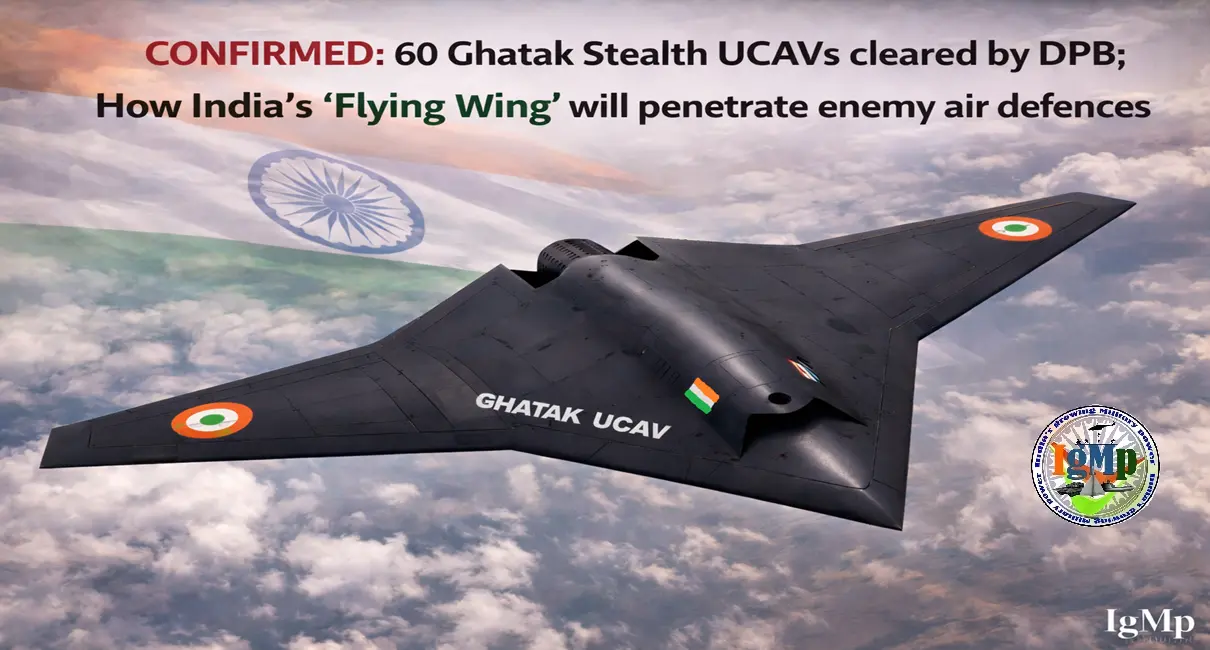
India Clears 60 Ghatak Stealth UCAVs – A Major Shift Toward Deep-Strike Drone Warfare


India has officially approved the procurement of 60 Ghatak stealth UCAVs, a decision cleared by the Defence Procurement Board that marks a major milestone in the country’s unmanned combat aviation roadmap. With a defined fleet size and production intent, the Ghatak program is now transitioning from a technology demonstrator into a full-fledged operational capability for the Indian Air Force.


In military planning terms, 60 combat aircraft represent a structural capability, not a symbolic number. Such a fleet could support multiple operational squadrons while accounting for training, maintenance cycles, and strategic reserves. Unlike reconnaissance drones, Ghatak is designed primarily for deep-penetration strike missions inside heavily defended airspace, allowing unmanned platforms to lead the first wave of attacks in high-risk environments.


A key feature of the platform is its stealth flying-wing configuration, which significantly reduces radar cross-section and infrared signatures. This design allows the UCAV to infiltrate contested zones protected by advanced air defense systems, strike high-value targets such as radar sites or missile batteries, and exit before detection thresholds are crossed. In doctrinal terms, the platform differs greatly from conventional MALE UAVs that focus mainly on surveillance and loiter operations.

For More information read the full article here: CONFIRMED: 60 Ghatak Stealth UCAVs cleared by DPB; How India’s 'Flying Wing' will penetrate enemy air defenses

 

AbhiDas94

New Member
India Eyes Su-57M1E: The AL-51F1 Game-Changer
The Indian Air Force (IAF) is reportedly shifting its focus from the baseline Felon to the advanced Su-57M1E variant. As India looks to bridge the gap before the indigenous AMCA arrives, this upgraded "final form" of the Sukhoi fighter has emerged as a top contender for a fast-tracked G2G deal.

Key Technical Upgrades:
  • The AL-51F1 Engine: Replacing the interim AL-41F1, the new powerplant enables a sustained supercruise of Mach 1.6 and delivers 17,500 kgf of thrust. Its serrated nozzles significantly enhance thermal stealth.


  • Counter-Stealth Radar: Beyond the X-band N036 Byelka suite, the M1E utilizes L-band arrays in the wing leading edges, specifically designed to detect stealth platforms optimized against traditional fire-control radars.


  • AI Integration: A redesigned cockpit with Wide-Area Displays (WAD) utilizes an AI suite to handle 90% of flight micromanagement, allowing pilots to focus on tactical sensor fusion.
With Russia reportedly offering technology transfer, the Su-57M1E could serve as a critical "stopgap" to maintain regional parity while boosting India’s domestic 5th-gen manufacturing ecosystem.

Read the full article source: India Eyes Su-57M1E: Why the Advanced Su-57 variant with AL-51F1 Engine is a Game-Changer for IAF
 

AbhiDas94

New Member
India’s $100 Billion Air Power Roadmap: AMCA, Tejas Mk2, and the FCAS Factor
India is charting a massive $100 billion modernization path to rebuild the IAF into a 50-squadron force by 2040. This strategy moves away from fragmented imports toward a layered, industrially cohesive ecosystem.

The Multi-Tiered Fleet Strategy:
  • The Indigenous Core: The Tejas Mk2 is set to replace MiG-29 and Mirage fleets, while the AMCA (5th-gen) remains the long-term strategic centerpiece for multi-domain warfare.
  • The French Connection: Building on the existing Rafale manufacturing base, India is seriously weighing the Future Combat Air System (FCAS). The goal isn't just an off-the-shelf purchase but a collaborative pathway for 6th-gen technologies like manned-unmanned teaming and advanced data fusion.
  • Operational Logic: New Delhi views FCAS as a potential successor to the Su-30MKI, acting as a "command node" in a distributed network.
Rather than choosing between "Make in India" and foreign platforms, the IAF is pursuing a two-track approach: using global partnerships to funnel high-end design philosophy and sensor tech back into the AMCA program.

Read the full article source: India plans $100 Billion Air Power overhaul, weighs FCAS as AMCA, Tejas Mk2 and Rafale manufacturing ecosystem take shape
 

AbhiDas94

New Member
Su-75 Checkmate: A Strategic Bridge for India’s 5th-Gen Ambitions?
As India navigates the high costs of the F-35 and the heavy-class complexities of the Su-57, the Sukhoi Su-75 Checkmate is emerging as a pragmatic alternative. Optimized for cost-efficiency and low observability, the Checkmate offers a unique "middle path" for the IAF.

Why the Su-75 Suits India:
  • Affordability & Scale: Designed as a lighter, single-engine stealth fighter, its projected lower lifecycle costs could allow the IAF to rebuild squadron strength without draining the budget for indigenous programs like the AMCA.
  • Deep Customization: Russia’s open-architecture offer allows India to integrate indigenous subsystems, including AESA radars, mission computers, and the Astra/Rudram missile families, ensuring sovereign control over threat libraries.
  • The "BrahMos" Model: Joint development could fast-track the Su-75's flight testing (slated for 2026) while providing India with high-end manufacturing IP.
Rather than competing with the AMCA, the Su-75 could act as a critical technical bridge, providing 5th-gen operational experience and a "high-low" mix capability to counter regional stealth threats.

Read the full article source: Why Sukhoi Su-75 Checkmate Could Be India’s Smartest Fifth-Generation Fighter Bet Before Su-57 or F-35
 

AbhiDas94

New Member
TASL: The Frontrunner for India’s AMCA Stealth Fighter Production?
As India moves toward a Special Purpose Vehicle (SPV) model for the 5th-generation AMCA program, Tata Advanced Systems Limited (TASL) is emerging as the primary private-sector contender to lead manufacturing. With the Ministry of Defence eyeing a majority private stake (over 50%), the focus is shifting to an Industrial Lead Partner capable of "micron-level" precision.

Why TASL Holds the Edge:
  • Stealth-Grade Manufacturing: Unlike heavy-engineering consortiums, TASL already produces high-tolerance aerostructures for the F-21, C-130J, and AH-64. This experience with "gap and flush" tolerances is critical for maintaining a low radar cross-section (RCS).
  • Integrated Ecosystem: With a network of 2,000+ MSME partners and existing assembly lines in Hyderabad and Nagpur, TASL offers a plug-and-play supply chain.
  • Global Benchmarks: Collaborative experience with Lockheed Martin and Airbus has matured TASL’s workflows in composite wing boxes and advanced sensor integration.
While mastering stealth coatings and internal weapons bays remains a challenge, TASL’s vertical integration makes it the most "production-ready" candidate to bridge the gap between design and a combat-ready fleet.

Read the full article source: Why TASL Is Emerging As The Frontrunner In AMCA Stealth Fighter Manufacturing
 

AbhiDas94

New Member
India Insists on 120kN AMCA Engine Full IPR with Safran: A Shift Toward True Sovereignty in Jet Engine

The Indian Ministry of Defence has adopted a non-negotiable stance in its negotiations with Safran for the development of a 120kN engine for the AMCA Mk2. Moving away from the traditional "licensed production" model seen in the GE-F414 deal, New Delhi is demanding 100% Intellectual Property Rights (IPR) and full design authority.

Key highlights of the proposal include:

  • Strategic Autonomy: India seeks "Export Sovereignty" to sell the engine to third parties without foreign vetoes.
  • Technical Mastery: Focus on mastering "hot-section" technologies, including single-crystal blades and advanced cooling channels.
  • No Derivative Rights: Safran would be barred from using AMCA-funded breakthroughs in its other commercial or military projects.
  • Plug-and-Play Design: The engine is being designed with dimensional compatibility to the GE-F414, allowing future integration into the Tejas Mk2 and TEDBF without structural redesigns.
This shift underscores India’s commitment to building a self-reliant aerospace ecosystem by 2047, ensuring that taxpayer-funded technologies remain under domestic control for future indigenous platforms.

Read the full analysis here: Indian Defence Ministry Stresses on Full IPR Ownership of 120kN AMCA Engine under Non-Negotiable Terms for GTRE-Safran Deal
 

AbhiDas94

New Member
India’s Hypersonic Answer to Chinese Air Defence: The RudraM-III & Su-30MKI
India is significantly bolstering its Suppression of Enemy Air Defenses (SEAD) capabilities with the integration of the RudraM-III on the Sukhoi Su-30MKI. This indigenous air-to-surface missile is designed specifically to dismantle sophisticated A2/AD bubbles created by systems like the S-400 and HQ-9.

Key Technical Advantages:

  • Hypersonic Performance: Operating at speeds of Mach 5 to 6+, it drastically compresses enemy reaction times.
  • Massive Stand-off Range: A strike reach of 550–600 km allows the Su-30MKI to neutralize radar nodes from the safety of Indian airspace.
  • Passive Homing: The missile tracks electromagnetic emissions; if the enemy shuts down their radar to "hide," the onboard GPS/INS guidance continues toward the last known coordinates.
  • Heavy Payload: Weighing 1.6 tonnes, the Su-30MKI can carry two of these "missile trucks" on reinforced hardpoints.
By forcing adversaries into a "lose-lose" scenario—either keep radars active and be targeted, or shut down and lose situational awareness—the RudraM-III ensures India maintains its aerial edge in contested borders.

Read the full analysis here: RudraM-III on Su-30MKI: India’s Hypersonic Answer to China’s S-400 & HQ-9 Air Defense
 

AbhiDas94

New Member
TASL: The Frontrunner for India’s AMCA Stealth Fighter Production?

As India moves toward a Special Purpose Vehicle (SPV) model for the 5th-generation AMCA program, Tata Advanced Systems Limited (TASL) is emerging as the primary private-sector contender to lead manufacturing. With the Ministry of Defence eyeing a majority private stake (over 50%), the focus is shifting to an Industrial Lead Partner capable of "micron-level" precision.

Why TASL Holds the Edge:
  • Stealth-Grade Manufacturing: Unlike heavy-engineering consortiums, TASL already produces high-tolerance aerostructures for the F-21, C-130J, and AH-64. This experience with "gap and flush" tolerances is critical for maintaining a low radar cross-section (RCS).
  • Integrated Ecosystem: With a network of 2,000+ MSME partners and existing assembly lines in Hyderabad and Nagpur, TASL offers a plug-and-play supply chain.
  • Global Benchmarks: Collaborative experience with Lockheed Martin and Airbus has matured TASL’s workflows in composite wing boxes and advanced sensor integration.
While mastering stealth coatings and internal weapons bays remains a challenge, TASL’s vertical integration makes it the most "production-ready" candidate to bridge the gap between design and a combat-ready fleet.

Read the full article source: Why TASL Is Emerging As The Frontrunner In AMCA Stealth Fighter Manufacturing
 

AbhiDas94

New Member
Su-75 Checkmate: A Strategic Bridge for India’s 5th-Gen Ambitions?

As India navigates the high costs of the F-35 and the heavy-class complexities of the Su-57, the Sukhoi Su-75 Checkmate is emerging as a pragmatic alternative. Optimized for cost-efficiency and low observability, the Checkmate offers a unique "middle path" for the IAF.

Why the Su-75 Suits India:
  • Affordability & Scale: Designed as a lighter, single-engine stealth fighter, its projected lower lifecycle costs could allow the IAF to rebuild squadron strength without draining the budget for indigenous programs like the AMCA.
  • Deep Customization: Russia’s open-architecture offer allows India to integrate indigenous subsystems, including AESA radars, mission computers, and the Astra/Rudram missile families, ensuring sovereign control over threat libraries.
  • The "BrahMos" Model: Joint development could fast-track the Su-75's flight testing (slated for 2026) while providing India with high-end manufacturing IP.
Rather than competing with the AMCA, the Su-75 could act as a critical technical bridge, providing 5th-gen operational experience and a "high-low" mix capability to counter regional stealth threats.

Read the full article source: Why Sukhoi Su-75 Checkmate Could Be India’s Smartest Fifth-Generation Fighter Bet Before Su-57 or F-35
 

AbhiDas94

New Member
India’s $100 Billion Air Power Roadmap: AMCA, Tejas Mk2, and the FCAS Factor

India is charting a massive $100 billion modernization path to rebuild the IAF into a 50-squadron force by 2040. This strategy moves away from fragmented imports toward a layered, industrially cohesive ecosystem.

The Multi-Tiered Fleet Strategy:
  • The Indigenous Core: The Tejas Mk2 is set to replace MiG-29 and Mirage fleets, while the AMCA (5th-gen) remains the long-term strategic centerpiece for multi-domain warfare.
  • The French Connection: Building on the existing Rafale manufacturing base, India is seriously weighing the Future Combat Air System (FCAS). The goal isn't just an off-the-shelf purchase but a collaborative pathway for 6th-gen technologies like manned-unmanned teaming and advanced data fusion.
  • Operational Logic: New Delhi views FCAS as a potential successor to the Su-30MKI, acting as a "command node" in a distributed network.
Rather than choosing between "Make in India" and foreign platforms, the IAF is pursuing a two-track approach: using global partnerships to funnel high-end design philosophy and sensor tech back into the AMCA program.

Read the full article source: India plans $100 Billion Air Power overhaul, weighs FCAS as AMCA, Tejas Mk2 and Rafale manufacturing ecosystem take shape
 
Top