General Space News.

Last edited:
For firework lovers.
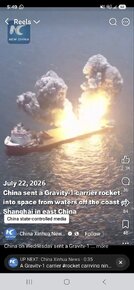
A chinese Long March 7A rocket was launched on 10 August, with an unknown load, but around 1,5 minutes after lift-off, it change into a beautiful fireball.

Chinese Rocket 'Snapped In Half' And Exploded


Also yesterday (10 August 2026) an H3-22S rocket has launched the QZS-7. The QZS-7 (Michibiki No.7) is a Japanese navigation satellite that will consist part of the Quasi-Zenith Satellite System (QZSS). With the launch of QZS-7, the QZSS will expand from a GNSS augmentation service to an independent regional navigation satellite system (RNSS) covering the Asia-Pacific region.
 
Last edited:
The Nancy Grace Roman Space Telescope (NGRST or RST) is a NASA infrared space telescope that was launched on a trajectory toward a Sun–Earth L2 orbit two days ago on 30 August 2026 by a Falcon Heavy Block 5 launch vehicle.
 
German startup Isar Aerospace has completed their first orbital flight of a "Spectrum" launcher from Andoya in Norway. The flight deployed six cubesats in SSO.

The actual launch takes place at around timestamp 0:58:20.

Spectrum is designed somewhat similarly to early SpaceX Falcon launchers, utilizing a single engine design in clusters in both stages. Intended maximum payload is 1000 kg to LEO. The company is aiming more towards mass-launching, intending for a cadence capacity of up to 40 flights per year, with a focus on military and organizational loads.
 
Satellite operator ICEYE is trying to buy Europe's second-largest launch provider Avio.


The Italian government isn't exactly enthused, and is apparently examining the buyout under the Italian "Golden Power" law, which governs foreign investment in national security and public interest industry. The reasoning is apparently that ICEYE has a very miniscule share (something like 5%) held by the Qatari Investment Agency.
The link says Leonardo holds 18% of Avio and the Qatari investment agency has 5% so which entities hold the remaining shares? What is their take on this?
 
The link says Leonardo holds 18% of Avio and the Qatari investment agency has 5% so which entities hold the remaining shares? What is their take on this?

Leonardo has an 18% share in AVIO. The rest is 60% free float and funds.
The Qatari Investment Agency has a 5% share in ICEYE.

The italian Government doesn't have a direct participation in AVIO, but it is an indirect shareholder thanks to Leonardo's 18%.
AVIO is subjected to EU and Italian national discipline (or golden power if you like) so the Government or the European Commission have a say when financial operations are launched on defense or strategic companies from foreigners.

The Qatari Investment Agency is clearly not an EU investor, so the italian government can (on paper) enforce its golden power and make requests. Even when, like in this case, Qatar is just a minor shareholder and is probably absolutely uninterested in the acquisition. The mere fact that they have a participation in ICEYE is sufficient.
 
Lincoln Experimental Satellite 1, also known as LES-1, is a communications satellite, the first of nine in the Lincoln Experimental Satellite program. It was made by MIT Lincoln Laboratory in Massachusetts and launched by the United States Air Force on 11 February 1965. LES-1 did not have a successful operational life due to being placed in a suboptimal orbit, and it ceased transmissions in 1967. After 45 years of inactivity, LES-1 spontaneously resumed transmissions in 2012.

 
Back
Top