Canada Defence Force

BostonMartin

New Member
Flight availability isn't really better for any jet. It's more about your own force structure. Gripen isn't widely used, so the logistics you set up for it are less robust (so cheaper) and less strained.
The availability and use of F-35s have been lower, in some cases much lower, than those of other fighter aircraft of the same age, concluded the Congressional Budget Office, the government agency that provides financial data to U.S. lawmakers.

“For example, the average availability rate of a 7-year-old F-35A has been about the same as that of a 36-year-old F-16C/D and a 17-year-old F-22,” it added in a report released in June.

Gripen supporters counter that their plane has a much lower cost to operate than the F-35s and has high availability rates.
 

John Fedup

The Bunker Group
The availability and use of F-35s have been lower, in some cases much lower, than those of other fighter aircraft of the same age, concluded the Congressional Budget Office, the government agency that provides financial data to U.S. lawmakers.

“For example, the average availability rate of a 7-year-old F-35A has been about the same as that of a 36-year-old F-16C/D and a 17-year-old F-22,” it added in a report released in June.

Gripen supporters counter that their plane has a much lower cost to operate than the F-35s and has high availability rates.
The cost per flight hour is significant. One can argue that for highly contested airspace, the higher operational cost for the F-35 is justified but for Canadian sovereignty patrol in North America, Gripen is a viable and less costly option.
 

Big_Zucchini

Well-Known Member
The availability and use of F-35s have been lower, in some cases much lower, than those of other fighter aircraft of the same age, concluded the Congressional Budget Office, the government agency that provides financial data to U.S. lawmakers.

“For example, the average availability rate of a 7-year-old F-35A has been about the same as that of a 36-year-old F-16C/D and a 17-year-old F-22,” it added in a report released in June.

Gripen supporters counter that their plane has a much lower cost to operate than the F-35s and has high availability rates.
I addressed that already. When switching aircraft you're building new logistics for it. It's always a very big deal. Every base, every squadron that receives the F-35, must make local adaptations for it. That means for the duration, and for a while until they're fully climatized to the new aircraft, there will be lower availability. It is also affected by the fact that the USAF/USN are still transitioning to the F-35, and as the earliest adopters with the biggest fleet they are also using a lot of aircraft in need of upgrades.
These issues of scale do not apply to Canada, and I've already provided one example where a smaller force can make the F-35 work with very high availability.

The cost per flight hour is significant. One can argue that for highly contested airspace, the higher operational cost for the F-35 is justified but for Canadian sovereignty patrol in North America, Gripen is a viable and less costly option.
The E/F variant of the Gripper already doubles the flight hour cost of the C/D (reported $4k -> $8k). It lives a shorter life and costs more up-front. You won't keep it flying for another 40-50 years like an F-35 because it's already on the obsolescent path. So you gotta keep that in mind, that it's not as economical as it seems. If we assume it flies for 20 years before it's re-exported, you're only saving money through flight hours for half that time.
Is this not so big saving worth the money?

True flight hour costs include more than just the wear and tear. They include expenditure of munitions, and perishables like EFTs.
An aircraft like the Gripen doesn't discount these. The fat F-35 hauls huge fuel stores, an internal bay that's more than enough for the usual CAP, and powerful internal sensors and effectors that substitute pods.
Meaning if the F-35 is advertized with a $33k flight hour cost, you can be pretty sure that a full internal load remains in the region of that.
But if you do CAP with the Gripper and take EFTs for the range, a quad pack of AAMs, and an IRST or self protection pod, then you can bet you're going way over that $8k tag.

The JSF is also built more globally, and its robust network of users and suppliers also factors into the costs. Not only are parts going to be more available to you, simply because they're manufactured in a larger volume, but every partner nation that manufactures parts taps into the profits, and can offset some of the associated costs.

In the end, flight hour cost is a very superficial argument.

 

John Fedup

The Bunker Group
I addressed that already. When switching aircraft you're building new logistics for it. It's always a very big deal. Every base, every squadron that receives the F-35, must make local adaptations for it. That means for the duration, and for a while until they're fully climatized to the new aircraft, there will be lower availability. It is also affected by the fact that the USAF/USN are still transitioning to the F-35, and as the earliest adopters with the biggest fleet they are also using a lot of aircraft in need of upgrades.
These issues of scale do not apply to Canada, and I've already provided one example where a smaller force can make the F-35 work with very high availability.


The E/F variant of the Gripper already doubles the flight hour cost of the C/D (reported $4k -> $8k). It lives a shorter life and costs more up-front. You won't keep it flying for another 40-50 years like an F-35 because it's already on the obsolescent path. So you gotta keep that in mind, that it's not as economical as it seems. If we assume it flies for 20 years before it's re-exported, you're only saving money through flight hours for half that time.
Is this not so big saving worth the money?

True flight hour costs include more than just the wear and tear. They include expenditure of munitions, and perishables like EFTs.
An aircraft like the Gripen doesn't discount these. The fat F-35 hauls huge fuel stores, an internal bay that's more than enough for the usual CAP, and powerful internal sensors and effectors that substitute pods.
Meaning if the F-35 is advertized with a $33k flight hour cost, you can be pretty sure that a full internal load remains in the region of that.
But if you do CAP with the Gripper and take EFTs for the range, a quad pack of AAMs, and an IRST or self protection pod, then you can bet you're going way over that $8k tag.

The JSF is also built more globally, and its robust network of users and suppliers also factors into the costs. Not only are parts going to be more available to you, simply because they're manufactured in a larger volume, but every partner nation that manufactures parts taps into the profits, and can offset some of the associated costs.

In the end, flight hour cost is a very superficial argument.
Given the rapid pace of new developments wrt military aerospace, I am glad I don't have to make the expensive choices. The political considerations are stuff waiting to happen that the RCAF unfortunately has to deal with Canada is famous (actually infamous) for keeping military kit well past its best before date. I don't think any jet that is selected will be viable for 30 years let alone 40+ years.
 

BostonMartin

New Member
I addressed that already. When switching aircraft you're building new logistics for it. It's always a very big deal. Every base, every squadron that receives the F-35, must make local adaptations for it. That means for the duration, and for a while until they're fully climatized to the new aircraft, there will be lower availability. It is also affected by the fact that the USAF/USN are still transitioning to the F-35, and as the earliest adopters with the biggest fleet they are also using a lot of aircraft in need of upgrades.
These issues of scale do not apply to Canada, and I've already provided one example where a smaller force can make the F-35 work with very high availability.


The E/F variant of the Gripper already doubles the flight hour cost of the C/D (reported $4k -> $8k). It lives a shorter life and costs more up-front. You won't keep it flying for another 40-50 years like an F-35 because it's already on the obsolescent path. So you gotta keep that in mind, that it's not as economical as it seems. If we assume it flies for 20 years before it's re-exported, you're only saving money through flight hours for half that time.
Is this not so big saving worth the money?

True flight hour costs include more than just the wear and tear. They include expenditure of munitions, and perishables like EFTs.
An aircraft like the Gripen doesn't discount these. The fat F-35 hauls huge fuel stores, an internal bay that's more than enough for the usual CAP, and powerful internal sensors and effectors that substitute pods.
Meaning if the F-35 is advertized with a $33k flight hour cost, you can be pretty sure that a full internal load remains in the region of that.
But if you do CAP with the Gripper and take EFTs for the range, a quad pack of AAMs, and an IRST or self protection pod, then you can bet you're going way over that $8k tag.

The JSF is also built more globally, and its robust network of users and suppliers also factors into the costs. Not only are parts going to be more available to you, simply because they're manufactured in a larger volume, but every partner nation that manufactures parts taps into the profits, and can offset some of the associated costs.

In the end, flight hour cost is a very superficial argument.

I doubt availability is the main deciding factor for Canada but the whole world agree that the F35 has lower availability and spend less time in the air, compared to other fighters or their previous fighter jets depending on the country. It's that simple.
 

Big_Zucchini

Well-Known Member
I doubt availability is the main deciding factor for Canada but the whole world agree that the F35 has lower availability and spend less time in the air, compared to other fighters or their previous fighter jets depending on the country. It's that simple.
But "the whole world" doesn't actually include the F-35's entire user base. Only some part of it.
For at least most cases, availability rate refers more to the air force, not an individual plane.
Operators of the F-35 plus F-16/15/18 typically have a similar availability rate across the entire fixed wing fleet. That is despite the increasing complexity between every generation. That is because we can cope with said increase by adjusting the way we do maintenance.
An availability rate of ~50% is the norm no matter the aircraft, across most nations using somewhat modern aircraft.
The South African Gripen C fleet is said to also be at around 50% availability.

Getting a new plane type into an air force, as I said, requires building a whole maintenance infrastructure for it. That costs a lot. And also why typically the first couple acquisition contracts usually double or triple the flyaway cost. It's not just the sunk costs added, it's the whole infrastructure built. Over the life span of the Grips in Canada, it's very unlikely they will make up for this expense through flight hour costs alone, even if they fly mostly naked.

Given the rapid pace of new developments wrt military aerospace, I am glad I don't have to make the expensive choices. The political considerations are stuff waiting to happen that the RCAF unfortunately has to deal with Canada is famous (actually infamous) for keeping military kit well past its best before date. I don't think any jet that is selected will be viable for 30 years let alone 40+ years.
There are F-15s and F-16s today that are over 40 years old and used extensively. IIRC one of the F-15s used in the Iran war was used in the 1985 Operation Wooden Leg.
The eagle and falcon were designed at a time when aircraft development was much faster than it is today. i.e. shorter time from concept to operation. The F-35s are definitely going to be flying til their 40s.
 

Big_Zucchini

Well-Known Member
LM says......I would be more interested in what the USAF says.
Go ahead and find that number. I searched and the only numbers I found are $42k and above but these refer to a decade old number and variants B and C which naturally cost more.
But for as long as we cannot find up to date and representative numbers for both the F-35 and Gripen, I can find no strong argument in the Grip's favor in that particular aspect.
 

John Fedup

The Bunker Group
The F-35 has a ton of exotic avionics, the world's most powerful military jet engine (P&W F135) along with its stealth capabilities which together are likely going to result in a higher maintenance cost. In any event, the decision will factor in the current anti-US sentiment, the ratio of F-35s to Gripen (if deemed suitable) or whether to have an all F-35 fleet but perhaps smaller than 88. If a mixed fleet is the option, I can see another 16-24 F-35s which won't be delivered until block 4 and the ECU are ready and 40 Gripens.
 

John Fedup

The Bunker Group
Re: Flight hour cost. I trust Colby, and his numbers can be a good basis for debate. I see some familiar numbers there, so it seems some pundits often mixed operational FH cost (mostly fuel) and operational + maintenance.
A mixed fleet seems to be a probable outcome barring any major US-Canada trade resolution. It is likely our auto industry will not survive and any future US-Mexico-Canada trade agreement in 2026 won't be worth signing. Sales and defence business opportunities along with job creation will be more important than the state-of-the-art F-35 capabilities. Given the increasing damage to our economy, Canada may not be able to afford a mixed fleet of 88 jets or 12 SSKs for that matter. The army needs massive recapitalisation which could and should result in new local defence manufacturing to offset the destruction of our auto industry.
 

OldTex

Well-Known Member
Given the increasing damage to our economy, Canada may not be able to afford a mixed fleet of 88 jets or 12 SSKs for that matter. The army needs massive recapitalisation which could and should result in new local defence manufacturing to offset the destruction of our auto industry.
That is where the loss of a domestic industry, which supports sovereign defence capabilities is most felt. The general public don't seem to really appreciate that fact. In the end it becomes more important that local defense businesses are supported by the government in order to prevent the complete loss of manufacturing skills and knowledge.
 

Big_Zucchini

Well-Known Member
A mixed fleet seems to be a probable outcome barring any major US-Canada trade resolution. It is likely our auto industry will not survive and any future US-Mexico-Canada trade agreement in 2026 won't be worth signing. Sales and defence business opportunities along with job creation will be more important than the state-of-the-art F-35 capabilities. Given the increasing damage to our economy, Canada may not be able to afford a mixed fleet of 88 jets or 12 SSKs for that matter. The army needs massive recapitalisation which could and should result in new local defence manufacturing to offset the destruction of our auto industry.
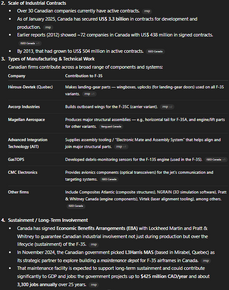
Canada is a level 3 partner, so it has a right to bid for exclusive JSF contracts. There are 8 partner nations + 1 SCP industrial partner. There are also 10 FMS participants.
That means Canada is invested into the program. It benefits from every success and loses from every failure.

I tried manually searching for Canada's level of participation, but it's all just little snippets here and there so I asked AI to summarize and it seems quite substantial.

  • $3.3 billion in contracts to Canadian industry by Jan 2025 (source)
  • Varied items including composite structures and engine components which are high end capabilities.
  • Thousands of jobs across manufacturing and maintenance.
1763733421150.png


The industrial potential for Canada from the Grip is much more limited, with lower end manufacturing capabilities required for a legacy platform.
 

John Fedup

The Bunker Group
I think Heatloss makes a good argument here. If Canada's prime goal is to reduce reliance on America, then the Rafale is the only good option.

This does carry serious political weight though, throwing Canada into the NATO leadership struggle, strengthening Fr*nce, and overall it's a very expensive endeavor.
Political consequences with Rafale would also be felt in Canada as Dassault would very ;likely base themselves in Quebec.for any Canadian production.
 

Terran

Well-Known Member
If memory serves the French themselves were the ones who said no to bidding on a Canadian fighter project with Rafale. I doubt the situation has changed enough for them to now offer.
 

Todjaeger

Potstirrer
If memory serves the French themselves were the ones who said no to bidding on a Canadian fighter project with Rafale. I doubt the situation has changed enough for them to now offer.
It might have. Dassault exited the competition after looking over the RFP due to concerns about interoperability and intel/data sharing with the US via NORAD and 5I's and that there Dassault would likely have greater issues meeting Canadian reqs than US competitors. One of several articles from 2018 which covers this can be found here.

If the RCAF is no longer as concerned about fielding a new/another jet which integrates into NORAD, then the Rafale might be back in as an option.
 
Top