
Canada Defence Force
- Thread starter Novascotiaboy
- Start date

KipPotapych
Well-Known Member
^ It’s not as random as it may seem, unfortunately. I singled this one out because it was so dumb that it was funny. And who does not appreciate Emily Blunt!
It has been recently revealed that there are people on Pentagon’s payroll who post rubbish on social media amplifying Trump’s and Hegseth’s idiotic views, including the current crazy anti-Canada, and, naturally, our military, campaign. The article in the Washington Post:
Or via the archive:
This Konrad guy, if people recall, if followed, was picked by the Pentagon as a type of press representative in some capacity or some such about a year or so ago (maybe a bit more). There was quite a bit of noise about it at the time since actual journalists were cut off from the briefings and not given access to the officials. My understanding is that this guy was eventually deemed to be too stupid even by this crew in charge (imagine that, lol) and dropped (though they are all posting the same rubbish anyway, which still leaves some questions open).
And even if this particular guy may be looking for clicks (I did not post any links to his posts), there is a predatory information campaign organized by this administration to attack Canada.
And while Canada is the current “hot topic”, it is not just Canada and it is not just social media shit-posting. Check out Ryan Evans’ (War on the Rocks guy) post on X from a couple of days ago: social media turned into real life with consequences for him and some of his stuff (thankfully just an extra, though not insignificant, financial burden for himself, but some of the stuff had to relocate their families due to the personal security risks). All due to one of the “influencers” mentioned in the article above. It’s pretty crazy, yet serious, shit.
As for real-life Rita what’s her name (Emily Blunt in The Edge of Tomorrow), good people of the internet found the source for image, dated June of last year (X and Facebook, respectively):
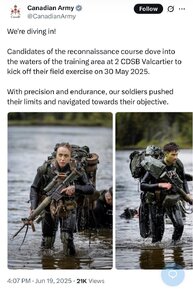

Here is Konrad being defended by a guy (the guy he quoted) on Pentagon’s payroll (mentioned in the article) and the cause of Evans’ troubles:

PS It’s weird that they keep calling it service instead of a job.
Edit: I saw a dude “stealing” my Emily Blunt bit. Laughing. Is the dude here, by any chance? Of course there is also “great minds think alike” possibility and the resemblance on that photo is clear.
It has been recently revealed that there are people on Pentagon’s payroll who post rubbish on social media amplifying Trump’s and Hegseth’s idiotic views, including the current crazy anti-Canada, and, naturally, our military, campaign. The article in the Washington Post:
Or via the archive:
This Konrad guy, if people recall, if followed, was picked by the Pentagon as a type of press representative in some capacity or some such about a year or so ago (maybe a bit more). There was quite a bit of noise about it at the time since actual journalists were cut off from the briefings and not given access to the officials. My understanding is that this guy was eventually deemed to be too stupid even by this crew in charge (imagine that, lol) and dropped (though they are all posting the same rubbish anyway, which still leaves some questions open).
And even if this particular guy may be looking for clicks (I did not post any links to his posts), there is a predatory information campaign organized by this administration to attack Canada.
And while Canada is the current “hot topic”, it is not just Canada and it is not just social media shit-posting. Check out Ryan Evans’ (War on the Rocks guy) post on X from a couple of days ago: social media turned into real life with consequences for him and some of his stuff (thankfully just an extra, though not insignificant, financial burden for himself, but some of the stuff had to relocate their families due to the personal security risks). All due to one of the “influencers” mentioned in the article above. It’s pretty crazy, yet serious, shit.
As for real-life Rita what’s her name (Emily Blunt in The Edge of Tomorrow), good people of the internet found the source for image, dated June of last year (X and Facebook, respectively):
Here is Konrad being defended by a guy (the guy he quoted) on Pentagon’s payroll (mentioned in the article) and the cause of Evans’ troubles:
PS It’s weird that they keep calling it service instead of a job.
Edit: I saw a dude “stealing” my Emily Blunt bit. Laughing. Is the dude here, by any chance? Of course there is also “great minds think alike” possibility and the resemblance on that photo is clear.
Last edited:
KipPotapych
Well-Known Member
(Full discussion linked in the tweet)
Reasonable questions (from here: Shahryar Pasandideh (@shahpas) on X)
I listened to this podcast and understand the argument to reduce Canada's reliance on the United States going forward, but I do not understand two of the claims about the F-35 in particular.
First, why should Canada be the only NATO member concerned about the United States potentially pulling the plug on/placing restrictions on how the F-35 can be used against Russia in a time of war? Presumably, such an American policy will not be solely directed at Canada and will also affect Finland, Norway, Poland, Germany, Denmark, the Netherlands, the United Kingdom, Italy, the Czech Republic, Greece, and Romania, all of whom also operate/will operate F-35 aircraft. Why should Canada be the only NATO member state to forgo ordering additional quantities of the F-35, which is, at this time, the best available fighter aircraft for use over a 30-year service life into the 2060s? Insofar as American restrictions on how the F-35 can be used against Russia is a real problem, it is a problem for multiple NATO member states, including those bordering Russia. I don't see European NATO countries forgoing F-35 orders or pursuing a mixed fleet of fighter aircraft to hedge against any American restrictions on how they can employ their F-35 aircraft against Russia.
Second, supposing that the United States pulls the plug on/places restrictions on how the F-35 can be used against Russia in time of war, why should Canada lead the charge on putting in place alternative aerial capabilities to attack targets deep inside Russia despite American opposition? The United States ultimately underwrites NATO on both the conventional and nuclear fronts. If one truly believes that the United States will not lift a finger for its NATO allies, then Canada will have to be cognizant that Russia may well directly retaliate against Canada in North America should Canada participate in such strikes against Russia with or without Canadian F-35 aircraft. This is what a world without the United States underwriting NATO looks like. In such a world, how will such strikes be in Canada's best interest with or without fighter aircraft other than the F-35? Presumably, if Canadian F-35 aircraft are unable to attack targets inside Russia as a result of American restrictions, then European NATO F-35 aircraft will also be unable to carry out such strikes. What role, then, would notional Canadian Gripen aircraft be expected to play in such a scenario, particularly if other NATO F-35 operators faced the same restrictions?
All things considered, NATO ex-USA will have much bigger problems in such a scenario than whether several dozen forward-deployed Canadian F-35 aircraft can or cannot be used to attack targets deep inside Russia. Given Canada's finite resources and the growing urgency of replacing the CF-18 fleet, as well as the RCAF's finite pool of aircrew and ground-based technicians, a single fleet of fighter aircraft is the most practical path forward. As I've said before, the problem with the latest Gripen variant is not that it is a bad aircraft, but that it makes for a poor long-term investment for Canada as an aircraft that will be deployed in the early 2030s and remain in service into the 2060s. If Canada really wanted Gripen, or Eurofighter, or Rafale, it should have ordered such aircraft a decade or more ago so as to replace these by the 2050s, not in the 2060s and beyond.
All things considered, Gripen is not fit for purpose over a ~2030-2060 service life given existing and prospective threat dynamics, including within North America for NORAD-type missions. The F-35 is, to be clear, very far from perfect, and not only on account of the current state of Canada-United States and NATO-United States relations. As the only low-observable aircraft available to Canada at this time, it is nevertheless the best available option on the market, as well as the aircraft that Canada has already ordered and paid for. If Canada wants to reduce its dependence on the United States, it will not happen overnight and will have to be a long-term project. The country is likely best off not making aggressive course corrections for which future generations of Canadian taxpayers will be on the hook. Although difficult, there are plausible ways to proceed with the 30-strong fleet of F-35A fighter aircraft, if not a somewhat expanded fleet of 40-50 such aircraft, while holding out for GCAP to become available sometime in the late 2030s. A second, much larger fleet of Gripen aircraft is unlikely to become an investment decision that future generations of Canadians will come to celebrate.

John Fedup
The Bunker Group
Some more good news on the acquisition front.
Canada’s military seeking anti-drone defences for bases, facilities
Canada’s military seeking anti-drone defences for bases, facilities
KipPotapych
Well-Known Member
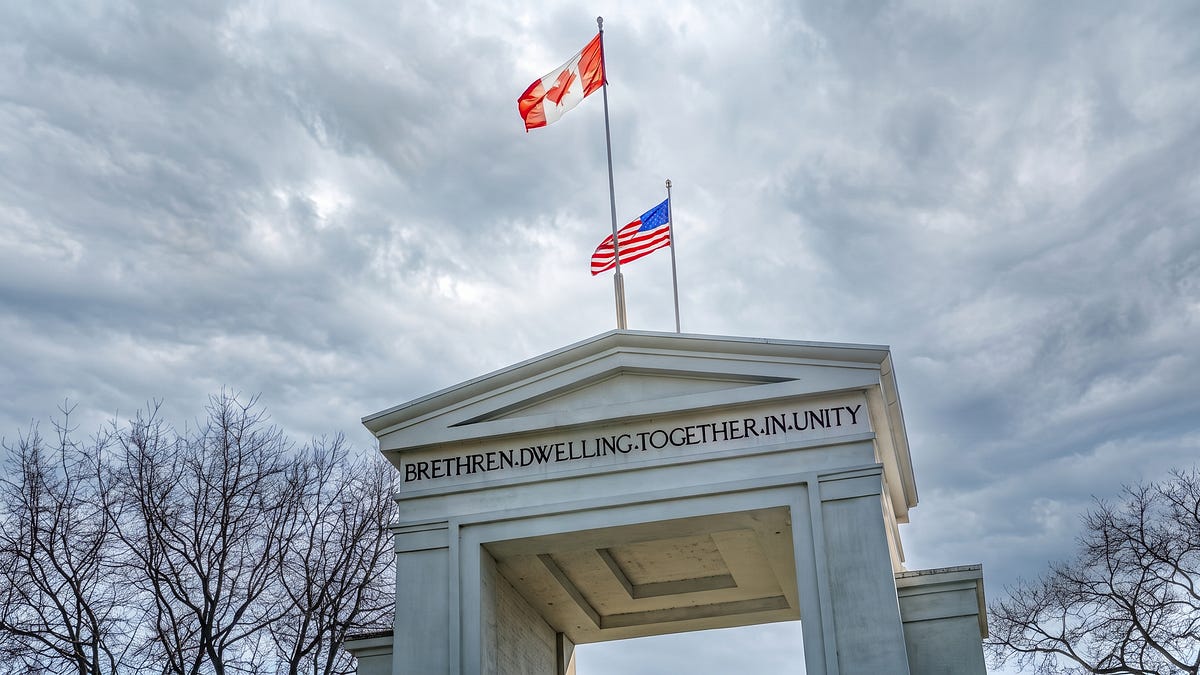
Wasn’t sure where to put this, as it pertains to the US thread as well (and even Russia too), but I figured it is more relevant here. Some good thoughts, as usually, by Seva Gunitsky:

KipPotapych
Well-Known Member
Alberta Premier Danielle Smith said Sunday that 39 patients are currently in hospital, with "at least" 19 in critical condition.
Terrible stuff. Wonder what happened.
Terrible stuff. Wonder what happened.

FormerDirtDart
Well-Known Member
Reporting is fire broke out in training area, ignition source not known, they were tracking it & letting it burn, apparently didn't think it was a threat to elements of 3PPCLI, high winds ~69 KPH swept the fire a kilometer in 30-60 secondsAlberta Premier Danielle Smith said Sunday that 39 patients are currently in hospital, with "at least" 19 in critical condition.
Terrible stuff. Wonder what happened.
Despite ealy reporting saying a gas well had been struck by a munition (artillery and CG Recoilless both reported) officials say gas well explosion or fire not involved. Also early reporting had stored ammunition detonating in the fire but officials also have stated there were no munition explosions
Reporting still 4 dead, 39 injured
A very tragic situation. With the winds that came up so quick and whipping the fire into their training positions It would have been a vision of hell. I once got caught in a prescribed burn that went bad and I've never forgotten how incredibly intense the heat was and how difficult it was just to breath. Peace be with those that passed and a speedy and good recovery for those injured.Reporting is fire broke out in training area, ignition source not known, they were tracking it & letting it burn, apparently didn't think it was a threat to elements of 3PPCLI, high winds ~69 KPH swept the fire a kilometer in 30-60 seconds
Despite ealy reporting saying a gas well had been struck by a munition (artillery and CG Recoilless both reported) officials say gas well explosion or fire not involved. Also early reporting had stored ammunition detonating in the fire but officials also have stated there were no munition explosions
Reporting still 4 dead, 39 injured
KipPotapych
Well-Known Member
The explosion part is still confusing. We will have to wait for the official investigation results. Just horrible, really. Hard to imagine.Reporting is fire broke out in training area, ignition source not known, they were tracking it & letting it burn, apparently didn't think it was a threat to elements of 3PPCLI, high winds ~69 KPH swept the fire a kilometer in 30-60 seconds
Despite ealy reporting saying a gas well had been struck by a munition (artillery and CG Recoilless both reported) officials say gas well explosion or fire not involved. Also early reporting had stored ammunition detonating in the fire but officials also have stated there were no munition explosions
Reporting still 4 dead, 39 injured
Thought of that movie with Josh Brolin about the hotshots at Granite Mountain. Brave something.
KipPotapych
Well-Known Member
Tragic indeed, mate. I live around these parts and know all about the winds (Saturday was windy as heck). It’s a real thing. So is fires. Sounds like some mistakes have been made in terms of assessments of the situation though. We will wait and see.A very tragic situation. With the winds that came up so quick and whipping the fire into their training positions It would have been a vision of hell. I once got caught in a prescribed burn that went bad and I've never forgotten how incredibly intense the heat was and how difficult it was just to breath. Peace be with those that passed and a speedy and good recovery for those injured.
Hope that count of 4 will remain so. Nothing was reported about any changes today that I saw.
John Fedup
The Bunker Group
As there is no NORAD thread, I am posting this article here. This is the first report I have seen about possble reluctance by CDN officers to accept NORAD postings in the US. Not hard to to believe though and the reasons make sense if the current trends continue. I don't expect much change post mid-terms and post 2028, WTF knows.
Canadian military officers reluctant to take US postings as Trump tensions reach NORAD, report says
Canadian military officers reluctant to take US postings as Trump tensions reach NORAD, report says
I guess it's to be somewhat expected. The Trump factor is hard to ignore. I believe the US is loosing standing around the world primarily due to Trump. Canadians definately can't stand him. I imagine it would be hard to get dependants to move to the US during a deployment especially.As there is no NORAD thread, I am posting this article here. This is the first report I have seen about possble reluctance by CDN officers to accept NORAD postings in the US. Not hard to to believe though and the reasons make sense if the current trends continue. I don't expect much change post mid-terms and post 2028, WTF knows.
Canadian military officers reluctant to take US postings as Trump tensions reach NORAD, report says
John Fedup
The Bunker Group
Not only that but as per the article, relativres and friends could be reluctant to visit.I guess it's to be somewhat expected. The Trump factor is hard to ignore. I believe the US is loosing standing around the world primarily due to Trump. Canadians definately can't stand him. I imagine it would be hard to get dependants to move to the US during a deployment especially.