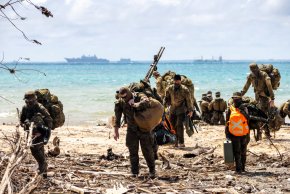
I really think that the question is whether or not the army has sufficient armoured mass to undertake the full requirements of five battle groups, plus spare vehicles. That is what I believe that you should be working from and arguing for.

That would be 12 Mechanized companies.Massive could you please qualify, is this the total regiments for each brigade or across two brigades.
Unless I'm mistake Army currently have for the " heavy stuff ".
3 x Tanks Sqns
6 x Cav Sqns
9 x Mech Inf Company's.
Total of 18 Coy / Sqn
I'm not sure what the future holds for brigade composition and specialization.
Therefore the above looks like what we mix and match with both for now and into the future.
Any news out there.
Regards S
Any news out there.
Regards S
You are right, without reinforcement they can only generate four BG.
For us, Bde's are task organised. The force that occupies Enoggera / Lavarack / Robertson/Edinburgh is not a war-fighting formation, it's a force generation formation. You can plug anything into it, although you are probably going to try and keep the number of LTCOL commanders to 4 - 8. 5x BG + 1x CER + 1x Fires Regt + 1 CSSB maximises what the Bde Comd can comfortably command.
You may chose to take less, of course. It may be that we choice to sacrifice one of them. But I think, at the higher levels of war, a combination of the more varied threat and the rate of casualties would force something like a 5 BG force.
Agree support company is at the pointy end, as are really any of the units within the Brigade such as Sigs, engineers, Artillery etc.That would be 12 Mechanized companies.
Each of the Mech battalions are 3 x mech infantry companies plus support company.
Support company is a warfighting company, not logistical support, that's admin company.

Getting the requisite sub-groups could be achieved by adding (a lot) more tanks. Tanks are manpower efficient for the combat power generated.
An option could be to have two mechanised brigades comprising a cavalry regiment (3 squadron CRV), 2 armoured regiments (2 tank squadron, 1 IFV company) and 2 mechanised regiments (1 tank squadron, 2 IFV company).
Thoughts?
Massive
Thanks for the informative discussion. Under Australian doctrine, where would Army aviation fit in. Could it be substituted for one of the BGs? Or would this normally be an additional attachment?
My big question around all this is that given an Amphibious Ready Group only comprises 1 BG HQ with 4 combat teams, aviation and support but consumes all our current amphibious naval assets, what is the likelihood we would ever deploy a full mechanized brigade in the format outlined above? My gut feel is that there is no contingency both urgent enough for us to need to do this, but with enough time for us to deploy using what I suspect would have to be commercial shipping to a safe port under naval escort. Or is this organisational format only for homeland defense - i.e. mostly deterrence - purposes?
I would think a massive re organisation of our Reserve forces is in order.we have a lot of bushmasters and motorised infantry for A Res should be given some priority.
We still need flexibility and mobility.
I know that most here are Mechanized and motorised focused.
But it's a long drive to anywhere in this country, and air mobility provides a hell of a lot of flexibility. I'm not talking paras, but light infantry that is well versed on quick tac loading and moving anywhere very quickly. There is only so much commandos can do, when we have 1.5 battalions of them, including reserves.
Air mobility is a specialised role.
You can't just take mech infantry and get them up to speed in a couple of weeks.
It takes a lot more time than that.
Maybe a brigade of light , airmobile infantry should be on the cards. A mix of regular battalions and reserve units.
Wow, you put a lot of effort and thought into addressing something I did not put out there.Sorry, I can't see a single justification for light infantry in the ARA, or for a para capability. ARes - I'll address that at the end.
First off is the what's next bit. Take the most famous paratroop operation (one done with hugely more logistics and warfighting capability than the ADF) - Market Garden. The para's seize key terrain, but they have to be relieved - they don't have the depth or the equipment to stand and fight. You need XXX Corps to move quickly. What's the equivalent here? In Australia I'll accept the reinforcing forces can be there within three days (which begs the question, where am I putting this light inf force that sheer distance can't do the job for me?), but overseas? Now, you could launch the reinforcing forces early (so five days sailing means they leave at D-5 and the para's will launch at D), but that's a massive strategic intelligence "look here" note for REDFOR. Normandy works because German doesn't ID the landing vessels have left before the para's launch; MG works because the reinforcing elements are already there. If there are days between leaving Dover and landing at Normandy, how well prepared are the German defenders?
Now what can light infantry do? With a bunch of light vehicles they have some mobility; but they will run out of fuel quickly. A handful of ATGM (noting Australia, like the rest of the west, are woefully undergunned in this area). a handful of 81 mm with maybe two fire missions in them? So they can seize a key asset (bridge), but then what? They can control out to maybe 5000 m. Time and time again, the modern battlefield has shown that light inf can rarely work, and often comes with heavier than needed casualties. As soon as REDFOR know they are there, they know they can just use motorised and towed guns the para force is that woeful. Oh, and prep the armoured formations with SPH for the reinforcing force...
So, without a mission that is feasible, duplicating 3 Bde for a light infantry Bde gives us at least two Bn of light infantry, about 600 people each in peacetime. The ADF is already short positions, 1200 people would fill 4 - 5 SPH Regt, 3 - 4 Tk Regt. Which one is more useful? Yeah, the cost of the equipment is lower, but under that thinking we should get rid of everything and just issue 9mm - there isn't much cheaper.
Finally, while I appreciate that just because every soldier and officer trains in light infantry work first that doesn't make us all light infantry, the honest reality is that after truck driving there is no other role in the ADF easier to learn. The RAR Bn's can pick up the delta faster (certainly much faster than going from light to mech). Look at 1 RAR last year; they rerolled to a dismounted NEO in enough time to do the job well. Even if I need more, taking a random civi to fully qual'd rifleman in jungle warfare will take no more than three months (as more than one senior RAInf person - officer, NCO and WO has told us). Plenty of time. Parachuting is even easier to learn. I will point out that our most successful combat para jump in history was done with soldiers who had done ... 1 practise jump. With static lines and modern parachute tech, anyone can jump.
Which leads on to the ARes question. It needs to be asked, what is their role and what is their point? I know what the doctrinal answer is, but they can't do that. Maintaining their numbers is increasingly hard. I would dearly love to remove a chunk of the seniors and get some youth injected in with ideas - because without a cultural change the olds and bolds have driven it into the ground. There is no quick and dirty answer here (although I have seen the idea of giving all the long range missiles Army buys to the ARes - and really like it), but a serious rethink on their role and mission.
Wow, you put a lot of effort and thought into addressing something I did not put out there.
Where did I say we need paras?
I.said air mobile light infantry.
Australia is big and our region or AO is also very big.
Moving mech or motorised infantry from the east coast to say, the Pilbara, East Timor or PNG will take weeks.
Light infantry, properly trained in airmobile operations, can harrass, delay, and hold key areas until the fighting force arrives.
Otherwise, you can potentially allow an enemy to hold, build up and prepare, unopposed for that arrival. Sure you could use other assets, like airforce or navy or SF. But that reduces their ability to conduct other tasks that may may stretch their capabilities.
Air mobile infantry is a good, effective way to conduct these operations.
Training and equipping light infantry is relatively cheap. And I can assure you, that training light infantry to be mounted in cars, is a lot easier than training mounted infantry to be airmobile infantry.
I will give one example.
On ex K92, conducted in the NT in the build up to the wet season, Bravo Company 3 RAR parachuted into Victoria River Station, some 800km from Katherine, and married up with 3/4 Cav and instantly became mounted infantry. That took a few hours.
Which begs another question, is infantry specialization a good thing for our sized army.Wow, you put a lot of effort and thought into addressing something I did not put out there.
Where did I say we need paras?
I.said air mobile light infantry.
Australia is big and our region or AO is also very big.
Moving mech or motorised infantry from the east coast to say, the Pilbara, East Timor or PNG will take weeks.
Light infantry, properly trained in airmobile operations, can harrass, delay, and hold key areas until the fighting force arrives.
Otherwise, you can potentially allow an enemy to hold, build up and prepare, unopposed for that arrival. Sure you could use other assets, like airforce or navy or SF. But that reduces their ability to conduct other tasks that may may stretch their capabilities.
Air mobile infantry is a good, effective way to conduct these operations.
Training and equipping light infantry is relatively cheap. And I can assure you, that training light infantry to be mounted in cars, is a lot easier than training mounted infantry to be airmobile infantry.
I will give one example.
On ex K92, conducted in the NT in the build up to the wet season, Bravo Company 3 RAR parachuted into Victoria River Station, some 800km from Katherine, and married up with 3/4 Cav and instantly became mounted infantry. That took a few hours.

 defense-update.com
Which begs another question, is infantry specialization a good thing for our sized army.
We have had only around 6 inf battalions, plus or minus for the last 50 years.
Niche has its benefits, but would we be better off with infantry flexibility.
Plan Bathsheba initially had the infantry battalions light and separate.
Get a lift in a PMV to then load up in a APC then get taken by air to do something else.
No tribes here.
The APC, IFV , PMV , Aviation owners have their own skill sets, the warm bodies inside also have theirs.
They are all in the same army and can talk and work with each other.
Cheers S
Training and equipping light infantry is relatively cheap.
Absolutely.
There is no difference between a 6 RAR section commander and a journeyman; between a 3 RAR Pl SGT or CSM and a master of trade. Modern infantry is as much a trade as a plumber or electrician, it's hard work that requires specialised knowledge. I take the micky out of my RAInf peers, but I can't do all that a Inf officer does and my trade WOs sure as hell can't match a RAInf WO.
Do we need as many Inf Bn in the ARA? That's an excellent question and I've long advocated to cutting by half or 1/3, using the ARes to fill out the replacement force with one Bn acting as 'seed'. But hey, in an Army built on the Cult of Light Infantry, that's a no goer! It also comes down to - what is the ARes for and how does it do it?

ARes / ARA
The modern work force is changing dramatically.
Both work life balance and people having a number of different employers at the same time.
An opportunity for defence.
I can see some reservist doing 50% of their working year in uniform and the other 50% in another sector or variations of that mix.
Something for defence to explore.
Regards S
Wow, you put a lot of effort and thought into addressing something I did not put out there.
Where did I say we need paras?
I.said air mobile light infantry.
Australia is big and our region or AO is also very big.
Moving mech or motorised infantry from the east coast to say, the Pilbara, East Timor or PNG will take weeks.
Light infantry, properly trained in airmobile operations, can harrass, delay, and hold key areas until the fighting force arrives.
Otherwise, you can potentially allow an enemy to hold, build up and prepare, unopposed for that arrival. Sure you could use other assets, like airforce or navy or SF. But that reduces their ability to conduct other tasks that may may stretch their capabilities.
Air mobile infantry is a good, effective way to conduct these operations.
Training and equipping light infantry is relatively cheap. And I can assure you, that training light infantry to be mounted in cars, is a lot easier than training mounted infantry to be airmobile infantry.
I will give one example.
On ex K92, conducted in the NT in the build up to the wet season, Bravo Company 3 RAR parachuted into Victoria River Station, some 800km from Katherine, and married up with 3/4 Cav and instantly became mounted infantry. That took a few hours.