
German Navy
- Thread starter gf0012-aust
- Start date
The main changes in the naval shipbuilding industry in Germany are:There have been so many changes in the past 30 years..
- The HDW shipyard in Kiel got split up into two in the 90s. One is owned by TKMS, the other by GNYK.
- TKMS also still has one other full construction site, the HDW shipyard in Hamburg. They used to have a smaller shipyard in Emden on the western border of Germany, but closed that recently.
- TKMS bought an additional shipyard in Wismar recently (last year) and is developing it, although they do not have staff on site so far; it is being operated by Meyer in the meantime.
- GNYK also "inherited" some designs and/or design capacity from HDW with that i think.
- Lürssen sold off its defence business temporarily known as NVL, now owned by Rheinmetall.
- This group also has two construction shipyards, Blohm+Voss in Hamburg and Peene-Werft in Wismar. Peene-Werft is a former East-German military shipyard near the Polish border.
- Unlike TKMS this group also operates or has shares in a number of repair shipyards for the Navy, in particular right next to the main navy base and navy arsenal in Wilhelmshaven.
- Lürssen itself as a company - outside the sold-off defence business - also still has stakes in repair yards that do navy ships, often only partial.
For the subcontractors and smaller ones:
- Rönner Group is a fairly unknown/newer name in shipbuilding. That's because they do their business under other names.
- Rönner is a traditional steel construction company. They bought up a number of smaller East-German shipyards in the early 90s and refocused them mostly towards component construction as a supplier. Also just steel construction like say bridges. I think they also built yachts at those. They do actively continue this part of the business with a focus on the maritime side, e.g. they bought up the whole steel construction department of Nobiskrug from Lürssen when that shipyard was dissolved recently.
- In 2019 Rönner bought Bredo, then in 2022 a majority stake in Lloydwerft (together with an investment partner), giving them a very solid share in repair shipyard capacity in Germany. As in they own more swimdocks than all the rest combined.
- In 2025 Rönner bought FSG to branch out into shipbuilding. FSG built e.g. the Berlin class (A704) AORs for the navy, but in general mostly focuses on container ships, ferries, offshore industry.
- Meyer owns two separate shipyards, focusing on civilian shipbuilding. Since 2024 the Meyer family only owns 20% of the business, the rest is state-owned (40% state government, 40% federal government).
- Their main shipyard in Papenburg on the Ems river (Meyerwerft) builds cruise ships. The really large kind. With sort of a market leader position in Europe. While it was considered to switch the shipyard to military production they instead recently got a contract for cruise ships worth 10 billion Euro that covers their capacity at this yard until the mid 2030s.
- Their second shipyard in Rostock (Neptunwerft) used to build components for the other yard and river cruiseships. Since Covid they're aiming to refocus this one mostly towards offshore industry and container ships similar to FSG above. This shipyard is currently building the A707 tankers for the navy.
- Fassmer owns two smaller shipyards in Berne (just outside Bremen) located near each other.
- One is their main facility that can build ships up to 130m length. That's the one that builds e.g. the 86m OPVs for the Federal Police and similar vessels. They mostly do final outfitting for these ships there, and may also do this for other shipyards (e.g. Meteor IV built by Meyer). As mentioned they recently rented another shipyard to switch to full inhouse production.
- The other (Schweers) was bought up by them and previously mostly built police/customs boats, SAR cruisers etc up to 60m length. Hence why that's the core business of Fassmer today.
- Secondary business besides shipbuilding is building rescue boats for larger ships, which they sell globally. If you see a Fassmer office in e.g. South-East Asia or South America that's for that secondary business.
- Abeking & Rasmussen has a single shipyard in Lemwerder (also just outside Bremen). They used to have a secondary business from the early 90s to late 10s in building fibre glass components for offshore wind industry.
- They also have facilities to build ships up to 130m length there. Mostly individual ships designed for customers.
- Main business is yachts, but they also have a fairly successful unique SWATH design they're selling as patrol boats and pilot boats/tenders to public authorities. Also minehunters - but not really much business in that regard.
- In recent years they have started multiple cooperation projects with nearby Fassmer, especially for larger naval/security vessels. E.g. they have a joint venture aiming for the MuSE tender contract from the Navy.
Last edited:
P.P.S. since it's not quite clear from the above
- Rönner Group, besides the recent FSG acquisition, owns in shipyards:
- Stahlbau Nord in Bremerhaven which built the Meko A200 hulls for Egypt as subcontractor to TKMS
- two riverside shipyards (SET Genthin and SET Tangermünde) that build riverine and coastal patrol boats and similar auxiliary ships for public authorities. Facilities at both are for ships up to about 80-85m length.
- Lürssen does still have its own shipbuilding capacity:
- Lürssen-Kröger Werft in Schacht (on the Kiel Canal) and Rolandwerft in Berne (where Fassmer is), both with facilities similar to Fassmer and A&R.
- both currently build superyachts, but used to do container feeder ships and (for Kröger) were occasionally used for military construction in the past - especially for larger programmes Lürssen was involved with, like minesweepers.

Fassmer’s business in South America also includes the OPVs as for Chile and Colombia. I always thought they would have been a better choice got Australia, too. Apart from anything else, they had experience in exporting their design to foreign shipyards, which Luerssen didn’t - and that cost both them and the RAN.
Just looked it up btw - Damen has partially rented an office building in Hamburg, which houses (or housed):I thought Damen had a footprint in Germany.
- Damen Naval Germany GmbH, the project office for F126 (called Damen Naval Hamburg in their business reports). Fairly sure they only have a handful of staff, imported from the Netherlands.
- Damen Services Germany GmbH, reselling third-party ship maintenance/repair services. Apparently mostly for Damen-built ships for warranty/aftersales service, e.g. they got a maintenance contract last year for Damen-built harbour tugs from Fairplay Towage (Damen has "Damen Services" subcompanies for this in a variety of places. One is in Brisbane for example).
- Van der Velden Barkemeyer GmbH, a subcompany (and trademark) of Damen Marine Components. They seem to develop rudders. Company has been around in Germany since '99 moving their offices around to various places. The only newsworthy thing i can find about them was that a German competitor sued them in 2005 for possible infringement of Chinese and Korean patents. Think Damen won that case.
- in 2024 they also shifted some other staff from Damen Marine Components there due to available office space.

Ananda
The Bunker Group
Germany Approves F128 Frigates With Conditions - Naval News
Germany’s Budget Committee has cleared the procurement of four TKMS MEKO A-200 DEU (F128) frigates, imposing strict conditions following a 70% cost increase.
 www.navalnews.com
Add Naval News article om F128 as F126 replacement program. The article talk on budget commitee approval, and conditions applied.
It's quite a bit more serious than described there.
The actual planned hearing for funding for F128 in the Budget Committee was last week. During this hearing the government under-secretary for defense procurement couldn't provide a sufficient explanation for how F128 can fulfill F126's ASW role to the same extent. The government was asking for around 11.8 billion for the full project right-away on top of the 2.5b sunk into F126.
The budget committee then decided to postpone its decision on the matter to this week subject to the government providing sufficient information. And to put some pressure on they then froze all Bundeswehr budget decisions up for approval until yesterday.
The Navy commander-in-chief had to cancel planned trips in order to personally assure the budget committee yesterday that F128 can fulfill an ASW role in the GIUK gap.
The article is also missing the part where the budget committee explicitly only approved funding for the first batch. The Bundeswehr will have to apply for new funding for the second batch option. Also, the article states a planned handover date for the first ship. That is now a required handover date.
The one-week freeze affected 15 other budget decisions for a combined value of a few billion. Nothing really major in there, but a bunch of mid-sized stuff.
The actual planned hearing for funding for F128 in the Budget Committee was last week. During this hearing the government under-secretary for defense procurement couldn't provide a sufficient explanation for how F128 can fulfill F126's ASW role to the same extent. The government was asking for around 11.8 billion for the full project right-away on top of the 2.5b sunk into F126.
The budget committee then decided to postpone its decision on the matter to this week subject to the government providing sufficient information. And to put some pressure on they then froze all Bundeswehr budget decisions up for approval until yesterday.
The Navy commander-in-chief had to cancel planned trips in order to personally assure the budget committee yesterday that F128 can fulfill an ASW role in the GIUK gap.
The article is also missing the part where the budget committee explicitly only approved funding for the first batch. The Bundeswehr will have to apply for new funding for the second batch option. Also, the article states a planned handover date for the first ship. That is now a required handover date.
The one-week freeze affected 15 other budget decisions for a combined value of a few billion. Nothing really major in there, but a bunch of mid-sized stuff.
They're not impressed with how the Bundeswehr is throwing their money around lately in general.
The projects that were frozen for a week over F128 included (among other stuff):
The projects that were frozen for a week over F128 included (among other stuff):
- naval high-energy laser project. budget committee refused funding on that in February because the Navy wanted to just hand it to a chosen consortium without looking at competitors on the market who offer the same much cheaper. Funding was released now, but also with conditions similar to F128.
- standard optics for new G95A1 assault rifle. Army refused them calling them "unusable" because it was military police troop-testing them. As in Joint Support Service, not Army. After multiple other options were looked at they're now buying those "unusable" ones.
- CFSN mission planning system for manned/unmanned teaming in the Air Force. That's something that was originally planned to be realized in FCAS (and Germany has the lead for that field there). At some point the Bundeswehr decided that they had wider requirements than what FCAS covers, so they needed a parallel development project just for that. Now they're just handing a couple hundred million to Helsing for it. After requirements were rewritten so that Helsing is the only choice on the market. Also includes Helsing developing new (!) UCAVs for testing CFSN btw, even if the system is later to be used with MBDA RCM2 instead...
- a spare Bombardier Global 6000 for the Air Force for continuous training of PEGASUS crews without exposing that precious ELINT payload. Because apparently you can't do that any other way with then twelve Global 6000/5000 aircraft in service.
- five combat craft medium for Navy Special Forces, FMS buy from the US. Same model SOCOM uses, Norway and UK also bought them. Without testing whether they actually fit into an A400M for airlifting (US/UK use C-17 for that), because while it can carry the weight 18 meters length is pretty much exactly the length of its cargo bay.
Last edited:
Contract for the Naval Laser has been signed with Rheinmetall and MBDA. Supposedly 480 million Euro. Planned IOC 2029. Based on the prototype tested onboard F124 frigate Sachsen, which took it along on 28,000nm worth of sea trials with 1000+ shots fired at air, sea and land targets.
Re lack of module space due to no F126, the consortium is now pushing the angle that since it's containerized it can also be used for drone defense in harbour protection. The Navy is instead planning to use the containerized solution on Berlin class AORs now.
The conditions package from the budget committee includes that a) this may not be used as a pre-selection for later serial production. b) if a land-based laser solution is procured other international competitors have to be looked at again (and such a land-based solution is required to be looked at in the first place) and c) there's strict project reporting duties towards the budget committee.
In addition the budget committee has charged the ministry of defense with looking into international development of possible space applications for lasers and develop its own usage scenarios, including for space-based lasers.
Re lack of module space due to no F126, the consortium is now pushing the angle that since it's containerized it can also be used for drone defense in harbour protection. The Navy is instead planning to use the containerized solution on Berlin class AORs now.
The conditions package from the budget committee includes that a) this may not be used as a pre-selection for later serial production. b) if a land-based laser solution is procured other international competitors have to be looked at again (and such a land-based solution is required to be looked at in the first place) and c) there's strict project reporting duties towards the budget committee.
In addition the budget committee has charged the ministry of defense with looking into international development of possible space applications for lasers and develop its own usage scenarios, including for space-based lasers.
Saab got the first subcontract for F128. About 197m per ship for an integrated superstructure with 9LV Combat System, Sea Giraffe 4A Fixed-Face, Sea Giraffe 1X "and passive sensors".
The wording of the press-release is near-identical to the 2021 one for the F123 MLU, where Saab - as the main contractor back then - is providing the exact same systems (not fixed-face for 4A) plus CEROS200 and modifications to IFF. At half the price. And that included the whole rest of the MLU.
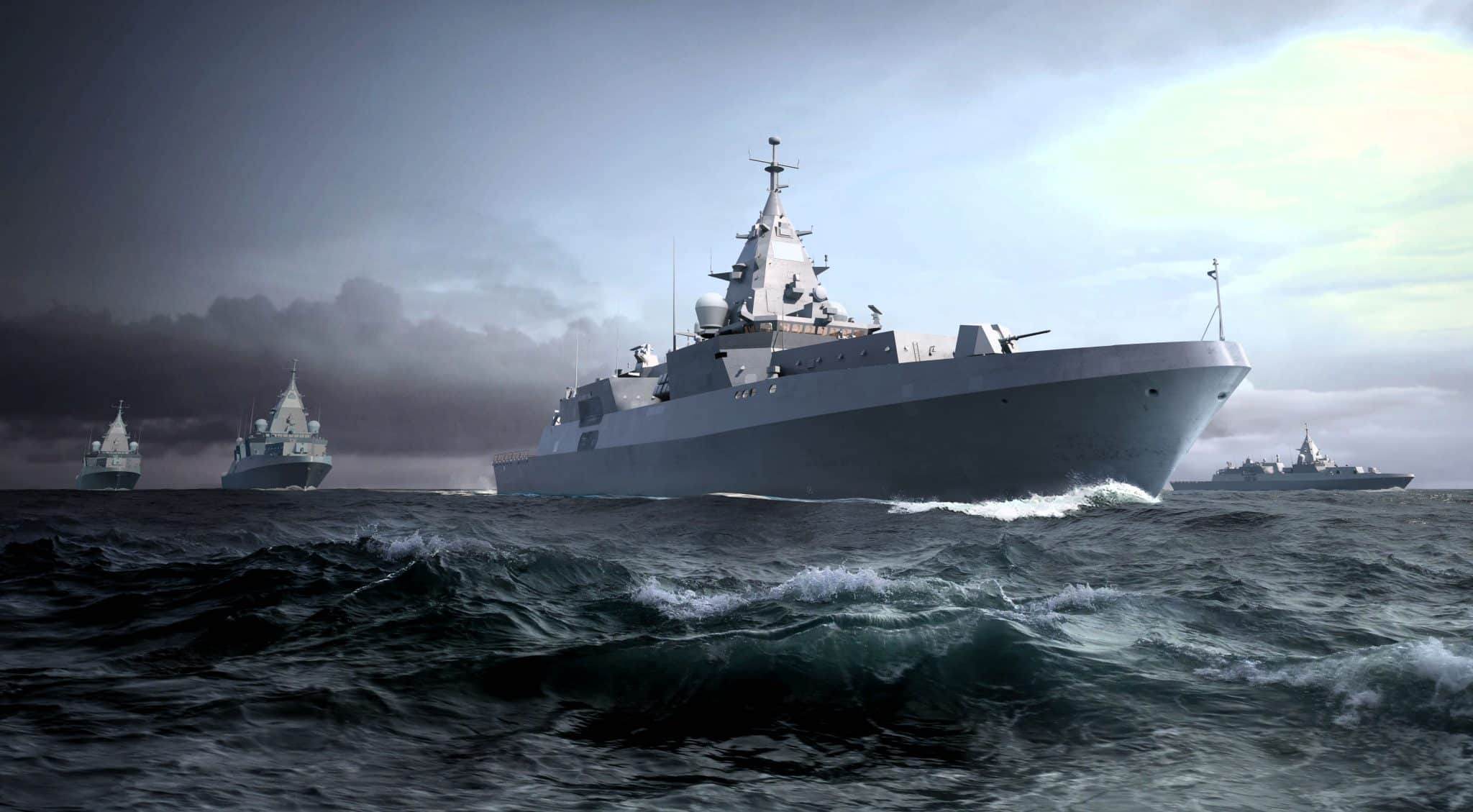
And considering the otherwise identical wording, it's interesting that the first visualization provided for F128 by TKMS still included two CEROS - as the image was based off the Algerian version. Guess TKMS is not mounting them for lack of need due to "upgrades provided by ESSM Block 2".
The wording of the press-release is near-identical to the 2021 one for the F123 MLU, where Saab - as the main contractor back then - is providing the exact same systems (not fixed-face for 4A) plus CEROS200 and modifications to IFF. At half the price. And that included the whole rest of the MLU.
And considering the otherwise identical wording, it's interesting that the first visualization provided for F128 by TKMS still included two CEROS - as the image was based off the Algerian version. Guess TKMS is not mounting them for lack of need due to "upgrades provided by ESSM Block 2".
Last edited:
TKMS has now officially withdrawn that competing offer for GNYK. Not exactly surprising, it did what they needed.So TKMS then submits a competing offer for GNYK, and "surprisingly" at the beginning of this month also an unpaid bill (1.7m Euro, peanuts) at GNYK surfaces stalling the selling of the yard to either party.
Rheinmetall is currently "not commenting" on their own non-binding bid for GNYK.
So contracts with Thales and Hensoldt will be cancelled?Saab got the first subcontract for F128. About 197m per ship for an integrated superstructure with 9LV Combat System, Sea Giraffe 4A Fixed-Face, Sea Giraffe 1X "and passive sensors".
The wording of the press-release is near-identical to the 2021 one for the F123 MLU, where Saab - as the main contractor back then - is providing the exact same systems (not fixed-face for 4A) plus CEROS200 and modifications to IFF. At half the price. And that included the whole rest of the MLU.
And considering the otherwise identical wording, it's interesting that the first visualization provided for F128 by TKMS still included two CEROS - as the image was based off the Algerian version. Guess TKMS is not mounting them for lack of need due to "upgrades provided by ESSM Block 2".
"Stint", another of those ex-Navy LCMs run by states for pollution control (see this post), is being replaced by a second ship based on the general Lütt Matten design characteristics (see this post). European-wide tender for construction has been issued for delivery by end of 2027.
Stint itself is out of service and planned to be sold off through VEBEG. Was in Navy service 1966 to 1994.
Stint itself is out of service and planned to be sold off through VEBEG. Was in Navy service 1966 to 1994.
The Navy successfully test-fired two IAI LORA ballistic missiles from F125 frigate Sachsen-Anhalt in the North Atlantic in the night of Aug 31st to Sep 1st.
The containerized launcher was apparently mounted on the flight deck. The firing position was in the GIUK gap somewhere between Iceland and Ireland, The test was kept secret, but a NOTAM was issued.
Video of the system and test published by the Navy on Instagram:

 www.instagram.com
The containerized launcher was apparently mounted on the flight deck. The firing position was in the GIUK gap somewhere between Iceland and Ireland, The test was kept secret, but a NOTAM was issued.
Video of the system and test published by the Navy on Instagram:
Deutsche Marine on Instagram: "Vizeadmiral Jan Christian Kaack, Inspekteur Deutsche Marine: „Mit dem erfolgreichen Schuss einer ballistischen Rakete gestern Nacht im Nordantlantik haben wir Marinegeschichte geschrieben. Ich bin hochzufrieden mit dieser Leistung. Das System lässt sich erfolgreich von unseren Einheiten aus einsetzen und die mögliche Reichweite übersteigt alles, was wir bisher kannten. Zum Schutz Deutschlands und unserer Verbündeten stellt diese Erprobung ein neues Kapitel in Sachen Abschreckung und Verteidigungsbereitschaft auf See dar.“ : Bundeswehr/Stamm/Gottschalch/EKT"
6,986 likes, 141 comments - wir_sind_marine on September 1, 2026: "Vizeadmiral Jan Christian Kaack, Inspekteur Deutsche Marine: „Mit dem erfolgreichen Schuss einer ballistischen Rakete gestern Nacht im Nordantlantik haben wir Marinegeschichte geschrieben. Ich bin hochzufrieden mit dieser...
www.instagram.com
Last edited:
The Navy is getting 15 Jehu class boats (Watercat M18 AMC) for the Naval Infantry Battalion for 175 million Euro - 10 fixed order +5 option.
Finland currently operates 12 of these boats, Lithuania another 2. In Germany they are mostly planned for patrols and landing operations, similar to how Sweden operates their CB90.
Marine Alutech formed a joint venture with a German shipyard in Kiel (Gebr. Friedrich) for production and maintenance of these and other boats of their Watercat line of small military speedboats. The shipyard otherwise mostly does maintenance for larger Navy vessels as their core business.
Finland currently operates 12 of these boats, Lithuania another 2. In Germany they are mostly planned for patrols and landing operations, similar to how Sweden operates their CB90.
Marine Alutech formed a joint venture with a German shipyard in Kiel (Gebr. Friedrich) for production and maintenance of these and other boats of their Watercat line of small military speedboats. The shipyard otherwise mostly does maintenance for larger Navy vessels as their core business.

Sandhi Yudha
Well-Known Member
Koninklijke Schelde/Damen Shipyards is now demanding €4,7 billion financial compensation from the German government, because of the cancellation of the order of 6 F126 destroyers.
Scheepsbouwer Damen wil miljarden van Duitse overheid voor schrappen order
Damen eist 4,7 miljard van Duitsland na annulering fregatten
Koninklijke Schelde claims that they already made a lot of costs, including the fabrication of components of the ships, which were ready to be assembled.
Scheepsbouwer Damen wil miljarden van Duitse overheid voor schrappen order
Damen eist 4,7 miljard van Duitsland na annulering fregatten
Koninklijke Schelde claims that they already made a lot of costs, including the fabrication of components of the ships, which were ready to be assembled.
Last edited: