Indian Navy Discussions and Updates

John Fedup

The Bunker Group
If you change the reactor you basically have to re-design a substantial part of the ship.
It's not a lego.
I am not a naval architect so I really don't know how much redesign work would be required when converting from reactor F to reactor I. Dimensions and weight are the main considerations but perhaps there is a lot of other stuff as well.
 

SolarisKenzo

Well-Known Member
I am not a naval architect so I really don't know how much redesign work would be required when converting from reactor F to reactor I. Dimensions and weight are the main considerations but perhaps there is a lot of other stuff as well.
Different reactors have different types of fuel, steam generators, vessels, core, primary and secondary circuits...
Two models of the same generation and with the same tech (for example two pressurized water 3rd gen reactors) can be extremely different, depending on the design you can have one that is double the size of the other with the same output in terms of MWs... or one that has 3 steam generators and one that has 5...
A reactor could need refuel after 10-20 years, another might be built completely closed and at the end of its life its just unusable...
 

John Fedup

The Bunker Group
WRT CVNs, India will have to decide on domestic content versus delivery/FOC. The same applies to a GT powered carrier. The other issue is an actual carrier capable jet for the 2040s and beyond.
 

Sandhi Yudha

Well-Known Member
The Anti-Submarine Warfare Shallow Water Craft (ASW-SWC) is a new class of anti-submarine warfare corvettes currently being built for the Indian Navy. The first of class, Arnala P68, was recently commissioned on 18 June 2025. Here in this video below we can a closer look to this new interesting class of anti-submarine corvettes.
 

Ananda

The Bunker Group

India commision third SSBN INS Aridhaman. Eventough it is part of Arihant class, however all three SSBN seems follow progresive enlargement. INS Arihant 96 m length with 4 Silo, INS Arighat 110 m but also with 4 Silo, while this INS Aridhaman 130m with 8 Silo.
 

SolarisKenzo

Well-Known Member
Fincantieri wins 200 million euro contract to supply WASS BLACK SHARK ADVANCED heavy torpedoes to the Indian Navy for their Scorpene class submarines.


AbhiDas94

New Member
Naval Ambition: India’s Indigenous 200-Ship Fleet Roadmap by 2035

The Indian Navy is executing a massive force-structure expansion, aiming for a 200-ship fleet by 2035. Following the recent commissioning of the ASW corvette INS Anjadip, CNS Admiral Dinesh Tripathi confirmed a "100% Indigenous" mandate for all future orders, leveraging India's maturing public and private shipbuilding sectors.

Key Force Multipliers in the Pipeline:
  • Carrier Strike Groups: Plans include a second Vikrant-class follow-on (45,000-ton) and a larger INS Vishal (70,000-ton) equipped with CATOBAR/EMALS.
  • Surface Combatants: Development of Project-18 Next-Gen Destroyers (13,000-ton), Project-17B Stealth Frigates, and Next-Gen Corvettes (Project-28A).
  • Undersea Dominance: A multi-tier program including 6 Project-75I (AIP), 12 indigenous Project-76 conventional submarines, 6 Project-77 SSNs, and the massive S5-class 17,000-ton SSBNs.
With a defense budget hitting $93.5 billion, the shift from "buying" to "building" is now a structural reality. This expansion aims to transform the Navy into a persistent, net-security provider across the Indo-Pacific, ensuring operational depth from the Malacca Strait to the Gulf of Aden.

Read the full article at source: Indian Navy Plans 200-Ship Fleet by 2035 with Complete Indigenous Construction
 

AbhiDas94

New Member
India’s S5 SSBN: A 17,000-Ton Leap in Nuclear Deterrence
India is scaling up its undersea nuclear triad with the S5-class SSBN, a massive successor to the Arihant-class. Displacing between 16,500 and 17,000 tonnes submerged, the S5 puts India in the elite league of the Ohio and Vanguard classes, specifically designed to counter peer-level threats in the Indo-Pacific.

Technical & Strategic Highlights:
  • VLS & Payload: The S5 features 16 vertical launch tubes designed for next-gen SLBMs. It will likely carry the K5 (6,500 km range) or the K6 (8,000+ km range), both equipped with MIRV warheads capable of reaching deep into the Chinese heartland from secure "bastions" in the Indian Ocean.
  • Power & Stealth: Driven by a new 190 MW pressurized water reactor, the S5 is expected to exceed 30 knots submerged. Advanced acoustic quieting, including pump-jet propulsion and high-end sonar suites, targets a 90–100 day submerged endurance.
  • Force Structure: Planners envision a fleet of four S5 boats alongside the Arihant class to maintain a continuous at-sea deterrent.
With over 90% indigenous content, the S5 represents the pinnacle of Aatmanirbhar Bharat in strategic military engineering.

Read the full article at source: MASSIVE: S5 SSBN expanding into a 17,000-ton beast to target China's heartland
 

AbhiDas94

New Member
Project-77: Indian Navy SSNs to Feature 2,500km Hypersonic SLCMs
India’s Project-77 nuclear-powered attack submarine (SSN) program is set to redefine Indo-Pacific maritime dynamics. Moving beyond traditional attack roles, these indigenous platforms are being designed to carry hypersonic Submarine-Launched Cruise Missiles (SLCMs) with a reported range of 2,500 km.

Technical & Tactical Breakthroughs:
  • The Hypersonic Edge: By integrating Mach 5+ maneuverable missiles, Project-77 can compress an adversary's reaction window to near zero, creating a "no-escape zone" for high-value naval and coastal assets.
  • 190MW Nuclear Power: A massive jump from the Arihant’s 83MW reactor, the new BARC-developed 190MW reactor will enable sustained underwater speeds exceeding 30 knots and provide the energy headroom for advanced sensors and pump-jet propulsion.
  • Acoustic Stealth: Anticipated use of pump-jet technology and refined hull shaping aims to give India an acoustic edge over regional peers, focusing on "Area Denial" at critical chokepoints like the Malacca Strait.
With an estimated cost of ₹1.2 lakh crore, Project-77 represents the pinnacle of Aatmanirbhar Bharat, shifting India from a regional navy to a true blue-water power.

Read the full article at source: Indian Navy Project-77 SSN to get 2,500 km range Hypersonic SLCM to expand its firepower
 

AbhiDas94

New Member
Indian Navy Vision 2047: The Rise of a "Trust in India" Blue-Water Power
The Indian Navy has unveiled its "Vision 2047" roadmap, shifting from "Make in India" to "Trust in India"—a philosophy targeting 100% component-level indigenization. By 2047, the IN aims to field a 300-ship fleet, positioning itself alongside the US and China as a top-tier Indo-Pacific maritime force.

Strategic Capability Matrix:
  • Surface Dominance: The 13,000-tonne Project-18 Destroyers will act as "Hypersonic Command Ships," featuring 144 VLS cells for BrahMos-II and advanced AESA radars with 500km tracking ranges.
  • Undersea Supremacy: The fleet will be anchored by the S5-class SSBN (17,000 tonnes / 200MW reactor) for strategic deterrence and the Project-77 SSN (10,000 tonnes) for carrier escort and hunter-killer roles.
  • Carrier Strike Power: A 3-carrier "2+1" doctrine is planned, transitionally supported by a Vikrant-class follow-on and culminating in the 80,000-tonne INS Vishal, a CATOBAR supercarrier with EMALS.
  • Expeditionary Reach: Four 30,000–40,000 tonne LPDs will provide massive troop lift and disaster-response capabilities across the region.
With a massive induction rate of one platform every 40 days, India is "weaponizing geography" to secure key chokepoints and provide net security across the Indian Ocean.

Read the full article at source: Indian Navy Vision 2047 : How India's growing economic and political clout will reflect on the maritime prowess of the country - Analysis
 
Now ADA is in a dilemma on how to cater to IN.
- tweak AMCA to N-AMCA
- or tweak TEDBF to ATEDBF
- or new design
- when to officially initiate
- define timeline keeping in mind global tech advancements.

AMCA & current TEDBF would use same engines in twin config. so their dimensions, weight, size are also identical.
Following is a scaled comparison as per their width:
View attachment 52402
View attachment 52401

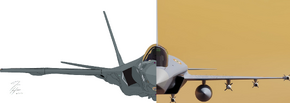
This comparison is identical to F-16 Vs F-35:

View attachment 52403

Although unofficial CADs are not the ultimate thing, the AMCA CAD looks relatively matured but if the TEDBF needs to be tweaked then clearly some things have to be modified like -
- lengthening & widening fuselage.
- reshaping narrow cockpit & over-sized canopy.
- create space for frontal sensors.
- adjust smaller intake area.
- pull up intakes & increase belly width for IWB.
- reduce bulky shoulder like fused CFT.
- remove vertical tail to twin canted ones.
- blend the wing more into fuselage.
- perhaps increase wing width/area little more.
- remove wingtip hardpoint by conformal tapered EW antennas.
IDK how i forgot this post 1 year back.
We noticed as per available diagrams & official dimensions that AMCA & TEDBF have identical span, dimensions, cross section at some places, like height from belly to cockpit ceiling looks almost same.
This means if AMCA can have IWB so can TEDBF.

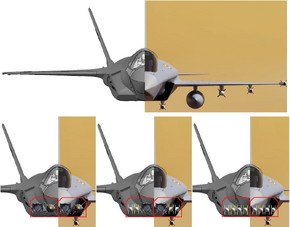
For notional AG load I used CADs of AGM-88G, JSM, AGM-158 JASSM.
For AA load i used Astr AAM CAD.
When we superimpose AMCA's IWB dimension box on both jets with AA, AG & mixed load, it looks like this -

1776278818168.png

We see that TEDBF needs some tweaking like i mentioned in last post. It would be like X-35 to F-35.

> IN indicated 5gen TEDBF at Aero-India'25. Some say it's for new CATOBAR IAC & 4gen TEDBF is for STOBAR IAC. IMO just like adjustment with Rafale has been done, similarly 5gen jet can be operated within STOBAR paramaters till CATOBAR IAC is made, otherwise from shore bases.

> Mechanical & Aero engineers can tell better, but i 've been thinking of putting a half-length catapult before ski-ramp, but it might reduce under deck space.

> Beast mode can never be compared with internal load, but -
- newer gen comes with newer architecture/framework, weapons, strategies, tactics.​
- Modular IWBs, CFTs can be implemented like in F-15 & planned in GCAP.​
- Like Su-75, a longer centerline IWB can hold Brahmos-NG type AGM.​
- A stealth jet can fire bigger AShM carried externally, but where/when stealth will be needed, a 4gen jet can't do it.​
- Ship of any size can be precisely hit by smart weapons & immobilized, sensors blinded.​
 
> Before writing further on reducing pilot life risk by 5gen TEDBF, i collected many points & divided them into 2 groups depending upon inclination more to 4gen or 5gen.
So, later in another post i'ld put the 5gen inclined points.

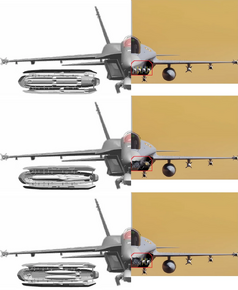
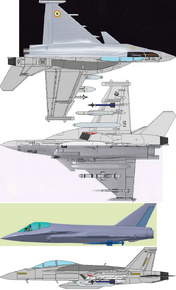
> 1st, for 4gen lovers i would like to do an approximate scaled comparison of this 4gen TEDBF with USN 4gen TEDBF the F-18 SH bcoz they would have same 2x F414 engines. And then present some points in my opinion.
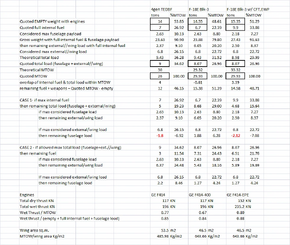
NOTE - AFAIK the EWP'll be implemented, but dorsal CFTs have been cancelled due to technical/performance issues, still i'm considering that theoretically, analogous to a hypothetical model. Considered CFT weight = 2x400 Kg & fuel in them = 2x1.6 tons, EWP weight = 408 Kg & its payload = 1,134 Kg.
1777709039922.png

1777709140788.png

1777709154706.png


> In emerging 6gen era, behind global 4gen jets are different nation's/people's different justifications -

+ Everybody want to save money , newer stuff is costlier, older stuff is cheaper, people can spend saved money on other assets, salty marine environment makes maintenance costly, etc but -​
- defence has always been costly matter in every gen's era - 2gen'll be costly, 3gen'll be costly, 4gen'll be costly.​
- salty marine environment has never ever stopped R&D from 1st gen towards 5gen then 6gen with RAM, RAS improvements.​
- India is socialist economy, not capitalist, if only the beauraucratic system can be tweaked.​
- Economise but also field future tech IN TIMEside by side, which didn't happen so far.​
- Economy should be boosted by absorbing citizens into industry & shifting from more consumer to more producer model. IT boom happened in 1990s, this is mid-2020s. Exploit supercomputing, AI/ML, robotics, etc. Vehicles, appliances, etc makers should compete globally.​
- Whichever Force doesn't have budget is destined to get defeated by technology.​
+ continue old business, market, ecosystem by R&D/producer nations for lagging/importing nations, whiile India's present & future exports are skeptical.​
- USA supplies/services Taiwan, S.Korea, Indonesia, Singapore, Pakistan, Philippines, Thailand, Israel, UAE, Bahrain, Jordan, Egypt, Saudi Arab, Kuwait, Greece, Turkey, Poland, Romania, Denmark, Norway, Portugal, cannad, Chile, Argentina. Only S.Korea & Turkey have made their own jets KF-21, Kaan.​
- Russia after big history, supplies/services Algeria, India, Iran, Etheopia, etc.​
- UK supplies/services Qatar, Turkey, Saudi Arabia, Austria, Italy, Germany, and Spain.​
- France supplies/servies Egypt, India, Qatar, Greece, Croatia, Indonesia, UAE, Serbia, Ukraine.​
- China trying to expand beyond Pakistan, Indonesia, Nigeria, etc.​
- India needs to get out of the above list of importing nations, but making too many new 4gen will create import tender for future 5/6gen even after AMCA which cannot be only 5gen for big India. STOBAR AC can have medium 5gen & CATOBAR AC can have 5.5-6gen N-AHCA.​
- Whether all above customer nations will buy Indian 4gen LCA, MWF, TEDBF, etc or USA, China, EU, Russia will try to sell them affordable 5gen is debatable.
They're making modification of exisitng 4gen since past few decades while India attempting multiple brand new 4gen from scratch for next few decades.​
+ 4gen can be given many MLUs - radar, cockpit, Networking, composites, RAS, some RAM, sensor pods, LR weapons, even a DEW pod, but -​
- still 4gen body'll be most visible object in sky to be hunted by 5gen.​
- using LR weapons on 4gen is compelling thing to use their last series, not ideal/desired/efficient which is actually with stealth sneaking closer & increasing NEZ, that's where 5gen got limited IWB & 6gen will fulfil.​
- Stealth jet has higher chance of breaking lock.​
- And now 5gen also threatened by 6gen R&D.​
- Hence on both sides of battle if USA, China, EU, Russia fight eachother in proper blown war not just skirmishes, in 2030s/40s whenever, they'll also suffer big 4gen losses,☠ that would be the job of 5/6gen
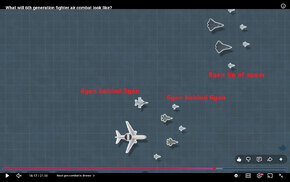
But 1 of most ignored point is that last series of 4gen'll hide behind 5/6gen & UCAVs if AI fully matured, while India's 5gen & UCAV R&D sluggish & no 6gen R&D -​
- USN has F-35, will have FA-XX,​
- PLAN is ready for J-35, will have J-50,​
- Russia is sluggish, but might disclose next gen successor of Su-33 any day.​
- France will have N-FCAS, could relax & jump to 6gen as Russia is sluggish.​
- Indian 4gen TEDBF will shout "AMCA help us!".
1777709204515.png
+ UCAVs will cover 4gen like bodyguard. Sure, that's the future to protect even the 6gen. But -​
- it needs agile, true naval AI-UCAV with ATWR>1 which is difficult for boomerang shaped UCAV.​
- Land based UCAV R&D is sluggish, naval UCAV TD not there yet.​
- Next it needs full scale model test on STOBAR, CATOBAR.​
- Enemy will also use their UCAVs against 4gen, 5gen.​
- UCAVS can also be put in 5gen, 6gen categories.​
- Chinas has shown at least 5 types of UCAVs, some are manned fighter sized.​
+ 4gen to be used in uncontested areas, in other words for brooming, mopping, against weaker adversaries, but-​
- this happens after 5/6gen does SEAD/DEAD,​
- 4gen can also do SEAD/DEAD with networking & LR weapons but enemy SAMs, AAMs are also getting networked IADS & LR.​
- IADS will be fortified by layered defence.​
- hence this still doesn't reduce threat to 4gen by mobile SAMs, MANPADS, IADS, 5/6gen.​
- Enemy's Stealth jets are like moving 'contested area'.​
+ People want to be self reliant free from imports, that's good, but should happen IN TIME bcoz a jet is matter of 20+40 years. ADA slide indicated 4gen TEDBF in 2038+ & wind tunnel test also yet to happen. China's economy & military was like India's decades back, but -​
- 5gen FC-31 paperwork began in 2007, flew in 2012, 4gen LCA-N flew same year.​
- After AMCA paperwork in 2010, IN approached ADA for 5gen jet but ADA stating -
= N-AMCA conversion not efficient,​
= Navy-1st design'll impact & upset IAF,​
= no cleansheet design either bcoz ADA is tiny, lacks manpower for CAD/CFD, wind tunnel tests of multiple projects, or previous govts. not giving funding, etc, but 5gen to be built on top of brand new naval 4.5gen which was wrong bcoz, there's experience from LCA, LCA-N, MWF designs & started AMCA project & DRDO was working on RAM, RAS, etc.​
- IN had to settle for 4gen TEDBF & paper work in 2019, Otherwise a cleansheet 5+gen TEDBF TD in parallel to AMCA would be ready in 15 years by now.
- 6gen J-50 speculated to be naval, flew last year, India doesn't even've official diagram of domestic naval/AF 6gen but looking for possible naval FCAS, AF-GCAP.​
- 5gen J31/35 ready now, the 4gen design has been frozen☃ to make in next decade.​
- Russia also gives surprises. After revealling Su-75 in 2021, what if it revealled & offered naval Su-75 or some other design?​
- IMO too many Rafale-M also not good. Earlier i thought that like plans for converting KF-21 to true 5gen, if 4gen TEDBF airframe can be upgraded like that then some LSP can be done. 4gen TEDBF could've been flying TD by now like X-35. But it's too late & wind tunnel test yet to happen hence IMMEDIATELY start stealth design exploiting supercomputing, AI/ML, etc, otherwise it'll automatically become problem later like MiGs as AMCA nears completion, it means when things are too late then no option is cheap overall, today appearing cheap, later it'll backfire.

 
...continued due to 10,000 characters limit:

Other 4gen reasons around world -
+ designers wan't to see their creation fielded,
+ revenue for future R&D, black budgeting
+ corporate profit
+ bonus of lobbysts
+ no R&D organisations for pure consumer nations
+ industrial rivalry
+ international agendas & interests
+ political intentions
+ cheap but risk to pilot's life
+ increasing falling squad strength
+ overconfidence, over-optimism with peace,
+ ignorance of global tech advancements,
+ some other bitter & natural facts of war.

Pitfalls can be avoided where others got compelled or stuck.

> If AMCA is expected to kill JF-17, J-10, F-16, Su-30MKK, J-11, J-15, J-16 then be ready to get LCA, MWF, TEDBF, MiG-29, Su-30MKI, Rafale killed by J-20, J-35, J-36, J-50.‍

Remaining points although i've also drafted in notepad but will make post very long, will be expanded in 5gen TEDBF posts like -
- anti-ship mission
- big weapons
- converting AMCA
- converting 4gen TEDBF
- Cleansheet design
- tip & body of spear
- beast mode Vs steath mode
- STOBAR Vs CATOBAR, lifts, arrestors
- 5gen jet size & weight
- progressing with each gens
- 5gen TEDBF geographical positioning in seas.
- possible future naval threats
- rework, redesign
- 5gen performance Vs 4gen
- UCAV compensating lack of 5gen.

And from tech PoV there's nothing to panic as such on all these points for techies, it's all daily paid job & India got AI/ML, robotics, supercomputing, JV & collabs, millions of techies now for PPP. Every domain from outside looks tough, like surgery.
The thing to panic is that time-bound & result oriented management is needed with accountability & free from molopoly to reduce life risk of pilots.
 
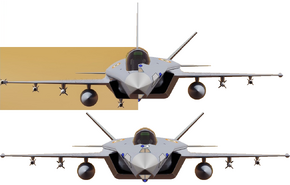
After adjusting pixels of available diagrams of TEDBF & AMCA to their dimensions & comparing, we found that their fuselage height is almost same; span & cross section area values are nearby, AMCA's belly spans more for IWB.

The overlay of AMCA's IWB outline shows that TEDBF can be tweaked towards 5gen (which i made last year but couldn’t show yet) or a cleansheet delta-canard jet.

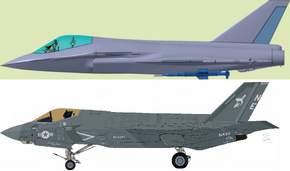
But as AMCA is not made yet, let's see comparison with existing similar tandem bi-plane medium category naval jet design - F-35-C, matching the pixels with dimensions. This can help in understanding transitioning from STOBAR jet design to CATOBAR & explore a STOBAR stealth design.
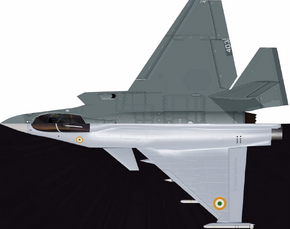
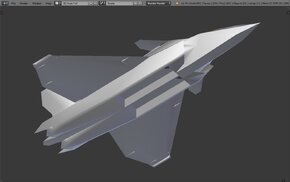
NOTE - This TEDBF 3D CAD is slightly different from official greyscale images not good resolution.

1778227663561.png

1778227674567.png

1778227684020.png

1778227699805.png


> From diagrams we can notice that -
- Like "Fat Amy", TEDBF looks chubby & voluminous too, but with smaller engines.​
- height of both fuselages are near equal,​
- From nose to exhaust, TEDBF seems to be longer,​
- F-35's fuselage width & wingspan is more due to IWB,​
- TEDBF nose is more tapered & drooped,​
- F-35's canopy is already big. TEDBF's canopy is way too big.​
- Rear half of F-35 packs cool stuff like cooling system, antennas, decoys, APU, counter-measures, etc. A 4gen jet may not have some of these things or not internally.​

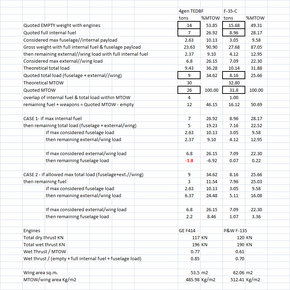
> Looking at numerical data -
- Total thrusts values look nearby,​
- but empty, gross, max weights, IWB load, fuel of TEDBF less than F-35's, perhaps bcoz CATOBAR has the catapult assist not on STOBAR,​
- hence the ATWR (A/c Thrust to Weight Ratio) of TEDBF is also more.​
- Wing area of F-35-C is more, but its weights increase in bigger ratio, so wing loading is more.​

More observations can be made.

> Take-off, gross weight, MTOW -
- Gross weight could be standard CAP config with certain fuel amount & minimum weapons. For my calculations i consider it as empty weight + full internal fuel + max fuselage load, analogous to a stealth jet.​
- In peace time light AA, AG, mixed loads are taken, just enough for CAP, to deter aggressors. MTOW is a war time capability which pushes A/c structural limits.​
- Common pattern in all fighter jets is observed that MTOW is roughly around or +/- of 2x empty weight.​
- MiG-29-K empty weight is 12 tons, quoted MTOW is 24.5 tons. With 2x RD-33MK engine's 88.3 KN thrust, wet T/MTOW = 0.74​
- Su-33 empty weight 18.4 tons, quoted MTOW 33 tons, < 2x empty weight. With 2x Al-31F3 engine's 125.5 KN thrust, wet T/MTOW = 0.78​
- F-35-C empty weight 15.68 tons, quoted MTOW 31.8 tons. With 1x F135 engine's 190 KN thrust, wet T/MTOW = 0.61​
- F-18-E empty weight 14.55 tons, quoted MTOW 29.93 tons, >2x empty weight. With 2x F414 engine's 117 KN thrust, wet T/MTOW = 0.67​
- TEDBF empty weight 14 tons, quoted MTOW 26 tons, <2x empty weight, due to STOBAR perhaps. With 2x 414 engine's 117 KN thrust, wet T/MTOW = 0.77​
- If aerial refuelling is available then T/o can be done with lesser fuel & more weapons.​
- Rear/longer T/o position is suitable for heavier load configs.​

> Landing & weight restrictions-
- On the deck side, arresting cables & deck itself are strong enough for stopping upto say 25-27 tons of aircrafts regularly. Structural limits are much higher with 50 tons C-130 landing tests in 1963 but risky & disruptive. Better cables are apparently designed for 6gen jets.​
- On the A/c side, that 27 tons becomes red line. Although max "Carrier Landing Weight" CLW of jets range around 63-80% of MTOW depending upon situations & strength of jet structure & cables.​
= Su-33 from searches appear to have CLW of 25 tons CLW, 75.75% of MTOW.​
= MiG-29K seems to have max CLW of 19.5 tons, 79.59% of MTOW.​
= F-35-C seems to have max CLW of 20.86 tons, 65.59% of MTOW.​
= F-18E is said to have CLW of 19-22 tons, 63.48-73.5% of MTOW.​
= If TEDBF CLW is also taken to be like F-18E then it is 16.5-19 tons.​
- All naval jets have "Carrier Bring Back Payload" CBBP (fuel + weapons), calculated as CLW - empty weight.​
= It has been observed to be in range of 13-30% of MTOW.​
= If heavier beyond CLW, the weapons, especially smart ones are expensive to be jetissoned, so some fuel is dumped.​

> Pattern noticed is that -
- While CATOBAR jets with catapult assist have ATWR range in 0.6X, or relatively more weight, less thrust.​
- STOBAR jets need more ATWR in range of 0.7X, or more thrust, less weight.​
- To tweak TEDBF into 5+G design this ATWR range & CLW range will have to be maintained.​
 
Top